Blog

  • Arma Virumque Cano: Capital, Poverty and Violence


    This article addresses how systems of capital that underpin the present world structure perpetuate both global insecurity and endemic poverty. By upholding the practice of global arms sales, violence is endorsed by state and non-state actors continuing this inequity. Alternatives to the dominant security paradigm nevertheless exist.


    Poverty is violence, an enjoined condition sustained by capital and yet paradoxically ignored by it. Capital is possessed and dispensed by the various capitalist constructs that currently function and while the 2008 global recession revealed many variables within these constructs as extremely suspect, they nevertheless remain, guaranteeing continued wealth for elite powers. The poor in turn exist insecure, in need and in want. As little action is offered against these inequitable systems, state or global – governments seem more intent on short-tem economic ‘Band-aids’ the focus being save OUR souls – the poor linger, trapped in violence, deprived of voice and rights.


    Essayists such as Peter Singer and Thomas Pogge have highlighted the factors that constitute much of the global systemic inequity of capital, although one remains particularly pervasive, that of the global sale of armaments. The possession and deployment of arms by governments, militia groups and organized crime perpetuate inequality, poverty and violence; with a gun there is no reason or inquiry, the means displays the message. Arms and the man, in reference to the title of this piece, defend their capital interests and so uphold suffering. A sobering statistic emerges from the Commission of Human Security: The United Nation’s Security Council, responsible ‘for the maintenance of international peace and security’ (www.un.org) has (with the exclusion of China) four permanent members – France, the Russian Federation, the United Kingdom and the United States – who together sell 78% of global exports of conventional weapons  (Figures taken from Commission of Human Security Final Report, 2003:134).  Germany, although not a permanent member of the Security Council, is another major contributor and is responsible for another 5% of conventional weapon sales. It is estimated that about two-thirds of these exports go to developing countries (ibid.). The question as I have suggested in previous articles following the peace education theorist Betty Reardon is what kind of ‘security’ are the permanent members of this council purporting to deal in and who is this security really for?  


    In peace theory, conflict is inevitable but when handled constructively conflict is a force for positive change. Both Gandhi and Martin Luther King Jr. practiced methods of non-violence and constructive activism, which resulted in effective change and the people of the Philippines, adopted similar successful methods in their overthrow of the Marcus dictatorship. Violence however, the default of state security, seldom achieves anything other than more violence, what counts here is control and fear. The semantically loaded term terrorism has become the early 21st century’s global mantra for continued armament-as-security spending. Capital thus spent and accrued denies resources for social justice programs such as the UN’s Millennium Development Goals. Regarding terrorism the sociologist Zygmunt Bauman notes that young people in deprived areas become potential targets for extremism [1], Jean Paul Sartre also comments that it is not their violence but ours (the ‘haves’) that oppresses and to the poor it is “the last refuge of their humanity” [2]. Bauman and Sartre’s writings are separated by forty-five years but they detail the same systematic insecurities that sustain poverty and violence, a lack of resources such as education and a systemic disregard for humanity by capital forces.


    Democratic governments, wary of their standing in the next election rarely activate radical policies to address inequity. After all why would they? Democratic regimes are in most cases so closely linked to elites and private business in order to ensure their own re-election that status-quo policies tend to dominate over radical changes by default; what’s theirs is theirs, why share? If this sounds simplistic it is meant to be. The economist Ha-Joon Chang reiterates the point that free market policies are not there to make poor countries richer. He further identifies the complex financial instruments that brought down economies in 2008[3]. Ha-Joon Chang recommends banning these financial instruments as products dangerous to society, which is fine, but other systems continue, namely the socialization that validates greed and competition for resources and rewards players with gleaming cars and kitchens. And in case this appears solely as the advertising campaign for western capitalism I believe that Kim Jung-il has a pretty nice place and a sweet ride; tending to support the adage of William Pitt, the Elder that unlimited power is apt to corrupt the minds of those who possess it no matter the flavour of the ideology.  


    So are there alternatives to the violence of poverty so sustained by the inequities and violence of capital? Realists and pragmatists would say no, this is how it is – social Darwinism. It’s unlikely that Darwin would approve of that term but appropriating other’s resources and ideas for one’s own needs tends to be a realist trait and realist colonizers powered by arms have rarely suffered the indignities of colonization, although it must be said that Japan fared rather well after the Second World War, at least up to 1990. Realism merely (merely?) reiterates tired falsehoods however, we return to the question of inequitable systemic violence and who is interested in acting against it.  The answer can be surprising. On a flight to Japan A US soldier who had served two terms of duty in Iraq told me in conversation that many US soldiers felt angered by the US government’s misappropriation of capital in Iraq and with a certain amount of pride recounted how he and others of the US military had worked in deprived areas of the South to build hospitals and relief housing. Soldiers of course simply bear the brunt of policy. They are placed in exceptional circumstances by the judgments of other humans – predominantly guided by capital interests – and those soldiers not morally driven (and yes even soldiers share this trait, my father being one of them) can contravene all manner of international laws and human rights.  The philosopher William James posits in The Moral Equivalent of War[4] that the “fatalistic view of war-function… is nonsense” and instead argues for a channeling of the military for solely “constructive interests” – the relief work mentioned above. James echoes H.G. Wells who also saw the military purpose as one of “service and cooperation and of infinitely more honorable emulations.” The question of addressing the enduring links between capital, poverty and violence remains a systemic one.


    If like the soldier above many more hold the capacity for humanism then this capacity needs to be imparted into positive action. The aforementioned peace educator Betty Reardon writes, “citizens both female and male are taking it upon themselves of monitoring governments own compliance with laws and fulfillment of policies as an active demonstration of the responsibility of democratic citizenship.” These actions remind governments of their obligations, “urging them to make needed changes before it becomes necessary to embark on measures of organized dissent and/or undertake non-violent resistance”[5]. Rights-driven frameworks are a mainstay of peace education and human rights organizations. They present substance to challenge both state and non-state actors who seek to utilize violence through arms as a means to control and prevail. Existing systems of capital uphold the two deeply iniquitous problems of poverty and violence ensuring their continuance. Social responsibility lies with each of us and it is our duty as responsible citizens therefore to redress these iniquities guided by powerful means such as peace education, to exist without greed and to live as one as wise as Gandhi suggested, in a world separated from the burden of violence and unequal capital in a world we want to see.


    [1] Bauman, Z.  Liquid Fear. Cambridge: Polity Press, 2006.

    [2] Fanon, F. The Wretched of the Earth. Middlesex: Penguin, 1961.

    [3] Ha-Joon Chang. 23 things they don’t tell you about capitalism London, Allen Lane, 2010

    [4] James, W. The moral equivalent of war.New York: American Association for International Conciliation, 1910

    [5] Reardon, B. Education for a culture of peace in a gender perspective. Paris: UNESCO Publishing, 2001.


    Author: I. R. Gibson (Associate Professor Interfaculty Institute for International Studies, Ritsumeikan University, Kyoto, Japan) Email: [email protected] 

    Image source: jamesfischer


  • Sustainable Security


    MyanmarPublished last week, Myanmar: Storm Clouds on the Horizon is International Crisis Group’s latest Asia report. It focuses on the potential for political violence and social instability as Mynamar’s leaders are undertaking reforms “to move the country decisively away from its authoritarian past”. For most of the past 50 years, the government of the Republic of the Union of Mynamar (also referred to as Burma) has been under direct or indirect control by the military. Since independence in 1948, the people of Myanmar have suffered civil wars which have mainly been struggles for ethnic and sub-national autonomy. The country has consistently been in the news for human rights violations. Perhaps one of the world’s most well-known political prisoners, the Nobel Peace Prize laureate and opposition politician Aung San Suu Kyi, also chairperson of the National League for Democracy (NLD) was released in 2010 after 21 years under house arrest.

    Thein Sein, current president of Myanmar, has put in place a far-reaching and radical reform agenda. The ICG’s report focuses on what reforms have been achieved and what this may mean for a possible resurrection of violence because “political prisoners have been released, blacklists trimmed, freedom of assembly laws implemented, and media censorship abolished. But widespread ethnic violence in Rakhine State, targeting principally the Rohingya Muslim minority, has cast a dark cloud over the reform process and any further rupturing of intercommunal relations could threaten national stability.” With former political prisoners being released, 2,000 high-profile activists and opposition politicians being allowed to return home, and further liberalization of the media, “social tensions are rising as more freedom allows local conflicts to resurface”.

    The report notes that “The easing of authoritarian controls has created the space for the population to air grievances, the ability to organise in a way that was not possible before, and the opportunity to have a real influence on government policies and decisions” which has led to an “exponential growth in civil society activity”. In order for the transition from authoritarian rule to democracy to be stable, and for peace and security to be sustainable, the government of Myanmar will have to face and resolve major challenges. Widespread militarization and the political and social marginalization (past and present) of ethnic and religious groups will have to be addressed. For example, it has been estimated that the recent 2012 violence between Rohingya Muslims and Rakhine Buddhists in Rakhine State led to an estimated 90,000 displaced people in addition to dozens of casualties. It will not be sufficient to react to past and present violence by allowing more freedom of speech and liberalizing the press. Trying to contain the violence and reducing state repression alone will not address the underlying drivers of insecurity. The government will have to take a sustainable security approach and make great efforts in order to actively address the causes of long-standing grievances. Addressing only the symptoms cannot lead to long-term stability and the rebuilding of trust between communities.

    The ICG offers several options to minimize the risks associated with single party dominance during Myanmar’s political transition. These include changing the electoral system to some form of proportional representation, building coalitions between the NLD and other political parties, and building bridges between the NLD and current president Thein Sein as well as other political forces- particularly the old guard. The ICG recommendations underscore the importance of all parties, and the majority of people, to feel involved in the political process. The marginalization of any political or ethnic/religious groups will most probably lead to further violence and insecurity in the future.

    ICG’s full report and details of the policy recommendations can be read here.

    Anna Alissa Hitzemann is a  Peaceworker with Quaker Peace and Social Witness. She currently works with Oxford Research Group as a Project Officer for the Sustainable Security Programme, with a focus on our ‘Marginalisation of the Majority World’ project.

    Image source: Rusty Steward

  • Sustainable Security

    michael-photo-low-res-jpeg2Dr Michael Nest has expertise in political and social issues around mining. He is also an anti-corruption expert and formerly worked for the Independent Commission Against Corruption in Sydney, Australia. He has recently focused on building capacity to prevent corruption in community development programmes, including a research paper on corruption in local-level development schemes funded by mineral revenues.  Michael is the author of Coltan (Polity Press, 2011), which is about the changing global supply chain for the mineral ‘coltan’ (or tantalum), the new US legislation focused on conflict minerals, and China’s emerging role in the market for this mineral. In 2012 and 2014, Michael advised African governments on the new certification mechanism for tin, tantalum, tungsten and gold being established to prevent conflict minerals from Central Africa entering the supply chain.  His latest co-authored book, Still a Pygmy: the unique struggle of one man’s fight to save his identity from extinction (Finch, 2015) is the first memoir by a Pygmy ever published.

    In this interview, Dr. Nest discusses the political, environmental, ethical and social issues surrounding the mining of columbite–tantalite (coltan).

    Q. In the past, arguably very few had heard of coltan. Yet in the past two decades it has entered into discussions in the UN and featured in several international media outlets’ reports. What is coltan and what is it used for?

    Coltan is the nickname for the mineral ‘tantalite’.  When processed, the mineral tantalite is called tantalum – so tantalum is the metal.

    Coltan – or properly speaking, the metal ‘tantalum’ – has a wide application.  About two-thirds of coltan is used in a device called a ‘capacitor’.  Capacitors are found in electronic products, especially consumer electronic products such as mobile phones, laptops, gaming platforms, and ipads, and are used to store and regulate the flow of electricity from the source of power (such as a battery) to the working parts of the device.  Capacitors have a crucial role in ensuring there is no power surge or fluctuations to the device that could disable or break it.  Coltan is also used for special alloys (mixtures of different metals), in memory chips for electronic consumer goods, and special coatings (such as on camera lenses).

    Q. In which parts of the world is coltan mined?

    Coltan comes from three sources: as a by-product of tin slag (20% of supply) – ‘slag’ is the waste material that sits in dumps around historic tin mines; recycling (30% of supply); and mines (50% of supply).

    Coltan is extracted from tin slag in Brazil, Malaysia and Thailand.  Coltan that comes from recycled scrap materials is extracted at metal recycling plants in many countries around the world.

    In terms of mines producing coltan/tantalite, these are found around the world.  In 2016, according to the US Geological Survey, the biggest producers of coltan are Rwanda, D.R. Congo, Brazil, China, and Australia (in this order), although historically Canada and Ethiopia have also been significant producers, and Australia was the largest producer until the global financial crisis in 2008.  There are lower levels of mine production in Mozambique, Namibia, Nigeria, and Zimbabwe.  Tantalite deposits have been identified and are being explored in Canada, Colombia, Egypt, Greenland, Madagascar, Namibia, Saudi Arabia, Sierra Leone, South Africa, Tanzania, Venezuela, and Zimbabwe.

    Q. There has been some literature examining the relationship between coltan extraction and violence with a fair amount of discussion focused on the Democratic Republic of the Congo (DRC). What role did coltan play in the DRC’s war?
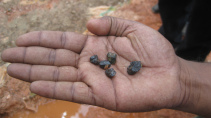
    coltan

    Image of coltan via Responsible Sourcing Network/Flickr

    The allegation made by activist organisations focused on reducing conflict in the D.R. Congo is that profits from coltan mining were a primary source of funding for armed militias waging war against the government.  These militias, so the argument goes, used coltan profits to buy weapons and food, which allowed them to wage war.  Militias in the DRC are notorious for their attacks on civilian populations, so the argument was not just that coltan profits perpetuated conflict against the government, but also that these profits were a chief cause of massacres of civilians, systemic rape and widespread destruction of property of civilians who live in Eastern DRC where coltan mines are located.

    In the late 1990s and early 2000s, activist organisations – as well as some media, academics and the UN – made connections between coltan profits and conflict in Eastern DRC, and focused overwhelmingly on coltan and not other minerals.  Many journalists continue to portray coltan as a major cause of conflict, although other commentators have now backed away from such simplistic claims and talk more broadly about ‘conflict minerals’ and acknowledge that conflict in the DRC occurs for a complex range of reasons.

    Conflict in Eastern DRC occurs for multiple reasons, including:

    • Local level struggles by powerful individuals for political domination
    • Competition for land for agricultural purposes
    • Ethnic rivalry
    • For control of natural resources, especially minerals
    • To protect land from outsiders seeking to exploit it (e.g., miners and loggers)
    • Poor men waging war as a means of making a living through theft and looting

    There were also broader factors around national-level conflict over the past 20 years that have drawn in local level actors and created incentives for war, including: military campaigns in DRC territory by the Rwandan and Ugandan armies (supposed by their local Congolese allies) focused on security concerns regarding opponents of their respective governments; defensive military campaigns by the DRC armed forces and government-allied local forces against the Rwandans and Ugandans and their proxies in the DRC, including retribution against civilian populations when they have regained territory; and armed groups with regional political agendas that oppose the DRC national government.  Fighting over mineral deposits was a minor element in all of these conflicts (a UN estimate of 1,500 local-level conflicts in the early 2000s was that fighting over natural resources accounted for only 8% of all conflicts), and conflict over coltan deposits was even less significant.

    As I argue in my book Coltan (Polity 2011), some armed groups did, however, profit from coltan and undoubtedly these profits were used to buy weapons, food and other material used to wage war.  These profits were gained in four ways: armed groups stole coltan stocks from mine sites and mining companies’ depots; armed groups directly controlled production of coltan by controlling mines themselves; armed groups taxed the trade of coltan into and out of territory they controlled (as they did for other minerals and goods); and armed groups became directly involved in the export of coltan from Central Africa to the buyers on the international minerals market.  Calculating profits made from coltan is difficult, but I estimate that the total amount made by the Rwandan army from coltan in 1999 was approximately US$62m; by the Rwandan army and its Congolese-based ally (the RCD-Goma) in 2000 approximately US$10m; and by all armed groups in 2008 approximately US$11.8m.  Note that the high total in 1999 was largely because the price of coltan on the international market boomed that year and in 2000.

    In sum, the war in the DRC was never just about minerals, and was certainly never just about coltan (gold, tin and tungsten were also importance sources of mineral revenue in the 2000s).  Tracing the role of coltan in war in the DRC, however, can tell us a lot about the connections between natural resources and conflict generally and research into these connections have helped broaden our understanding of the relationships between these natural resources and war.

    Q. Were any Western corporations responsible for indirectly financing armed groups during the war in the DRC through purchasing coltan from the country?
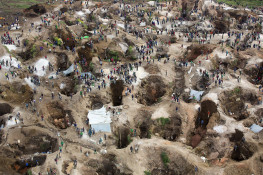
    Luwowo Coltan mine near Rubaya, North Kivu the 18th of March 2014. © MONUSCO/Sylvain Liechti Luwowo is one of several validated mining site that respect CIRGL-RDC norms and guaranties conflict free minerals.

    Luwowo coltan mine near Rubaya, North Kivu, DRC. Image by MONUSCO/Sylvain Liechti/Flickr

    During the wars between 1998 and 2003 companies from many different countries were involved in the coltan trade, including Western corporations.  The UN’s Report of the Panel of Experts on the Illegal Exploitation of Natural Resources and other Forms of Wealth in the D. R. Congo (April 2001) identified scores of private trading, brokerage, banking and transportation firms that participated in the illegal exploitation of natural resources from the DRC by trading or importing coltan from the DRC.

    While almost none of these transactions were directly with armed groups (with the probable exception of some transactions involving Rwandan and Congolese firms), foreign firms were an important element of the coltan commodity chain that enabled armed groups in the DRC to profit from the production and export of illegally mined coltan to the rest of the world.

    Because of the conflicted and dangerous conditions in Eastern DRC at the time, few foreign companies sent representatives into the country.  Instead, smaller Congolese or Rwandan trading firms bought and transported coltan into Rwanda, from where international minerals trading companies then imported it.  The UN identified twenty-seven firms from the following countries that imported coltan from the DRC via Rwanda: Rwanda (2 firms), Malaysia (1 firm), Germany (3 firms), Belgium (10 firms), Switzerland (1 firm), Netherlands (4 firms), UK (2 firms), Kenya (1 firm), India (1 firms), Pakistan (1 firm), and Russia (1 firm).  These firms sold the coltan they imported on to other minerals trading firms, or they sold it directly to processing plants.

    Three big minerals processing plants bought much of the coltan that was exported via Rwanda during the early phase of the Congo Wars: Cabot from Canada, HC Starck from Germany and Ningxia Non-Ferrous Metals Smelter from China.  After 2001, Cabot and HC Starck released statements saying they no longer bought Congolese coltan.

    Several airlines were involved in flying coltan out of Rwanda to second destinations, including Alliance Express (then 49% owned by South African Airways and 51% owned by the Rwandan government), Kencargo International (20% owned by Martinair), Airflo, Astral Aviation, and Martinair Holland, as well as the former Swissair and Sabena before these airlines collapsed.

    The UN’s final report into the illegal exploitation of natural resources in the DRC (published October 2002), recommended placing financial sanctions on 29 companies from Belgium, South Africa, Zimbabwe, Rwanda, Uganda and the DRC itself, that were identified as being involved in the illegal coltan trade.  The same report identified businesses from OECD countries that the UN considered to be in violation of the OECD Guidelines for Multinational Enterprises, including from the UK, USA, Belgium, Switzerland, and Germany.  Firms from non-OECD countries that were also identified as having violated these guidelines were from Malaysia, China, Hong Kong, South Africa, and St Kitts.  The UN did not recommend sanctions on these OECD and non-OECD firms.  Rather, it brought attention to the firms’ breaches of these guidelines, presumably with a view to the companies then being reported to the national reporting contact point for such breaches in the relevant OECD country.

    Q. In addition to the human rights issues attached to the coltan industry, is the mining process itself environmentally harmful?
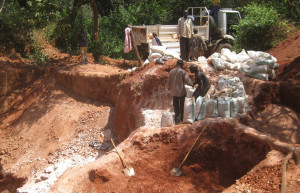
    coltan-miners

    Workers in a coltan mine in DRC. Image (cropped) via Responsible Sourcing Network/Flickr.

    Yes, there are environmental harms associated with coltan mining.  In the DRC, coltan mining overwhelmingly uses artisanal and small-scale (and occasionally medium scale) methods, although the harms these methods cause to the environment are not distinctive in that there is nothing specific about mining coltan that creates a different kind of harm to, for example, tin or tungsten.  Compare this to gold, where there are harms associated with the use of mercury.


    In the DRC when a coltan deposit is found, miners rush in to exploit the site, regardless of whether it is on agricultural land or in a national park, and the mining destroys the potential for the land to be used for grazing or cropping, or as a biological reserve for fauna and flora.  Like other artisanal mining of minerals, artisanal coltan mining involves stripping forest and bush cover, then any topsoil, and digging pits to a depth of about 6m to get access to the ore deposit.  Water, provided through a pump system where a generator can be used, or by diverting a creek or river if a generator is not available, is used to soften the earth and rock, to break it up, and then to separate mineral ore from soil and to wash away the soil.  Water use is a major factor in the environmental harm caused by mining.

    As I outlined in my book Coltan on pp.49-50, specific environmental effects of artisanal coltan mining include the following:

    • Forest clearance to expose soil for mining;
    • Cutting of timber to build worker camps;
    • Cutting of firewood;
    • Removing the bark from trees to make panning trays to wash coltan;
    • Pollution of streams by silt from washing process;
    • Diversion of streams from their original course;
    • Cutting lianas to make baskets to carry coltan;
    • Hunting animals, including for food, ivory and other body parts;
    • Animals injured after escaping snares;
    • Disturbance of fauna due to people resident in, and moving through, reserves;
    • Reduced population of invertebrates and reduced photosynthesis in aquatic plants due to silting of streams;
    • Reduced fish stocks in lakes and rivers affected by silt pollution;
    • Erosion, including landslides, of unprotected ground during rains;
    • Ecological changes due to loss of key species, such as elephants;
    • Long-term changes in watershed due to rapid run-off in deforested areas;

    There have been some studies that document these impacts.  A study of mining communities in the Kahuzi Biéga National Park in 1999 found that they ate elephants, gorillas, chimpanzees, buffalo, and antelope – all poached from the park.  However, a subsequent report in 2001 found that tortoises, birds, small antelope, and monkeys were being eaten because all the big animals had been killed.

    Q. Do you feel that there are any plausible ways for companies to be certain that the coltan they use in manufacturing their products is not from a conflict zone or unethically produced?

    A company can improve certainty around the origins of any coltan used in its products, if it sources metals directly through a smelter that has an exclusive long-term contract with a coltan producer in a country such as Brazil, China, or Mozambique.  In such smelters, supply from these producers is so consistent there is virtually no likelihood of it being ‘contaminated’ by ore from other destinations.  The conflict-free smelter programme, which works with over 200 smelters, has safeguards in place to verify the origins of minerals processed by its members.  While there is always a chance that these consignments of minerals could be mixed with ore from militia-controlled mines in the D.R. Congo, this would be fairly unlikely as the reputation of the smelter (and the programme) is at stake and there is considerable due diligence around the provenance of minerals.

    The challenge of sourcing ethically produced coltan is complicated when companies are buying components, especially components manufactured from yet other components, to manufacture their final goods, e.g., electronic items.  It is impracticable for an end-manufacturer to check the origin of all the metals that are used in all components – because literally thousands of components may be involved – and unrealistic to think that companies are able to do this.  The best they can do, is try to identify component manufacturers that have declared they will abide by ethical standards for sourcing minerals and have systems in place this claim to be verified – and of course end-product manufacturers should insist on seeing evidence of such checks.

    It is important that all D.R. Congo coltan is not seen as being a ‘conflict mineral’, in a way that become common after the US Government first passed its conflict minerals Dodd-Frank legislation in 2010.  Civilian Congolese producers of coltan should be allowed to sell their product on the world market, and such production and trade is one of the few economic opportunities available to many Congolese.  The emphasis in terms of due diligence around ethical production of coltan should be on determining if coltan comes from conflict zones and is produced by armed groups, rather than if it comes from the DRC itself – this is an important distinction.  There are various schemes in place, or being established, in the DRC to ensure civilian-produced coltan is traced through to export.  The most well-known of these is the industry traceability and due diligence programme for coltan, tin and tungsten, which is managed by the International Tin Research Institute.

    Q. As you mention, there have been a range of international efforts that have endeavoured to address the ethics surrounding coltan mining. Overall, do you feel that current efforts are succeeding or falling short?

    Efforts have brought attention to ongoing violence and instability in the DRC, which is a good thing.  The problem is that the focus of activists, and even government initiatives such as the US Dodd-Frank legislation, has often been solely on conflict minerals as a cause of violence rather than a range of factors.  Thus, while there is heightened attention, there is also a simplified narrative being propagated that is detrimental to understanding the causes and consequences of the conflicts.

    There is no doubt that international efforts have had an effect on the mining industry in DRC, but also Rwanda.  The passing of US legislation and consequence temporary embargo by the DRC government in late 2011 on any exports of conflict minerals, severely curtailed mining and trading of these minerals in eastern provinces (it was business as usual for mining in other provinces, such as Katanga).  This showed that international efforts can definitely have an impact (presumably President Kabila of the DRC felt that he had to impose the embargo to appear to be doing something about the conflict minerals trade).  New OECD regulations, the conflict-free smelter program and the International Tin Research Institute’s ‘tag and bag’ scheme for tin and coltan in Rwanda and some mines in DRC are also closing opportunities for ‘laundering’ conflict minerals through civilian-controlled supply chains, while also guaranteeing opportunities for civilian-produced and traded minerals.

    There are criticisms of these schemes, especially ITRI’s tracking scheme which is expensive for participants, and regional governments and officials feel they are excluded from its data or operations.  Nevertheless, in a complex and difficult political and economic environment, the combination of regional and international efforts have resulted in more mines and more mineral transactions coming under civilian control, and therefore generated economic opportunities for Congolese civilians.  This said, anti-government militias and the DRC army are still involved in some mining and trading of the 3Ts and gold.

    The big question is whether current political tensions around President Kabila’s possible election to a third term, will cause the ITRI scheme to be suspended, see renewed militias activity in Eastern provinces, and a resumption of widespread smuggling of minerals out of Eastern Congo into Uganda, Rwanda and Burundi.

    Q. Do you think China will complement the efforts of Western organizations and the DRC’s own efforts at cracking down on the conflict mineral trade or will China’s status as the world’s largest coltan refiner make matters more difficult?

    sea_of_phones

    Coltan is used in electronic devices such as mobile phones. Image via Wikimedia.

    To answer this question properly, we have to pull apart the idea of ‘China’.  The Chinese government may have some interest in protecting its international reputation by participating in or publicly supporting international government initiatives to control the production and trade of conflict minerals.  This might include passing some minimal regulation on its own industry (possibly that it has no intention of enforcing).  It will have no interest in supporting activist initiatives, as it will not to want to fuel or strengthen independent civil society, let alone one that might actually have influence over aspects of international commerce.  The Chinese minerals industry, on the other hand, is aware of its strong and growing position in the global mining and minerals sector – a sector that the Chinese government itself sees as strategic.  Without pressure from its own government to desist from importing, smelting or otherwise trading in conflict minerals, the Chinese minerals industry will see no reason to change the current situation.  Some Chinese consumer product manufacturers, especially in the electronics sector, will be aware of the potential for boycotts by Western consumers to damage their sales and reputation, but Western consumers are not significant for some electronics manufacturers.  Asian (especially Chinese), African and Latin American consumers will be far more important, and awareness or concern by these consumers about conflict minerals is low.  In sum, while Chinese actors may be interested in some international efforts to regulate the trade of certain products, conflict minerals will be low on the list of priorities and there is unlikely to be any Chinese effort in this regard.

    Q. Looking to the future, what impact do you feel Donald Trump’s presidency may have on talking the problem of conflict minerals?

    Trump made it clear during his campaign that he is in favour of minimal regulation for business and that the US should be more isolationist in terms of spending less time and effort worrying about global affairs.  Given that responses to conflict minerals are based around additional regulations for business (regulations that everyone agrees have a cost in terms of compliance), which also represent an effort by OECD governments to shape conflict minerals production and trade in Central Africa, a Trump administration is highly unlikely to have much, if any, interest in such initiatives.  US business groups have already contested the regulations of the Dodd-Frank Act, and they will see a Trump presidency as creating another opportunity to exert pressure and have the regulations pared back or abolished.  A Trump administration is also likely to cut funding for USAID projects focused on capacity building for Central African governments to regulate production and trade of the mining industry.

  • Marginalisation of the majority world

    The International Peace & Security Institute (IPSI), in collaboration with The Johns Hopkins University School of Advanced International Studies (SAIS) Conflict Management Program, hosted a high-level panel discussion and networking reception on Wednesday, August 17.  The event, “Why Here, Not There? Investigating emerging nonviolent movements,” examined the dynamics that enable nonviolent movements to occur in some regions and not others at specific moments in time.  The event was broadcast live nationwide and on the internet by C-SPAN.

    Watch the video here: IPSI

    Image source: Al Jazeera English

    Read more »

  • UNSC’s Climate Change Session Masks Members’ Intransigence

    Last week’s discussion at the U.N. Security Council on the security implications of climate change was an important step in the right direction. This is only the second time that the subject, which may turn out to be the defining issue for global security in the 21st century, has made it onto the agenda of the U.N. body charged with maintaining international peace and security. The discussion’s importance is limited, however, since the real path to addressing the security implications of climate change lies outside the council. The special session, initiated by Germany, focused specifically on the council’s role in preventing climate-induced conflict over increasingly scarce food, water and arable land. The solution to these conflicts, however, can only be found in reducing carbon emissions — including by scaling up the deployment of renewable energy technologies and increasing energy efficiency measures — and not in responding to climate crises once they have occurred.     

    The physical effects of a warming climate are now widely regarded as, in the words of theU.K. National Security Strategy document, “risk multipliers.”  Everyone from the U.S. National Intelligence Council to the Royal Society has highlighted the link between the consequences of higher global temperatures and human insecurity.

    Read the full article here. You will need a subscription to WPR to read the full article; if you are not subscribed already then you can get a free trial subscription here.

    Image source: United Nations Photo

  • Sustainable Security

  • Israel’s shadow over Iran

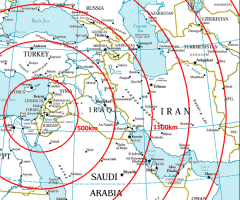
    Most of the international attention on Iran in the second half of 2009 focused on the political turmoil following the presidential election of 12 June. The discussion of Iran’s nuclear capabilities and plans receded from the foreground, though it continued behind the scenes among all the states and international agencies involved. The signs are that, whatever the outcome of the domestic confrontation between the Mahmoud Ahmadinejad regime and the opposition, the coming months will see a sharpening of tension over the nuclear issue. This raises the question of whether there will be a military assault on Iran’s nuclear facilities – most likely by Israel, since there is little likelihood that the Barack Obama administration would countenance direct United States military action against Iran – in an attempt to stop the country from acquiring a nuclear weapon (see “Iran, Israel, America: the nuclear gamble”, 2 October 2009).
    In current circumstances, any unexpected or dramatic incident is likely to be read in terms of its bearing on the complex interplay over the nuclear question of Iran, Israel and the United States.  The assassination by a remote-controlled bomb of the Iranian quantum-physicist (and opposition supporter) Massoud Ali Mohammadi on 12 January 2010 is one such. The Iranian government immediately attributed Dr Mohammadi’s killing to the United States and Israel, working in collaboration with internal dissidents.  

    Tehran’s accusation against its main adversaries is as predictable as Washington’s denial of any involvement in the murder. While the truth of this event remains to be established, what can be said is that on a larger diplomatic front the United States has little to gain from any rupture in relations with Tehran. The rhetoric in Washington from conservative sources and supporters of Israel may be as strong as ever, and is more than matched by the propaganda of the Ahmadinejad government; but in reality the US and Iran actually have overlapping interests. Both have reason, albeit for different reasons, to oppose al-Qaida and the Taliban (with Iran recalling the deaths of Iranian diplomats at the Taliban’s hands in 1998); and the US government is well aware of the potential for Iran to make things very difficult for it in Iraq.

    The deep state

    Two pieces of evidence, however, suggest that events involving Israel may make the delicate Tehran/Washington relationship even harder to sustain. The first is that sources close to the Israeli government confirm and are clear that training and other preparations continue for possible military action against Iran. This is not to say that an attack is imminent, or indeed inevitable: just that the option is, and will remain, readily available.

    The Binyamin Netanyahu government has been careful to moderate its public pronouncements about Iran; but its repeated statements that Iran is Israel’s primary security concern – far outweighing Hamas, Hizbollah and certainly the Palestinians on the West Bank – are far more than rhetoric. Some nuclear analysts in the United States believe that Washington could come to terms with a nuclear-armed Iran, should that be Tehran’s ultimate aim; for Israel, such an outcome is simply not acceptable.

    The second piece of evidence enters here, namely a range of reports suggesting that Iran has gone much further than previously believed in protecting its nuclear facilities.  The reports centre on news of a new nuclear plant being constructed inside a mountain near the holy city of Qom (see William J. Broad, “Iran Shielding Its Nuclear Efforts in Maze of Tunnels”, New York Times, 6 January 2010).

    The argument is being made that the Qom development – news of which follows Iran’s admission in September 2009 that it is building a uranium-enrichment plant inside a mountain near Qom – is just one of many of this type; that a programme of systematic protection of sensitive sites has been operating for several years; and that these are sufficiently robust to greatly diminish the likely success of any air-strikes.  The reports do not explicitly claim that the diverse sites are clearly linked to a nuclear-weapons (as distinct from a civil nuclear-power) programme, but the implication is that they are, and that they’re intended as a form of deterrence.

    It is impossible to verify these reports. What can be said is that Iran has huge experience in tunnel-engineering, not least in carving road-and-rail routes through mountainous terrain, as well as the construction of subway-systems in three cities (Tehran, Isfahan and Shiraz).  Some of the world’s leading tunnelling-contractors, including Germany’s Herrenknecht, have offices in Tehran. President Ahmadinejad himself, a transport engineer by profession, was in 1998 a co-founder of the Iranian Tunnelling Association.

    Iran has, therefore, the capability to protect sensitive facilities and there is a fair amount of evidence that it has done so. Any kind of nuclear development is seen in the country as a powerful symbol of modernity (and is to that extent popular); and the risk of an attack on nuclear facilities, even if they are not weapons-related, makes protection a high priority for the authorities.

    Indeed, if as is probable Iran did embark on a scheme some years ago to develop a major civil-nuclear programme that could also give it the potential to “break out” into nuclear weapons, then its thinking from the start would have been that an Israeli military assault was at some point likely.  From that early point it would have made eminent sense to focus intense efforts on extremely strong protection of selected facilities; indeed it would be a sign of political and technical incompetence not to have done so.

    It is still feasible that Iran is not actually engaged in developing nuclear weapons but is determined to maintain that option. Merely to do this in a survivable way, however, would require sophisticated levels of protection. The latter would be far better provided by tunnelling into mountains than digging deep holes and covering facilities with substantial layers of concrete, earth and rock. The latter option would leave facilities vulnerable to attack by the 2.3-tonne GBU-28 “bunker-busting” bomb available to the Israelis; whereas such a weapon would have little if any effect on deep tunnels other than to wreck entrances (and even this risk can easily be countered by dummy entrances and other technical tricks).

    The US air force has for some years funded the development of a far more powerful system, the 13.6-tonne GBU-57A/B Massive Ordnance Penetrator (MOP). The first of these are due to be deployed later this year, though there are no indications whatsoever that they will be made available to the Israelis (see “MOPping Up: The USA’s 30,000 Pound Bomb”, Defense Industry Daily, 22 December 2009). In any event, if Iran has created deeply buried facilities within mountains, even the GBU-57 would have little effect.

    The hard choice

    The logic of the foregoing is that even if Iran has not yet decided to divert into a nuclear-weapons programme, there is a strong risk of an Israeli attack – but that Iran’s leadership will be confident that a raid would leave important parts of any programme intact. Moreover, Iran’s elite could respond to an attack from the middle-east’s only nuclear-weapons power by withdrawing from the non-proliferation treaty; mobilising the people around a unifying cause; portraying the country as a regional leader against aggression; and “really” going all-out for nuclear weapons.  The result would be yet more assaults by Israel in subsequent months, with complex political effects across the region in which (for example) the reaction of Arab elites and Arab citizens would be very different.

    The long-term consequences of any Israeli operation against Iranian nuclear targets are unpredictable, but probable among them is serious regional instability. Yet where the dominant security paradigm remains fixated on Iran’s nuclear potential, this would not be enough to stop Israel. 

    The United States clearly recognises this fact, and the Barack Obama administration – unlike its predecessor – well understands how damaging a war would be. The watchwords of the Washington’s dealings with Tehran in coming months will continue to be caution and patience. It is far less certain that the US president has any serious control over Israel’s plans and calculations. For that reason alone, a crisis remains likely some time in 2010.

  • Sustainable Security

    States recently embraced a new policy regarding the fight against maritime piracy, and many began authorizing their cargo ships to carry private armed guards to help protect them when travelling through pirate-infested waters. Whilst this approach has yielded some success in protecting ships, it has also produced some major problems.  

    Author’s Note: For a more detailed argument about why states should cooperate to regulate armed guards providing anti-piracy protection, see the article “Gunslingers on the High Seas: A Call for More Regulation,” 24 Duke J. Comp. & Int’l Law 105 (2013), written by Yvonne M. Dutton, which is available on SSRN.

    In 2011, the fight against maritime piracy changed. Until then, the world’s navies were primarily charged with providing the bulk of anti-piracy protection, and individual ships were encouraged to do their part in deterring piratical acts by employing the industry’s “best management practices” – a set of primarily passive defense measures.  But, in early 2011, the International Chamber of Shipping (ICS), the main trade association for the shipping industry, announced that it had changed its previous stance opposing the use of armed guards on ships. Instead, it stated that the decision of whether to hire armed guards should be left to ship owners and their flag states.

    States embraced the new policy position, and many began authorizing their cargo ships to carry armed guards to help protect them when travelling through pirate-infested waters. The reason for the change was simple: the world’s navies had managed to prevent many pirate attacks after they began patrolling the Gulf of Aden and Indian Ocean in 2008, but they simply could not control enough of the high seas to make travel safe for all.  By 2012, some 60% of cargo ships employed armed guards. Hiring the guards is not cheap—costing ship owners about $60,000 for a four-person team to accompany travel through the Gulf of Aden. On the other hand, the evidence suggests that no ship protected by private armed guards has been the victim of a successful pirate attack. In 2009, despite the presence of the world’s navies, Somali pirates attacked more than 200 ships, resulting in more than 40 successful hijackings. The contrast with 2015 is significant, with the International Maritime Bureau (IMB) Piracy Reporting Centre showing no attempted or successful Somali pirate attacks.

    Although apparently no ship protected by private armed guards has been successfully attacked, there are reasons to be concerned that the guards will not perform their anti-piracy duties in a way that does not escalate violence, involve unlawful use of force, or cause international incidents.  A March 2011 incident between private armed guards hired to protect the cargo vessel Avocet and alleged pirates in the Gulf of Aden illustrates this point. Video footage shows PMSC personnel firing dozens of shots at an approaching skiff after their team leader ordered them to fire “warning shots.” The guards continued to shoot even after the skiff crashed into the Avocet. The Private Maritime Security Company (PMSC) defended the actions of its personnel as justified, stating that the guards feared for their lives and were acting in self-defense. A maritime industry expert, though, expressed the view that the failure to fire actual warning shots and the rapid and sustained rate of gunfire show the guards used excessive force.

    A recent New York Times report suggests that the risk that private armed guards may mishandle potential pirate attacks has increased, rather than decreased, over the last several years. The report centers on a video showing four unarmed men being gunned down at sea by someone who industry experts believe is a private armed guard wielding a semi-automatic weapon. Other private armed guards interviewed for the article lamented a booming $13 billion-a year security business teeming with untrained guards. They stated that many armed guards employed by a shipping industry concerned with cost-cutting “lack combat experience, speak virtually no English (despite a fluency requirement), and do not know how to clean or fix their weapons.”  And untrained guards can panic and fire too soon or hesitate for so long that they miss the chance to employ preventative measures that could prevent resort to deadly force.

    Pakistan_Navy_Special_Service_Group_member_silhouetted_aboard_Pakistan_Navy_Ship_PNS_Babur

    Image via Wikimedia Commons.

    However, no coordinated set of international guidelines regulates PMSCs and the hiring and training of private armed guards to aid in the fight against piracy. States instead each make their own rules. Germany and France are examples of states that have taken a more hands-on approach, requiring PMSCs to meet certain criteria to help ensure that guards are thoroughly vetted and well-trained in the use of force before the company can obtain a special license or certificate to provide services on the state’s flagged ships.  The Marshall Islands is similarly hands-on, requiring ship owners to hire only from PMSCs that have been certified to the International Organization for Standardization’s (ISO) 2015 Guidelines for PMSCs by an accredited certification body. The United Kingdom takes a different approach and refrains from mandating particular licensing or certification standards. It does, however, encourage its ship owners to employ guards from PMSCs that have been voluntarily accredited under the ISO’s 2015 Guidelines for PMSCs. Finally, some states are more hands-off as regards vetting and training of guards. For example, Singapore states that the decision of whether to hire armed guards is a matter for ship owners to decide. It does warn that the decision should be made “after a thorough risk assessment and after ensuring all other practical means of self-protection have been employed.”

    A Call for More Regulation and Coordination

    States that have employed a more hands-on approach to vetting guards and ensuring that PMSCs meet certain standards of operation and training should be commended. However, unless all states are similarly vigilant, we cannot eliminate the risk that untrained “cowboy” guards will indiscriminately shoot to kill when the law and facts do not warrant that use of force.  All states should accept responsibility for making sure that the world’s oceans are safe from “cowboy” guards by negotiating an international convention establishing one set of regulations to govern PMSCs and the qualifications and training of maritime security personnel. A world where each state’s PMSC standards differ can create an incentive for ship owners concentrating on the bottom line to choose to sail under the flag of a country with looser regulations.  Similarly, absent an agreed-upon international standard, PMSCs may choose to register themselves in a jurisdiction with lax laws.

    Getting states to agree on a regulatory scheme for PMSCs will require effort. On the other hand, states need not start with a blank slate: the ISO has already created guidelines for PMSCs.  The ISO’s 2015 Guidelines for PMSC address security management system elements and operational planning for PMSCs providing armed guards in high-risk areas.  For example, Section 4.2.5 of the Guidelines states that the PMSC “should establish and document its processes for compliance with home state, coastal and flag state laws as regards the procurement, licensing and transshipment of firearms for each transit.”  That same section more precisely also states that the PMSC should “comply with any home or flag state or local requirements in respect of identifying and licensing individuals who will use such firearms, including ‘end user certificates’ where national laws apply.” Section 4.3.2 discusses procedures PMSCs should employ for background screening and vetting of guards, stating that “[s]election of qualified personnel should be based on specific competencies and criteria defined by the organization including knowledge, applicable and relevant military, law enforcement or equivalent experience, skills, abilities and attributes.” Section 4.4.3 states that the PMSC “should establish, implement, and maintain procedures to ensure all security operatives carrying out tasks on its behalf are aware of and receive training” on, among other things (1) the maritime environment; (2) ship security systems and defense arrangements; (3) rules on the use of force generally and as they apply for specific transits; (4) competence with specific firearms and how to properly store arms; (5) the prohibition of consuming alcohol or dugs while on the ship; and (6) procedures to document any incidents involving the use or arms. In terms of operational planning, for example, Section 5.1 states that the PMSC “should establish and document processes and protocols for legal authority and licensing, preparation, deployment, command and control and communication with its security personnel.” (ISO makes the Guidelines available for download from its website for a fee.)

    As noted above, the Marshall Islands now mandates that its shippers hire armed guards only from PMSCs certified to the standards of the 2015 ISO Guidelines by a United Kingdom Accreditation Service (UKAS) authorized certification body.  The United Kingdom encourages its shippers to “use independent third party certification” to the ISO Guidelines “as an important component of their criteria in selecting a PMSC.” States have little excuse not to follow their lead—the ISO standards and certification processes already exist.

    Certification, though, should not be the end of the process. To make certain that PMSCs continue to deliver quality, reputable services, states should create a regular monitoring mechanism that can be implemented by either an existing institution or one that is newly-created. And all states should ensure that the PMSCs their shippers hire are subjected to that regular monitoring mechanism. The process of monitoring PMSCs necessarily will not be without costs. But both ship owners and states should be willing to fund the effort. To continue with a system in which each state creates its own rules or not rules at all puts innocent lives at stake and risks escalating levels of violence at sea. All civilized states should instead work towards making the seas safer for all, not riskier.

    Yvonne M. Dutton is an Associate Professor of Law teaching international criminal law, comparative law, evidence, criminal law, and criminal procedure. Dutton has practiced law as a federal prosecutor in the U.S. Attorney’s Office for the Southern District of New York, where she tried narcotics trafficking and organized crime cases. She also practiced as a civil litigator in law firms in New York and California.  Dutton’s research interests include international criminal law, international human rights law, and maritime piracy. Broadly speaking, her scholarship examines questions about international cooperation and the role and effectiveness of international institutions in deterring and holding accountable those who commit crimes of international concern. Dutton has published a number of law review articles analyzing issues associated with maritime piracy. 

  • Sustainable Security

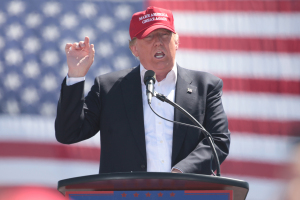
    Donald Trump’s presidency has called into serious question the role of the US in the Paris Agreement, the direction of international cooperation on climate change, and the role of the US in the liberal international order.

    Just one year ago, the world was celebrating the adoption of the Paris Agreement as a new foundation for global cooperation on climate change. The North/South firewall that created asymmetrical obligations under the Kyoto Protocol was removed, leaving in its place, a level playing field upon which to build efficient international regulatory cooperation. As Prime Minister David Cameron remarked, “What is so special about this deal is that it puts the onus on every country to play its part.” The more optimistic among us were already discussing how the voluntary aspects of this hybrid agreement could be strengthened to advance the effectiveness of the treaty regime.

    The election of Donald Trump as the 45th President of the United States, however, has called into serious question the role of the US in the Paris Agreement, the direction of international cooperation on climate change, and moreover, the role of the US in the liberal international order and its cohesiveness moving forward. On climate change, for example, Trump and his cabinet vacillate between outright denial and “lukewarmism” (open to the possible existence of climate change but denial of its importance or the urgency of a response).

    As such, most of us who take international cooperation seriously are filled with more than a little anxiety and/or dread at the prospect of a Trump presidency but it is important to view Trump as a symptom of a systemic problem: a struggle at the heart of liberal democracy.

    The past and future of liberal democracy

    Winston Churchill’s remark that, “the best argument against democracy is a five-minute conversation with the average voter” gets to the heart of the post-Cold War rebalance between the paternalism of liberal autocracy (or undemocratic liberalism) and the recent growth of populist illiberal democracy.

    As Fareed Zakaria reminds us, “The tension between constitutional liberalism and democracy centers on the scope of governmental authority. Constitutional liberalism is about the limitation of power, democracy about its accumulation and use.” The purpose of liberalism’s controls on democracy is to create a long-term structure that is resistant to the short-term solutions of individual leaders to placate the short-term thinking of the people. The liberal international order seeks to do the same between states.

    The recent pendulum swing towards illiberal democracy reflects the shortened time horizon of the electorate in the West and their resentment of the longer time horizon of the elites necessary for a liberal international order.

    Foreign policy and the willingness of the electorate to pay for it

    donald_trump_25927764516

    Image credit: Gage Skidmore/Wikimedia.

    Trump has been able to tap into a populist resentment of the costs Americans are paying to support international public goods, in particular a global trade regime that is perceived to have benefited Mexico and China at America’s expense and “collective” security arrangements in Europe and Asia that have provided US allies a far greater peace dividend at a disproportionately lower cost than for Americans. For many Americans, ungrateful allies but also America’s challengers are free riding on an international order shouldered by the American taxpayer.

    There are, of course, virtually no benefits and considerable costs for America to withdraw from the international economic order or its security alliances, but Trump may be able to increase the cost for other states of participating in the international order secured by the US.

    The Republican Party has been trying to limit disproportionately high financial obligations to the UN since the 1980’s, but with an electorate choosing to give them control of the Presidency, Congress, and the Supreme Court, the credible threat of US isolationism has not been this great since the rejection of the League of Nations.

    By threatening to walk away from international agreements that provide others benefits reliant on American beneficence, Trump, who has made a career out of rent seeking in real estate development and personal branding, will seek to extract greater rents from the international order.

    The danger for Trump is that reduced obligations for Americans, or unreasonably high costs for free riders, create incentives for them to seek other sources of global leadership. However, there is reason to believe that Japan and South Korea see much larger costs from Chinese domination; middle-eastern allies see much higher costs than benefits from a US withdrawal; and post-modern Europe will realize it is mostly defenseless without American security guarantees.

    None of this “deal making” will improve the lives of the Americans who voted for Trump, but it will likely force US allies to come to terms with their contribution to the peace benefit they’ve enjoyed for so long.

    Paris and domestic politics

    The Trump administration has begun the process of rolling back the implementation of President Obama’s Clean Power Plan and is likely to reduce donations to international climate funds. In the short term, this will appease many in the Republican Party who feel that responsibility for addressing climate change creates short-term costs that disproportionately fall on Americans and provides benefits primarily to non-Americans. That said, these policy changes are likely to result in more coal plants outside the US than within it.

    Article 28 delays the possibility of withdrawing from the Paris Agreement for four years, but the US could repudiate the ratification of the UN Framework Convention on Climate Change, a process that would only take one year. As the Paris Agreement creates no binding mitigation obligations for the US, it is not clear what the Trump administration gains from walking away from either treaty, especially when it is clear that the US would lose a seat at the table it could use to stall the progressive development of the regime.

    With former Exxon CEO Rex Tillerson as Secretary of State, the US is likely to continue to support the transition away from fossil fuels (or decarbonization of the global economy) but work actively to slow the pace of implementation to a crawl.

    Contagion: from a domestic politics issue to an international problem

    In the West, the long-term thinking of liberal democracies facilitated increased prosperity among partners in the international order.

    And that prosperity empowered undemocratic liberal elites to expand national rights and responsibilities and translate them into international rights and responsibilities. Tacit approval for these measures, however, was reliant on continued domestic prosperity. But as that prosperity has faltered, it is unsurprising that support for liberal internationalism has declined among the electorate.

    The vote for Brexit typifies the impulse of the people to support measures described by illiberal democrats as necessary to regain control of their uncertain economic and cultural destiny. The EU’s migrant crisis and austerity measures from the financial crisis have strengthened illiberal nationalists across Europe, weakening the normative power of the liberal autocracy at the heart of supranational Europe.

    In all cases, the excesses of undemocratic liberalism, followed by reduced domestic prosperity, have eroded popular support for international cooperation where the domestic costs are perceived to exceed the benefits.

    Conclusion

    Trump’s formal repudiation of the TPP and rejection of the TTIP reflect the shortened time horizon of an electorate unwilling to invest in potential future economic gains, but these decisions don’t inherently threaten the international economic order. If, on the other hand, Trump imposes 45% tariffs on imports from China (another ill-advised campaign promise) or walks away from US security guarantees these actions would present serious systemic risks.

    It’s worth considering, however, that by painting the worst-case scenario of US withdrawal from the international order so vividly, Trump has highlighted the benefits provided by American leadership that are frequently taken for granted.

    In seeking to protect US sovereignty (by reducing what are viewed as asymmetrical obligations) Trump may reinforce the importance of reciprocity in international cooperation and diminish the desire to internationalize Western liberal values. An international criminal court with the support of the US, China, and Russia would be stronger than the current European incarnation. The UN Security Council would be stronger if each member of the P-5 paid the same proportion of UN dues, and the UN General Assembly (where two-thirds of the members collectively pay less than 2% of the total UN budget) would be more legitimate if it were unable to determine the UN budget with a two-thirds voting majority.

    Scaling back liberal excesses need not result in authoritarianism, isolationism, or gunboat diplomacy. If addressed prudently, illiberal democratic rebalancing may produce more sustainable liberal democracies and a better liberal democratic foundation for international cooperation.

    Murray Carroll is a co-founder and director of the International Court for the Environment Coalition. He has a law degree from the London School of Economics, and is a graduate student of international relations at Harvard University and international law at the University of London. Responsibility for the views expressed in this commentary rest exclusively with the author.


  • Sustainable Security