Blog

  • Bay of Bengal: a hotspot for climate insecurity

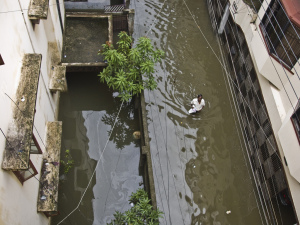
    Bay of bengal Climate InsecurityThere is no region of the world that faces more threats from climate change than South Asia. Of particular concern is the littoral surrounding the Bay of Bengal, including the Eastern Indian states of West Bengal and Odisha, Bangladesh, and coastal Burma. This region is uniquely vulnerable to a changing climate because of a combination of rising sea levels, changing weather patterns, and uncertain transboundary river flows. Away from the seashore, China holds the high ground in the Tibetan Plateau and the Himalayas, and complicates the geopolitical picture further by acting as the source of the region’s fresh water.

    On the Bay of Bengal’s coast these problems of a changing climate combine with already existing social problems like religious strife, poverty, political uncertainty, high population density, and rapid urbanization to create a very dangerous cocktail of already security threats. Climate change has been called a “threat multiplier” or “an accelerant of instability” by military and intelligence communities because of how it will impact these already existing threats. With a population of more than 300 million people (91 million in West Bengal, 42 million in Odisha, 142 million in Bangladesh, 52 million in Burma), tense militarized borders, overlapping ethnic and religious communities, and uncertainty about the future, there is no region in the world that faces a more dangerous combination of threatsfrom climate change than here.

    Rising Sea Levels

    One of the key tenets of national security is the ability of a country to ensure the integrity of its sovereign territory. Yet, as glaciers far from South Asia melt, the sea rises and encroaches upon its farms, villages, and cities. As Hemingway wrote about going bankrupt, sea level rise happens “gradually, then suddenly.” Slowly, a rising ocean brings increasing intrusion of brackish water into groundwater, harming costal agriculture. Moreover, gradual ocean encroachment harms the coast’s natural protections, whether dunes, reefs, barrier islands, or mangrove forests. Then, suddenly, when a major cyclone blows in a storm surge will overcome previously unsurmountable barriers.

    The shorelines of the Bay of Bengal stand to lose swaths of territory from sea level rise. Bangladesh, as a country predominantly composed of river delta, is most at risk. It stands to lose 11% of its territory – home to 15 million people – from a sea level rise of only 1 meter, a level that is not a particularly extreme prediction over the next 4 decades. Few invading armies could do worse damage.

    Oddly enough, the world’s oceans do not rise at the same rate. With rising global sea levels, in some areas the sea level could actually fall while it rises in others. A recent study from the National Center for Atmospheric Research (NCAR) found that sea level rise will be particularly high along the Bay of Bengal, due to changes in currents caused by rapid surface warming of the Indian Ocean.

    In the region, the cities of Dhaka, Kolkata, and Yangon all lie in major river deltas and are vulnerable to storm surges. In its 2007 report, the Intergovernmental Panel on Climate Change (IPCC) specifically listed cities in Asian mega deltas as “hotspots for vulnerability” because of sea level rise and changing patterns of river flow. Already straining at their infrastructure limits, these densely packed cities are becoming more vulnerable in a warming world.

    Changing Transboundary Water Flow

    Water does not stay within lines on a map. Instead, gravity draws it inexorably from the mountains to the sea. China, through its control of Tibet, controls the headwaters of almost all of the major rivers of Asia – only the Ganges lies outside of China’s control, originating in India. Of the major rivers that empty into the Bay of Bengal, all cross borders. Water is only plentiful during the monsoon season, so these rivers provide much-needed sustenance to agriculture, people, and ecosystems throughout their trip to the sea during the dry season – when they are fed by glacier and snow melt. Competition and tension over that flow is evident around the world when water crosses borders.

    This is true of Bangladesh and India, for which the flow of the Ganges are a source of tension. The Farakka Barrage on the Ganges River, just 10 miles upriver from the Bangladesh border, allows India a measure of control over the river. The dam allows India to divert the flow of the Ganges down a canal to the Hooghly River and into the port of Kolkata. Since the dam was built in 1975, there have been allegations from Bangladesh that India diverts water in the dry season and releases too much in the monsoon season. In 1996, the two countries agreed to a 30 year treaty to share the Ganges’ flow, but tensions still remain.

    The Brahmaputra River, meanwhile, provides a source of tension between the two regional powers, India and China. China recently announced that they are building a series of hydroelectric dams along the Brahmaputra’s upper reaches in Tibet, but they have forsworn any attempt to divert or hold back the great river’s flow. However, these assurances have not quieted all voices in India, who point to plans in China’s South-North Water Diversion Project to divert water from the Brahmaputra in order to ensure water for industry and the cities of China’s parched north. China’s leaders have denied these extravagant plans, but their engineers have lobbied for such a project. It would complete a dream of Chairman Mao’s, who said: “Southern water is plentiful, northern water scarce. If at all possible, borrowing some water would be good.”

    Climate change exacerbates these concerns about transboundary water management in the region. Climate change is threatening both the glaciers that sit at the top of these mighty rivers, feeding them during the dry season, and the very viability and predictability of the Indian Monsoon rains. Temperatures in the Tibetan Plateau and the Himalayas have risen 1.5 degrees Celsius since 1982, a rate more than three times as fast as the global average. Meanwhile, changes in weather patterns due to climate change could cause repeated failures in the monsoon. While there is little likelihood of an immediate and total melting of the glaciers, uncertainty about their future flows is enough to stoke tension in the region.

    The Potential for Conflict

    Climate change is altering the environment of the region; the glaciers are retreating, the rivers’ flows are becoming more unpredictable, and the seas are rising. However, whether those changes manifest themselves into either civil or interstate conflict will depend upon how both the populations and the governments in the region react to those changes. How long governments have to adapt depends upon unpredictable weather and climate patterns – but as the Stern Review bore out, earlier action is almost always cheaper and more effective than waiting. How governments adapt is important as whether; some adaptations, like capturing water that would otherwise flow across borders in new reservoirs could actually make the threat of conflict worse. If countries do not work cooperatively, they could stoke conflict.

    Throughout history, one of the most effective ways to deal with climate change has been migration – from a climate that is no longer hospitable to one where living is easier. However, modern borders do not reflect the historical ties between the regions. Migration is a natural response. However, in areas with already high population density and an overlapping patchwork of ethnic and religious communities, new immigrant communities often come into direct conflict with established communities. Last year saw ethnic strife in the Indian state of Assam between indigenous Bodos and immigrant Muslims, many of whom hailed from over the nearby border in Bangladesh. Over 75 people died, and over 400,000 people were temporarily displaced. In this region, it is impossible to say whether a group of migrants are “climate refugees” or simply moving to a place with better economic opportunity, but this is what we should expect in the future.

    It is difficult to find examples of any interstate wars fought directly over water; to the contrary, water has been a catalyzer of cooperation. However, as countries realize that they can control and shape water flow through mega dams and water diversion projects, there is a danger that the claims of downstream countries could be ignored. Along the Mekong River, for example, China has proceeded to dam and control the river’s flow through its territory – leading downstream neighbors to complain that China is causing droughts. Yet because of the power imbalance between China and smaller countries like Laos and Cambodia, the Chinese have little to fear. Similar thinking by Chinese leadership over dam building along the Brahmaputra, their shared river with India, could lead both countries to stumble into a conflict that neither of them want.

    In the age of climate change, conflict is more likely as threats are multiplied. Nowhere is this truer than around the Bay of Bengal. However, war is never pre-ordained. Instead, the threat of conflict is determined by how countries react. Good international governance can encourage countries to not simply pull up the drawbridge and think only of themselves, but will encourage them to see what their actions will mean for regional neighbors. Climate change is increasing the threat of wars and unrest around the Bay of Bengal; but foresight about its impacts can help the region’s leaders work together to solve a problem that knows no boundaries.

    Andrew Holland is Senior Fellow for Energy and Climate at American Security Project, a Washington D.C based think tank. He is an expert on energy, climate change, and infrastructure policy. He has over seven years of experience working at the center of debates about how to achieve sustainable energy security and how to effectively address climate change.

    Image source: amioascension
  • Bay of Bengal: a hotspot for climate insecurity

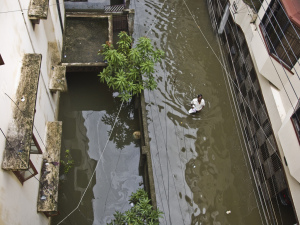
    Bay of bengal Climate InsecurityThere is no region of the world that faces more threats from climate change than South Asia. Of particular concern is the littoral surrounding the Bay of Bengal, including the Eastern Indian states of West Bengal and Odisha, Bangladesh, and coastal Burma. This region is uniquely vulnerable to a changing climate because of a combination of rising sea levels, changing weather patterns, and uncertain transboundary river flows. Away from the seashore, China holds the high ground in the Tibetan Plateau and the Himalayas, and complicates the geopolitical picture further by acting as the source of the region’s fresh water.


    On the Bay of Bengal’s coast these problems of a changing climate combine with already existing social problems like religious strife, poverty, political uncertainty, high population density, and rapid urbanization to create a very dangerous cocktail of already security threats. Climate change has been called a “threat multiplier” or “an accelerant of instability” by military and intelligence communities because of how it will impact these already existing threats. With a population of more than 300 million people (91 million in West Bengal, 42 million in Odisha, 142 million in Bangladesh, 52 million in Burma), tense militarized borders, overlapping ethnic and religious communities, and uncertainty about the future, there is no region in the world that faces a more dangerous combination of threatsfrom climate change than here.

    Rising Sea Levels

    One of the key tenets of national security is the ability of a country to ensure the integrity of its sovereign territory. Yet, as glaciers far from South Asia melt, the sea rises and encroaches upon its farms, villages, and cities. As Hemingway wrote about going bankrupt, sea level rise happens “gradually, then suddenly.” Slowly, a rising ocean brings increasing intrusion of brackish water into groundwater, harming costal agriculture. Moreover, gradual ocean encroachment harms the coast’s natural protections, whether dunes, reefs, barrier islands, or mangrove forests. Then, suddenly, when a major cyclone blows in a storm surge will overcome previously unsurmountable barriers.

    The shorelines of the Bay of Bengal stand to lose swaths of territory from sea level rise. Bangladesh, as a country predominantly composed of river delta, is most at risk. It stands to lose 11% of its territory – home to 15 million people – from a sea level rise of only 1 meter, a level that is not a particularly extreme prediction over the next 4 decades. Few invading armies could do worse damage.

    Oddly enough, the world’s oceans do not rise at the same rate. With rising global sea levels, in some areas the sea level could actually fall while it rises in others. A recent study from the National Center for Atmospheric Research (NCAR) found that sea level rise will be particularly high along the Bay of Bengal, due to changes in currents caused by rapid surface warming of the Indian Ocean.

    In the region, the cities of Dhaka, Kolkata, and Yangon all lie in major river deltas and are vulnerable to storm surges. In its 2007 report, the Intergovernmental Panel on Climate Change (IPCC) specifically listed cities in Asian mega deltas as “hotspots for vulnerability” because of sea level rise and changing patterns of river flow. Already straining at their infrastructure limits, these densely packed cities are becoming more vulnerable in a warming world.

    Changing Transboundary Water Flow

    Water does not stay within lines on a map. Instead, gravity draws it inexorably from the mountains to the sea. China, through its control of Tibet, controls the headwaters of almost all of the major rivers of Asia – only the Ganges lies outside of China’s control, originating in India. Of the major rivers that empty into the Bay of Bengal, all cross borders. Water is only plentiful during the monsoon season, so these rivers provide much-needed sustenance to agriculture, people, and ecosystems throughout their trip to the sea during the dry season – when they are fed by glacier and snow melt. Competition and tension over that flow is evident around the world when water crosses borders.

    This is true of Bangladesh and India, for which the flow of the Ganges are a source of tension. The Farakka Barrage on the Ganges River, just 10 miles upriver from the Bangladesh border, allows India a measure of control over the river. The dam allows India to divert the flow of the Ganges down a canal to the Hooghly River and into the port of Kolkata. Since the dam was built in 1975, there have been allegations from Bangladesh that India diverts water in the dry season and releases too much in the monsoon season. In 1996, the two countries agreed to a 30 year treaty to share the Ganges’ flow, but tensions still remain.

    The Brahmaputra River, meanwhile, provides a source of tension between the two regional powers, India and China. China recently announced that they are building a series of hydroelectric dams along the Brahmaputra’s upper reaches in Tibet, but they have forsworn any attempt to divert or hold back the great river’s flow. However, these assurances have not quieted all voices in India, who point to plans in China’s South-North Water Diversion Project to divert water from the Brahmaputra in order to ensure water for industry and the cities of China’s parched north. China’s leaders have denied these extravagant plans, but their engineers have lobbied for such a project. It would complete a dream of Chairman Mao’s, who said: “Southern water is plentiful, northern water scarce. If at all possible, borrowing some water would be good.”

    Climate change exacerbates these concerns about transboundary water management in the region. Climate change is threatening both the glaciers that sit at the top of these mighty rivers, feeding them during the dry season, and the very viability and predictability of the Indian Monsoon rains. Temperatures in the Tibetan Plateau and the Himalayas have risen 1.5 degrees Celsius since 1982, a rate more than three times as fast as the global average. Meanwhile, changes in weather patterns due to climate change could cause repeated failures in the monsoon. While there is little likelihood of an immediate and total melting of the glaciers, uncertainty about their future flows is enough to stoke tension in the region.

    The Potential for Conflict

    Climate change is altering the environment of the region; the glaciers are retreating, the rivers’ flows are becoming more unpredictable, and the seas are rising. However, whether those changes manifest themselves into either civil or interstate conflict will depend upon how both the populations and the governments in the region react to those changes. How long governments have to adapt depends upon unpredictable weather and climate patterns – but as the Stern Review bore out, earlier action is almost always cheaper and more effective than waiting. How governments adapt is important as whether; some adaptations, like capturing water that would otherwise flow across borders in new reservoirs could actually make the threat of conflict worse. If countries do not work cooperatively, they could stoke conflict.

    Throughout history, one of the most effective ways to deal with climate change has been migration – from a climate that is no longer hospitable to one where living is easier. However, modern borders do not reflect the historical ties between the regions. Migration is a natural response. However, in areas with already high population density and an overlapping patchwork of ethnic and religious communities, new immigrant communities often come into direct conflict with established communities. Last year saw ethnic strife in the Indian state of Assam between indigenous Bodos and immigrant Muslims, many of whom hailed from over the nearby border in Bangladesh. Over 75 people died, and over 400,000 people were temporarily displaced. In this region, it is impossible to say whether a group of migrants are “climate refugees” or simply moving to a place with better economic opportunity, but this is what we should expect in the future.

    It is difficult to find examples of any interstate wars fought directly over water; to the contrary, water has been a catalyzer of cooperation. However, as countries realize that they can control and shape water flow through mega dams and water diversion projects, there is a danger that the claims of downstream countries could be ignored. Along the Mekong River, for example, China has proceeded to dam and control the river’s flow through its territory – leading downstream neighbors to complain that China is causing droughts. Yet because of the power imbalance between China and smaller countries like Laos and Cambodia, the Chinese have little to fear. Similar thinking by Chinese leadership over dam building along the Brahmaputra, their shared river with India, could lead both countries to stumble into a conflict that neither of them want.

    In the age of climate change, conflict is more likely as threats are multiplied. Nowhere is this truer than around the Bay of Bengal. However, war is never pre-ordained. Instead, the threat of conflict is determined by how countries react. Good international governance can encourage countries to not simply pull up the drawbridge and think only of themselves, but will encourage them to see what their actions will mean for regional neighbors. Climate change is increasing the threat of wars and unrest around the Bay of Bengal; but foresight about its impacts can help the region’s leaders work together to solve a problem that knows no boundaries.

    Andrew Holland is Senior Fellow for Energy and Climate at American Security Project, a Washington D.C based think tank. He is an expert on energy, climate change, and infrastructure policy. He has over seven years of experience working at the center of debates about how to achieve sustainable energy security and how to effectively address climate change.

    Image source: amioascension

  • La Legión del Afecto: Colombia’s Powerful Network for Peace

    The fate of Colombia’s Legión del Afecto as a government-financed peacebuilding program is uncertain, but it looks to endure as an independent social movement. Its persistence is due both to its historical development and to its emphasis on affective relationships.

    Authors Note:  This material is based upon work supported by the United States National Science Foundation under Grant #1452541. Any opinions, findings, and conclusions or recommendations expressed in this material are those of the authors and do not necessarily reflect the views of the National Science Foundation.

    The Legión del Afecto – translated as the Legion of Affection – is a Colombian social network broadly mobilized around peace. It is arguably the most overlooked, yet broadest-based network, for peace in Colombia. Unlike other more-publicized movement networks like the Congreso de los Pueblos or the Marcha Patriotica, the Legión del Afecto was established as intentionally non-polarized with respect to the left/right politics that have long generated conflict in the country and across Latin America.

    Instead, the politics of the Legión del Afecto might best be described as a politics of sentir – a politics of feeling. “Ver, oir, sentir” (to see, to hear, to feel) is one of a few familiar phrases of the Legión del Afecto, which has been echoed in all corners of the country.

    The politics of “feeling”

    Image credit: Legión del Afecto.

    While recognizing and valuing social difference – especially across lines of race, ethnicity, and sexual orientation – the Legión del Afecto has emphasized the bodily capacity to sense and feel as a point of social and political convergence for the country’s youth in the face of seemingly insoluble conflicts at multiple scales; the fact that each individual feels differently (because of distinct biographies, identities, and physical experiences) should not matter as long as a politics could be build around respecting and valuing others’ bodily capacity for feeling.

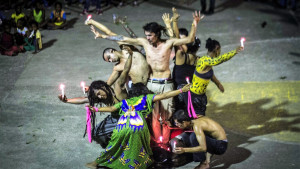
    In essence, this respect and valuing of the other is what “affection” has come to mean in the network. As a result, non-verbal means of communicating feelings have become highly valued in the Legión del Afecto. So-called ‘alternative languages’ of dance, music, theatre, clowning, acrobatics, fire-blowing and more, along with shared banquets, journeys, festivals and other shared sensorial events have been central to continued mobilization and motivation of legionarios (Legion participants), often youth between the ages of 15 and 25.

    In a country where many have been killed for simply appearing to favor one side or the other, the focus on feeling rather than on political side-taking has been crucial to the survival and thriving of both the network and the leaders within it. Because of this intentional and conspicuous lack of side-taking, the Legión del Afecto has been able to enter and intervene in location and communities across the country where others – e.g., police, military, government – were once unable to go. Of course, it would not be accurate to portray legionarios as lacking political views or direction; the opposite is true. However, as a network the Legión del Afecto has focused on creating space for dialogue and political learning rather than defining or persuading one single way of analyzing current national and global trends.

    These spaces of learning and dialogue have been particularly important as the network grew to include ex-combatants from all sides of the Colombian conflict. Intentionally setting down the conflicts associated with polarized national politics meant that the Legión del Afecto could mobilize ex-guerilla, ex-paramilitary, ex-soldiers, ex-gang members as well as many others affected by violence and by the pervasive lack of opportunity for marginalized youth.  These participants enriched the Legión del Afecto through sharing their differences in lived experience, rather than swallowing or forgetting their pasts.

    Origins and Evolution of the Legión

    The Legión del Afecto began in 2003 (under another name) as a collaboration between different ‘base’ (i.e. grassroots) groups in the city of Medellín, which had many prior years of experience in peaceful social transformation at the community level. In particular, two groups – Casa Mía, a group focused on urban youth, and La Colonia de San Luis, a group serving once-rural families who experienced violent displacement – united their expertise in the formation of the Legión del Afecto. Casa Mía was especially important as many of the Legión del Afecto’s founding antecedents – for example, the focus on afecto or affection – came from its founding leaders’ own collaborative legacy of radically innovative and daring peacebuilding in the Santander neighborhood of Medellín. The earlier peacebuilding of Casa Mia involved building trust and affection among young men pertaining to dueling gangs as well as standing up for justice and non-violence in the face of direct threats from paramilitary groups.  That such strategies were effective in the face of conflict is perhaps best evidenced by the fact that the Legión del Afecto, after first being funded by the UNDP (for methodological development), was scooped up as a government-sponsored program, housed under Acción Social (under president Uribe), and then the Departamento para la Prosperidad Social (DPS) (under Santos).

    As a government program, the Legión del Afecto grew a centralized administration, and new rules and regulations to follow, but it was never “just” a government program. As the Legión del Afecto spread from it’s origins in the city of Medellín to over 40 other cities, towns, and rural municipalities across the country, the network tapped into and drew from existing base community groups in each location. In each place, new leaders were nurtured alongside already-established community leaders who grew and gained new ideas. Existing effective ties were used to strengthen the network and bring in new participants. And in each place, the particularities and challenges of the location brought new strategies for peacebuilding that were focused on the traditions, as well as the problems, of each region: for example, a focus on traditional music (gaitas) in San Jacinto, or a focus on memory and ritual in many rural places where violent acts had occurred.

    The Legión Today

    It is often stated that there are currently “over 2000” young legionarios across the country, but the actual effect of the Legión del Afecto is much larger. behind any official count of participants, there are thousands of families and tens of thousands of friends and community members who have been affected by the peacebuilding efforts of the network. These friends, families, and community members are the ones who came to grand events – like the Carnival del Pan (2009, Cali), or Hip Hop Sin Fronteras (2010, Medellin), which mobilized massive numbers of participants. And these friends, families and community members are also the individuals who know and trust the participants in the Legión del Afecto through their small daily actions, and who therefore have been willing to work together with them in their efforts to build an ‘everyday’ peace in communities across the country.

    Today, this expanded and enduring capacity of the network is more important than ever; despite recent funding uncertainty for the Legión del Afecto as a government program, the Legión del Afecto persists as a grassroots network – a potentially powerful, motivated, and emotionally interconnected movement of young and old, who hold some very significant lessons for the development of a truly post-conflict society.

    Further Information on the Legión

    More information about the Legión del Afecto, its history, activities, and methodologies, is being made available through the grassroots website still-in-progress: www.legiondelafecto.org.

    The Legión del Afecto network is present in the following cities and regions in Colombia: La Macarena, Playa Rica (la Y), San Juan de Lozada, San Vicente del Cagüan, La Catalina, Montañita, Puerto y Florencia, Medellín, San Luis, San Fransísco y Sonsón, Samaná Florencia y Pensilvania, Soacha, Bogotá y Viota, Barrancabemerbeja, San Pablo y Puerto Wilches, Chiquinquirá y San Miguel de Sema,  Cartago, San José del Palmar, Bojayá, Quibdó, Buchadó, Pamplona, Cúcuta, Tibú, La Gabarra, Cali, Buenaventura, Armenia, La Tebaida, Manizales, Cartagena, Montes de María, Magangué y Plato, Puerto Tejada, y Villavicencio, Copey, San Juan del Cesar y Villanueva Guajira, Chibolo, Carepa, Turbo, Acandí, Ungía y Carmen del Darién y Mistrató, Tumaco, Líbano y Natagaima, Ovejas, Santa Rosa del Sur y Simití, Puerto López, El Retorno , San José del Guaviare y Mocoa.

    Allison Hayes-Conroy is an assistant professor of Geography and Urban Studies at Temple University. She has studied the Legion del Afecto as a peacebuilding initiative alongside the other two authors – both participants in the Legión – since 2011. Hayes-Conroy’s has published widely on role of the body in social movements and initiatives. Her work on peace-based social initiatives in Colombia and her work on bio-social pedagogical innovation have both been funded by the U.S. National Science Foundation.

     Cesar Buitrago Arias, is a community leader and law student. He has worked for 20 years to support the needs of displaced families like his own, who come to the city of Medellin, Colombia from rural areas due to violence.

     Alexis Saenz Montoya, is a Ph.D. Student in the Department of Geography and Urban Studies at Temple University. His research interests lie in the intersection of community-based organizations and popular education in Latin America.

  • Sustainable Security and the Challenges of 2014

    This article was originally published on openSecurity’s monthly Sustainable Security column on 27th January, 2014.  Each month, a rotating network of experts from Oxford Research Group’s Sustainable Security programme and their partners explore on-going issues of global and regional insecurity. 

    Sustainable Security is a concept that has been around for almost a decade now. It was first conceptualised by my colleagues Chris Abbott and Paul Rogers, whose thoughts on the subject have appeared many times in these pages. In 2000, Paul summed up what looked to many commentators like a surprisingly quiet decade of US hegemony as characterised by an unsustainable ‘control paradigm’, in which the symptoms of global insecurity were suppressed with force while their root causes were ignored and left to fester. The 9/11 attacks and subsequent ‘war on terror’ served to confirm Paul’s hypothesis that military domination would not be sufficient to ‘keep a lid’ on security challenges, even in the world’s most powerful states.

    The Sustainable Security paradigm has been developed by the Oxford Research Group as an alternative lens through which to view global security, identifying the underlying drivers of conflict and insecurity rather than its symptoms, such as violence, organised crime or radicalisation. The point is to understand how unmet human needs and feelings of insecurity interrelate and lead to violence, then to work to prevent conflict by addressing its root causes. The aim of this new monthly column on openSecurity is to facilitate precisely this kind of understanding through contributions from the Sustainable Security Programme’s network of experts on non-traditional security issues.

    Taking a sustainable security approach requires some thought about the future of our planet as well as its current unsustainable state. Changes to climate, demography, economic production and consumption, political and national identity, access to information and military technology will all condition the future security of our world. What, then, does 2014 hold in the way of challenges and opportunities?

    2014: the end of the war on terror?

    British Soldier with 1 Welsh Guards returns from patrol in Zarghun Kalay, Afghanistan Source: Ministry of Defence (Flickr)

    By the end of 2014, the last NATO combat troops should have withdrawn from Afghanistan. Does this mean that the alliance’s war on terror will end where it began 13 years earlier? I doubt it. Billions of dollars and thousands of lives later, Afghanistan looks about as stable as Iraq. Pakistan, India, Iran and other powerful actors will continue to play their own cards at the Afghan table and it is barely conceivable that the US and its allies will not seek to use their own military influence and proxies to keep the Taliban down, however appalling the post-Karzai elections this April.

    As much as President Obama has sought to distance himself from the toxic Bush legacy of overt and unilateral interventionism, the nature of the ‘Obama doctrine’ is war on terror-lite. It is covert, stealthy, and still the wrong side of international law. Obama’s strategy relies on the use of ‘remote control’ warfare: special forces, private military contractors and, above all, armed drones, or unmanned combat air vehicles (UCAVs). Since 2009, US drone attacks have escalated dramatically and killed hundreds, including civilians, in Pakistan, Yemen, Somalia and Afghanistan, where the UK also increasingly uses UCAVs. Withdrawing combat units does not mean that NATO states will cease to pursue war by remote control in Afghanistan.

    Arguments that UCAV systems and operators are more offensive or inclined to kill civilians miss the larger legal point that the US is increasingly pursuing undeclared wars and targeted assassinations, whether it employs drones, special forces, mercenaries, manned gunships or cruise missiles. The backlash to such action is demonstrable through the further radicalisation of communities living in fear of constant surveillance and attack from the unseen. It is employing terror against terror.

    2013 was something of a break-out year for UCAVs. Israel set many of the precedents that the US has followed in drone warfare as well as targeted killings. The technology is simple and easy to imitate. While the UK and France invest in US systems and test indigenous prototypes, China and Iran have flown their own first UCAVs. Russia and others are not far behind. Even very modest air forces like Nigeria’s have built their own rudimentary drones. Non-state constructors cannot be far behind. Drone proliferation may define this decade as wireless communications defined the last.

    Militarisation of the greater Middle East

    If 2013 was the year that the democratic hopes of the Arab Spring unravelled, 2014 may be the year that it turns to regional war. Libya appears to be at the vanguard, although there remains a chance that it could follow Yemen’s path of dialogue and isolate its increasingly prominent radical fringe. Egypt’s generals have learned nothing from Algeria’s tragic past and the leaden Mubarak years. Iraq’s Maliki regime still believes it has nothing to learn from Syria’s sectarian implosion, continuing to marginalise a Sunni minority.

    Neither the US, UK nor France is likely to want to overtly intervene in the inferno of Syria or the escalating crises of Iraq, Libya and Egypt; plenty of others will. Meanwhile, the Sahara is becoming steadily more militarised. France has just announced a major repositioning of its forces in Africa out of their urban and coastal bases and into the Sahel to hunt and destroy al-Qaida affiliates. Ever since 2009, US special forces, drone operators and private contractors have been quietly moving from Djibouti across the Sahel and Horn, increasingly sharing facilities with France.

    Transition tensions

    Away from the Middle East, 2014 could be a year of democratic consolidation among rising powers. No less than eight of the 15 largest emerging economies expect to hold elections this year and a couple more are already polarising around polls due in early 2015.

    Taksim Sqaure protestors, 16 June, 2013. Source: Wikimedia

    Taksim Sqaure protestors, Istanbul, Turkey, 16 June, 2013. Source: Wikimedia

    India, Brazil, Turkey, South Africa, Thailand and Egypt all plan to hold elections this year, in the wake of major protest movements in 2013. New parties from the margins are shaking up politics in India and South Africa, potentially increasing instability as the establishment fights back. Thailand is already politically paralysed as its metropolitan establishment lashes back at the populist aspirations of the rural majority. Turkey could see something similar if, as expected, conservative premier Erdogan seeks the presidency in August. Emerging giants Brazil and Indonesia will probably weather their elections better but nonetheless will be distracted.

    While 2014 may not be a peak year for economic growth or political stability among regional powers, overall the longer-term trend looks positive – marginalised groups, whether from the middle or working classes, asserting their rights and taking a stand against corruption and environmental degradation.  With notable exceptions in Egypt, Thailand and perhaps Turkey, there is a deepening of democratic culture, whether or not civil society is fully respected, in many major developing states and significant incidences of demilitarisation and respect for rights.  However, many of the biggest of them – Brazil, Mexico, Indonesia, Argentina to name just the democracies – are major oil, food and timber exporters with structural incentives to resist, for example, international efforts to restrict carbon emissions.

    Elections to the European Parliament in May and the US Congress in November may be less encouraging. The Tea Party trend and the rise of populist nationalism will continue squeezing progressive policy options on both sides of the North Atlantic.

    2014 as prelude to 2015

    Finally, 2014 is the year in which much of the work has to be done to prepare for the potentially landmark policy processes of 2015, each of which will have significant impact on future global security. For the UK, this includes the political parties setting their manifesto commitments ahead of the May 2015 general election and preparations for the ensuing review of National Security Strategy and Defence and Security Review. Three international processes also stand out.

    For arms reduction there is the quinquennial Nuclear Non-Proliferation Treaty Review Conference, due next May. Difficult debates are expected given the Obama administration’s focus on superiority in strategic conventional weapons.

    For climate change the UN Framework Convention on Climate Change is to set a new universal climate agreement to replace the 1997 Kyoto Protocol on carbon emissions after 2020. This will extend emissions targets from industrialised to developing countries but faces huge hurdles in overcoming resistance from energy lobbies and climate change sceptics in the most powerful states.

    To address development there is also the culmination of the Post-2015 Development Agenda process to supersede the Millennium Development Goals and forge a new agenda with the Sustainable Development Goals. This is a massive project and there remains much to be done to ensure that conflict-affected states are not left behind, as they have been by the MDGs, and that the new agenda tackles inequality as a crucial part of achieving sustainable human security and development.

    2014, then, is a time for looking backwards and forwards. While the dynamics of the war on terror are still very much in play, the withdrawal from Afghanistan and the re-escalation of violence in Iraq and Libya present an opportune context for sincere reflections on the disastrous consequences of war without borders. Such inquiry needs to look forward too, to the implications of the current administration’s ‘war-lite’ and the unstoppable proliferation of remote control technologies.

    This is also the year where we have the chance to get the agenda right for the big international policy decisions of 2015. Looming elections may make it a difficult year for politicians in the US, Europe and many emerging powers to show leadership on such controversial issues. Thus, 2014 will be an important year in deciding whether we continue to control the symptoms of global insecurity or whether we begin to address seriously the inequalities and injustices that underlie it.

    Richard Reeve  is the Director of Oxford Research Group’s Sustainable Security programme. He works across a wide range of defence and security issues and is responsible for the strategic direction of the programme. Richard has particular expertise in global security, Sub-Saharan Africa, peace and conflict analysis, and the security role of regional organisations.

  • Music and Dance in Youth Peacebuilding

  • 2015: Towards a brave new nuclear world?

    by Marianne Hanson and Jenny Nielsen

    Deep tensions and frustrations are rising to the fore as the Nuclear Non-Proliferation Treaty Review Conference in New York gets underway. All parties must act bravely to bridge these deep divides if they are to make progress towards a nuclear-free world.

    This year marks several important events in the international nuclear non-proliferation and disarmament regime, including the 2015 Non-Proliferation Treaty Review Conference (NPT RevCon) being held in New York currently, the hoped-for finalization of the Iran deal with the P5 +1 states, and the 70th commemoration of the Hiroshima and Nagasaki bombings. It also marks five years since international humanitarian law was first mentioned explicitly in the NPT process, prompting some states to pursue a ‘humanitarian initiative’, a framing of the discourse on nuclear weapons away from a purely strategic context and towards an emphasis on the catastrophic human, health, resource and environmental consequences which would result from any use of nuclear weapons.

    Opening meeting of the 2010 NPT RevCon in New York. Source: Flickr | IAEA

    The RevCon, held every five years, is an important diplomatic process for international security. It takes stock of what has been done in the preceding period to curb nuclear proliferation and to implement measures for disarmament, but also looks forward and sets goals for driving these processes further. Since the ending of the Cold War, the divide between those NPT member-states which do not have nuclear weapons and the ones which do possess them (the US, Russia, China, Britain and France) has grown, with many in the former camp deeply disillusioned about the prospects for getting the latter group to disarm. The Conference aims to reach consensus in its final outcome document on what actions should be taken, but it is far from assured that such consensus will be possible this month.

    The US administration continues to stress that ‘as long as nuclear weapons exist, the US will maintain a safe, secure, and effective nuclear arsenal’, and this sentiment is echoed by other nuclear weapon states. It is important to note, however, that while we have been lucky in avoiding a nuclear conflict since 1945, given the evidence and research on the risks associated with nuclear arsenals, as long as nuclear weapons exist, there is no guarantee that our luck will hold. As politicians, strategists, diplomats, and civil society groups convene at the UN, they may wish to reflect on what type of brave new nuclear world they want to create.

    Divisive issues

    The 2015 RevCon  takes place  20 years after  the NPT—widely regarded as the cornerstone of the nuclear non-proliferation regime—was indefinitely extended  through a compromise package deal (of three decisions and a Resolution on the Middle East). The Middle East resolution specifically called for efforts towards the establishment of a Middle East zone free of nuclear and all other WMD and their delivery systems. With the elusive Helsinki conference mandated by the 2010 NPT Action Plan yet to be held, due to diverging postures by the regional parties, this issue remains a challenge for states at the New York meeting.

    Not surprisingly, there exists a divergence of views on the pathway and measures needed to work towards the elimination of nuclear weapons, including on which proposals are feasible in today’s strategic and political environment. The nuclear weapon states continue to insist that only an incremental, step-by-step approach, with slow reductions, is realistic, given the security tensions present in many parts of the world today. It seems to many non-nuclear weapon states and civil society groups however that this approach has not produced results, and they fear that disarmament will always be postponed and held hostage to such claims. These advocates of disarmament stress the dangers of continuing to rely on nuclear weapons; for a growing number of them, creating a legal ban against nuclear weapons is seen as desirable and feasible, even if the nuclear states do not sign  up to such an agreement at the outset.

    Any serious efforts to address these divides will require engagement and informed dialogue between the various constituencies involved in the nuclear weapons policy debate. These constituencies include:

    • Strategic nuclear communities of nuclear weapon states who devise, implement and sustain nuclear deterrence policy, and who inevitably argue for continuation of the status quo;
    • Non-nuclear weapon states and civil society groups driving and advocating nuclear disarmament (including those driving the humanitarian initiative);
    • Non-nuclear weapon states – including those in NATO, East Asia and Australia – relying on extended nuclear deterrence.

    It appears very difficult to bridge the diverging views held by these constituencies. A nuclear ban and the stigmatization of nuclear weapons will surely not be acceptable to those individuals and states who still promote nuclear deterrence as a core component of defence doctrines. Some in these strategic communities may perceive the NPT RevCons as merely high-level diplomatic theatrics that take place every five years and which have no direct relevance to infrastructure and ‘real’ policy on nuclear deterrence. Efforts to consolidate a stigmatization of nuclear weapons through a legal framework, such as a proposed nuclear weapons ban treaty—without the engagement of the nuclear weapon possessors and their respective strategic communities will not garner internalized changes. At the 2015 NPT RevCon, the nuclear weapons states will argue that proposals for a nuclear ban at this time will divert focus away from the agreed 2010 Action Plan and the P5 ‘step-by-step’ process.

    But many non-nuclear states and civil society groups argue that the lack of implementation of the 2010 Action Plan is undermining the credibility of the regime and the entire NPT review process. They suggest that a nuclear weapon ban treaty ought to be considered. Their argument is that while this will certainly not create a risk-free world in international security, neither will continuation of the status quo provide us with long-term security and stability. Indeed they argue that the status quo carries with it far higher levels of risk to human security and will inevitably lead to discord in international cooperation on non-proliferation priorities.

    Opportunities

    States parties to the NPT, the nuclear armed states outside the NPT and civil society groups should act bravely to bridge the deep divides on preferred and promoted pathways towards implementing nuclear disarmament, in order to move towards a frank dialogue and progress. This will require balanced assessment by all constituencies of perspectives and priorities. A continuation of the status quo vis-à-vis implementation of Article VI commitments to disarm will not be acceptable to many non-nuclear weapon states whose frustration has been simmering for decades over perceived unfulfilled ‘empty promises’ made in 1995, 2000, and 2010.

    At present, the discourse on nuclear weapons policy remains engaged only in ‘enclave deliberation’, perpetuating the views within and excluding external or opposing views and arguments. Palpable frustration and miscommunication abounds within and between these various constituencies, making it imperative to engage and stimulate meaningful dialogue between them. There is a real need to promote informed, respectful, and frank engagement and dialogue between these camps.

    Perhaps a way to inch closer to establishing such a dialogue would be to convene key stakeholders in a non-binding, Track II forum, with informed individuals from these separate constituencies, and with a progressive yet balanced agenda which addresses the underlying social constructs, assumptions and rationales of the role of nuclear weapons in security strategies and defence doctrines. An informed forum across the spectrum of diverging perspectives could help to bridge these deep divides.

    If the important discussions on framing a humanitarian narrative regarding nuclear weapons which are taking place in New York (as well as in Geneva, and recently in Oslo, Nayarit and Vienna) are to have an actual impact on nuclear deterrence policy, efforts need to be focused on promoting these ideas to the stakeholders within the defence and strategic communities of the nuclear weapon states (as well as to those four nuclear weapon states who remain outside the NPT framework).

    The evidence highlighted so far by the humanitarian initiative describes catastrophic scenarios of devastation and nuclear winter. Such dystopias are not inevitable; we have the means to avert them. A nuclear-free world is surely a worthy goal to aim for, but moving these efforts forward will require an understanding of and engagement with alternatives to nuclear deterrence as well as the courage from all constituencies to engage with one another.

    Marianne Hanson is Associate Professor of International Relations at the School of Political Science and International Studies, University Of Queensland. She has published widely in the field of international security, with a focus on weapons control, and is currently engaged in a book project examining the emergence of the humanitarian initiative in nuclear weapons debates. 

    Jenny Nielsen is a Postdoctoral Research Fellow in the School of Political Science and International Studies. Previously, she was a Research Analyst with the Non-proliferation and Disarmament Programme at the International Institute for Strategic Studies (IISS), a Programme Manager for the Defence & Security Programme at Wilton Park, and a Research Assistant for the Mountbatten Centre for International Studies (MCIS) at the University of Southampton. She holds a PhD from the University of Southampton which focused on U.S. nuclear non-proliferation policy vis-à-vis Iran in the 1970s.

    Featured image: US nuclear test detonation in 1952. Source: WikiMedia

  • Trump, North Korea and the Risk of War

    Summary

    April has seen the inexperienced Trump Administration further escalate US military activities from Iraq and Syria to Afghanistan and Yemen. Attacking Syrian regime targets for the first time sent a clear signal of muscular change from the Obama era and suggested to President Trump a means to reverse his negative domestic approval ratings. However, it is the crisis over North Korea’s nuclear missile programme that has the greatest potential to escalate suddenly and disastrously into a conflict of global significance.

    Introduction

    Last month’s briefing, Sustainable Security in the Trump Era, discussed the outlook for the sustainable security approach in terms of the incoming Trump administration, concluding that in all three major areas of concern – economic, environmental and military – the Trump prospect was not positive. It would maintain a highly sceptical approach to climate change even if it might end up getting left behind technologically and economically, and its economic policies would do nothing to reduce the widening wealth/poverty inequalities that cleave American society.

    In terms of US security policy, the indications after two months in office were that Trump would expand the military budget and armed forces, give military commanders greater freedom of action, was willing to support an expanded global military posture and saw this as integral to “making America great again”. This briefing continues the overall theme in relation to the military outlook, the main emphasis being on the potential for a crisis involving North Korea.

    The Military Posture

    The March briefing identified a number of areas where the military posture was being expanded. These included an increased use of air power in supporting Iraqi troops attempting to take control of Mosul, the expanded use of Special Forces in Yemen, more powers for US forces to initiate action against militias in Somalia, and the deployment of additional ground troops to Iraq. In the past month there have been further indications of a military expansion.

    • In Iraq, the use of air power in Mosul has increased still further, although the so-called Islamic State (IS) remains entrenched in the western heart of the city.
    • In northern Syria, the US Air Force has been establishing an airfield between Kobane and Raqqa to support the looming offensive against this other stronghold of IS. Up to 1,000 more US troops are anticipated to join the 950 US Special Forces, Rangers and Marines already bolstering the mainly Kurdish Syrian Democratic Forces militia for this offensive.
    • In western Syria, the US Navy carried out a major sea-launched cruise missile raid on an Assad-regime air base in response to a suspected government attack on rebel-held Khan Sheikhoun that used chemical agents and killed many civilians.
    • In Yemen there have been 85 armed drone and strike aircraft attacks since President Trump’s inauguration, more than President Obama approved in 2015 and 2016 combined.
    • In Afghanistan the US Air Force used the world’s most powerful conventional bomb, the GBU-43/B Massive Ordnance Air Burst (MOAB), for the first time against an IS faction.
    • Also in Afghanistan, Trump’s National Security Advisor, General H R McMaster, arrived on a surprise visit that coincided with the deployment of several hundred US Marines to bolster the Afghan National Army, which was suffering increasing losses from attacks by Taliban and other armed opposition groups. There were calls for a further major increase in US military forces in the country at the start of the so-called “fighting season”.
    • Reports at the end of the month that the Trump administration has decided to hand more authority to the Pentagon in terms of how it conducts the wars in Iraq and Syria.
    • Trump diverted a ‘powerful armada’, including a carrier battle group and a nuclear submarine, towards North East Asia and says he fears a “major, major conflict” with North Korea.

    It is in this context that the burgeoning crisis with North Korea requires specific analysis.

    A Crisis out of Nowhere?

    During the course of the past month the issue of North Korea’s nuclear and missile development programmes has come to the fore for reasons which are not easy to pinpoint. It is true that there have been some additional tests of steadily more advanced missiles (one of which failed completely) and there is a possibility that a new nuclear test is being readied. Beyond this, though, little has changed on the North Korean side, and it is the Trump administration that has started to rethink policy, with this stemming from two factors.

    One, as already mentioned, is that Trump’s attitude to security is to focus far more on the use of military force and far less on diplomacy, in marked contrast to the Obama administration. In a sense this harks back to the George W Bush administration after the 9/11 attacks and the subsequent termination of the Taliban regime in Afghanistan. In his January 2002 State of the Union Address to Congress, Bush extended the war against al-Qaida and the Taliban to a conflict with the “axis of evil” centred on Iraq, Iran and North Korea. In the past 15 years, the Iraqi regime of Saddam Hussein has been terminated and the Trump White House is taking a harsh line over the recent Iran nuclear deal. This leaves North Korea and it is here that the second factor comes into play.

    Until a few months ago, US policy was to use sanctions and diplomacy in dealing with North Korea, not least in collaboration with China as the one state with serious influence over Pyongyang. This was based on an assessment that North Korea’s progress towards a functioning nuclear force capable of targeting the United States was still quite a few years off.

    There are credible reports that recent US intelligence analysis indicates that this is no longer the case and, specifically, that North Korea is progressing to the point where it could produce seven or eight nuclear weapons each year, compared with the previous assumption of one a year. It is also believed to be having success in shrinking the size and weight of warheads so that they can be carried by long-range missiles and that it is within a very few years of producing reliable intercontinental ballistic missiles (ICBMs) that could reach the United States. On a worst case assessment the belief is that North Korea might have up to 40 nuclear weapons by the end of President Trump’s first term, as well as being able to deploy the first of a number of ICBMs.

    The extent to which this is an exaggeration is simply not clear but that is not entirely relevant since President Trump and his advisors believe that the time to act is now. As he put it a few days ago: “People put blindfolds on for decades, and now it’s time to solve the problem”. This is because the worst case assessment is very much dependent on a very intensive programme of testing of missiles and of warheads and without this the progress of North Korea’s whole nuclear programme will be hugely limited.

    How to Act

    At the time of writing (28 April) the approach of the Trump administration appears still to be one of seeking much tougher sanctions in order to change the policies of the North Korean regime, but these will have minimal effect without severe sanctions on North Korea’s ability to import fuel. Since China is the dominant supplier, cooperation between Washington and Beijing has to be forthcoming but there are both generic and specific reasons why Beijing is not too sympathetic to putting further pressure on North Korea. The first are that any action which precipitates a collapse of the regime could lead to a war of survival by the regime, including the risk of nuclear use, it would certainly lead to a huge influx of refugees into China and even if the regime collapsed without social catastrophe, the prospect of a unified pro-Western regime on its borders does not appeal to Beijing.

    The specific reasons revolve around the manner in which the United States is using its military power in the expectation that the Pyongyang regime will change its policies, and there is a particular concern that the radar linked to the Terminal High Altitude Area Defence (THAAD) anti-missile system now being deployed in South Korea has the capacity to gain considerable intelligence on some of China’s key defence capabilities.

    China is also likely to be far more aware of the psychology of the North Korean regime and the way it sees its nuclear force as essential to state survival. Like some other states, it is only too well aware that not long after Gaddafi’s Libya gave up its WMD programme the regime was terminated with considerable NATO military support.

    In short, rapid action to effect a change in North Korea’s nuclear and missile plans has no chance of success – only longer-term careful diplomatic action may work. If not, then China, the United States and others will have to get used to the idea that a nuclear-armed North Korea will be a feature of the security of the region. It is worth noting that some leading Western military figures from the Cold War era that had experienced the dangers of the East-West nuclear confrontation ended their careers supporting the idea of global nuclear disarmament. That opportunity was lost and the world may have to get used to the consequences, at least in the case of North Korea.

    Conclusion

    Such a prospect, though, will not appeal to the Trump White House, and given that his administration is already putting far more emphasis on military thinking and options, there really is a risk that in the coming months the decision may be taken to undertake pre-emptive military action against North Korea’s warhead and missile production facilities. This is a highly unwelcome and potentially disastrous prospect but Trump has said that North Korea has to curb its ambitions. In effect he has drawn a red line and, since he criticised Mr Obama for doing so over Syrian chemical weapons and then failing to carry out his threat, President Trump may feel he can hardly afford the opprobrium that would follow should he fail to respond in this case.

    Moreover, this has a particular relevance for the UK, where the Foreign Secretary, Boris Johnson, has said that the UK would support further US action in Syria. With the Royal Air Force having conducted its first ever exercises with South Korean and US counterparts in Korea last November, this raises the issue of whether the same would apply in the case of North Korea, an interesting question at the start of a general election campaign.


    Image credit: Uri Tours/Flickr

    Paul Rogers is Global Security Consultant to Oxford Research Group and Professor of Peace Studies at the University of Bradford. His ‘Monthly Global Security Briefings’ are available from our website. His new book Irregular War: ISIS and the New Threats from the Margins will be published by I B Tauris in June 2016. These briefings are circulated free of charge for non-profit use, but please consider making a donation to ORG, if you are able to do so.

  • Introducing Jobbik: Hungary’s Second Largest Party

  • The Coming Peace: Africa’s Declining Conflicts

    Africa is often presented as a war-ridden continent, but this depiction is becoming outdated. In the 21st century, the amount of warfare in Africa has declined dramatically, and today most Africans are more secure than ever.

    “Africa” and “conflict” are words all too often linked in Western minds. From Cold War proxy wars, to what Robert Kaplan saw as “the coming anarchy”  in the 1990s, to Boko Haram massacres today, news from Africa may seem dominated by never-ending conflict. That image is out of date. In 2002 Tony Blair was justified in describing the state of Africa as a “scar on the conscience of humanity”, but in the years since there has been an underappreciated success story in Africa. The amount of warfare in Africa has declined dramatically, and today most Africans are more secure than ever. Troubled areas remain, unfortunately, but the larger picture of receding conflict has implications for how we think about African security needs. Outside actors can help reinforce positive external and internal trends that mitigate conflict, can avoid creating new conflict zones like Libya or South Sudan, and should recognize emerging human security needs that are becoming relatively more important as armed conflict declines.

    Africa’s waning wars

    Quietly over the last 15 years, many African wars did end, to paraphrase Scott Strauss. Lingering Cold War struggles like the Angolan civil war burned out. West African nations including Liberia and Sierra Leone ceased being playgrounds for warlords and regained their status as functional, if weak, states. Eastern Congo is still violent, but far less so than during the 1990s “African World War”. Overall, 21st century Africa has seen more wars end or abate than ignite.

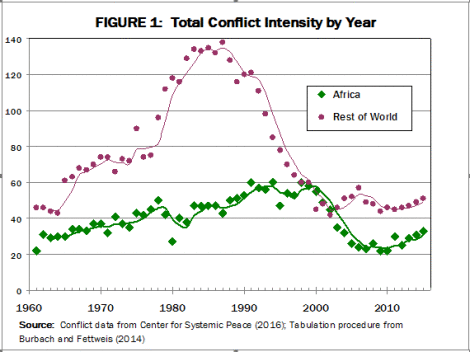
    The trend towards peace in Africa can be seen by using various datasets on armed conflict (for more on data sources, tabulation, and trend analysis, see Burbach and Fettweis 2014). The Center for Systemic Peace (CSP), for example, tracks conflicts from 1946 to the present, scoring each for the intensity of its societal impact. Figure 1 shows the yearly sum of conflict intensity assessed by CSP, for both Africa and the rest of the world. The end of the Cold War brought peace to much of the world, but African conflicts increased in the 1990s. States like Somalia and Sierra Leone collapsed into warlordism, for example. Central Africa was hit by the Rwanda genocide and bloody chaos in Eastern Congo, killing one to five million people.  At least three-fourths of the world’s total war deaths in the late 1990s took place in Africa (Burbach and Fettweis 2014, Figure 4).

    After the year 2000, the tide of war receded. Africa’s total conflict intensity as measured by CSP fell by approximately half. A similar pattern is shown by the Uppsala Conflict Data Project. Using somewhat different definitions, the Uppsala data shows that the number of conflicts in Africa resulting in 1,000 or more “battle deaths” per year declined from an average of 12 in the late 1990s to an average of 3.5 from 2010-2013. Some decades-long wars ended with formal peace accords, as with Angola in 2002; elsewhere, states gradually gained the upper hand on armed disorder. Given the unfortunate rise of warfare in the Middle East, Africa is no longer the most violent region of the world.

    africa-conflict-data

    The decline of warfare in Africa is even more dramatic in terms of individual risks. Africa’s population is growing rapidly, up 150% since 1980. Declining conflict despite a much larger population means the mortality risk from war has fallen substantially. An average of 32 people per 100,000 population were killed per year in the 1980s and 45 per 100,000 in the 1990s. In 2013, though the rate was only 8 per 100,000 (Burbach & Fettweis 2014, Figure 5). World Health Organization data shows an astonishing 95% decline in African conflict deaths from 2000 to 2012. In the 1980s, warfare killed more Africans than vehicle accidents. Today, perhaps three to six times as many Africans die in road crashes than from conflict. Many more Africans are harmed by crime or domestic violence than by warfare. Africa is still afflicted by more conflict than most ofthe world and the suffering of those involved is very real. Nevertheless, a greater proportion of Africans live free of war today than ever in the post-independence period.

    Celebrating African peace may seem premature given the civil war in South Sudan or the ravages of Boko Haram. Conflict has increased since 2011, but the level of armed conflict still remains lower than any time from 1970 – 2000. The most tragic development is the civil war in South Sudan, which the U.N. estimated had killed 50,000 as of spring 2016. Fortunately, South Sudan’s case is nearly unique: a newly created nation, devoid of physical or administrative infrastructure, with ethnically divided, soon-to-be-unemployed armed factions eyeing the lucrative oil revenues awaiting whomever could seize power. As academic panelists noted in 2011 – two years before the civil war –  predictors of conflict were flashing red in South Sudan. Few African countries contain such a combustible mix of problems anymore.

    Accounting for the decline

    Image by UN Photo via Flickr.

    Image by UN Photo via Flickr.

    There are several factors behind the ebbing of conflict in Africa. One important change is the geopolitical environment. During the Cold War, the U.S. and the Soviets armed and funded rival factions in civil wars, allowing bloody wars to fester for decades in countries like Angola, Mozambique, and Ethiopia. Then, 1990s Africa fell into turmoil as superpower-sponsored regimes collapsed. A disinterested world mostly left Africa to its fate, but continued trade in weapons and resources with warlords. In the last decade, however, the U.S., Europe, and China have all become more active in diplomacy, security assistance, and peacekeeping. The US and China are together pressing the South Sudanese factions to stop fighting, rather than choosing sides. The world has become somewhat less willing to sell arms or purchase minerals that directly fuel conflicts, admittedly with a long way to go.

    Africans themselves deserve great credit for ending the wars that plagued their continent.  Economic growth, improvements in governance, and greater space for peaceful political participation have all made state failure and internal conflict less likely. As Paul Collier among others has noted, civil wars tend to create vicious cycles that spread insecurity to whole regions. Many regions of Africa have climbed out of the conflict trap; political, security, and economic improvements are reinforcing each other. The nations of Africa increasingly work together through the institutions of the African Union to head off or resolve conflict, and to deploy peacekeepers to conflict zones. Needs still outpace available resources, but that cooperation is a marked change from 20th century Africa.

    A peaceful future?

    Whether the trend towards peace continues depends foremost on Africa’s leaders, but external actors can encourage positive trends in African security. Most directly, partners can help the AU and its member nations improve peacekeeping and conflict resolution capabilities. Likewise, the world should continue arms embargoes against combatants and regulating trade in valuable resources where exploitation appears to be a key ingredient of protracted conflict. Ongoing encouragement and incentives for democratization and governmental reform are helpful. Western countries should consider, however, that broad efforts like anticorruption programs are probably more helpful than International Criminal Court indictments of individual leaders, which can generate nationalist backlash.

    The world should especially try not to create new ground for conflict. Libya and South Sudan are Africa’s worst conflict zones today. Both were birthed through Western action – the removal by force of the Qaddafi regime, and diplomatically sponsoring South Sudan’s independence from Khartoum. While the moral cases were sound, both countries were left with non-existent governments, antagonistic armed factions, and grossly inadequate provision for disarming, demobilizing, and re-integrating fighters. American and European governments focused more on freeing people from hated regimes than on answering – let alone resourcing – the “what next?” question. Chaos followed, just as many African governments had warned at the time.

    From a humanitarian perspective, advocates should consider whether other challenges in Africa deserve relatively more attention. For example, Fearon and Hoeffler suggest that domestic violence against women and children now imposes larger human costs than warfare, and also that domestic violence can be reduced more cost-effectively than armed conflict. The ballooning toll of vehicle accident deaths in Africa may represent an opportunity for international technical or educational assistance to pay off with many saved lives. Beyond road safety, Africa is rapidly urbanizing.  Western visions of menacing rebels waving AK-47s in the bush privilege the exotic, but most Africans confront more prosaic threats to health and safety. The human security challenges Africans confront are increasingly those of city-dwellers:  crime, sanitation and utilities, safe and reliable transport, etc. Better policing, regularized urban housing, and expansion of infrastructure in megacities like Lagos and Kinshasa ought to be top priorities.

    Conclusion

    Sixteen years ago The Economist magazine suggested Africa was a “hopeless continent”. Lately The Economist has been bullish on Africa, citing the decline in warfare as a key reason for the continent’s improving business prospects. With remarkable speed, in the 21st century African conflict declined and safety improved, a hugely positive change in the welfare of Africans. Africa’s international friends should ensure their priorities respond to contemporary human security challenges, not ghosts of the past – and certainly they should avoid making things worse. Recognition of Africa’s progress itself would be a boon:  the continent’s increasingly out-of-date image as an undifferentiated war-torn anarchy retards investment and engagement from overseas. The tragedies of the moment deserve action, but we should not overlook that there is also much good news out of Africa.

    David T. Burbach is an Associate Professor of National Security Affairs at the Naval War College in Newport, RI.   Dr. Burbach received a Ph.D in Political Science from the Massachusetts Institute of Technology, and has expertise in African security, defense planning, and U.S. foreign policy.   The views expressed in this article are personal and do not represent official positions of the U.S. Navy.

  • The French Front National: Between the Old and the New

    Too Quiet on the Western Front? The Sahel-Sahara between Arab Spring and Black Spring

    While the world’s attention has been focused on the US-led military interventions in Iraq and Syria a quieter build-up of military assets has been ongoing along the newer, western front of the War on Terror as the security crises in Libya and northeast Nigeria escalate and the conflict in northern Mali proves to be far from over. In the face of revolutionary change in Burkina Faso, the efforts of outsiders to enforce an authoritarian and exclusionary status quo across the Sahel-Sahara look increasingly fragile and misdirected.

    Read Article →

    Humanitarian Consequences of Nuclear Weapons: Five Reasons for the P5 to participate in Vienna

    The ‘humanitarian dimension’ initiative highlighting the consequences of nuclear weapons has evolved and consolidated itself in the non-proliferation regime since 2010. The five nuclear weapons states (NWS or P5) under the NPT – China, France, Russia, UK and US – boycotted the first two international conferences on the humanitarian consequences of nuclear weapons. A third conference will be held in Vienna on 8-9 December 2014. This article gives five reasons why the P5 should consider participating.

    Read Article →

    VIDEO – Militarisation of the Sahel: An interview with Richard Reeve

    Sustainable Security programme Director Richard Reeve discusses our latest report ‘From New Frontier to New Normal: Counter-terrorism operations in the Sahel-Sahara’. The report, commissioned by the Remote Control project, finds that 2014 is a critical year for militarisation of the Sahel-Sahara and the entrenchment of foreign powers there.

    Read Article →

    Building the Case for Nuclear Disarmament: The 2014 NPT PrepCom

    The humanitarian impact of nuclear weapons, highlighted by a wide-ranging, cross-grouping, multi-aim initiative which continues to consolidate itself in the non-proliferation regime, has come to the fore in the 3rd Prepatory Committe for the 2015 NPT Review Conference. Frustrated with the lack of progress towards NPT Article VI commitments to complete nuclear disarmament, the initiative has invigorated attention to the urgency of nuclear disarmament and a need for a change in the status quo. NPT member states and civil society continue to engage actively in publicizing the humanitarian consequences of nuclear weapons as an impetus to progress towards nuclear disarmament.

    Read Article →

    Beaux Gestes and Castles in the Sand: The Militarisation of the Sahara

    Whatever the benefits for Mali, the French-led eviction of jihadist groups from northern Mali may have made the wider Sahara a less safe place, and has done little to lower the capacity of such groups to threaten European interests.. In 2014, France is implementing a major redeployment of its forces in Africa into the Sahel and Sahara. Meanwhile, the US has been quietly extending its military reach from Djibouti to Mauritania. However, as elsewhere, the western military approach to countering Islamist insurgency in the Sahel rests on very unsteady foundations and the potential to provoke wider alienation and radicalisation is strong.

    Read Article →

    Can the Nuclear Non-Proliferation Treaty outrun its double standard forever?

    The recent walkout by Egyptian negotiators at UN talks have demonstrated that, like a building with rotten foundations, the nuclear non-proliferation regime is far less stable than many believe it to be. Egypt’s actions make clear that anything less than a regime specifically geared towards addressing the reasons why some states seek nuclear weapons is a regime existing on borrowed time.

    Read Article →