Blog

  • New Report on Alternatives to Militarisation in the Indian Ocean

    New Report on Alternatives to Militarisation in the Indian Ocean

    Issue:Global militarisation

    In the Lowy Institute’s latest Strategic Snapshot, International Security Program Associate Ashley Townshend explores the strategic dynamics between China and India in the Indian Ocean. While the potential for rivalry exists, Mr Townshend argues that the combination of a skewed distribution of capabilities and collective interest in stability, together with a range of enhanced confidence-building mechanisms, should go a long way to dampening the region’s underlying competitive impulses.

    Source: Lowy Institute For International Policy

    Image source: Swami Stream

  • Sustainable Security

  • Yemen: Latest U.S. Battle Ground

    Yemen: Latest U.S. Battle Ground

    Stephen Zunes | Foreign Policy in Focus | January 2010

    Issue:Global militarisation

    Tagss:Al Qaeda, Yemen

    The United States may be on the verge of involvement in yet another counterinsurgency war which, as in Iraq and Afghanistan, may make a bad situation even worse. The attempted Christmas Day bombing of a Northwest Airlines flight by a Nigerian apparently planned in Yemen, the alleged ties between the perpetrator of the Ft. Hood massacre to a radical Yemeni cleric, and an ongoing U.S.-backed Yemeni military offensive against al-Qaeda have all focused U.S. attention on that country.

    Yemen has almost as large a population as Saudi Arabia, yet lacks much in the way of natural resources.  What little oil they have is rapidly being depleted. Indeed, it’s one of the poorest countries in the world, with a per-capita income of less than $600 per year. More than 40 percent of the population is unemployed and the economic situation has worsened for most Yemenis, as a result of a U.S.-backed structural adjustment program imposed by the International Monetary Fund. 

    The county is desperate for assistance in sustainable economic development. The vast majority of U.S. aid, however, has been military. The limited economic assistance made available has been of dubious effectiveness and has largely gone through corrupt government channels.

    Al-Qaeda’s Rise

    The United States has long been concerned about the presence of al-Qaeda operatives within Yemen’s porous borders, particularly since the recent unification of the Yemeni and Saudi branches of the terrorist network. Thousands of Yemenis participated in the U.S.-supported anti-Soviet resistance in Afghanistan during the 1980s, becoming radicalized by the experience and developing links with Osama bin Laden, a Saudi whose father comes from a Yemeni family. Various clan and tribal loyalties to bin Laden’s family have led to some support within Yemen for the exiled al-Qaeda leader, even among those who do not necessarily support his reactionary interpretation of Islam or his terrorist tactics. Hundreds of thousands of Yemenis have served as migrant laborers in neighboring Saudi Arabia. There, exposure to the hardline Wahhabi interpretation of Islam dominant in that country combined with widespread repression and discrimination has led to further radicalization.

    In October 2000, al-Qaeda terrorists attacked the U.S. Navy ship Cole in the Yemeni port of Aden, killing 17 American sailors. This led to increased cooperation between U.S. and Yemeni military and intelligence, including a series of U.S. missile attacks against suspected al-Qaeda operatives.

    Currently, hardcore al-Qaeda terrorists in Yemen — many of whom are foreigners — probably number no more than 200. But they are joined by roughly 2,000 battle-hardened Yemeni militants who have served time in Iraq fighting U.S. occupation forces. The swelling of al-Qaeda’s ranks by veterans of Abu Musab al-Zarqawi’s Iraqi insurgency has led to the rise of a substantially larger and more extreme generation of fighters, who have ended the uneasy truce between Islamic militants and the Yemeni government.

    Opponents of the 2003 U.S. invasion and occupation of Iraq correctly predicted that the inevitable insurgency would create a new generation of radical jihadists, comparable to the one that emerged following the Soviet invasion and occupation of Afghanistan. Unfortunately, the Bush administration and its congressional supporters — including then-senators Joe Biden and Hillary Clinton — believed that a U.S. takeover of Iraq was more important than avoiding the risk of creating of a hotbed of anti-American terrorism. Ironically, President Obama is relying on Biden and Clinton — as well as Secretary of Defense Robert Gates, another supporter of the U.S. invasion and occupation — to help us get out of this mess they helped create.

    Not a Failed State

    Yemen is one of the most complex societies in the world, and any kind of overreaction by the United States — particularly one that includes a strong military component — could be disastrous. Bringing in U.S. forces or increasing the number of U.S. missile strikes would likely strengthen the size and radicalization of extremist elements. Instead of recognizing the strong and longstanding Yemeni tradition of respecting tribal autonomy, U.S. officials appear to be misinterpreting this lack of central government control as evidence of a “failed state.” The U.S. approach has been to impose central control by force, through a large-scale counterinsurgency strategy.

    Such a military response could result in an ever-wider insurgency, however. Indeed, such overreach by the government is what largely prompted the Houthi rebellion in the northern part of the country, led by adherents of the Zaydi branch of Shia Islam. The United States has backed a brutal crackdown by Yemeni and Saudi forces in the Houthi region, largely accepting exaggerated claims of Iranian support for the rebellion. There is also a renewal of secessionist activity in the formerly independent south. These twin threats are largely responsible for the delay in the Yemeni government’s response to the growing al-Qaeda presence in their country.

    With the United States threatening more direct military intervention in Yemen to root out al-Qaeda, the Yemeni government’s crackdown may be less a matter of hoping for something in return for its cooperation than a fear of what may happen if it does not. The Yemeni government is in a difficult bind, however. If it doesn’t break up the terrorist cells, the likely U.S. military intervention would probably result in a greatly expanded armed resistance. If the government casts too wide a net, however, it risks tribal rebellion and other civil unrest for what will be seen as unjustifiable repression at the behest of a Western power. Either way, it would likely increase support for extremist elements, which both the U.S. and Yemeni governments want destroyed.

    For this reason, most Western experts on Yemen agree that increased U.S. intervention carries serious risks. This would not only result in a widespread armed backlash within Yemen. Such military intervention by the United States in yet another Islamic country in the name of “anti-terrorism” would likely strengthen Islamist militants elsewhere as well.

    Cold War Pawn

    As with previous U.S. military interventions, most Americans have little understanding of the targeted country or its history.

    Yemen was divided for most of the 20th century. South Yemen, which received its independence from Great Britain in 1967 after years of armed anti-colonial resistance, resulted from a merger between the British colony of Aden and the British protectorate of South Arabia. Declaring itself the People’s Democratic Republic of Yemen, it became the Arab world’s only Marxist-Leninist state and developed close ties with the Soviet Union. As many as 300,000 South Yemenis fled to the north in the years following independence.

    North Yemen, independent since the collapse of the Ottoman Empire in 1918, became embroiled in a bloody civil war during the 1960s between Saudi-backed royalist forces and Egyptian-backed republican forces. The republican forces eventually triumphed, though political instability, military coups, assassinations, and periodic armed uprisings continued.

    In both countries, ancient tribal and modern ideological divisions have made control of these disparate armed forces virtually impossible. Major segments of the national armies would periodically disintegrate, with soldiers bringing their weapons home with them. Lawlessness and chaos have been common for decades, with tribes regularly shifting loyalties in both their internal feuds and their alliances with their governments. Many tribes have been in a permanent state of war for years, and almost every male adolescent and adult routinely carries a rifle.

    In 1979, in one of the more absurd episodes of the Cold War, a minor upsurge in fighting along the former border led to a major U.S. military mobilization in response to what the Carter administration called a Soviet-sponsored act of international aggression. In March of that year, South Yemeni forces, in support of some North Yemeni guerrillas, shelled some North Yemeni government positions. In response, Carter ordered the aircraft carrier Constellation and a flotilla of warships to the Arabian Sea as a show of force. Bypassing congressional approval, the administration rushed nearly $499 million worth of modern weaponry to North Yemen, including 64 M-60 tanks, 70 armored personnel carriers, and 12 F-5E aircraft. Included were an estimated 400 American advisers and 80 Taiwanese pilots for the sophisticated warplanes that no Yemeni knew how to fly.

    This gross overreaction to a local conflict led to widespread international criticism. Indeed, the Soviets were apparently unaware of the border clashes and the fighting died down within a couple of weeks.  Development groups were particularly critical of this U.S. attempt to send such expensive high-tech weaponry to a country with some of the highest rates of infant mortality, chronic disease, and illiteracy in the world.

    The communist regime in South Yemen collapsed in the 1980s, when rival factions of the Politburo and Central Committee killed each other and their supporters by the thousands. With the southern leadership decimated, the two countries merged in May 1990. The newly united country’s democratic constitution gave Yemen one of the most genuinely representative governments in the region.

    Later in 1990, when serving as a non-permanent member of the UN Security Council, Yemen voted against the U.S.-led effort to authorize the use of force against Iraq to drive its occupation forces from Kuwait. A U.S. representative was overheard declaring to the Yemeni ambassador, “That was the most expensive ‘no’ vote you ever cast.” The United States immediately withdrew $70 million in foreign aid to Yemen while dramatically increasing aid to neighboring dictatorships that supported the U.S.-led war effort. Over the next several years, apparently upset with the dangerous precedent of a democratic Arab neighbor, the U.S.-backed regime in Saudi Arabia engaged in a series of attacks against Yemen along its disputed border.

    Renewed Violence and Repression

    In 1994, ideological and regional clan-based rivalries led to a brief civil war, with the south temporarily seceding and the government mobilizing some of the jihadist veterans of the Afghan war to fight the leftist rebellion.  

    After crushing the southern secessionists, the government of President Ali Abdullah Saleh became increasingly authoritarian. U.S. support resumed and aid increased. Unlike most U.S. allies in the region, direct elections for the president and parliament have continued, but they have hardly been free or fair. Saleh officially received an unlikely 94 percent of the vote in the 1999 election. And in the most recently election, in 2006, government and police were openly pushing for Saleh’s re-election amid widespread allegations of voter intimidation, ballot-rigging, vote-buying, and registration fraud. Just two days before the vote, Saleh announced the arrest on “terrorism” charges a campaign official of his leading opponent. Since that time, human rights abuses and political repression — including unprecedented attacks on independent media — have increased dramatically.

    Obama was elected president as the candidate who promised change, including a shift away from the foreign policy that had led to such disastrous policies in Iraq and elsewhere. In Yemen, his administration appears to be pursuing the same short-sighted tactics as its predecessors: support of a repressive and autocratic regime, pursuit of military solutions to complex social and political conflicts, and reliance on failed counterinsurgency doctrines.

    Al-Qaeda in Yemen represents a genuine threat. However, any military action should be Yemeni-led and targeted only at the most dangerous terrorist cells. We must also press the Yemeni government to become more democratic and less corrupt, in order to gain the support needed to suppress dangerous armed elements. In the long term, the United States should significantly increase desperately needed development aid for the poorest rural communities that have served as havens for radical Islamists. Such a strategy would be far more effective than drone attacks, arms transfers, and counterinsurgency.
    Comments

    Post new comment


  • Competition over resources

    Competition over resources

    In the environmentally constrained but more populous world that can be expected over the course of this century, there will be greater scarcity of three key resources: food, water and energy. Demand for all three resources is already beyond that which can be sustained at current levels. Once population growth and the effects of climate change are factored in, it is clear that greater competition for such resources should be expected, both within and between countries, potentially leading in extreme cases to conflict.

    Afghanistan, and the world’s resource war

    Paul Rogers | openDemocracy | June 2010

    Issue:Competition over resources

    A new report that highlights Afghanistan’s extensive mineral deposits provides fuel for the United States’s military project. But it also signals the existence of a wider resource-competition that reflects the 21st-century’s emerging geopolitics.

    Source: openDemocracy

    Image source: isafmedia


    Read more »

    Less Is More: Sensible Defense Cuts to Boost Sustainable Security

    John Norris & Andrew Sweet | Center for American Progress | June 2010

    Issues:Climate change, Competition over resources, Global militarisation, Marginalisation

    From the Center for American Progress:

    “If we are to meet the myriad challenges around the world in the coming decades,” argues Secretary of Defense Robert Gates, then our “country must strengthen other important elements of national power both institutionally and financially, and create the capability to integrate and apply all of the elements of national power to problems and challenges abroad.” Gates’s experience leading our armed forces under two presidents underscores the importance of not relying solely on our unquestioned military might to protect our shores and national security interests around the globe. Instead, Gates maintains, we need to adopt the concept of sustainable security—a strategy that embraces the need to slim defense spending, bringing our own fiscal house in order while investing in nonmilitary economic and social development programs abroad to combat the conditions that breed poverty and political instability.

    Article and image source: Center for American Progress

    Read more »

    Tackling the world water crisis: Reshaping the future of foreign policy

    Dr David Tickner, Josephine Osikena (Ed.) | The Foreign Policy Centre | June 2010

    Issues:Climate change, Competition over resources

    This new FPC publication is being launched to mark World Environment Day (5 June). The report aims to stimulate discussion and debate amongst a wide ranging audience in an effort to promote the centrality of water on today’s foreign policy agenda, particularly in light of the increasing environmental shocks and stresses presented by climate change and global population growth. In an increasingly interconnected world, where cooperation is no longer an option but an imperative, how can foreign policy inform and provide a more effective response to improving the management of freshwater while ensuring reliable and sustainable access?
    Download the report here

    Order the report and find more information here

    Article and image source: The Foreign Policy Centre – find out more here

    Read more »

    Boiling point

    Joydeep Gupta | China Dialogue | May 2010

    Issue:Competition over resources

    Friction over shared – and shrinking – water resources is escalating in south Asia, where India and Pakistan are at loggerheads over river rights. Joydeep Gupta reports.
    Water is rapidly overtaking the territorial dispute over Kashmir to become the biggest bone of contention between India and Pakistan. And the rhetoric in Pakistan is getting uglier by the day. One of the first questions this Indian reporter faced in Islamabad in late March was: “Why is India stealing our water?” The question came from a Pakistani journalist at the start of a workshop on precisely this topic, which brought together journalists from India and Pakistan as well as water experts. After two days of discussion, the Pakistani journalist said: “Now I know India is not stealing our water and that it is sticking to the treaty. But does it not realise we need more water? How can we survive without it?”


    About the author: Joydeep Gupta is a director of the Earth Journalism Network at Internews and secretary of the Forum of Environmental Journalists of India.
    Source: China Dialogue

    Image Source: Sanju

    Read more »

    Exploring the security implications of climate change in South Asia – International Alert co-hosts South Asia Climate and Security Expert Roundtable in Dhaka

    Janani Vivekananda | International Alert | April 2010

    Issues:Climate change, Competition over resources, Marginalisation

    International Alert, together with the Bangladesh Institute for Peace and Security Studies (BIPSS) and  the Regional Centre for Security Studies and the Peacebuilding and Development Institute in Sri Lanka, co-hosted an expert roundtable on the Security Implications of Climate Change in South Asia in Dhaka, Bangladesh on 29th-30th March 2010.
    The two-day event brought together experts from Bangladesh, India, the Maldives, Nepal, Pakistan and Sri Lanka for an important regional exchange on issues related to climate change and security. International Alert’s recent work on climate change, fragility and conflict has shown that the security implications of climate change are a very real but relatively unexplored issue worldwide and in this region. This event marked the start of a significant process, creating a space for a critical discussion on the interlinkages between climate change and conflict in South Asia.


    Source: International Alert

    Image source: Orangeadnan

    Read more »

    Rivers a source of rising tension between Pakistan and India

    Manipadma Jena | Reuters AlertNet | April 2010

    Issues:Climate change, Competition over resources

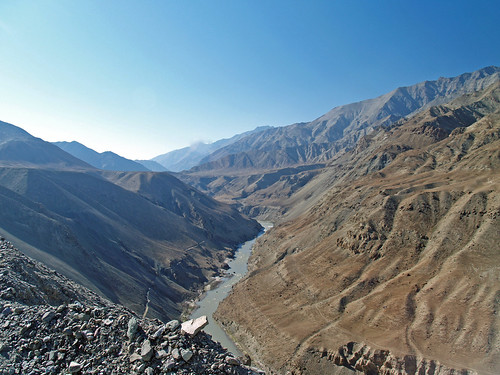
    A 1960 trans-boundary water sharing agreement between India and Pakistan has stood the test of two wars and various periods of unease. Climate change, however, may prove the toughest test of the Indus River deal, observers say. The two rival South Asian nations share the 190 billion cubic meters of Himalayan snowmelt that course through the Indus each year. The river originates from India’s Himalayan Hindu Kush mountains and flows through Jammu and Kashmir and then through Pakistan to reach the Arabian Sea. But experts say that climate change could alter the timing and rate of snow melt, with an initial increase in annual runoff followed eventually by a steep decrease that will severely curb river flows. That could provoke conflict between the two nations, particularly as India develops dams along the upper riches of the Indus, raising questions in Pakistan over whether falling water availability is due to climate change or to India’s reservoirs.

    Manipadma Jena is a Reuters AlertNet correspondent and freelance development journalist based in Bhubaneswar, India

    Source: Reuters AlertNet

    Image source: stevehicks

    Read more »

  • Sustainable Security

  • Marginalisation of the majority world

    Marginalisation of the majority world

    A complex interplay of discrimination, global poverty, inequality and deepening socio-economic divisions, together make for key elements of global insecurity. While overall global wealth has increased, the benefits of this economic growth have not been equally shared. The rich-poor divide is actually growing, with a very heavy concentration of growth in relatively few parts of the world, and poverty getting much worse in many other regions. The ‘majority world’ of Asia, Africa and Latin America feel the strongest effects of marginalisation as a result of global elites, concentrated in North America and Europe, striving to maintain political, cultural, economic and military global dominance.

    Kenyan Somali Islamist Radicalisation

    Africa Briefing N°85 | International Crisis Group | January 2012

    Issue:Marginalisation

    International Crisis Group has released a briefing paper illustrating the Islamist radicalisation of ethnic Somalis in Kenya, and the causes behind the trend. Decades of economic marginalisation of the Somali-dominated North Eastern Province border region has combined with government and public suspicion of ethnic Somalis to produce an unpleasant climate where either Somali loyalty is questioned, or Somalis are accused of ‘taking over’ when they move into the cities or succeed in business and politics. On the other hand, this has been compounded by the shift of East African Muslims in general away from Sufism and towards the conservative strand of Wahhabi Islam that posits the Muslim umma against the secular state, thereby enabling Somalia-based Al-Shabaab to capitalise on grievances in Kenya and encourage oppositional and even irredentist tendencies. The response of the government has overwhelmingly been one of force.

    Article Source: International Crisis Group

    Image Source: tik_tok

    Read more »

    WEF examines the Risks of Global Marginalisation

    World Economic Forum | Global Risks 2012 | January 2012

    Issue:Marginalisation

    A new report from the World Economic Forum highlights the increasing importance of marginalisation as a security issue over the coming decades. The seventh edition of the WEF’s Global Risks report describes what they see as the ‘seeds of dystopia’ threatening both social and political stability across the world.

    Image source: ectopic (ibandera). 

    Read more »

    Stories of harassment, violence and discrimination: migrant experiences between India, Nepal and Bangladesh

    Fiona Samuels, Sanju Wagle, Tahmina Sultana, Mirza Manbira Sultana, Navneet Kaur and Shantamay Chatterjee | Overseas Development Institute | January 2012

    Issue:Marginalisation

    A recently published Project Briefing from the Overseas Development Institute reports on the findings of a study examining the experience of Nepalese and Bangladeshi migrants in India. This vulnerable group of people face marginalisation on many different levels, having been compelled to emigrate in the first place because of economic hardship; and facing job-, wage-, and housing-insecurity on arrival because of their ambiguous legal status. Fear of disclosure or of being identified by their accents prevents migrants not only from taking a stand against exploitation, but also from forming networks within the host communities, thereby compounding the other forms of insecurity. In addition, migrants are often marginalised on their return home: “There is a common belief that women who Migrate to india engage voluntarily in commercial sex work once there,” while husbands left behind suffer from the stigma surrounding their wives’ supposed profession. The briefing concludes with recommendations for mitigating insecurity experienced by this group, who would otherwise be at permanent risk of violence and exploitation.

    To read the full briefing, click here

    Image Source: FriskoDude

    Read more »

    Land, livelihoods and identities: Inter-community conflicts in East Africa

    Laura A. Young and Korir Sing’Oei | Minority Rights Group International | December 2011

    Issues:Competition over resources, Marginalisation

    In a report published in December 2011, Minority Rights Group International highlights the problems facing minority groups, specifically in an area covering Kenya, Uganda and Jonglei State in South Sudan. Competition over resources has increased the potential for confrontation not only with local dominant ethnic groups, but also with the state and international corporations, thereby increasing the liklihood of different forms of conflict on different levels. Progressive legal protections are often not enforced because of a disconnect at state-level between legislation and law-enforcement, which only exacerbates existing problems caused by long-standing discrimination. Moreover, conflict involving already marginalised people adversely affects the women and children in these groups in particular, which in turn re-impacts on the community because of the traditional roles that women play in family cohesion and as food producers.

    Many problems arise not simply because people belonging to minority groups are themselves marginalised, but also their community and governance structures which previously had been successful in mediating conflict such as (in an East African context) cattle raiding. Marginalisation not only discriminates against individuals because of their backgrounds or beliefs but also rides roughshod over communal organisation and mediation, leaving groups unable to adapt to change or protect their interests when threatened by more powerful entities.

    To read the full report and press release, click here

    Image Source: Leonie_x

    Read more »

    Inequality: What’s the policy narrative?

    Andy Sumner | Global Dashboard | December 2011

    Issue:Marginalisation

    The following article from Global Dashboard takes on the issue of ‘inequality’ by attempting to address what exactly is understood by the term, why it is so bad for society, and what can be done about it. While many reports focus on the damage done to economic growth by inequality, or the sheer moral wrong in the existence of extreme poverty, this piece also refers to the security implications of high inequality when combined with other potential social faultlines such as ethnicity. However, the closing list of policy recommendations, tested with success in many Latin American countries, shows that this threat can be alleviated if met with determined cross-societal political will.

    Article Source: Global Dashboard
    Image Source: Hans Zinsli

    Read more »

    Boko Haram: Nigeria’s growing new headache

    Strategic Comments | International Institute for Strategic Studies | November 2011

    Issue:Marginalisation

    The International Institute for Strategic Studies  has published an article in Strategic Comments that focuses on the threat posed to Nigerian security by the Boko Haram Islamist group.  By placing Boko Haram in a religious context, both historical and geographical, the author examines its recent emergence as an ideological player in Nigerian society.  However, while articulating its vision through an Islamist framework, the group is largely focused on local issues of economic and religious marginalisation in the north, where 75% of the population live in poverty, compared with 27% in the south. The article also touches on conflict in the Niger Delta over control of resources, in a wider reference to the troubles facing the government in Abuja.

    Article Source: International Institute for Strategic Studies

    Image Source: pjotter05


    Read more »

  • Sustainable Security

  • Sustainable Security

    Carefully Managing Water Resources to Build Sustainable Peace

    Carefully planned interventions in the water sector can be an integral part to all stages of a successful post-conflict process, from the end of conflict, through recovery and rebuilding, to […]

    Read Article →

    In Deep Water: China tests its neighbours’ patience

    Control of water, including navigation rights, resource extraction and the exploitation of shared watercourses is at the heart of today’s geopolitical tensions in Asia. China’s recent actions in the South China Sea and Himalayas have given rise to further—and at times violent—conflict over the region’s natural resources. So will water insecurity lead to greater partnership in Asia? Or will it lead to a revival of China’s traditional sense of regional dominance and undercut efforts to build a rules-based approach to growing resource conflicts?

    Read Article →

  • Sustainable Security

    The Somali fishermen’s registration programme was lauched to help Somalia’s fisheries management and to secure its waters against piracy. Though commendable, the programme has yielded serious problems.

    Following the end of the civil war, the fisheries sector re-emerged as an important economic activity in Somalia, evidenced by the increase in the number of artisanal fishermen operating in the Puntland, Galmudug, and Somaliland regions. The exact number of these fishermen is unknown since neither the respective Ministries of Fisheries nor the District Fishing Associations register Somalis who fish. The lack of information on the number of fishermen, fishing fleet, services, the state of marine resources, and landings reduces the ability of decision makers to make informed decisions regarding the establishment of a robust fisheries management structure in Somalia.

    In support of the various Ministries, the United Nations Food & Agriculture Organization (FAO) is involved in projects to improve the understanding of Somalia’s fisheries sector. One of these activities is the development of a biometrics-based, artisanal fishermen -specific, registration system (Biometric Information Technology System or BITS) for the Ministry of Fisheries and Marine Resources in Puntland, Galmudug, and Somaliland.

    The data collected using BITS is expected to help formulate a more nuanced understanding of fishermen livelihoods in Somalia—which is necessary for effective fisheries management at the regional and national levels. The information can also prove useful for the government and international naval forces in the attempt to secure Somali waters against piracy and enable legitimate fishermen to operate more freely at sea.

    Piracy and Somalia

    Somali piracy and illegal, unreported, and underreported (IUU) fishing are two issues that have long been entangled in rhetoric and practice. According to the grand narrative of Somali piracy, without a government to police the coastline or prosecute offenders, Somali waters and resources were vulnerable to foreign illegal fishers. In order to protect their livelihoods, Somali fishermen took up arms against the illegal fishers as a form of retribution and/or taxation for plundering their fish and natural resources (see also Hansen, 2011; Bueger, 2013; Gilmer 2016).

    More than a decade after the perceived beginnings of Somali piracy, the grand narrative is still invoked by pirates and members of the Somali public. As artisanal fishermen, pirates, and foreign illegal fishers continue to operate within the same vast maritime spaces, inevitably, accusations of mistaken arrests began to emerge. Coastal communities claimed their fishermen were being picked up by foreign navies. Piracy prisoners held in foreign prisons maintained they were innocent fishermen who were mistaken as pirates. These stories not only raised questions of possible injustices, but they also spotlighted the issue that other than the members of Somalia’s coastal communities and local fishing organizations, no one could say for certain (or prove) who was or was not a pirate/fishermen/illegal fisher.

    Establishing a system for identifying Somalia’s maritime community, and sharing that information with international naval forces, was imagined as a starting point for more objective monitoring of Somalia’s waters (i.e., protecting against further potential injustices).

    The Somalia fishermen’s registration programme

    From 2013 to 2015, FAO utilized the BITS while conducting the Somalia fishermen’s registration programme (hereinafter referred to as the registration programme). The program is/was funded by the Trust Fund to Support the Initiatives of States to Counter Piracy off the Coast of Somalia of The Contact Group on Piracy off the Coast of Somalia (CGPCS). Collectively, the registration program consisted of three Trust Fund to Support Initiatives of States to Counter Piracy off the Coast of Somalia projects: Project #55 Fishermen Identification Database System; Project #69 Galmudug and Jubbaland Fishermen Fleet Registration; Project #70 “Somaliland” Fishermen and Fleet Registration.

    Via field officers, the Ministries collected basic information about more than 5,000 fishermen from all associations within Puntland, Galmudug, and Somaliland during face-to-face structured interviews. This data was entered into a database held by the Ministries. In 2016, a data analysis workshop was conducted in Bossaso, Somalia to “ground truth” the collected data and to discuss the overall successes and challenges of the registration program. Discussions revealed how the registration program became part of a broader struggle over the power to (re)construct the identities of people, labor niches, and maritime spaces of Somalia.

    The registration programme helped shift the site for identifying legitimate fishermen from at sea to onshore in Somalia at the various fishing landing sites where the registration exercises took place. Consequently, landing sites became the new key political sites in the struggle to define and identify legitimate fishermen. More specifically, the process of submitting/entering an individual’s data into the BITS was overseen by the heads of the local fishing associations.

    By discouraging the field officers from registering the data of pastoralists and pirates, the heads of the local fishing associations helped create a new group of maritime “others”. These “others” are considered potential criminals (i.e., pirates or illegal fishers) nand will not be afforded the same freedoms of mobilities at sea as legitimate fishermen. Indeed, by not having their data registered, these individuals were also rendered ineligible for future development programming geared towards registered fishermen.

    The data linked to those labeled legitimate fishermen is used to design future fisheries sector development programming. Those labeled legitimate fishermen become a target group for future FAO- or other agency-facilitated fisheries development projects. Maritime others, however, are left out of this development target group. As a result, the heads of the local fishing associations not only reshaped future development to exclude pirates (former or current) and pastoralists, but they may also have contributed to a future increase in piracy activity by pushing certain maritime “others” back out to sea without the occupational legitimacy/protections provided by a fishermen identification card (See Gilmer, 2017).

    Because who they are and what they are doing in maritime space remains an unknown, they must remain under the watchful eye of law enforcement. Although some individuals do, indeed, return to the sea with the intent to commit crimes, most do not. Thus, this reveals the paradox that the programme that set out to simultaneously develop and decriminalize Somali fishermen has only effectively displaced the criminalization onto a more specific maritime population of Somalis.

    Beyond the politics of submitting/entering data, the process of distributing fishermen identification cards also played an important role in reshaping future geographies of development and mobilizing certain bodies. In Puntland, government officials utilized the distribution of fishermen identification cards as leverage to bargain with FAO representatives for future planning meetings in Somalia. By securing these future planning meetings, Puntland officials were also able to secure future patronage in exchange for all-expenses-paid trips for the heads of the local fishing associations.

    The future planning meetings were also relocated from the coastline to the inland city of Garowe to maximize the FAO-provided daily service allowance each attendee (i.e., head of the local fishing association) would receive. However, moving the meetings away from the coastline greatly diminishes the likelihood that fishermen will be able to participate in any of the meetings. Thus, the fishermen and their respective communities remain on the margins of development planning for Somalia’s fisheries sector.

    Conclusion

    The Somali fishermen registration programme is commendable in that it is the first cross-regional attempt to collect data on Somalia’s artisanal fishermen and fishing livelihoods since prior to the Somalia civil war. FAO will continue to support the Ministries but the expectation at this point is that the Ministries continue to register fishermen and collect basic information. Furthermore, FAO in partnership with the Ministries, will roll out additional information systems, such as the landing site and sale system, and vessel registration system.

    These initiatives will add to the information gained from the Somalia fishermen’s registration program and continue to develop the knowledge of the fishing sector in Puntland, Galmudug, and Somaliland. However, it is also imperative to analyze the processes involved in these data collection projects to understand the politics of identity as they play out at various sites. These politics and local struggles play a key role in shaping the institutionalization of Somalia’s maritime identities and broader access to future fisheries development aid.

    Brittany Gilmer is an assistant professor in the Department of Criminal Justice at Florida International University

  • Marginalisation of the majority world

    Marginalisation of the majority world

    A complex interplay of discrimination, global poverty, inequality and deepening socio-economic divisions, together make for key elements of global insecurity. While overall global wealth has increased, the benefits of this economic growth have not been equally shared. The rich-poor divide is actually growing, with a very heavy concentration of growth in relatively few parts of the world, and poverty getting much worse in many other regions. The ‘majority world’ of Asia, Africa and Latin America feel the strongest effects of marginalisation as a result of global elites, concentrated in North America and Europe, striving to maintain political, cultural, economic and military global dominance.

    A New Strategy for the US: From the Control Paradigm to Sustainable Security

    Schuyler Null | The New Security Beat | May 2011

    Issues:Climate change, Competition over resources, Global militarisation, Marginalisation

    Writing for the New Security Beat, Schuyler Null discusses a recent event on creating a new national security narrative for the US held at the Woodrow Wilson Center. The event was based on a white paper by two active military officers writing under the pseudonym “Mr. Y” (echoing George Kennan’s famous “X” article). In “A National Strategic Narrative,” Captain Wayne Porter (USN) and Colonel Mark Mykleby (USMC) argue that the United States needs to move away from an outmoded 20th century model of containment, deterrence, and control towards a “strategy of sustainability.”

    Image source: LizaP.

    Read more »

    Sustainable Security and Environmental Limits

    Rachel Tansey | Quaker Council for European Affairs | May 2011

    Issues:Climate change, Competition over resources, Global militarisation, Marginalisation

    The Quaker Council for European Affairs publicises a briefing on the topic of Sustainable Security, specifically highlighting environmental concerns:

    “The treatment of the natural world by humankind has contributed towards the two related major trends that are likely to drive insecurity in the coming decades: climate change and competition over natural resources.”

    Article source: Quaker Council for European Affairs

    Image source: kretyen

    Read more »

    Human Security and Marginalisation: A case of Pastoralists in the Mandera triangle

    Abdul Ebrahim Haro | Exclusively written for sustainablesecurity.org | May 2011

    Issues:Competition over resources, Marginalisation

    This paper seeks to bring out the relevance of human security in pastoral areas of Mandera triangle and the relationships and contradictions that exist between it and national security. The “Mandera Triangle” encompasses a tri-border region of Ethiopia, Somalia, and Kenya that exemplifies, in a microcosm, both a complex and a chronic humanitarian crisis that transcends national boundaries. The resident Somali pastoral population is highly vulnerable to periodic droughts and floods; high levels of poverty; long-term disruption to the traditional systems of livelihood; ongoing inter-clan conflicts and border tensions between states. 

    Image source: TURKAIRO

    Read more »

    The economic relationship of armed groups with displaced populations

    Josep Maria Royo Aspa | Forced Migration Review | March 2011

    Issues:Global militarisation, Marginalisation

    Practically all armed groups are heavily dependent on external support. Armed groups primarily seek support from both other states and from the diasporas, displaced populations and other armed groups, in order to prevent the burden of  the war effort from falling entirely on the civil population they claim to protect, a situation that has its own political costs. States too need external support to deal with outbreaks of instability and violence; during the Cold War this was normal and it still continues today in most current armed conflicts.

    Image source: Gustavo Montes de Oca

    Article source: Forced Migration Review

    Read more »

    NGOs Call for Immediate and Full Reporting of Every Casualty in Libya

    NGO coalition | Oxford Research Group | April 2011

    Issues:Global militarisation, Marginalisation

    As rebel forces reportedly claim that 10,000 deaths have occurred and up to 55,000 have been injured since the start of the conflict in Libya, a group of NGOs have sent a call to those intervening in Libya to commit to properly monitoring and recording every casualty in the conflict.

    This call is made in the belief that the accurate recording and reporting of all casualties will benefit accountability, any assessment of the international intervention, and humanitarian programming.

    Article source: Oxford Research Group

    Image source: Defence Images

    Read more »

    How the Competing Security Needs of Caribbean Community Members have Crystallized Through Multilateralism and Consensual Decision-Making

    Serena Joseph-Harris | Exclusively written for sustainablesecurity.org | April 2011

    Issues:Competition over resources, Global militarisation, Marginalisation

    In a paper exclusively written for sustainablesecurity.org, Serena Joseph-Harris (former High Commissioner for Trinidad and Tobago) focuses on competition over natural resources, the role of maritime routes in the Caribbean, and the importance of multilateral approaches to finding sustainable solutions in the Caribbean.

    Image source: Len@Loblolly

    Read more »