Blog

  • A Sharper Edge: QME, the Iran Deal and the Gulf Arms Race

    In order to persuade its allies in Israel and Gulf Arab states to support the Iran nuclear deal, the United States is relying on inducements of weaponry sales; this regional militarisation is further destabilising the wider Middle East region.

    The July 2015 international deal on regulating Iran’s nuclear programme, the Joint Comprehensive Plan of Action (JCPOA), looks to be a triumph for international diplomacy in a region that all too often sees diplomacy lose out to military force. However, in order to persuade its allies in Israel, Saudi Arabia and other Gulf Arab states to support the deal, the United States is offering ‘consolation packages’ of ever-higher quantities and qualities of weaponry.  This regional militarisation is further destabilising the wider Middle East region by fuelling an arms race and by increasing the attractiveness of hybrid or proxy warfare.

    16908600218_5cf4667ed9_k

    A Saudi Air Force F-15. Image via Flickr

    Arms Sales to Gulf Arab States

    The six Arab monarchies that comprise the Gulf Cooperation Council (GCC: Bahrain, Kuwait, Oman, Qatar, Saudi Arabia, UAE) are enthusiastic consumers of weaponry, which they overwhelmingly procure from the US, UK and France. Saudi Arabia is by far the largest military spender and arms importer among them. According to the Stockholm International Peace Research Institute (SIPRI), the Kingdom’s record military expenditure of over $80 billion in 2014 made it the fourth highest military spender in the world, overtaking the UK and France. It is now the world’s second largest arms importer. The other GCC states are also major spenders: Oman is probably the world’s highest military spender by percentage of GDP, averaging 12% between 2010 and 2014; last year the United Arab Emirates’ military expenditure reached $23 billion and it has been the world’s fourth largest arms importer for a decade. Together, the GCC states account for about 12% of global arms imports. Only India imports more weapons.

    The Gulf States enjoy a close commercial and strategic relationship with the United States, which is manifested in the huge sums spent on US weaponry, and the fact that the US military overtly uses land, air and naval bases in at least five of the six Gulf Arab states; its ongoing presence in Saudi Arabia is much lower key. Despite this, there are limitations on the quality and quantity of weaponry that the US can sell to GCC states. This is because of the US’ ongoing commitment to maintain Israel’s ‘qualitative military edge’ (QME) over its regional adversaries.

    A term coined by Israel’s founding leader David Ben-Gurion in 1953, QME was formally written into US law by Congress in 2008. Legislation now states that the US President must carry out an ongoing ‘empirical and qualitative assessment’ of Israel’s QME over military threats to Israel, and this must be brought into consideration when assessing applications to provide military hardware or services to other countries in the Middle East. As the GCC states could in the future become adversaries to Israel, whose statehood none currently recognize and which Saudi Arabia and Kuwait opposed in the 1967 and 1973 wars, this has long restricted sales of the highest technology weapons, surveillance and targeting systems to Gulf Arab states.

    QME and anti-Iran Alignments

    Recent regional events, and the JCPOA in particular, have seen Israel and the Gulf States find themselves increasingly aligned against Iran. The Israeli leadership has been consistently critical of the deal while the Gulf States were hesitant to support it because of their fears that an economically, militarily and diplomatically resurgent Iran would dominate the Middle East region and potentially vie with them to become the US’ chief regional ally.

    Relations between Israel and the Gulf have long been shrouded in secrecy, although that does not mean they have not existed. From 1950 until Israel’s invasion of Lebanon in 1982, for instance, there was periodic Israeli involvement in the operation of the ‘Trans-Arabia Pipeline’ (Tapline), and throughout the 1990s Israel and various GCC states began to set up trade offices; various Gulf States have, at different times and to varying extents, had a hand in the Arab-Israeli peace process. In the last few years, Israel and the Gulf States have increasingly found their regional interests aligning; this came to the fore during the 2011 Arab uprisings when they argued that American policy was exacerbating regional instability.

    The coincidence of interests between Israel and the GCC was referenced by Israeli Prime Minister Binyamin Netanyahu in September; in a speech to the UN General Assembly he spent much of his time denigrating the Iran deal, but he also mentioned the ‘common dangers’ faced by Israel and Arab states, and his hope that they could build ‘lasting partnerships’ to counter such dangers. There has predictably been no discussion of any official agreement between Israel and any Gulf State, but rumours of potential partnerships have been germinating: one suggested that Bahrain, an island in the Persian Gulf, was looking to buy Iron Dome anti-missile defence systems from Israel; these reports were hotly denied by Bahraini officials.

    GCC Support for the Iran Deal

    Despite stiff and vocal opposition from the Republican majority in the Senate, Obama has recently signed waivers that would conditionally allow the lifting of US sanctions subject to Iran fulfilling its JCPOA obligations. An altogether different challenge for Obama was placating America’s allies in the Gulf.

    Although Obama was not reliant on the Gulf Arab States to approve the Iran deal, it was sufficiently controversial to dent relations between them and the United States. This was demonstrated in May of this year when Obama invited GCC leaders to Camp David, where he attempted to persuade them personally of the merits of the deal: new Saudi monarch King Salman pulled out of attending at the last minute. Those that remained were hoping for a formal security treaty that would bind the US to support the GCC militarily in the case of an attack, but the Obama administration eventually won their support with promises of ‘support and capacity-building’, which essentially boiled down to bigger, faster arms deals.

    King Salman has played a tough game with the Obama administration. After his no-show in May, the Saudis reminded the US that they do not rely exclusively on the American arms market when in June they conducted extensive talks with France, discussing the potential purchase of French civil nuclear technology and further arms deals, the immediate outcome of which was the French sale of $500 million worth of helicopters. Qatar and Egypt (likely financed by GCC patrons) have also made multi-billion dollar arms deals with France this year; as has Kuwait with Italy. There was also much talk of Saudi interest in Russian equipment during August.

    Salman eventually reconciled with the Obama administration during a lavish state visit to Washington in September. Before talks between the two heads of state, Obama administration officials confirmed that Israel would be the only regional recipient of the forthcoming F-35 stealth fighter; they can thus claim to be considering Israel’s QME. However, officials also said that Obama would discuss ‘a range of other options meant to bolster Saudi defences’. Salman ultimately professed to come away reassured that the Iran deal would ‘contribute to security and stability in the region’. His price for this statement was a reassurance from Obama that US weapons technology and systems would be fast-tracked to Saudi Arabia, and a free hand to use such weapons in the Saudi-led war in Yemen.

    Arms Sales and Geopolitics

    Obama’s solution to winning support for the Iran deal from the Gulf Arab States is inherently flawed. While Gulf Arab leaders, having been promised these deals, professed their conviction that the deal would lead to regional stability, the promise of further military hardware was nevertheless purported to be intended to help states repel potential attacks from Iran. Although the narrative of the Israeli and American right is that Iran wants nuclear weapons to destroy Israel, an alternative explanation is that it is the huge qualitative and quantitative superiority in conventional weapons by US-allied Sunni Arab states that has driven Iran’s desire to develop nuclear weapons capabilities.

    While the Iran nuclear deal may decrease the likelihood of a preemptive attack on Iran by either its Gulf Arab rivals or Israel, the escalating wars in Yemen and Syria indicate that Saudi Arabia and other conservative Arab monarchies (Morocco and Jordan have joined GCC allies in both interventions) are increasingly willing to employ a more interventionist approach in the region, both directly and via proxies, wherever they see the expansion of Iranian interests. This is facilitated by US weaponry, intelligence and diplomatic support.

    The war in Yemen has already had catastrophic humanitarian consequences, with at least 2,615 civilians killed and about 1.5 million people displaced. Reports suggest that larger quantities of US military hardware could be making their way to Syria after a 24 October meeting between US Secretary of State John Kerry and Saudi officials, including King Salman, to discuss greater support for ‘moderate’ Syrian rebels in response to Russian air strikes. The White House has claimed that Russia would not succeed in achieving a military solution to the conflict, but the United States is equally unlikely to enforce a military solution.

    The JCPOA is a diplomatic breakthrough that will likely be far more successful in reducing Iran’s capacity to develop nuclear weapons than air or missile strikes. However, while Iran can no longer look to the nuclear option to give it a military advantage, or parity, it may consider other options. The strategic alignment of Israel and the Gulf States means that Obama has greater leverage to use arms deals to maintain the support of his Gulf allies, but a result of these deals is that a huge amount of conventional weaponry is being poured into the Gulf and from there to regional conflicts.

    Many of these conflicts involve Iranian proxies, and Iran may compensate for its lack of either nuclear or conventional leverage by increasing military support for these proxies, including those in Syria and Yemen. The United States’ method of securing regional support for the JCPOA thus adds fuel to the fire of regional conflicts and humanitarian crises, and makes diplomatic outcomes, whether in Syria or Yemen, ever more distant.

    Finbar Anderson is Communications Intern with Oxford Research Group.  Having lived and studied in Egypt, he has recently completed a Master’s degree in History of International Relations, focusing on the politics of the Middle East, at the London School of Economics. 

  • Privatising the War on Drugs: PMSCs in Colombia and Mexico

    Privatising the War on Drugs: PMSCs in Colombia and Mexico

    US drug policy has become increasingly privatised in recent years as the US government contracts private military and security companies (PMSCs) to provide intelligence, logistical support and training to state security forces in drug-producing and –transit states. As the cases of Colombia and Mexico illustrate, this privatisation strategy is having a damaging impact on these already fragile environments.


    Read Article →

    Colombia and Mexico: The Wrong Lessons from the War on Drugs

    As activists around the world participate in a Global Day of Action against criminalisation of drug use, evidence from the multi-billion dollar War on Drugs in Colombia suggests that militarized suppression of production and supply has displaced millions of people as well as the problem, not least to Mexico. The wrong lessons are being exported to Central America and beyond, but a groundswell of expert and popular opinion internationally is calling for alternative approaches to regulating the use and trade in drugs.

    Read Article →

    Exporting (in)Security? Questioning Colombian Military Engagement in West Africa

    With skills and expertise in fighting insurgencies and drug trafficking networks, Colombia’s armed forces are increasingly being sought for engagement in similar security challenges in West Africa. But increasing Colombian engagement gives rise to a number of important questions – not least of which is the goal and expected outcomes of replicating militarised approaches to the war on drugs that have already failed in Latin America.

    Read Article →

    Conflict, Poverty and Marginalisation: The case of Curvaradó and Jiguamiandó (Urabá, Colombia)

    In Colombia there are many regions where poverty and the absence, or weak presence, of the state has facilitated the emergence of violence by armed groups. Among these are the Afro-Colombian communities of the Curvaradó and Jiguamiandó in the Urabá region. Whilst the Colombian government fails to fully develop social development programs (including education, health and infrastructure) and sustainable economic development policies to assist marginalised communities, the people of Curvaradó and Jiguamiandó will remain poor, uneducated, vulnerable, and at risk of lose their territories once again.

    Read Article →

  • Inspirations for Post-liberal Peacebuilding from Latin America

  • The Case for Community-Led Counterterrorism

    Drone-tocracy? Mapping the proliferation of unmanned systems

    While the US and its allies have had a monopoly on drone technology until recently, the uptake of military and civilian drones by a much wider range of state and non-state actors shows that this playing field is quickly levelling. Current international agreements on arms control and use lack efficacy in responding to the legal, ethical, strategic and political problems with military drone proliferation. The huge expansion of this technology must push the international community to adopt strong norms on the use of drones on the battlefield.

    Read Article →

    VIDEO – Militarisation of the Sahel: An interview with Richard Reeve

    Sustainable Security programme Director Richard Reeve discusses our latest report ‘From New Frontier to New Normal: Counter-terrorism operations in the Sahel-Sahara’. The report, commissioned by the Remote Control project, finds that 2014 is a critical year for militarisation of the Sahel-Sahara and the entrenchment of foreign powers there.

    Read Article →

  • The Case for Community-Led Counterterrorism

    Drone-tocracy? Mapping the proliferation of unmanned systems

    While the US and its allies have had a monopoly on drone technology until recently, the uptake of military and civilian drones by a much wider range of state and non-state actors shows that this playing field is quickly levelling. Current international agreements on arms control and use lack efficacy in responding to the legal, ethical, strategic and political problems with military drone proliferation. The huge expansion of this technology must push the international community to adopt strong norms on the use of drones on the battlefield.

    Read Article →

    VIDEO – Militarisation of the Sahel: An interview with Richard Reeve

    Sustainable Security programme Director Richard Reeve discusses our latest report ‘From New Frontier to New Normal: Counter-terrorism operations in the Sahel-Sahara’. The report, commissioned by the Remote Control project, finds that 2014 is a critical year for militarisation of the Sahel-Sahara and the entrenchment of foreign powers there.

    Read Article →

  • The Syrian War and the Foreign Fighters from the Muslim World

  • The Syrian War and the Foreign Fighters from the Muslim World

  • El Salvador’s gang truce: a lost opportunity?

    Belize: challenges and contradictions in gang policy

    Like its neighbours in the northern triangle (El Salvador, Honduras and Guatemala), Belize has a high murder rate that is closely connected to the strong presence of gangs. But the character of gang activity in Belize is quite different from its Central American neighbours. Belize has pioneered some innovative solutions to the problem it is facing. But it will need to overcome the challenges of internal resistance and an acute lack of resources in order to address the political, economic and social issues that marginalise Belize’s large youth population.

    Read Article →

    Colombia and Mexico: The Wrong Lessons from the War on Drugs

    As activists around the world participate in a Global Day of Action against criminalisation of drug use, evidence from the multi-billion dollar War on Drugs in Colombia suggests that militarized suppression of production and supply has displaced millions of people as well as the problem, not least to Mexico. The wrong lessons are being exported to Central America and beyond, but a groundswell of expert and popular opinion internationally is calling for alternative approaches to regulating the use and trade in drugs.

    Read Article →

    Mexico’s Conflicting Migration Policy Goals: National Security and Human Rights

    Mexico has rapidly become a major site of transmigration from Central America to the United States, as people move in search of employment opportunities or escape from social violence. This rise in migrant flows from Mexico’s southern border overlaps with problems of control of contraband, organised crime, and the trafficking of drugs and arms. However, the government’s militarised approach to the phenomenon means that the use of force and human rights violations go unresolved and military approaches to preserving public order go unchecked. As long as migration remains a security issue, instead of a developmental and human rights matter, it will not be tackled appropriately. Instead, the government must start to view the matter through a citizen, not national, security lens.

    Read Article →

    Exporting (in)Security? Questioning Colombian Military Engagement in West Africa

    With skills and expertise in fighting insurgencies and drug trafficking networks, Colombia’s armed forces are increasingly being sought for engagement in similar security challenges in West Africa. But increasing Colombian engagement gives rise to a number of important questions – not least of which is the goal and expected outcomes of replicating militarised approaches to the war on drugs that have already failed in Latin America.

    Read Article →

    Militarised Public Security in Latin America in Venezuela

    Across Latin America, governments are sending their militaries into the streets to act as de facto police forces in the face of disproportionally high crime and violence rates. This trend has been going on for several years, but has accelerated in 2013. With the move to deploy over 40,000 troops for citizen security in Venezuela, President Nicolás Maduro joined a growing list of leaders throughout the region that have relied on their militaries to carry out police duties. In the first of our two-part discussion ‘Countering Militarisation of Public Security in Latin America’, Sarah Kinosian discusses the conditions that are causing the trend to thrive.

    Read Article →

    Countering Militarised Public Security in Latin America: Lessons from Nicaragua

    Facing a myriad of public security challenges that have provoked some of the highest indices of crime and violence in the world, authorities in Central America have followed a variety of different responses, ranging from repressive and reactive policies to grass roots prevention. Of these approaches, the Nicaraguan National Police’s Proactive Community Policing model stands out due to the results it has achieved. In the second of our two-part discussion, ‘Countering Militarisation of Public Security in Latin America’, Matt Budd explores the lessons that Latin American countries can extract from Nicaragua’s unique approach to public security.

    Read Article →

  • Beyond Disarmament, Demobilization and Reintegration of Ex-combatants

  • Mexico’s Conflicting Migration Policy Goals: National Security and Human Rights

    Mexico has quickly become a major site of transmigration from Central America to the United States, as people move in search of employment opportunities or escape from social violence. This rise in migrant flows from Mexico’s southern border overlaps with problems of control of contraband, organised crime, and the trafficking of drugs and arms. However, the government’s militarised approach to the phenomenon means that the use of force and human rights violations go unresolved and military approaches to preserving public order go unchecked. As long as migration remains a security issue, instead of a developmental and human rights matter, it will not be tackled appropriately. Instead, the government must start to view the matter through a citizen, not national, security lens.

    Celaya - Mexico On the freight train that drive along the south states of Mexico towards north regions, every years thousands of central -american illegal migrants, travel on the wagon roofs. risking so their life for reach the United States border. Source: The Borderland Chronicles

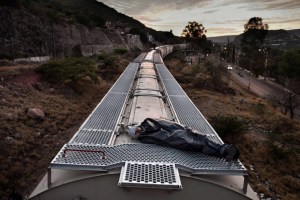
    Celaya – Mexico: On the freight trains that drive along the southern states of Mexico towards northern regions, every year thousands of central -american illegal migrants travel on the roofs of moving trains. Source: The Borderland Chronicles

    Mexico has rapidly developed into a major country of origin, destination, return and transit for migrants. The situation of undocumented transmigrants, most of them Central Americans headed for the United States in search of dignified job opportunities or fleeing social violence back home, has lately attracted particular attention. With limited resources and no permit to enter Mexico, they are required to cross the country clandestinely and vulnerable to abuse by criminal groups and corrupt state agents. The National Commission of Human Rights and civil society groups have for years been documenting the violence, exploitation and humiliations facing transmigrants, including robberies, sexual violence, torture, homicides, and especially kidnappings and extortion.

     Human rights on shaky grounds

    Coatzacoalcos, Veracruz, Mexico, 2011 A family from Honduras rest in a church in the outskirts of the city of Coatzacoalcos as they wait for the next train to pass by. Source: The Borderland Chronicles

    A family from Honduras rest in a church in the outskirts of the city of Coatzacoalcos, Mexico, as they wait for the next train to pass by. Source: The Borderland Chronicles

    One of the milestones for human rights in Mexico was set with the 2011 constitutional reform that granted constitutional status to all human rights enshrined in the international treaties to which Mexico is party. For migrants, however, the panorama has not brightened much. The massacre of 72 migrants that had occurred in San Fernando, in the northern state of Tamaulipas, in August 2010, provided the impetus for the adoption of a new Migration Law. Published in May 2011, it entered only tardily into force with the publication of its Regulations in September 2012.

    Initially, the legislation was hailed as an advance for migrant rights. Unlike the previously applicable General Population Law, it establishes that irregular entry into Mexico is not a crime. But its structural flaw is that while it demands the authorities respect the rights of all migrants, irrespective of their legal status, it also deems migration an issue of national security. The latter, according to the National Security Law, is to be understood as the actions designed to maintain the integrity, stability, and permanence of the Mexican state. In other words, the Migration Law maintains a criminalising approach towards undocumented migrants and effectively paves the way for racial and ethnic profiling in migration checks; corruption; and migrant detention as an instrument for the preservation of public order.

    Mexico’s migration policy, designed by the Secretariat of the Interior (SEGOB), has direct bearing on migration management, carried out by the National Migration Institute (INM). The latter has adhered to the perspective of national security since its 2005 designation as a national security agency. In practice this has meant that INM agents receive training in human rights as well as in national security and subjects related to interrogation and the use of force; abuse and humiliate undocumented migrants during control operations; and administer migrant detention centres that are prison-like installations with very limited access for civil society groups and journalists interested in documenting the human rights situation in these facilities.

    If anything, this stance has hardened with the current Commissioner, former police and intelligence official Ardelio Vargas, who was appointed in January 2013 and has vouched to implement the migration policy from a national security lens. For the authorities it is necessary to apply this perspective, because migration flows have diversified over time and now comprise not only persons seeking better job opportunities, but also individuals who smuggle migrants or collaborate with criminal gangs. Managing migration from a national security standpoint, therefore, allows Mexico to shield both its borders and honest migrants against unsavoury elements.

    Edging closer to national security?

    The 2012 presidential victory of Enrique Peña Nieto marked the return to power of the Institutional Revolutionary Party (PRI) that had ruled Mexico between 1929 and 2000 and left an indelible mark on state-society relations. Alarmingly, the current administration appears determined to defend the nexus between migration and national security. For the authorities this approach is warranted, because migration flows are unfolding in the context of organised crime, which found in undocumented migration a new criminal niche once the Felipe Calderón administration (2006-2012) had declared its war on drug trafficking. The fight against organised crime, however, has blended with migration control such that the social phenomenon of migration is now considered and tackled as a security threat, not as a human rights issue.

    The rhetorical intent to do so, at least, is expressed in the sectorial plans, planning instruments that contain the objectives and strategies that seek to strengthen government actions and respond to the needs and policies outlined in the National Development Plan, itself the blueprint that governs  the programme and budget formulation of the entire Federal Public Administration. The sectorial plans that are of particular interest for this discussion are those of the SEGOB and the Secretariat of National Defense (SEDENA).

    The SEGOB document adopts a multidimensional approach to national security that is meant to identify external and internal dynamics that might come to constitute risks and threats to the integrity and stability of the Mexican state. These dynamics are of a social, environmental, economic, political, technological, and demographic nature and include examples such as organised-crime-related violence, terrorism, migration, the trafficking of arms, persons and drugs, and the proliferation of weapons of mass destruction.

    For the SEGOB, the need to respond effectively to migration to and from Mexico requires the government to foster inter-institutional cooperation through a comprehensive migration policy (set out in the forthcoming Special Migration Programme 2014-2018), one that is able to take into account the multiple dimensions of migration, to leverage its development potential, and to minimise its costs. As the phrasing suggests, the country is prepared to welcome skilled migrants, but will deter undocumented ones. The plan acknowledges that Mexico faces the difficult task of balancing national sovereignty with migrant rights, yet it has little more to say on the subject than reiterating the need to transform the INM. The latter, it is worth pointing out, has been an oft-stated yet never accomplished ambition.

    The second text affirms that the SEDENA has an essential role to play in preserving internal security and strengthening democratic institutions. In view of the unprecedented insecurity associated with organised crime, which also found a criminal niche in migrant kidnappings, the Armed Forces responded to the civilian authorities’ call for assistance by maintaining nationwide deployments, particularly the country’s most sensitive areas.

    Of particular relevance is the plan’s commitment to boosting border security, given the vulnerability that arises especially at the southern border with multidimensional problems such as the control of contraband and migrant flows, organised crime, and the trafficking of drugs and arms. These dynamics, the SEDENA believes, require it to maintain a permanent of some 30,000 troops and to cooperate with the Armed Forces of Belize and Guatemala as well as with the Federal Police and the Attorney General’s Office in the country’s crucial zones. The SEDENA document, more than its SEGOB equivalent, suggests that far from making greater strides towards respecting migrant rights, Mexico will perpetuate the circle of exclusion, violence, and corruption. Rather than moving towards a human rights perspective, Mexico chooses to embrace wealthier, skilled migrants while closing its doors to poorer, untrained ones.

    The United States, Mexico, and Central America are partnering to promote border security, but these efforts not only fail to impede migration flows, but also expose migrants to greater danger and –given the ineffective fight against corruption–to continued abuse by state agents who know they can prey on migrants with impunity. At the same time, the creation of a militarised security corridor stretching from the Central American isthmus up to the United States can also be deployed to suppress social dissent against the expansion of infrastructure projects that primarily serve the interests of transnational enterprises or against mining projects that have a devastating impact on the environment and local communities’ access to water.

    Towards a citizen security framework

    In order for its migration policy and management to be more effective and humane, Mexico will need to undertake a host of changes, starting with the professionalisation, transparency, and accountability of the INM. However, irrespective of the extent to which this may be achieved, the treatment of migrants is unlikely to change as long as migration is linked to national security and Mexico acts as a filter for undocumented migration to the United States. Instead, the latter will need to be understood as a development and human rights issue. Above all, it will need to be approached from the perspective not of national security, but of citizen security.

    According to the Inter-American Commission on Human Rights, citizen security is the “social situation in which all persons are free to enjoy their fundamental rights and public institutions have sufficient capacity…to guarantee the exercise of those rights and respond effectively when they are violated.” This definition leaves no doubt that the central objective must be to protect the person, rather than the state. The application of a citizen security approach to migration would require the Mexican state not only to avoid military participation in internal security and migration control, but also to take seriously the professionalisation of the INM (including adequate recruitment and training, the creation of a human rights culture, decent remuneration, and an effective sanctions system) and to establish oversight mechanisms that will foster transparency and accountability.

    As long as the Mexican government remains unprepared to pursue a different migration policy, citizens will need to play a greater role in pressuring it to do so. Civil society groups have a relevant role to play in sensitising the population and creating the political will to prioritise the human rights and development aspects of migration over security.

    Sonja Wolf is a researcher at the Institute for Security and Democracy (INSYDE), Mexico City. She has acted as project coordinator and principal investigator of INSYDE’s Assessment Study of Mexico’s National Migration Institute (INM), the first comprehensive study to examine the INM’s institutional and migration management and the ways in which it facilitates corruption and migrant abuse.

    Featured image: Migrants traveling on the roof of a freight train near Ixtepec, Oaxaca. Source: CIP Americas