Blog

  • Climate refugees: Human insecurity in a warming world

  • Women and Combat: The Case of the British Military

  • Challenging UK Arms Sales to Saudi Arabia in the Courts

  • Is Trident Influencing UK Energy Policy? Part 2

    Momentum towards a nuclear weapons ban treaty: what does it mean for the UK?

    International momentum towards a treaty to ban nuclear weapons reached a milestone in the December 2014 Vienna conference. Even assuming that the UK does not initially sign up to such a treaty, it is subject to the pressures of a changing legal and political environment and could find its present position increasingly untenable – not least on the issue of Trident renewal.

    Read Article →

  • Is Trident Influencing UK Energy Policy? Part 2

    Momentum towards a nuclear weapons ban treaty: what does it mean for the UK?

    International momentum towards a treaty to ban nuclear weapons reached a milestone in the December 2014 Vienna conference. Even assuming that the UK does not initially sign up to such a treaty, it is subject to the pressures of a changing legal and political environment and could find its present position increasingly untenable – not least on the issue of Trident renewal.

    Read Article →

  • The Power of Sport for Youth in Conflict

    Action sports are increasing in popularity in the Middle East. For youth in conflict zones, these collaborative projects provide space for local voices and means of empowerment.

    In 2001, Kofi Annan founded the United Nations Office on Sport for Development and Peace (SDP), advocating sport as having ‘an almost unmatched role to play in promoting understanding, healing wounds, mobilising support for social causes, and breaking down barriers’. Since then, the SDP movement has continued to proliferate with groups and organizations using sport and physical activity to help improve the health and well-being of individuals and communities around the world.

    Of the 1000+ organizations currently working under the SDP umbrella, many are focused in sites of war and conflict with the aim of peace building, with growing interest in the potential of sports programmes as psycho-social interventions following natural disaster.

    SDP organizations such as Football 4 Peace, Right to Play, Hoops 4 Hope, Skateistan, and Peace Players International have been acclaimed as making valuable contributions to the quality of many individual’s lives in contexts of war, conflict, and poverty.
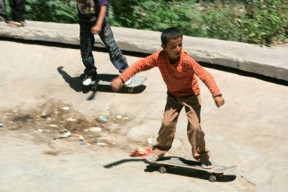
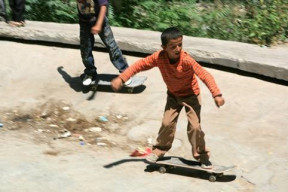
    Afghan boy on a skateboard. Image credit: Skateistan.

    Despite the best intentions, however, too many SDP programmes adopt a ‘deficit model’ that assumes poor youth in war-torn or disaster stricken contexts need ‘our’ western versions of sport for their empowerment. Sport sociologists Douglas Hartmann and Christina Kwauk, for example, are concerned that officials of sport-based intervention programmemes tend to “ignore the ways in which youth interpret and actively and creatively negotiate poverty and inequality as well as the ways in which their sport-based interventions actually commit symbolic acts of violence while reproducing conditions of marginalization”.

    Instead, they advocate a more critical alternative to youth development that pays attention to “local practices, local knowledge, the sociocultural and political-economic contexts as well as the needs and desires of communities themselves”.

    My research (funded by a three-year Marsden, Royal Society grant) has been a direct response to this call by focusing on the multiple and diverse ways youth are actively and creatively engaging with recreational, non-competitive sports in their responses to conditions of war, conflict and post-disaster. The case study of Gaza provides an interesting example of the grassroots approaches being developed by youth in contexts of conflict.

    Youth Engagement with Sport in Conflict Zones: The Case of Gaza
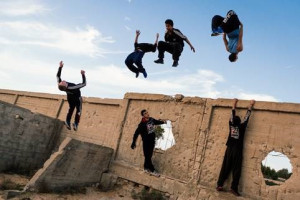
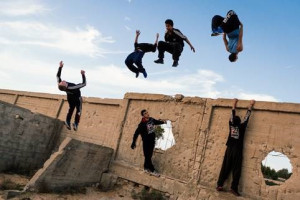
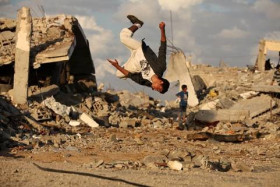
    Youths doing parkour in Gaza Strip. Image credit: PK Gaza.

    Parkour (also known as free running)—the act of running, jumping, leaping through an urban environment as fluidly, efficiently and creatively as possible—reached Gaza in 2005 (shortly after the withdrawal of the Israeli army and the dismantling of Israeli settlements), when unemployed recent university graduate Abdullah watched the documentary Jump London on the Al-Jazeera documentary channel in his over-crowded family home in the Khan Younis refugee camp. He promptly followed this up by searching the Internet for video clips of parkour, before recruiting Mohammed to join him in learning the new sport. Continuing to develop their skills, they soon found parkour to be so much more than a sport, “it is a life philosophy” that encourages each individual to “overcome barriers in their own way”.

    To avoid conflicts with family members, local residents and police, members of PK Gaza (the name chosen by the group) sought out unpopulated spaces where they could train without interruption. Popular training areas included cemeteries, the ruined houses from the Dhraha occupation, UNRWA (United Nations Relief and Works Agency) schools, and on the sandy hills in Nusseirat, formerly an Israeli settlement now deserted in the centre of Gaza City. The latter is particularly meaningful for the youth who proclaim that by practicing parkour in the space, “we demonstrate that this land is our right”.

    As part of the younger generation of technologically savvy Gazan residents, the founders of PK Gaza are explicitly aware of the potential of the Internet for their parkour practices, and for broader political purposes. “We started filming ourselves with mobile phones and putting the videos on YouTube”, explains Mohammed, and have continued to develop more advanced filming techniques using borrowed cameras and editing the footage on a cheap computer.
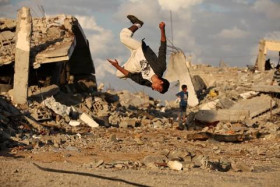
    Boy doing parkour in Gaza. Image credit: PK Gaza.

    The PK Gaza Freerunning Facebook page has thousands of followers from around the world, their Instagram account has almost 3000 followers, and the group also posts regular YouTube videos that can receive upwards of tens of thousands of views. Each of Facebook, Instagram and YouTube are key spaces for interaction and dialogue with youth beyond the confines of the Gaza strip. In so doing, “we contribute very significantly to raising international awareness of what is happening in Gaza. We offer video clips, photographs and writings related to the situation in which we live in the Gaza strip and deliver the message to all the people’s that’s watching online that there are oppressed people here”, proclaimed Mohammed.
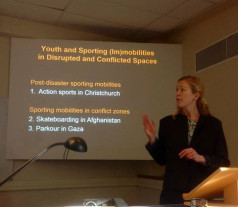
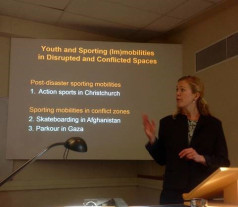
    Professor Holly Thorpe giving a presentation on research findings. Image credit: Holly Thorpe.

    As well as raising awareness of the conditions in Gaza and offering a temporary escape from the harsh realities of everyday life, the PK Gaza team strongly advocates the socio-psychological benefits of their everyday parkour experiences. They proclaim the value of parkour for their resilience and coping with the frustrations, fears, anxieties and pains of living in the Khan Younes refugee camp. As Abdullah explains, “I have witnessed war, invasion and killing. When I was a kid and I saw these things, blood and injuries, I didn’t know what it all meant … this game [parkour] makes me forget all these things”. As the following comments from Gazan psychologist, Eyad Al Sarraj (MD) suggest, some medical and health professionals also acknowledge the value of such activities for young men living in such a stressful environment:

    Many young people in Gaza are angry because they have very few opportunities and are locked in. An art and sports form such as free running gives them an important method to express their desire for freedom and allows them to overcome the barriers that society and politics have imposed on them. It literally sets them free”.

    Such observations are supported by a plethora of research that has illustrated the value of physical play and games for resilience in contexts of high risk and/or ongoing physical and psychological stress (e.g. refugee camps), and the restorative value for children and youth who have experienced traumatic events (e.g. natural disaster, war, forced migration).

    Conclusion

    To conclude, a key finding from my research to date is the need to move away from the ‘deficit model’ that assumes poor youth in developing or war-torn contexts are victims needing ‘our’ versions of sport for their empowerment. If the SDP community can begin with a recognition of the agency, creativity and needs of local youths, then we can better work with them to achieve their self-defined goals in contexts of conflict.

    Dr Holly Thorpe is Associate Professor in the Faculty of Health, Sport and Human Performance at the University of Waikato. As a sociologist of sport and physical culture, she has published widely on youth sport, action sports, and critical sport for development, including six books and over 60 journal articles and chapters. In 2016, she founded Action Sports for Development and Peace (www.actionsportsfordev.org), and gave a Ted talk ‘Action Sports for a Better World’. She continues to work on a Royal Society funded project—Sport in the Red Zone—examining the power (and politics) of sport in sites of conflict and disaster, including Afghanistan, Gaza, New Orleans and Christhcurch. She welcomes your feedback, so please feel free to get in contact:

  • The Power of Sport for Youth in Conflict

    Action sports are increasing in popularity in the Middle East. For youth in conflict zones, these collaborative projects provide space for local voices and means of empowerment.

    In 2001, Kofi Annan founded the United Nations Office on Sport for Development and Peace (SDP), advocating sport as having ‘an almost unmatched role to play in promoting understanding, healing wounds, mobilising support for social causes, and breaking down barriers’. Since then, the SDP movement has continued to proliferate with groups and organizations using sport and physical activity to help improve the health and well-being of individuals and communities around the world.

    Of the 1000+ organizations currently working under the SDP umbrella, many are focused in sites of war and conflict with the aim of peace building, with growing interest in the potential of sports programmes as psycho-social interventions following natural disaster.

    SDP organizations such as Football 4 Peace, Right to Play, Hoops 4 Hope, Skateistan, and Peace Players International have been acclaimed as making valuable contributions to the quality of many individual’s lives in contexts of war, conflict, and poverty.

    Afghan boy on a skateboard. Image credit: Skateistan.

    Despite the best intentions, however, too many SDP programmes adopt a ‘deficit model’ that assumes poor youth in war-torn or disaster stricken contexts need ‘our’ western versions of sport for their empowerment. Sport sociologists Douglas Hartmann and Christina Kwauk, for example, are concerned that officials of sport-based intervention programmemes tend to “ignore the ways in which youth interpret and actively and creatively negotiate poverty and inequality as well as the ways in which their sport-based interventions actually commit symbolic acts of violence while reproducing conditions of marginalization”.

    Instead, they advocate a more critical alternative to youth development that pays attention to “local practices, local knowledge, the sociocultural and political-economic contexts as well as the needs and desires of communities themselves”.

    My research (funded by a three-year Marsden, Royal Society grant) has been a direct response to this call by focusing on the multiple and diverse ways youth are actively and creatively engaging with recreational, non-competitive sports in their responses to conditions of war, conflict and post-disaster. The case study of Gaza provides an interesting example of the grassroots approaches being developed by youth in contexts of conflict.

    Youth Engagement with Sport in Conflict Zones: The Case of Gaza

    Youths doing parkour in Gaza Strip. Image credit: PK Gaza.

    Parkour (also known as free running)—the act of running, jumping, leaping through an urban environment as fluidly, efficiently and creatively as possible—reached Gaza in 2005 (shortly after the withdrawal of the Israeli army and the dismantling of Israeli settlements), when unemployed recent university graduate Abdullah watched the documentary Jump London on the Al-Jazeera documentary channel in his over-crowded family home in the Khan Younis refugee camp. He promptly followed this up by searching the Internet for video clips of parkour, before recruiting Mohammed to join him in learning the new sport. Continuing to develop their skills, they soon found parkour to be so much more than a sport, “it is a life philosophy” that encourages each individual to “overcome barriers in their own way”.

    To avoid conflicts with family members, local residents and police, members of PK Gaza (the name chosen by the group) sought out unpopulated spaces where they could train without interruption. Popular training areas included cemeteries, the ruined houses from the Dhraha occupation, UNRWA (United Nations Relief and Works Agency) schools, and on the sandy hills in Nusseirat, formerly an Israeli settlement now deserted in the centre of Gaza City. The latter is particularly meaningful for the youth who proclaim that by practicing parkour in the space, “we demonstrate that this land is our right”.

    As part of the younger generation of technologically savvy Gazan residents, the founders of PK Gaza are explicitly aware of the potential of the Internet for their parkour practices, and for broader political purposes. “We started filming ourselves with mobile phones and putting the videos on YouTube”, explains Mohammed, and have continued to develop more advanced filming techniques using borrowed cameras and editing the footage on a cheap computer.

    Boy doing parkour in Gaza. Image credit: PK Gaza.

    The PK Gaza Freerunning Facebook page has thousands of followers from around the world, their Instagram account has almost 3000 followers, and the group also posts regular YouTube videos that can receive upwards of tens of thousands of views. Each of Facebook, Instagram and YouTube are key spaces for interaction and dialogue with youth beyond the confines of the Gaza strip. In so doing, “we contribute very significantly to raising international awareness of what is happening in Gaza. We offer video clips, photographs and writings related to the situation in which we live in the Gaza strip and deliver the message to all the people’s that’s watching online that there are oppressed people here”, proclaimed Mohammed.

    Professor Holly Thorpe giving a presentation on research findings. Image credit: Holly Thorpe.

    As well as raising awareness of the conditions in Gaza and offering a temporary escape from the harsh realities of everyday life, the PK Gaza team strongly advocates the socio-psychological benefits of their everyday parkour experiences. They proclaim the value of parkour for their resilience and coping with the frustrations, fears, anxieties and pains of living in the Khan Younes refugee camp. As Abdullah explains, “I have witnessed war, invasion and killing. When I was a kid and I saw these things, blood and injuries, I didn’t know what it all meant … this game [parkour] makes me forget all these things”. As the following comments from Gazan psychologist, Eyad Al Sarraj (MD) suggest, some medical and health professionals also acknowledge the value of such activities for young men living in such a stressful environment:

    Many young people in Gaza are angry because they have very few opportunities and are locked in. An art and sports form such as free running gives them an important method to express their desire for freedom and allows them to overcome the barriers that society and politics have imposed on them. It literally sets them free”.

    Such observations are supported by a plethora of research that has illustrated the value of physical play and games for resilience in contexts of high risk and/or ongoing physical and psychological stress (e.g. refugee camps), and the restorative value for children and youth who have experienced traumatic events (e.g. natural disaster, war, forced migration).

    Conclusion

    To conclude, a key finding from my research to date is the need to move away from the ‘deficit model’ that assumes poor youth in developing or war-torn contexts are victims needing ‘our’ versions of sport for their empowerment. If the SDP community can begin with a recognition of the agency, creativity and needs of local youths, then we can better work with them to achieve their self-defined goals in contexts of conflict.

    Dr Holly Thorpe is Associate Professor in the Faculty of Health, Sport and Human Performance at the University of Waikato. As a sociologist of sport and physical culture, she has published widely on youth sport, action sports, and critical sport for development, including six books and over 60 journal articles and chapters. In 2016, she founded Action Sports for Development and Peace (www.actionsportsfordev.org), and gave a Ted talk ‘Action Sports for a Better World’. She continues to work on a Royal Society funded project—Sport in the Red Zone—examining the power (and politics) of sport in sites of conflict and disaster, including Afghanistan, Gaza, New Orleans and Christhcurch. She welcomes your feedback, so please feel free to get in contact:
  • Countering Militarised Public Security in Latin America: Understanding the trend in Venezuela

    Countering Militarised Public Security in Latin America: Understanding the trend in Venezuela

    Across Latin America, governments are sending their militaries into the streets to act as de facto police forces in the face of disproportionally high crime and violence rates. This trend has been going on for several years, but has accelerated in 2013. With the move to deploy over 40,000 troops for citizen security in Venezuela, President Nicolás Maduro joined a growing list of leaders throughout the region that have relied on their militaries to carry out police duties. In the first of our two-part discussion ‘Countering Militarisation of Public Security in Latin America’, Sarah Kinosian discusses the conditions that are causing the trend to thrive.

    Read Article →

  • ‘Petropolitics’ and the price of freedom

    ‘Petropolitics’ and the price of freedom

    “As the price of oil goes down, the pace of freedom goes up… As the price of oil goes up, the pace of freedom goes down…” So says New York Times columnist Thomas Friedman, who argues that the first law of ‘petropolitics’ is that the price of oil and the pace of freedom are inversely correlated in countries “totally dependent on oil” for economic growth. However, the correlation between recent oil price spikes and anti-authoritarian action – particularly in the Arab Spring – challenges this assessment. But if this pattern of change is to continue, Western states must curb their hypocritical dependence on authoritarian oil-exporting governments by developing more sustainable sources of energy.

    Read Article →

    Sustainable Finance and Energy Security

    General volatility in financial markets – fuelled by irresponsible lending and trading practices, as well as evidence of market manipulation – have had an effect on oil prices. Although the specific effects of the finance sector on oil prices requires further investigation, we can already understand that a sustainable and secure future will require the development of a wider energy mix to meet rising demand. To this end, more sustainable financial systems must be developed to service the real needs of citizens

    Read Article →

    National security and the paradox of sustainable energy systems

    The transition away from a centralised global economy built around conventional energy sources to a decentralised global economy mostly fuelled by renewable resources is one we must make for the sake of our children’s futures and that of our planet. Writing for sustainablesecurity.org, Phillip Bruner asks if national security is at present, deeply concerned with preserving access to conventional energy, then how would national security for a decentralised renewable energy Internet be managed? Who would manage it? And what role, if any, could the public play in helping to alleviate some of the burdens of 21st century threat mitigation?

    Read Article →

    Environment, Energy, Economy: a threefold challenge to sustainable security

    Whether it’s the economy, energy or the environment which you value most, when it comes to security, each holds equal weight. If security can be defined in terms of what is or isn’t sustainable, then it must evolve to incorporate additional elements that transcend more traditional views on geopolitics.

    Read Article →

  • UN Peacekeeping and Counter-Terrorism

    Losing control over the use of force: fully autonomous weapons systems and the international movement to ban them

    Later this month, governments will meet in Geneva to discuss lethal autonomous weapons systems. Previous talks – and growing pressure from civil society – have not yet galvanised governments into action. Meanwhile the development of these so-called “killer robots” is already being considered in military roadmaps. Their prohibition is therefore an increasingly urgent task.

    Read Article →

    Nuclear Weapons: From Comprehensive Test Ban to Disarmament

    Despite not yet entering into force, the 1996 Comprehensive Test Ban Treaty has succeeded in almost eliminating nuclear weapons testing and in establishing a robust international monitoring and verification system. A breakthrough in its ratification by the few hold-out states could have important positive repercussions for the Nuclear Non-Proliferation Treaty or nuclear disarmament in the Middle East.

    Read Article →