Tag Archives: Middle East

A Sharper Edge: QME, the Iran Deal and the Gulf Arms Race
In order to persuade its allies in Israel and Gulf Arab states to support the Iran nuclear deal, the United States is relying on inducements of weaponry sales; this regional militarisation is destabilising the wider Middle East region.
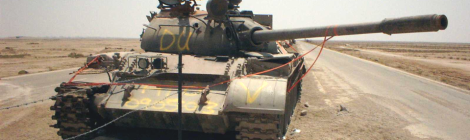
DU-turn? The changing political environment around toxic munitions
Is the US backpedalling on its use of depleted uranium (DU) rounds? There are indications that the use of these highly toxic munitions could increasingly be a political liability for the US, with countries affected by DU, like Iraq, other UN Member States, and populations in contaminated areas all expressing concerns over its use and impact. But stigmatisation, although important, is not enough on its own – in order to make sustained progress on accountability and in reducing civilian harm, a broader framework that addresses all toxic remnants of war is needed.

Iraq and Syria: The Thirty-Year War, continued
Barack Obama’s new strategy against the Islamic State commits the United States to further long-term conflict. It involves a great forgetting of the recent war in Iraq.
Nuclear Weapons: From Comprehensive Test Ban to Disarmament
Despite not yet entering into force, the 1996 Comprehensive Test Ban Treaty has succeeded in almost eliminating nuclear weapons testing and in establishing a robust international monitoring and verification system. A breakthrough in its ratification by the few hold-out states could have important positive repercussions for the Nuclear Non-Proliferation Treaty or nuclear disarmament in the Middle East.
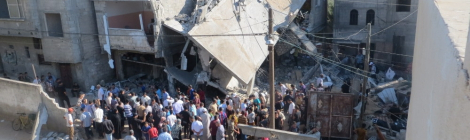
Gaza: Context, Consequences and the Utility of Force
Israel’s current military operation, ‘Protective Edge’, has now exceeded the length and scale of the 2008-09 was, with no end in sight. And like Israel’s previous operations, the current undertaking is failing to undermine Hamas’s paramilitary capabilities and support base.
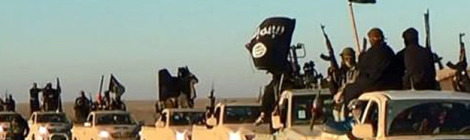
Iraq: Days of Danger
An unlikely alliance of four states – Iran, Syria, the United States and Russia – is coalescing to oppose the ISIS advance in Iraq. Is military intervention in Iraq imminent?
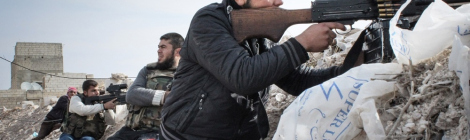
The War in Syria: Responding to Stalemate
The Syrian War is now in its fourth year and the indications are that the regime will survive and consolidate its position in 2014. This is radically different from early last year when many analysts thought it was under serious pressure, and it should be recalled that in mid-2011, a few months into the war, the prevailing view was that the regime would not last to the end of that year. The costs have been huge, with around 140,000 killed, twice that number injured and more than a third of the population displace, millions of them refugees in other countries. Here, Paul Rogers seeks to put this appalling conflict in a longer term regional context as an aid to looking at possible policy options in attempting to bring the war to an end.

International Dimensions of the Ukraine Crisis: Syria and Iran
The Russian annexation of Crimea may be in direct contravention of international agreements but is popular in Russia and almost certain to hold. Given tensions within Ukrainian society and its weak transitional government, there remains some risk of further intervention in eastern Ukraine and possibly the Trans-Dniester break-away region of Moldova. Even if there is no further escalation in the crisis, the deterioration in EU/Russian and US/Russian relations is of great concern, not least in relation to two aspects of Middle East security – the Syrian civil war and the Iran nuclear negotiations.
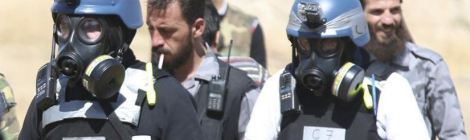
Chemical Weapons Use in Syria: a Test of the Norm
Recent events in the Syrian civil war have proved an unparalleled test of the norm against the use of chemical weapons. At its core this was a test of the willingness of countries to uphold the norm, in this case in the face of a flagrant violation, and a response that in the end stumbled upon a satisfactory conclusion—reaffirming the special category of chemical arms—but which in the process said a great deal about current attitudes to the use of military force as a means of humanitarian intervention.
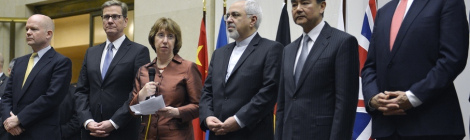
The Iran Interim Deal: Responses, Potential Impacts, and Moving Forward
Implementation of the interim deal with Iran, which freezes the country’s nuclear enrichment in exchange for limited sanctions relief, began in January. As a result, we are witnessing a substantial shift in diplomatic relations between Iran and its regional neighbours – some positive, some not. This deal marks a significant step for the international non-proliferation regime, but will it achieve the trust and confidence-building goals intended? As the US and Iran face increasing domestic pushback on the terms of the agreement, questions remain on the interim deal’s impact on relations in the region and abroad, and the effect these relations may have on the prospects of coming to a full comprehensive follow-up agreement between Iran and the P5+1 countries.
Leave a Reply