Blog

  • Colombia and Mexico: The Wrong Lessons from the War on Drugs

    Colombia and Mexico: The Wrong Lessons from the War on Drugs

    As activists around the world participate in a Global Day of Action against criminalisation of drug use, evidence from the multi-billion dollar War on Drugs in Colombia suggests that militarized suppression of production and supply has displaced millions of people as well as the problem, not least to Mexico. The wrong lessons are being exported to Central America and beyond, but a groundswell of expert and popular opinion internationally is calling for alternative approaches to regulating the use and trade in drugs.

    Read Article →

    The United States, Niger & Jamaica: Food (In)Security & Violence in a Globalised World

    due to a complex range of interconnected issues from climate change to misguided economic policies, political failure and social marginalisation, over 2 billion people across the world live in constant food insecurity. Anna Alissa hitzemann takes a sustainable security approach to look at the importance of “physical and economic access to basic food” by exploring the links between food insecurity and violence.

    Read Article →

    Causes of Conflict: A Strategic Perspective on US–Sino Relations in the Caribbean

    Author and former High Commissioner of Trinidad and Tobago to the Court of St. James, Serena Joseph-Harris writes that China’s increasing regional profile in the Caribbean highlights the challenges now posed to American exceptionalism as Beijing defines its own course in the region. This article focuses on the potential within the Caribbean Basin for the burgeoning proceeds presently derived from increases in the legitimate investment, trade, and commerce emanating from Beijing and Washington to become entwined with illicitly derived funds generated from transnational crime activities, specifically the trafficking of drugs.

    Read Article →

    Mano Dura: Gang Suppression in El Salvador

    Widespread social exclusion makes El Salvador fertile ground for gang proliferation and, over time, gang members have resorted to greater levels of violence and drug activity. Yet, government approaches have proved spectacularly ineffective: the homicide rate escalated, and gangs have adapted to the climate of repression by toughening their entry requirements, adopting a more conventional look, and using heavier weaponry. Sonja Wolf argues for approaches which focus on prevention and rehabilitation and looks at why such approaches have been continually sidelined.

    Read Article →

  • From The Great War to Drone Wars: The imperative to record casualties

    From The Great War to Drone Wars: The imperative to record casualties

    The centenary of the First World War also marks the anniversary of the practice of recording and naming casualties of war. But a century on, new forms of ‘shadow warfare’ limit the ability to record casualties of conflict and thus threaten to allow states a free hand to employ dangerous new tactics without threat of individual or international accountability. Without verifiable casualty figures, – including information on who is being killed and how – we cannot evaluate the acceptability, effectiveness or impact of ‘remote control’ tactics as they are rolled out among civilian populations.

    Read Article →

    The Costs of Security Sector Reform: Questions of Affordability and Purpose

    In considering security sector reform, questions of affordability have often been subordinated to questions of effectiveness and expediency. A recent series of reviews of security expenditures by the World Bank and other actors in Liberia, Mali, Niger and Somalia has highlighted several emerging issues around the (re)construction of security institutions in fragile and conflict-affected states.

    Read Article →

  • Rising Golden Dawn: Inside Greece’s Neo-Nazi Party

    Golden Dawn, a Greek Neo-Fascist party, has gradually enjoyed greater success in Greek and European parliamentary elections. What are the drivers behind this development?

    The Greek Golden Dawn, a violent neo-Nazi party, has remained in the margins of the Greek political system for most of its political life. However, within the context of the emerging economic crisis both in Europe and in Greece, the party marked an electoral breakthrough in May and June 2012, receiving 7 per cent of the vote in May and 6.9 per cent in June, translating into 21 and 18 parliamentary seats out of 300 respectively. As the economic crisis unfolded, and societal upheaval in Greece became reinforced by the emerging migration crisis, the party retained its support in the 2014 European Parliament Elections receiving 9.38 per cent of the vote; and in the January and September 2015 general elections, when it retained third place in the party system with 6.28 and 6.99 per cent of the vote respectively.

    The ideology of Golden Dawn

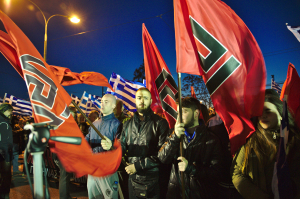
    golden_dawn_members_at_rally_in_athens_2015

    Image by Wikimedia Commons.

    The Golden Dawn is unlike all other parties in the Greek parliament; and most other far right parties in Europe. While the party itself rejects the fascist label, it nonetheless espouses all core fascist- and more specifically Nazi- principles. In our book, we show the party rejects liberalism and socialism and endorses what it terms the ‘third biggest ideology in history’, i.e. nationalism, combined with support for an all-powerful state premised on ‘popular sovereignty’. In its manifesto the party states that being a member of the Golden Dawn entails the acceptance of the following principles: the establishment of the state in accordance to nationalism; the moral obligations that derive from this ideology including the rejection of any authority that perpetuates societal decline; the acceptance of nationalism as the only authentic revolution; the establishment of the popular state in which there are no inequalities on the basis of wealth; racial supremacy and more specifically the belief in the continuation of the ‘Greek race’ from antiquity to the modern day; the idea that the state must correspond and be subservient to the nation/race; and the nationalization of all institutions.

    The fascist myth of palingenetic ultra-nationalism constitutes a key ideological premise underpinning the party’s discourse. The ideology of the Golden Dawn may indeed be categorised within the ‘ethnic nationalism’ variant, emphasising blood, geneaology and the perennial nature of the Greek nation. The party emphasises ties with ancient Greece, past wars, imperial experience during the Ottoman years and invasion in the 1940s. In this context, the party makes frequent references to ancient Greece, emphasising the heroic traits of those belonging to the Greek nation. Historical figures, whether heroes of ancient Greece, Byzantium, the Greek War of Independence, the Second World War or Cyprus are glorified for their heroism, bravery and sacrifice. By referring to a very large array of officially recognised historical events, personalities and national identity traits and placing them within the ethnic election framework, the Golden Dawn successfully integrates them into its ultra-nationalist palingenetic ideology.

    The Golden Dawn seeks ‘catharsis’. The party’s key goal is to eliminate all political divisions and cleanse the nation from outsiders. Communists are identified as those internationalists that seek the annihilation of the Greek nation. Contributing to this ethnocide are also Greece’s external enemies, which include all foreigners who according to the Golden Dawn contribute to the moral and cultural decay of Greece, for example people of Jewish origin and all immigrants.

    Militarism hence is the key to both the Golden Dawn’s ideology and organizational structures. The army is the ultimate value, they claim. A value that encloses within it ‘blood, struggle and sacrifice’. The party’s members see themselves as ‘street soldiers’ fighting for the nationalist cause. This places violence at the heart of Golden Dawn’s activities and illustrates their distinctive view of democracy as a bourgeois construct only to be used as a means for achieving their ultimate goal: its abolition, as its leader Nikolaos Michaloliakos claims. It also explains the link between Golden Dawn members and army officials, as well as the organization of ‘paramilitary orders’ or ‘battalions’.

    Therefore the party should be understood as neo-Nazi, not because of its past use of Nazi paraphernalia, but rather because its ideology and organizational structures fulfil the criteria of what constitutes a neo-Nazi group. Its association with a large number of violent acts resulted in the imprisonment of the majority of its MPs including the party leader in 2013/2014. 70 defendants, which include the party leader and the party’s MPs, went on trial in Spring 2015 on charges including murder, grievous bodily harm and sustaining a criminal organization. The trial remains on-going.

    Accounting for the rise of Golden Dawn

    How may we explain the rise and sustained support for the Golden Dawn? The Golden Dawn’s electoral fortunes have coincided with both the economic and migration crises that have affected Europe as a whole. For example, in 2012 during the peak of Greece’s economic crisis, the country’s unemployment was at 24.5 per cent with youth unemployment at 55.3 per cent. In 2013 these figures increased to 27.5 and 58.3 respectively. The government deficit was -8.6, which increased in 2013 to -12.1. In addition, Greece experienced the bulk of the migration crisis as the entry point for a high number of refugees who travel from Turkey to the islands of Kos, Chios, Lesvos and Samos. For example, an estimated number of 856.723 refugees arrived by sea in 2015 and 169.459 in 2016.  It would make sense to seek causal links between the economic and migration crises on the one hand, and the rise of the Golden Dawn on the other. However, the adoption of a comparative logic suggests that this argument does not hold when subjected to empirical scrutiny. Other European countries that were also severely affected by the Eurozone and/or migration crises have not experienced a comparable rise in support for the far right. For example, Spain’s unemployment levels are second in the EU after Greece with 24.8 per cent in 2012 and 26.1 per cent in 2013. Youth unemployment in Spain is also very high at 52.9 per cent in 2012 and 55.5 in 2013. Portugal’s somewhat lower unemployment rates at 15.8 per cent in 2012 and 16.4 per cent in 2013 are still above the EU average. The same goes for the country’s youth unemployment rates at 37.9 per cent in 2012 and 38.1 in 2013.

    We posit an alternative explanation that takes into account the broader implications of the crises of Greek society. We understand the rise of the Golden Dawn as a response to a perceived breach of the social contract in Greece. Therefore, we see this rise not as question of intensity of economic and/ or migration crisis, but rather as a question of the nature of the crisis, i.e. economic and/migration versus overall crisis of democratic representation. Extreme right parties such as the Golden Dawn are more likely to experience an increase in their support when a societal crisis culminates into an overall crisis of democratic representation. This is likely to occur when severe issues of governability impact upon the ability of the state to fulfil its social contract obligations. The perceived inability of the state to mediate the effects of the crisis and to deliver services based on the redistribution of the collective goods of the state. When state capacity is limited or perceived to be limited, then the result is the delegitimization of the party system as a whole. This is because the system is perceived as incapable to address the crisis and mediate its socioeconomic effects. This breach of the social contract is accompanied by declining levels of trust in state institutions, resulting in party system collapse.

    Conclusion

    If we are right, then the Golden Dawn is a specific symptom of a broader institutional pathology. Therefore in order to contain this phenomenon, political actors should focus on institutional reform in order to restore the domestic social contract and reintegrate key social groups back into the political mainstream. More specifically:

    1. Empower the middle class: because the middle class is key to both economic prosperity and democratic stability. Weak democratic institutions and widespread corruption have resulted in the weakening of the middle ground and this is what allows extremist groups to co-opt middle-class voters. Unless we address this institutional pathology at its core, extremism will keep recurring.
    2. Welfare reform: because the appropriation of key social groups into the mainstream depends on social security. The greater the insecurity, and the broader the populace it affects, the greater the potential of extremist elements to co-opt these social groups that would otherwise support mainstream alternatives.
    3. Strengthen civil society institutions: Because civil society fosters tolerance. Greek civil Society is weak at all levels: weak structure, limited impact and limited membership. There is a wider sentiment of public distrust towards this type of organisations in Greece because of the long tradition of corruption and clientelistic relations that prevail.
    4. Reform the education system: Because education is a key means of socialisation that institutionalises political culture. The type of socialisation that occurs from an early age at the school level is the one that becomes most embedded. And, because people of a younger age are more easily moulded into violence and extremism, they tend to occupy a large portion of far right party membership. As long as the Greek education system promotes exclusion and vilifies the other through official textbooks, it will continue to offer opportunities for right-wing extremism.

    Dr Sofia Vasilopoulou is a Senior Lecturer in Politics at the University of York.

    Dr Daphne Halikiopoulou is an Associate Professor in Comparative Politics at the University of Reading.

  • Responding to Climate Disruption – Developing the Agenda

    This article is taken from Paul Rogers’ Monthly Global Security Briefings and was originally posted by Oxford Research Group on 12 March, 2014.

    Recent examples of short-term climate disruption have done much to bring the overall issue of climate change up the political agenda. In responding to what will be one of the key challenges of the next decades – well beyond the 15-year lifetime of the post-2015 global development goals currently under discussion – much of the attention has been focused on the need to adapt to those elements of climate change that are already irreversible and also to the need to decarbonise existing high carbon-emitting economies. What needs much greater attention is the fundamental need to ensure that low-carbon emitters in the Global South are enabled to combine effective human development with responding to the challenges of climate change.

    Asymmetric Impacts

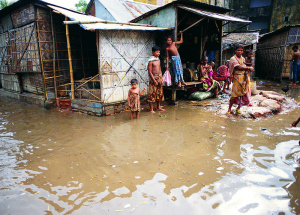
    Floodwaters surround houses in Dhaka, Bangladesh, one of the world's most climate vulnerable countries.

    Floodwaters surround houses in Dhaka, Bangladesh, one of the world’s most climate vulnerable countries. Source: CAPRA Initiative (Flickr)

    The scientific evidence that climate change is happening is now overwhelming and only a tiny handful of scientists question its anthropogenic causes. The most recent decadal report from the World Meteorological Office (WMO), for 2001-2010, confirms that climate change already involves disruption, with the decade seeing a clear increase in impact across the world. Events since 2010, including excessive heat waves, floods, droughts and the strongest land-fall cyclone (Typhoon Haiyan) ever recorded all point to accelerated disruption.

    In recent years there has been a relative pause in the rate of atmospheric warming but research points to aspects of the Southern Oscillation being responsible, temporarily slowing the overall rate of warming of the atmosphere, but not of the oceans. This is expected to change in the second half of the current decade and the effect of this will be that anthropogenic-induced warming and natural cycles will be in synchrony, leading to rapid change and greater climatic disruption.

    Climate change is thus expected to accelerate but there is, in addition, abundant evidence that it is already a markedly asymmetric process. There are many indications that substantial areas of the tropics and sub-tropics will heat up and dry out faster than temperate latitudes. This is significant for four reasons:

    • These regions support the majority of the world’s people and produce the majority of the world’s food, much of it being locally produced in subsistence farming systems.
    • Most of the poorer and more marginalised people live there, with least resilience to climate disruption.
    • These regions also include most of the rapidly growing megacities where infrastructure is not keeping pace with growth, resulting in low urban resilience.
    • They include the vast “carbon sinks” of the Amazonian, African and Southeast Asian rain forests, the diminution of which will accelerate atmospheric carbonisation.

    The other element of asymmetry – relatively faster warming of the near-Arctic – is directly advantageous to some countries, most notably Russia and Canada, both of whom stand to benefit in the short term in three ways:

    • Sea ice will diminish, opening up new commercial sea routes.
    • Arctic fossil and other mineral resources will be easier to exploit.
    • Agriculture will “move North”, opening up new regions for development.

    These two countries are also major fossil fuel producers so they benefit through these revenues, including easier exploitation of Arctic reserves, as well as from the impact of their use since this is likely to enhance Arctic warming. It is hardly surprising that neither government has much interest in controlling carbon emissions. As a Permanent Observer at the Arctic Council, the UK could do much to work with the five Nordic countries, all Main Council Members, on this issue, also involving new observer states, such as China, India, Japan and South Korea that have an interest in new sea routes, but are increasingly aware of the potential direct negative impacts on their own economies of climate change.

    The Changing Political Environment

    The direct denial of climate change as a phenomenon affecting human society still persists and is most clearly seen in two powerful interest groups. One is the fossil fuel industry, especially oil companies and producer countries that have a clear interest in protecting their revenues. There are also major interest groups clustered around those who genuinely believe that the unrestricted free market form of capitalism is the only appropriate system for the global economy. As such they are deeply suspicious of governmental interference in the economy and therefore highly suspicious of a world-wide challenge that demands strong intergovernmental coordination and government action.

    Both groups have been powerful and effective supporters of the denial community and though they are helped by the governmental attitudes of countries such as Russia and Canada, their greatest support came from the Bush administration in the United States in 2001-2009. Their influence is now declining for three broad reasons.

    • One is that the frequency of severe and even extreme weather events is changing public opinion in many countries. The UK is a good example where serious winter flooding was enough to ensure that the Prime Minister, David Cameron, agreed that climate change was of huge concern, even though many in his own party remain doubters. At a global level, the WMO report adds credibility to the view that extreme weather events, like the canary in the coal mine, are harbingers of what is to come.
    • A second element is that the most powerful state, under Barack Obama, acknowledges that climate change is happening, even though powerful denier elements remain resolute in their resistance.
    • Finally, a number of major industrial groups, especially those in the engineering industry, are embracing the prospects for new market opportunities as renewable energy technologies and techniques of storage and conservation come into their own

    Current Responses to Climate Change

    The two main responses to climate change currently envisaged are the progressive decarbonisation of carbon-intensive societies and the adaptation of high- and low- carbon societies to the impacts of climate change that are inevitable given the existing increases in atmospheric carbon. Both of these remain likely to gain in importance given the recognition of the huge challenges ahead. While the action so far is inadequate, it at least now shows signs of some prioritising. Whether the 80% carbon emission requirements of industrial societies can be achieved within twenty years is, at most, questionable, but it is now at least recognised as a worthy aim.

    There is also recognition that adaptation is addressing symptoms rather than responding to causes – improved flood defences in a country such as Britain may well be necessary but unless climate change is halted they are just short-term responses that will progressively be overwhelmed. Similarly, there is already good work going on in aiding the adaptation of less developed economies through, for example, the breeding of robust food grain varieties more able to withstand low rainfall. Such work needs considerable expansion but this, and the progressive decarbonisation of high emitters still misses out a crucial element in responding to climate change.

    The Missing Element

    In relative terms, the missing element is the low level of investment in the evolution of low-carbon economies of societies that have not substantially industrialised, mainly those in the tropical and sub-tropical regions of the Global South. Such countries include most of the most marginalised and poorest people on Earth where there is a deep-rooted desire for far greater life chances, yet these cannot be met through the modes of economic organisation of the industrialised North. If the marginalised majority is to see its development prospects enhanced then this has to be achieved through new forms of low-carbon economic development. Countries have to succeed without following the path taken by industrialised states over the past two hundred years.

    It follows that there is a very strong case for a state such as the UK prioritising any form of development assistance which aids this process. Much of this will centre on any form of low carbon energy use, including a wide range of renewable technologies, with major improvements in energy conservation and storage. Much work is already going on in this area, not least in relation to renewable energy technologies readily available to non-networked societies. It is also notable that when technologies emerge which demonstrate obvious utility, the speed of take-up can be remarkable. The cell-phone revolution in sub-Saharan Africa is just one example.

    Regrettably, UK Department for International Development (DFID) operational plans for 2013-14 indicate that low carbon development (LCD) targets from the Department’s 2011-15 strategy have been reduced or abandoned. The 2015 target for installed clean energy capacity has been reduced by almost 97%, from 3GW to 100MW. The original target to raise $610 million in private finance for LCD has disappeared, having raised $15 million by 2013.

    If the UK development programme was to commit just 20% of its budget to this area of work, the results could be extremely valuable, especially if part of that was to encourage North-South research and development partnerships. Furthermore, while the British development programme has many faults, it has grown to be the world’s second largest and there is sufficient cross-party support for this to be sustained against opposition. Because of the size of this programme, the UK has a more powerful voice than most in intergovernmental fora relating to development. It can use this voice to help ensure that the commitment promoted here is shared by other national and intergovernmental development programmes.

    Conclusion

    Climate disruption is one of the greatest challenges facing humankind, a challenge that is at last becoming recognised as such because of the extreme nature of many recent weather events. Decarbonising major industrial economies and funding adaptation to the already inevitable impact of climate change are essential responses but they must be accompanied by major programmes to ensure that human development in the poorer economies can be fully accomplished through processes of low carbon economic development. This is a critically important task over the coming decades, is insufficiently recognised as such, and should be a priority for any serious political party committed to the world-wide development of human well-being.

    Paul Rogers is Global Security Consultant to Oxford Research Group, for which he writes monthly security briefings.  He is Professor of Peace Studies at the University of Bradford and author of numerous books including ‘Beyond Terror’. Paul writes a weekly column for openDemocracy  and tweets regularly at @ProfPRogers.

  • Mission Impossible: The Elusive Search for Peace in Syria

    The Syrian war is one of the worst political and humanitarian crises since the Second World War and mediation attempts have proven largely fruitless. What are the reasons behind their failure, and what are the prospects for peace in the future?

    January 2017 will see new leadership both at the UN and in the US. António Guterres will become the 9th Secretary-General of the United Nations and Donald Trump will take office as the 45th President. These leaders will inherit from their predecessors a problem that ranks among the toughest and most complex in the world today: the Syrian civil war a, conflict that began in 2011 and since then has seen between 312,000 and 470,000 deaths.

    Both men have declared Syria a policy priority. Trump has given few specifics beyond a desire to depart from current U.S. policy, whereas Guterres has said that, under his leadership, ending the Syrian civil war will be the UN’s most important task.

    Guterres faces tough odds: the catalogue of failed mediation efforts in Syria has by now grown quite long. After the Arab League’s failed attempt in the early phase of the conflict, the UN dispatched to Syria first Kofi Annan and then Lakhdar Brahimi, both of whom fervently tried to broker various ceasefire arrangements, and both of whom returned empty-handed. More recently, the diplomatic initiative has rested with U.S. Secretary of State John Kerry and Russian Foreign Minister Sergei Lavrov, who have sought to find a way to collaborate on Syria despite diverging priorities.

    In September 2016, this duo managed to negotiate a ceasefire, but, in a rather typical display of how tenuous progress is in Syria, the deal fell apart within days, following an ill-timed accidental American bombardment of Syrian troops in Deir el-Zour and unrelenting combat in Aleppo. In parallel, Staffan de Mistura, the UN’s third envoy since the war began, has continued to probe for breakthroughs, however small and local, to keep a semblance of a process alive, but without substantive progress.

    Why Syria is a mediator’s “mission impossible”

    There are several reasons why previous mediation has fallen short in Syria. International disunity and distrust in the various mediators are important factors – rebels rejected the most recent UN initiative, a limited humanitarian ceasefire in Aleppo, on the grounds that the UN was “biased” against them. The main explanation, however, lies in the nature of the conflict. Kofi Annan labeled it a mediator’s “mission impossible”: a war fought between many and fractured coalitions, infused with sectarian enmity, and subject to constant meddling from foreign powers.

    Academic research sheds light on all of these factors, and why and how they effect peace mediation. First, the higher the number of belligerents, the harder a conflict is to settle. In Syria, where the number of actors is extraordinarily high, it has proven impossible to design a deal that is attractive to a critical mass of parties. This problem has been particularly acute with respect to the opposition, which frequently have fallen to infighting and agree on little beyond the necessity of ousting President Bashar al-Assad.

    Second, historical evidence shows that conflicts where belligerents anchor their demands in religious traditions are more intractable than other conflicts. In Syria, religious fault lines have gradually hardened, especially between Sunni and Shia, raising the threshold for peace deals that depend on sectarian co-existence. The widespread presence of jihadists who view the conflict in cosmic, Manichean terms add one further barrier to initiating a process premised on the exchange of concessions.

    Third, with the possible exception of the Islamic State, nearly all actors in Syria enjoy the material and diplomatic support of foreign sponsors. Conflicts that attract external interventions tend to be more resistant to mediation, most likely because foreign powers can offset shifts on the battlefield by escalating the influx of weapons and other resources to their preferred client. Further, support from foreign sponsors makes belligerents less dependent on support from the local population, which otherwise can generate social pressure that incents negotiations.

    Combined, these factors have created a situation where it has been difficult for mediators to identify a viable power-sharing deal, and even less, generate firm expectations that such a deal could be implemented.

    The conflict will end, but how?

    Like all wars, the war in Syria will end. The question is how long it will take and the means through which this will be achieved. Logically, the war in Syria can end in three ways: through a military victory, by petering out into a “cold war”, or via a negotiated agreement.

    Even though the majority of civil wars end in military victory, most analysts have held the view that this is an unlikely outcome in Syria. Neither side has had the resources to impose, much less maintain, a monopoly on violence in the entirety of the country. However, there are signs that a regime victory has become, if not likely, at least a possibility. The fall of Aleppo to regime troops in December 2016 will free up considerable forces that can be reallocated for tactical offensives in other areas. Continued Russian efforts and a realignment of U.S. priorities in Syria under a Trump Presidency may allow the regime to make further gains.

    Another scenario is that the war gradually de-escalates into a “cold war”, with little or no active fighting. In parts of the country, especially the South, this is already the de facto situation, as localized truces and standoffs have produced a state of suspended warfare. A generalization of this scenario, though, is premised on the exhaustion not only of the primary belligerents (e.g., via manpower shortages), but also of their foreign sponsors, which would require significant shifts in both regional and international politics.

    The third way the war can end is via a negotiated agreement, either induced via external mediation of the kind discussed above, or emerging from direct negotiations between the parties within Syria. We know from statistical research that a growing number of civil wars end in negotiated agreements, but, in light of the challenges listed above, there is clearly some way to go before that will happen in Syria.

    A changing landscape?
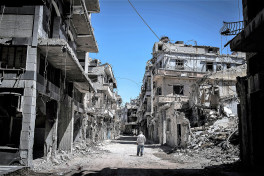
    syria-homs

    Image credit: Chaoyue 超越 PAN/Flickr

    As neither of three paths to peace appears imminent, continued war is therefore the only realistic scenario in the short- to mid-term. But there are signs of a changing landscape, both militarily and politically, which may open up avenues to a negotiated agreement, at least in limited forms between the regime and the non-jihadist opposition.

    The most important shift, potentially, is the election of Donald Trump as the next U.S. President. While the details of the President-elect’s Syria policy remains opaque, it is likely to include two ingredients: more direct coordination with Russia and stronger military efforts against the Islamic State. With Trump as President, the U.S. may be willing to shift publicly on issues that are currently recognized only implicitly, such as the acceptance of Assad’s staying in power, the failure of train-and-supply efforts, and the Islamist domination within the opposition. The current battery of economic sanctions may also be revisited.

    The coming of Trump is therefore likely to favor Damascus, but it could also increase the prospects for substantive negotiations. Historically, when great powers favoring opposing belligerents in a civil war come together, it have tended to favor negotiated outcomes. If Russia, Turkey and the U.S. can maximize their leverage with their respective clients, they could help push them to the negotiation table. But chances are still slim: they have tried before without succeeding and Trump’s Syria policy may alienate the opposition, reducing U.S. leverage.

    The fall of Aleppo signifies another important change in the strategic landscape. By capturing the city, regime forces dealt a demoralizing blow to the opposition, while further alienating Western audiences. It remains unlikely that the regime can claw back all lost territory, let alone rule it in a legitimate manner, but the victory in Aleppo may add further leverage to its strategy of seeking local “reconciliation agreements”. Several hundred such local truces have already been struck across the country and, if generalized, may portend a demographic “sorting out” that would leave Syria organized into more or less autonomous zones, akin to the  “cold war” scenario above.

    For its part, the UN is likely to continue its valiant search for solutions, small and large. If the new UN Secretary General is to deliver on his promise to prioritize a peaceful solution in Syria, he needs to find a way to capitalize on the expected rapprochement between Russia and the U.S. His man in the field, envoy de Mistura has signaled that he concurs with the military fight against the Islamic State but that a military strategy needs to be accompanied by “political devolution” in Syria. This indicates that the UN is considering an arrangement styled on Bosnia or Iraq – essentially power-sharing along sectarian lines – for Syria. Even if the UN manages to leverage the U.S. and Russia behind such a plan, however, it currently appears unlikely that the opposition would give up on its demands for regime change, and that Damascus, smelling military victory, would seriously consider it.

    Magnus Lundgren is a postdoctoral research fellow at Stockholm University, Sweden. His research focuses on conflict resolution in civil wars and on decision-making in international organizations such as the UN. His most recent publications include ”Which international organizations can settle civil wars” and ”Mediation in Syria: Initiatives, strategies, and obstacles, 2011-2016”. He is the co-founder of the Multilateral Negotiation Project, a non-profit that seeks to enable better global negotiation processes. He can be followed on Twitter @magnusllundgre

  • What the Environmental Legacy of the Gulf War Should Teach us

  • Nitrogen: a driver of global food insecurity?

  • Quiet Legacies and Long Shadows: The Obama era of counterterrorism in the Sahel-Sahara

    Getting Older But Not Wiser: the Arms Trade Treaty’s First Birthday

    April 2nd marked the first anniversary of the adoption of the much celebrated Arms Trade Treaty (ATT), the world’s first treaty to establish common standards of international trading in conventional weapons and which in turn aims to ‘ease the suffering caused by irresponsible transfers of conventional weapons and munitions’. But with the continued irresponsible arms trading and an overall rise in the global arms trade, it seems that some states have yet to put the ideals of the ATT into practice.

    Read Article →

    Beyond crime and punishment: UK non-military options in Syria

    The defeat of the UK government’s parliamentary motion on support in principle for military action against the Syrian regime means that Britain will play no part in any direct attack on Syria. What then are its options for resolving the Syrian conflict, protecting civilians and punishing those responsible for war crimes there? This article assesses what the UK can do in terms of pushing for a negotiated peace settlement and to hold accountable those responsible for using chemical weapons and any other war crimes committed during this century’s worst humanitarian crisis.

    Read Article →

    A top-down approach to sustainable security: the Arms Trade Treaty

    2012 has been hailed as a potential landmark year in the push for greater regulation of the global trade in conventional arms. After more than a decade of advocacy to this end, negotiations took place throughout July towards the world’s first Arms Trade Treaty (ATT), which is intended to establish the highest possible common international standards for the transfer of conventional weapons. However, although significant progress was made during the month of intense negotiations, the ATT is not yet open for signature. In this article, Zoë Pelter explores what role a potential treaty – if reopened for further negotiation – could play in a move towards sustainable security.

    Read Article →

  • Europe’s Borders, Refugees, and the Islamic State

  • Alternative for Germany and the Rise of Right-Wing Populism