Blog

  • Sustainable Security

    Scarred in recent years by questionable involvements in the likes of Afghanistan and Iraq – and by the casualties they wrought – risk-averse Western governments have begun to look to others to do the shedding of blood in their ‘wars of choice’. The risky boots-on-the-ground role that was once the proud preserve of NATO armies anxious to showcase their abilities is now politically unpalatable. Proxies appear to be the answer. Biddable local allies who are of a mind to work in collaboration with Western militaries are very much in demand: the former supply the troops, the latter the training and the technological support – if not, indeed, the weapons as well. A symbiosis based on the principle that my-enemy’s-enemy-is-my-friend is the goal. This simple formula, though, is one that is not always bound to produce positive results. Proxies should always carry a health warning; they tend not to be as biddable as hoped.

    Take the Kurds. They are an ethnic group inhabiting a region – Iraq and Syria – where suitable proxies for Western powers are very much in demand for use against Islamic State (IS). The Kurds appear to be ideal candidates as proxy fighters: they are numerous; of a warrior-caste; are politically acceptable to Western audiences, and have a natural enemy in IS. As a militant group intent on territorial expansion, IS threatens Kurdish communities. The case for synergy is thus obvious: Western militaries and the Kurds can work together for mutual benefit. Not quite so obvious, however, are the various reasons why the relationship between Kurd and Western militaries is one that has the ready capacity to go awry. The chief driver of any breakdown is that Kurdish proxies can and will have their own priorities that clash with those of their sponsors.
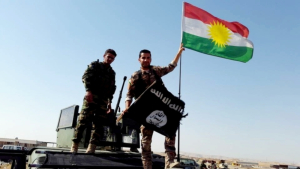
    Image of Peshmerga replacing the ISIS flag with  the Kurdish flag by Kurdishstruggle via Flickr.

    The first point to note here is that the Kurds are a people divided. A fractiousness has historically long been evident between the various clans, tribes and families that make up this nation. These differences may have now mellowed but they have never completely dissipated. And then there are the differences created by linguistic schisms – Sorani and Kurmanji – and sectarianism – Sunni and Shia. Differences also developed due to the politics of whichever state the Kurds found themselves in after the demise of the Ottoman Empire. The Kurds within Syria developed under the tutelage firstly of French colonial rulers and then under a succession of socialist governments in Damascus. Both influences – or rather impositions – shaped a Kurdish community that was very much secular in make-up. It was the same in Turkey; Kemalist policies pushed secularism. In contrast, however, in Iraq, the laissez-faire approach of British colonial masters and then the inability of Iraqi governments to penetrate and shape attitudes in its northern Kurdish region left in place a largely tribal-based, conservative structure that is still today strong on religious (Sunni) influences.

    Today, the Kurdish area of northern Iraq, known as the Kurdish Regional Government (KRG), is riven by a split between a Western region dominated by the party of President Masoud Barzani – the Kurdish Democratic Party (KDP) – and an eastern region where the party of former Iraqi president, Jalal Talabani – the Patriotic Union of Kurdistan (PUK) – holds sway. The KDP, dominated by the Barzani tribe and with strong links north to its political patron, Turkey, maintains the strings of power in the KRG. It is based in the ‘capital’ of Erbil. The PUK, more left-of-centre, modernist and leaning towards Iran, holds sway around Suleimaniyeh. These two parties, indeed, and using their peshmerga forces, fought a civil war in the 1990s. And while there is currently what might be seen as a national KRG peshmerga force, these two parties still maintain their own peshmerga units and there is thus always the possibility that tensions may lead to some renewed clashes. Moreover, with future independence in mind, one eye is constantly being kept on the need to prepare for a possible future conflict with the Iraqi army and its associated Shia militia. Here is one particular problem for the Kurds of Iraq – who is the real enemy? Is it IS; is it fellow Kurds, or is it Baghdad? This then also becomes a problem for any power that seeks to use these Iraqi Kurds as proxies against IS – as the United States and others do. Can they be made to keep their eyes focused on IS and not elsewhere? And will the training and weapons they might be supplied with be directed at IS, or could they be used against other US proxies – such as other groups of Kurds and/or the Iraqi army?

    In Iraq, for instance, any future push on IS-held Mosul will, the US military hopes, involve the KRG’s peshmerga forces supported by US artillery and air power. Washington does not want the Shia-dominated Iraqi army to be seizing, on its own, the Sunni city of Mosul. Re-occupation of the city should be leavened, ideally from the US viewpoint, by the employment of Sunni Kurds. As things stand, however, there is a reluctance on the part of Erbil to push forward. The KRG has now, to a large degree, stabilised its own ‘borders’ (including the internal one within Iraq), which they see forming the basis of a future independent Kurdistan. Assaulting the Arab city of Mosul will doubtless involve a major loss of life and of treasure (in a cash-strapped KRG) that will produce little in the way of obvious gain for the Kurds while there is a bigger prize in mind.

    Then there are the Kurds in Turkey. The Kurdistan Workers’ Party (Kurdish: Partiya Karkerên Kurdistanê‎, PKK) is a left-wing Kurdish militant group that has long been fighting for more autonomy for the Kurdish-majority region of south-east Turkey. Ankara looks upon the PKK, not unnaturally, as a terrorist group. Recently, during the IS-generated chaos in northern Iraq, battle-hardened PKK units moved across the area and have proved to be some of the best fighters against IS; certainly better than the peshmerga. So here, logically, should be the ultimate proxy of choice for the US inside Iraq – the PKK. The idea, though, that US forces should assist the PKK in any way would bring paroxysms of protest from Turkey – a NATO ally. The KDP government in Erbil (with its own allies in Ankara in mind) is itself ardently agitating to prevent the PKK from setting up any zones within Iraq that it will come to control politically (such as around Sinjar). The PUK, on the other hand, has long supported the PKK, mostly because of the commonality of their left-wing politics.

    There are also the Kurds in northern Syria to consider. There are dozens of bickering Kurdish political parties jockeying for control there. The only force there that is armed, though, is the militia – the People’s Protection Units (Kurdish: Yekîneyên Parastina Gel, YPG) – of the main party, the Democratic Union Party (Kurdish: Partiya Yekîtiya Demokrat‎, PYD). The PYD – again, avowedly secular and actively left-wing – was formed mainly from PKK members who had fled from Turkey in the 1990s. The PYD is thus looked upon by Turkey as just an offshoot of the PKK and is, therefore, also a ‘terrorist’ group. But again, its YPG militia have proved very effective – certainly more effective than US-allied Arab groups in Syria – at confronting and besting IS. The YPG have also shown a penchant for actually taking the fight to IS by moving into Arab-majority areas of Syria (something the peshmerga in Iraq are reluctant to do). Here is another proxy that seems ideal. But how is the US to support the YPG effectively without incurring the wrath of Ankara? Moreover, there will probably come a time soon when Turkey will try and seize Kurdish areas of northern Syria in order to eliminate what it sees as the PYD’s terrorist threat. The PYD’s main enemy would then be Turkey, and not IS. What would the US do then?

    And then there is the cross-border relationship between the Iraqi and Syrian Kurds. It would seem natural for the Kurds in Iraq to support their ‘compatriots’ in Syria. Beyond natural kinship would also be the fact that both are fighting IS. But the KDP in the KRG, having allied itself with Turkey and being more tribal and religiously conservative, wants no truck with the ‘communist’ PYD. Indeed, it has even tried to prevent any assistance reaching the PYD across the Euphrates. To this end, a large trench system has been built by KDP peshmerga to act as a physical barrier designed to prevent any help from the PUK – who do support the PYD (mostly, again, for ideological reasons) – being sent across the border into Syria. Thus the US military is providing assistance to two armed Kurdish groups – the YPG and the KDP’s peshmerga – who are highly likely to one day become engaged in combat with one another.

    Thus when Western military organisations look to the Kurds to provide suitable proxies against IS, problems abound. The notion of a symbiosis created by a common enemy is tempered by the fact that the Kurds, of whatever ilk, tend to have more than just one enemy. This is not a good basis for the role of reliable proxy. But apart from the Kurds, who else is there?


    Rod Thornton is a Senior Lecturer at King’s College London based in Qatar. He spent nine years in the British Army before moving into academia. His research interests focus on terrorism, low-intensity warfare and new forms of warfare – particularly, as a Russian-speaker, on Russian hybrid warfare.  He has lived in the Middle East for four years, including one year at the University of Hewler in Erbil, Kurdish region of Iraq. He is the author of many articles and a book, Asymmetric Warfare: Threat and Response in the 21st Century (Polity Press 2007).

  • The climate peril: a race against time

    The climate peril: a race against time

    Paul Rogers | Open Democracy | November 2009

    Issue:Climate change

    The approach to the United Nations climate-change summit in Copenhagen on 7-18 December 2009 is mired in controversy as blocs of states vie with each other to determine the real agenda.  The multiple interests involved range from elite trading-networks and powerful oil-producers to small-island states in the global south. The underlying reality is a deep-seated inequality in bargaining-power in which the United States and leading European Union member-states can assemble delegations of a hundred or more specialist advisers, whereas the poorest states may have two or three diplomats with no special help. The stark injustice is reinforced by the fact that the climate dynamics of the world’s environment put the majority world most at risk.

    The beginning of progress in redressing current dangers and unfairness is accurate information and sound analysis. There have great advances here since the significance of atmospheric carbon- accumulation was registered in the mid-1970s, around the time of the original study of The Limits to Growth. At that time, most analyses predicted that climate change would have its dominant impact on the temperate latitudes of north and south. In part this was because very long-term natural changes in climate (across millions of years) appeared to have had little impact on the tropics and sub-tropics. When the British land-mass was covered in ice and snow around 11,000 years ago, for example, the climate of sub-Saharan Africa was not greatly different to what it is today. The conclusion reached was that the regions likely to experience the largest climate- change impacts were also among the world’s richest – and thus would be best able to adjust.

    The next generation saw improvements in climate-change modelling that by the early 1990s had overturned this thinking. There was now a recognition that the tropical and sub-tropical land- masses would indeed be greatly affected, though less by a process of warming than by major changes in world rainfall-distribution; the expectation being that more of the world’s rain would fall over the oceans and the northern and southern polar regions, and far less over the tropics and sub-tropics (see David Rind, “Drying out the tropics”, New Scientist, 6 May 1995). This “drying-out” of the tropics would – if not prevented by radical cuts in carbon-emissions – drastically reduce crop-yields. With two-thirds of the world’s people dependent on local food- production, the consequences could be disastrous.  

    The sinking road

    Some current analysis on climate change also predicts increasing variations in rainfall distribution, part of a damaging global asymmetry in temperature-related trends. A study by Britain’s Met Office made public on 28 September 2009 assesses several recent climate-change models in terms of the consequences of a 4ºC overall rise in temperature (using 1980 as the baseline of comparison). This may seem alarmist; but since average temperatures in 1980-2009 have already risen around 0.7ºC, and since there is a very long time-delay between cutting carbon-emissions and containing climate change, the approach is actually realistic. The projection is quite properly indicative of the world as it could look in 2055, unless there are radical cuts in carbon-emissions that go a very long way beyond current plans (see Shanta Barley, “A World 4ºC Warmer”, New Scientist, 3 October 2009).

    The asymmetry of impact predicted by this recent modelling is very significant. Many parts of the world will warm relatively slowly; much of the southern ocean will become only marginally warmer; most other oceans (the Arctic excepted) will warm by 2-3ºC compared with 2009 levels. Some continental land-masses will experience a slightly below-average rise; in this category will be the southern part of south America, parts of southern India, and southeast Asia and Australia. Even so, these regions still face temperature increases of 3ºC or more, leading to dangerous shifts in climate, while the ocean-warming will intensify tropical storms and lift sea-levels.

    This is serious enough, but the modelling should cause even greater concern in relation to the projected impact on other land-masses and the Arctic. Much of Amazonia, and central and north America, is expected to warm by around 10ºC on average on current trends; as will southern Africa, central and eastern Europe, much of the middle east, and central and north Asia right through to the Pacific.  The temperature increases across the Arctic could even exceed 12ºC, leading to wholesale melting of the Greenland and Canadian Arctic island icecaps and major increases in sea-levels across the world.  These are potentially catastrophic changes.

    It is possible that further modelling will lead to some modification of these results, and there is no pretence that climate-change predictions made at a single point in time are immutable. But the work that has been done suggests with reasonable certainty that the continuation of present trends will carry two major consequences.

    The first is that the impact of climate change will be highly variable across the world. Its effect on land-masses will be massive, on the oceans (apart from the Arctic) slightly less so. The most worrying in ecological terms among all the expected outcomes would be the  destruction of the Amazonian rainforest, a process that would accelerate the existing impacts of human activity. 

    The second is that many of the poorest regions of the world, those least able to cope with climate change, will suffer the most (see Camilla Toulmin, Climate Change in Africa [Zed Books, 2009]). The severity of the effects can be gauged if it is recalled that the world’s tropical and sub-tropical land-masses are home to a majority of the world’s people and produce almost all of their food.

    The saving pressure

    What are the implications of this analysis for the Copenhagen summit? It is important to emphasise the context of the meeting, namely that it is part of a process rather than an isolated event. This in turn means that not everything depends on its outcome alone – but the larger picture is such that the process does need to be accelerated in 2010-12 in order to prevent catastrophic impacts by 2040-50. The radical action required includes a reduction in carbon- emissions by industrialised and industrialising states amounting to 40% by 2020 and 80% by 2030.

    This may seem from the perspective of the present – including the widespread low expectations of the Copenhagen meeting – impossibly idealistic. But there are also many hopeful indicators, both at grassroots and government levels. The emergence of a new generation of determined and organised climate-change activists in a number of western countries, prepared to take non-violent direct action is one such; the embrace by some politicians of the need for bold action, after the “lost decade” of George W Bush, is another. The developments in China are especially interesting; the official Chinese stance may foreground demands that western states curb their emissions while allowing China’s economy to catch up, but on the ground there are signs of an embrace of wind-power, photovoltaics and solar-thermal systems, as well as efforts at least to curb the increase in carbon-emissions.

    But for large-scale and comprehensive progress to occur, nothing less than a reworking of the structures of the global economy that addresses the issues of socio-economic divisions and environmental constraints is needed.  Here too there are positive signals, such as the support by British prime minister Gordon Brown (at the G20 finance ministers’ meeting in Scotland on 7 November 2009) for a Tobin-like tax on financial transactions. This, from the leader of one of the world’s larger economies, represents a near-astonishing breakthrough whose impact among financial analysts is just beginning to be felt (see Saskia Sassen, “A global financial detox”, 3 September 2009).

    Beyond this, the economic shift of the coming generation must be grounded in a serious analysis of the essentials of the new green economy. The work being done by the London-based New Economics Foundation (NEF) – for example, in its new “great transition” project – is just one welcome indicator. Much more research is needed, but even the initial analysis by the NEF is enough to show that “blue-sky” thinking can also be deeply practical.

    Copenhagen may not achieve much, but this itself may not be fatal; for in terms of preventing the extremes of climate change, what happens elsewhere may well turn out to be more vital. The work of independent think-tanks (such as Sustainablesecurity.org) and dedicated activists could, in combination, become a singularly powerful force; the response of enlightened political leaderships could prove invaluable. But these agencies will  need an infusion of more energy and broad-based support to enable the pressure for fundamental change to reach a tipping-point.


    Comments

    Post new comment


  • Sustainable Security

    ‘Petropolitics’ and the price of freedom

    “As the price of oil goes down, the pace of freedom goes up… As the price of oil goes up, the pace of freedom goes down…” So says New York Times columnist Thomas Friedman, who argues that the first law of ‘petropolitics’ is that the price of oil and the pace of freedom are inversely correlated in countries “totally dependent on oil” for economic growth. However, the correlation between recent oil price spikes and anti-authoritarian action – particularly in the Arab Spring – challenges this assessment. But if this pattern of change is to continue, Western states must curb their hypocritical dependence on authoritarian oil-exporting governments by developing more sustainable sources of energy.

    Read Article →

    Sustainable Finance and Energy Security

    General volatility in financial markets – fuelled by irresponsible lending and trading practices, as well as evidence of market manipulation – have had an effect on oil prices. Although the specific effects of the finance sector on oil prices requires further investigation, we can already understand that a sustainable and secure future will require the development of a wider energy mix to meet rising demand. To this end, more sustainable financial systems must be developed to service the real needs of citizens

    Read Article →

    National security and the paradox of sustainable energy systems

    The transition away from a centralised global economy built around conventional energy sources to a decentralised global economy mostly fuelled by renewable resources is one we must make for the sake of our children’s futures and that of our planet. Writing for sustainablesecurity.org, Phillip Bruner asks if national security is at present, deeply concerned with preserving access to conventional energy, then how would national security for a decentralised renewable energy Internet be managed? Who would manage it? And what role, if any, could the public play in helping to alleviate some of the burdens of 21st century threat mitigation?

    Read Article →

    Environment, Energy, Economy: a threefold challenge to sustainable security

    Whether it’s the economy, energy or the environment which you value most, when it comes to security, each holds equal weight. If security can be defined in terms of what is or isn’t sustainable, then it must evolve to incorporate additional elements that transcend more traditional views on geopolitics.

    Read Article →

  • Maoists

    Maoists

    India’s 21st-century war

    Paul Rogers | Open Democracy | November 2009

    Issues:Climate change, Global militarisation, Marginalisation

    Tagss:India, Maoists, Naxalite insurgency

    In an age of climate change and deepening inequality, the spreading Naxalite insurgency in India – not al-Qaida – may show the world its future.

    This article was originally posted on openDemocracy.

    Read more »

  • Sustainable Security

    Jenny Nielsen and Nathalie Osztaskina

    With geopolitics and deterrence doctrines back in the ascendant, the prospects for multilateral nuclear disarmament look worse than for a generation; many options are on the table but whether states will engage constructively and pursue any of these proposals remains an open question.

    Following the failure of the states parties to the NPT to adopt a consensus Final Document at the 2015 RevCon due to significant divisions on key issues, the voting and statements at the UN General Assembly First Committee (which deals with disarmament and threats to peace) highlighted the ‘even stronger polarisation and hardening of positions’ between the non-nuclear weapon states (NNWS) and NWS given the latter’s refusal to make meaningful progress on their disarmament obligations.

    As recently heard at the 2015 EU Non-Proliferation and Disarmament Conference, ‘the First Committee has confirmed the polarisation and also the deep mistrust that is there between nuclear-weapon states and a considerable part of the non-nuclear weapon states’. To aggravate this, no state or group of states seemed to be capable of playing ‘a bridge-building role’. As a result, the world was left without a consensus on how to begin disentangling the tight knot of nuclear politics so that NWS could move towards their NPT commitment to disarmament.

    The re-emergence of nuclear deterrence

    Following Moscow’s aggressive actions in Crimea and eastern Ukraine, the salience of nuclear weapons and the role of nuclear deterrence in security and defence doctrines is re-emerging in European political discussions, particularly regarding NATO’s posture.

    At the 2015 EU Non-Proliferation and Disarmament Conference, Russian analyst Alexei Arbatov stressed the regrettable paradox that despite the lower number of nuclear weapons since the end of the Cold War, ‘the probability of their use is now higher’. Chillingly, Arbatov added ‘it is not only higher than 25 years ago, it is probably higher than at any time since the early 1980s’.

    23128494592_6ee987a7de_k

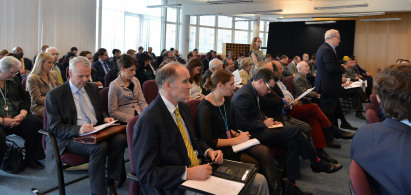
    Guests at a roundtable organised by the Vienna Center for Disarmament and Non-Proliferation (VCDNP) on November 19, 2015. Image credit: Flickr

    Based on ‘the resurgence of state-based threats’, Professor Wyn Bowen argues that the UK’s recently published 2015 Strategic Defence and Security Review (SDSR) has ‘brought deterrence back to the centre stage for the United Kingdom more than any other time since the end of the Cold War’.

    At the same time, in the UK, the recently elected leader of the Labour Party, Jeremy Corbyn — a long-standing opponent of nuclear weapons and vice president of the Campaign for Nuclear Disarmament (CND) — has stated that he would not condone the use of nuclear weapons if he were elected prime minister. Corbyn’s Trident statements have clearly ruffled feathers amongst some in the military and political establishment, with a parliamentary ‘Main Gate’ decision on renewing the UK’s nuclear weapons system confirmed for 2016.

    Despite Corbyn’s recent statements, elite debates have largely remained limited to discussions of whether the UK should build four new nuclear-armed ballistic missile submarines in order to ensure continuous at sea deterrence (CASD).

    Another key debate within NATO concerns how the alliance might re-articulate, refresh and clearly communicate its nuclear posture to reflect the current geo-strategic environment. NATO’s former Deputy Assistant Secretary General for Weapons of Mass Destruction Policy and Director for Nuclear Policy, Guy Roberts, recently argued that ‘to be fully credible, NATO’s nuclear posture and policy needs to be firmly articulated and communicated to Russia and other would-be adversaries’.

    Furthermore, it was recently argued at the 2015 EU Non-Proliferation and Disarmament Conference that ‘we no longer have a debate about the potential withdrawal of’ the 160-200 theatre nuclear weapons (TNW) still in Europe. The debate instead now focuses on the role of nuclear deterrence in the broader defence posture of the NATO alliance. Guy Roberts argues that ‘if Russia continues to use nuclear threats and intimidation tactics, then the West will need to plan deterrence, response, and escalation control options that are credible and particularly tailored to the mindset of the Russian leadership. Otherwise, Russia may see its own rhetoric as validated and NATO as weak’.

    Possible ways forward

    So, what are possible ways forward vis-à-vis multilateral nuclear disarmament goals as mandated by the NPT in the current security environment? Given the re-ascendance of perceptions of imminent state-based security threats, how can we move from increasing frustrations among NNWS and procrastination or obstruction by states towards constructive engagement? Technical, legal and normative proposals exist to further progress towards nuclear disarmament commitments by NPT member states.

    Legal Approaches

    Many NNWS that are supporting the evolving Humanitarian Initiative are pursuing a legal measure that would ultimately delegitimise nuclear weapons use and possession. Proposals exist for a group of NNWS to pursue such a legal ban on nuclear weapons even without the participation of the five NWS and the other four non-NPT nuclear possessors (Israel, India, Pakistan and North Korea). Proponents argue that by concluding a legal ban, an international norm delegitimising nuclear weapons will be established, regardless of engagement by states with nuclear arsenals. The multilateral fora addressing nuclear disarmament have been subject to intense contention given the postures on this issue.

    As voted for by 135 states at the 2015 session of the First Committee, the 2016 sessions of the Open-Ended Working Group (OEWG) could serve as a multilateral forum for discussions on nuclear disarmament. This is a measure specifically taken to avoid the polarisation that has characterised the Humanitarian Initiative and the refusal of the NWS to engage with it. Since 2009, the five NWS have been pursuing their own discussions on disarmament, known as the P5 Process, with limited results even before the NATO/Russia schisms over Ukraine. It is still unclear whether the five NWS and some NNWS under extended deterrence arrangements (i.e. the other 25 NATO members plus other allies) would participate in the OEWG.

    In 2014, the Marshall Islands initiated a different legal approach towards demanding accountability vis-à-vis nuclear disarmament progress through the Global Zero lawsuits. Whether this approach through the lawsuits filed in the International Court of Justice will bring effective results – other than grabbing headlines and elevating the issue of nuclear disarmament on the international agenda – remains to be seen.

    While a nuclear ban may be a key long-term normative and legal aim for some NNWS, the Comprehensive Nuclear-Test-Ban Treaty (CTBT) (and its sophisticated International Monitoring System) is a realistic short-term objective. The CTBT is a developed and available legal and technical step towards nuclear disarmament. With the 20th anniversary of the CTBT due in 2016, its entry into force should be a policy priority for states looking to bolster the nuclear non-proliferation regime.

    In democracies at least, civil society and disarmament advocacy groups could funnel their energy and passion to promoting the establishment of the CTBT, educating the electorate on this issue and lobbying parliamentarians. With broad declaratory support voiced by NPT states parties (and Israel) for the CTBT, further ratifications of this treaty by states with some nuclear capabilities (called ‘Annex II’, including signatories China, Egypt, Iran, Israel and the US) would significantly strengthen the non-proliferation regime and states’ commitment to disarmament. Recent declaratory support by US officials (including Kerry, Gottemoeller and Moniz) and efforts to re-energise the CTBT debate in the United States are therefore a positive development.

    Technical Approaches

    Another approach to furthering progress vis-a-vis nuclear disarmament is the US-launched International Partnership for Nuclear Disarmament Verification (IPNDV). This initiative aims at addressing the technical challenges of disarmament verification, bridging NNWS’ and NWS’ understanding of the key measures and practical issues involved in verifying disarmament agreements. At a recent Vienna Center for Disarmament and Non-Proliferation event following the IPNDV’s November meeting in Oslo, US Assistant Secretary of State Frank Rose, provided an overview of the IPNDV. The Partnership made progress in establishing three Working Groups and authorised them to move forward with their important technical assignments. Rose believes that, by concentrating on technical tasks, the Partnership ‘can make real and important progress’ in achieving multilateral cooperation and towards realising disarmament goals.

    Several other pragmatic, technical proposals exist in support of reducing nuclear salience in security doctrines, including de-alerting arsenals and reducing stocks of delivery systems. In a recent Washington Post op-ed, former Defense officials William J. Perry and Andy Weber argued against the implementation of a US nuclear-armed cruise missile system which could heighten the risk of miscalculation by an adversary.

    From entrenched postures to dialogue

    Given the current deep divides on how to move forward on nuclear disarmament goals amidst heightened strategic discontents, pragmatic and confidence-building measures, including dialogue and trust-building activities, which enjoy broad support by international actors should be pursued. Frustrations, ineffective criticism and outright obstructions need to be channelled into constructive efforts, at the core of which should be frank and respectful dialogue. This applies to both sides of the debate. Only through unpacking the core assumptions underlying the extreme postures and perspectives on the perceived value of nuclear weapons, can these social constructs begin to be appreciated.

    Effective progress towards a secure world without nuclear weapons as the ultimate security guarantee and ultimate insurance policy remains a long and arduous journey that will require open minds, constructive dialogue and a mix of various technical and legal measures at the right time. The dislodging of deeply entrenched postures and institutional cultures won’t happen in the short-term, even if a normative and legal ban is attained by a group of NNWS.

    Following the outcome of the 2015 NPT RevCon, the five NWS are faced with the challenge of soothing perceptions of their lack of commitment to their Article VI obligation to pursue “a treaty on general and complete [nuclear] disarmament”. Whether the current international tensions between Russia and the West will test the NWS’s solidarity within the NPT P5 Process, as well as bilateral arms control measures, remains to be seen.


    Jenny Nielsen is a Postdoctoral Fellow at the Vienna Center for Disarmament and Non-Proliferation (VCDNP). Previously she was a Visiting Scholar at the NATO Defence College (NDC), Postdoctoral Research Fellow at the University of Queensland (UQ), Research Analyst at the International Institute for Strategic Studies (IISS), and Programme Manager for the Defence & Security Programme at Wilton Park.

    Nathalie Osztaskina is an Intern at the VCDNP. Her research focuses on disarmament efforts and the humanitarian movement, nuclear security, and promotion of CTBT’s entry into force. She worked previously at the Geostrategic Forecasting Corporation, doing research on the Russian-Ukrainian crisis.

  • Climate change

    Climate change

    Climate change is high on both domestic and international political agendas as countries face up to the huge environmental challenges the world now faces. Whilst this attention is welcome, less energy is being focused on the inevitable impact climate change will have on security issues. The well-documented physical effects of climate change will have knock-on socio-economic impacts, such as loss of infrastructure, resource scarcity and the mass displacement of peoples. These in turn could produce serious security consequences that will present new challenges to governments trying to maintain stability.

    Articles EXCLUSIVELY written for sustainablesecurity.org

    Issues:Climate change, Competition over resources, Global militarisation, Marginalisation

    To browse a list of all of the articles EXCLUSIVELY written for sustainablesecurity.org – follow this link

    Read more »

    Louisiana is Sinking

    Anna Alissa Hitzemann | | January 2013

    Issues:Climate change, Competition over resources, Marginalisation

    Hurricane Katrina and the sinking of coastal Louisiana stand as a reminder that we must address climate change, competition over resources and marginalisation as the root causes of conflict before it is too late.

    Most will remember the horrific pictures on the news in 2005 when hurricane Katrina struck New Orleans. Nearly 2,000 people died, thousands more were left homeless and displaced, the material destruction was catastrophic with damages well over $100 billion.

    Image source: Brother O’Mara

    Read more »

    Climate Change and Security Threats: Time to Call a Spade a Spade?

    Ben Zala | | January 2013

    Issue:Climate change

    As the devastating bushfires in Australia sharpen questions about the need for urgent action on climate change in that country, is it time to abandon the debate over the pitfalls of viewing climate change through a ‘security lens’?

    Image source: HighExposure

    Read more »

    Greener Cities: What We Can Do

    Anna Alissa Hitzemann | | October 2012

    Issues:Climate change, Competition over resources

    A recent article on this website entitled The United States, Niger & Jamaica: Food (In)security & Violence in a Globalised World explored some of the possible links between climate change, food insecurity and violence. Many current articles in the media warn of growing food insecurity as global warming and climate change have devastating effects on crops, livestock and even fisheries. A piece in yesterday’s Guardian states that if extreme weather becomes the norm (which it has) then “starvation awaits”.
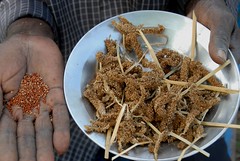
    Image source: Gates Foundation

    Read more »

    The United States, Niger & Jamaica: Food (In)Security & Violence in a Globalised World

    Anna Alissa Hitzemann | | September 2012

    Issues:Climate change, Competition over resources, Marginalisation

    The United Nations Development Programme (UNDP) defines food security as “all people at all times having both physical and economic access to the basic food they need”. However, due to a complex range of interconnected issues from climate change to misguided economic policies, political failure and social marginalisation, over 2 billion people across the world live in constant food Insecurity. It is important to take a sustainable security approach to look at the importance of “physical and economic access to basic food” by exploring the links between food insecurity and violence.

    Image source: Bioversity International

    Read more »

    Moving Beyond Crisis: Survival 2100 and Sustainable Security

    William Rees | Movement for a Just World | June 2012

    Issues:Climate change, Competition over resources, Global militarisation, Marginalisation

    In a piece for the International Movement for a Just World, William Rees maps out a vision for what he calls ‘Survival 2100.’ The goal of such a strategy would be “to engineer the creation of a dynamic, more equitable steady-state economy that can satisfy at least the basic needs of the entire human family within the means of nature.” The alternative, Rees argues is to “succumb to more primitive emotions and survival instincts abetted by cognitive dissonance, collective denial, and global political inertia.”
    Image source: hundrednorth.

    Read more »

  • National Security And The Threat of Climate Change

    National Security And The Threat of Climate Change

    Issue:Climate change

    CNA Corporation, a US Department for Defense funded think-tank, published this report in April 2007. The report was produced by CNA’s writers and researchers under the guidence of a Military Advisory Board (MAB) consisting of retired admirals and generals. 

    The report includes several formal findings:

    ►Projected climate change poses a serious threat to America’s national security.

    ►Climate change acts as a threat multiplier for instability in some of the most volatile regions of the world.

    ►Projected climate change will add to tensions even in stable regions of the world.

    ►Climate change, national security and energy dependence are a related set of global challenges.

    Download as PDF

  • Marginalisation of the majority world

    Marginalisation of the majority world

    A complex interplay of discrimination, global poverty, inequality and deepening socio-economic divisions, together make for key elements of global insecurity. While overall global wealth has increased, the benefits of this economic growth have not been equally shared. The rich-poor divide is actually growing, with a very heavy concentration of growth in relatively few parts of the world, and poverty getting much worse in many other regions. The ‘majority world’ of Asia, Africa and Latin America feel the strongest effects of marginalisation as a result of global elites, concentrated in North America and Europe, striving to maintain political, cultural, economic and military global dominance.

    Why Here, Not There? Investigating emerging nonviolent movements

    John Hopkins University | International Peace and Security Institute | August 2011

    Issue:Marginalisation

    The International Peace & Security Institute (IPSI), in collaboration with The Johns Hopkins University School of Advanced International Studies (SAIS) Conflict Management Program, hosted a high-level panel discussion and networking reception on Wednesday, August 17.  The event, “Why Here, Not There? Investigating emerging nonviolent movements,” examined the dynamics that enable nonviolent movements to occur in some regions and not others at specific moments in time.  The event was broadcast live nationwide and on the internet by C-SPAN.

    Watch the video here: IPSI

    Image source: Al Jazeera English

    Read more »

    Beyond ‘Controlling’ Global Refugee Flows: A Sustainable Security Approach

    Ben Zala | World Policy Blog | July 2011

    Issue:Marginalisation

    Writing for the World Policy blog, Ben Zala analyses the recent announcement of Australia and Malaysia’s agreement to “swap” asylum seekers. He argues that until legitimate attempts are made to address the factors driving refugee flows – such as on-going military conflicts, economic insecurity, and increasing environmental and resource constraints – the problem will only continue to get worse.


    Image source: United Nations. 

    Read more »

    Conflict, Poverty and Marginalisation: The case of Curvaradó and Jiguamiandó (Urabá, Colombia)

    Amira Armenta | Exclusively written for sustainablesecurity.org | July 2011

    Issue:Marginalisation

    In Colombia there are many regions where poverty and the absence, or weak presence, of the state has facilitated the emergence of violence by armed groups. Among these are the Afro-Colombian communities of the Curvaradó and Jiguamiandó in the Urabá region

    Image source: Yuliam Gutierrez

    Read more »

    The Geopolitics of Climate Change

    Chris Huhne | Department of Energy and Climate Change | July 2011

    Issues:Climate change, Marginalisation

    In a speech to Future Maritime Operations Conference at the Royal United Service Institute, London, Secretary of State for Energy and Climate Change examines the security implications of climate change:

    “We cannot be 100% sure that our enemies will attack our country; but we do not hesitate to prepare for the eventuality. The same principle applies to climate change, which a report published by the Ministry of Defence has identified as one of the four critical issues that will affect everyone on the planet over the next 30 years.

    Around the world, a military consensus is emerging. Climate change is a ‘threat multiplier’. It will make unstable states more unstable, poor nations poorer, inequality more pronounced, and conflict more likely. And the areas of most geopolitical risk are also most at risk of climate change.”

    Article source: DECC

    Image source: DECCgovuk

    Read more »

    Drought in east Africa the result of climate change and conflict

    Felicity Lawrence | The Guardian | July 2011

    Issues:Climate change, Competition over resources, Marginalisation

    Aid agencies say that weather in the region has become more erratic and years of war leave populations especially vulnerable

    Prolonged drought in the Horn of Africa is the immediate cause of the severe food crisis already affecting around 10 million people in parts of Kenya, Ethiopia, Djibouti and Somalia. Rains have failed over two seasons, with a strong La Niña event having a dramatic impact across the east coast of Africa. Now this year’s wet season has officially ended, there is little prospect of rain or relief before September.

    Article source: The Guardian

    Image source: Oxfam International

    Read more »

    Selling Nature to Save Nature, and Ourselves

    Stephen Leahy | Terraviva | July 2011

    Issues:Climate change, Competition over resources, Marginalisation

    Avoiding the coming catastrophic nexus of climate change, food, water and energy shortages, along with worsening poverty, requires a global technological overhaul involving investments of 1.9 trillion dollars each year for the next 40 years, said experts from the U.N. Department of Economic and Social Affairs (UN-DESA) in Geneva Tuesday.

    “The need for a technological revolution is both a development and existential imperative for civilisation,” said Rob Vos, lead author of a new report, “The Great Green Technological Transformation”. 

    Article source: Terraviva

    Image source: Paul Keller

    Read more »

  • Sustainable Security

    The beginning of the Arab Awakening and its mass-based social and political mobilizations has spurred a dynamic debate about whether and how the international community should support and back the revolutions across the Middle East and North Africa region. An especially thorny and controversial issue has been that of armed intervention: are there circumstances under which external parties should become militarily involved on the ground? If yes; with what goal? Debates over the legitimacy of direct external intervention have been widely discussed in the past few years; often with a specific reference to the emerging ‘responsibility to protect’ (R2P) norm.

    The concept itself began to be employed in the early 2000s as a term of reference to replace the more ambiguous and controversial ‘humanitarian intervention’ framework. The idea of R2P broadly posits that sovereignty, beyond rights, also encompasses duties; and specifically the obligation for each state to guarantee the safety and protection of its citizens. If the state is unable or unwilling to do so, the international community has a responsibility to assist it, and if these efforts also fail, outside intervention—including but by no means limited to military action—can become justifiable. Since the endorsement of the concept within the international community, first by the United Nations General Assembly and then by the UN Security Council (UNSC), the principle of R2P has been used to both stress individual countries’ obligations towards their own people, as well as to argue in favor of international intervention to uphold the principle.

    In this context, the UNSC’s authorization of the use of force in Libya is often cited as a watershed moment in the development of R2P. But did military intervention in Libya assist or hinder in the strengthening of a global ‘responsibility to protect’ norm?

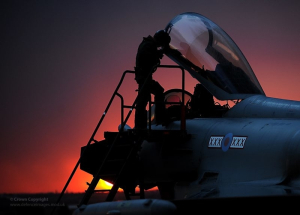
    A Royal Air Force Typhoon pilot enters the cockpit as the sun sets over Gioia del Colle, southern Italy. As RAF Typhoon aircraft play a greater part in deliberate targeting operations, where targets are pre-planned, more are carrying four of the 1000lb Enhanced Paveway II bombs. The aircraft's ability to use its Litening III targeting pod to direct the highly accurate bombs means that a single Typhoon can have a devastating effect on Qadhafi regime targets. This image is available for non-commercial, high resolution download at www.defenceimages.mod.uk subject to terms and conditions. Search for image number 45152844.jpg ---------------------------------------------------------------------------- Photographer: Sgt Pete Mobbs Image 45152844.jpg from www.defenceimages.mod.uk

    Image of RAF Typhoon pilot climbing into the cockpit before a mission over Libya by Defence Images via Flickr.

    To some observers, the Libyan intervention gave R2P the boost it needed. They argue that the principle itself was invoked to support external military intervention. Accordingly, this gave R2P ‘teeth’ whilst showing its growing international legitimacy and acceptance. Yet, a closer reading of the international community’s reliance on R2P in the weeks preceding Operation Unified Protector may lead to lesser enthusiastic evaluation. On the one hand, it is true that both UNSC 1970 (2011) and 1973 (2011) urged the government of Libya ‘to meet its responsibility to protect its population’ thus openly referring to R2P. On the other hand, when it came to justifying the use of force, the UN Security Council grounded its authorization on Chapter VII of the UN Charter, after labeling the violence taking place in Libya a threat to international peace and security.

    On balance, while the period leading up to NATO’s Operation Unified Protector did show a growing role and relevance for the R2P norm in the international arena; still it would be an exaggeration to say that military intervention was grounded solely (or even predominantly) on R2P. This is the case even though it is possible to justify Operation Unified Protector according the ‘R2P’ criteria: the intervention came in response to the Qaddafi government’s manifest brutality and unwillingness to halt targeting of its population and it was encouraged not only by prominent internal defections but also backed by significant regional support. The use of force was also directly authorized by the UNSC, though Resolution 1973 (2011). Finally, the official mandate of the operation, which included employing all ‘necessary means’ to protect ‘civilians and civilian populated areas under threat of attack’ was—despite being quite broad in its scope—was similarly in line with the R2P framework.

    But whether it would be correct to state that R2P was revitalized in the discussions leading up to the beginning of Operation Unified Protector, it is important to look at both the conduct and the legacy of the intervention to make a more long term assessment of its impact on R2P.

    Here the record is decidedly mixed. Operation Unified Protector’s mandate was about civilian protection, while explicitly excluding a military occupation of Libya and reiterating the international community’s commitment to ‘Libya’s ‘sovereignty, independence, territorial integrity and national unity.’ Yet in its actual military operations it is possible to see how the military mandate was gradually stretched beyond the original (or intended) boundaries, leading to the de facto pursuing of regime change in Libya. By the spring of 2011, military sorties against the regime’s military and communication gradually went beyond merely disabling the government’s capacity to harm the civilian population and directly focused on weakening the regime’s military capabilities, in turn key to shifting the balance of power against Qaddafi. This is especially the case as NATO’s military operations, including air-cover provision for opposition forces, went hand-in-hand with coalition members, like France or the UK, active train and equip programs of rebel groups.

    While these actions were not blatantly disregarding UNSC Resolution 1973—they indeed be seen as necessary to prevent and halt targeting of the civilian population—still they certainly stretched the mandate to ‘the absolute limit’—as argued by Gareth Evans. While such ‘mission creep might have been inevitable and dictated by the changing realities on the ground, still in NATO’s gradual expansion of its operations went de facto well beyond the UNSC 1973.

    In turn, this fueled criticism from countries like Russia or China, states that were already skeptical about the merits of the R2P framework and championing a much stricter interpretation of state sovereignty and the right to non-interference. Put simply, the ‘generous’ interpretation of the mandate in Libya contributed to further curb the international enthusiasm for the emerging R2P norm. It allowed countries like China to become even more skeptical and reluctant to authorize future ‘R2P’ operations, citing the risk that the limited mandate will be then extra-judicially expanded to pursue regime change. Criticism has also come from countries lacking a strong pro-state sovereignty stance. For example, Brazil has argued for the creation of stricter guidelines and monitoring mechanisms to prevent future unauthorized expansion of the norm.

    In this context, the Libyan experience has certainly not helped making the case for R2P or strengthening its popularity on the global stage. The general skepticism towards R2P in Libya undermined the level of international consensus for the R2P norm and laid the basis for the reluctance to authorize a similar mission in Syria. At the same time, it is important not to over-emphasize the link between Libya and Syria. Geopolitics explains the lack of R2P intervention and UNSC agreement on Syria better than international law. Here factors like the Syrian regime’s better air-defense system and military apparatus, the strong economic and political interests of countries like Russia in supporting the Assad regime, the more fractionalized nature of the anti-Assad opposition, and the far less prominent direct national interests of NATO member countries in Syria all help understanding the lack of agreement and decisive strategy to deal with the protracted and blood conflict.

    Still, Operation Unified Protector did not strengthen the overall stance of R2P on the global arena, while underlining some of the pre-existing dilemma related to humanitarian intervention, including how to prevent its politicization (or whether that is possible at all); how to ensure strict adherence to the mandate and how to remain engaged in the ‘day after’—another key shortcoming of the Libyan intervention.

    Dr. Benedetta Berti is a foreign policy and security researcher, analyst, consultant, author and lecturer. Her work focuses on human security and internal conflicts, as well as on post-conflict stabilization (specifically integration of armed groups, democracy/governance and crisis management and prevention) and peacebuilding. Dr. Berti is the author of three books, including Armed Political Organizations. From Conflict to Integration (Johns Hopkins University Press, 2013) and her work and research have appeared, among others, in Al-Jazeera, Foreign Policy, Foreign Affairs, the Wall Street Journal and The New York Times. She is a fellow at INSS, a TED Senior Fellow, a FPRI Senior fellow, a Young Atlanticist Fellow, a Körber Foundation’s Munich Young Leader and a member of the UN Alliance of Civilizations “Global Experts.” In 2015 the Italian government awarded her the Order of the Star of Italy (order of Knighthood).

  • Sustainable Security

    Engendering Peace? The militarized implementation of the women, peace and security agenda

    Almost 15 years after the first resolution to address women, peace and security, the agenda’s implementation is increasingly subverted by the militarised security paradigm. Implementing UNSCR 1325 has been interpreted as being about fitting women into the current peace and security paradigm and system; rather than about assessing and redefining peace and security through a gender lens. As a result, the opportunity to create a new recipe for peace and security, based on taking women’s perspectives into account, is being lost.

    Read Article →

    Security Sector Roles in Sexual and Gender-based Violence

    Democratic Republic of Congo’s sexual violence epidemic is not only a weapon of ongoing violent conflict but an expression of entrenched systemic problems. Indeed, sexual and gender-based violence (SGBV) is most commonly perpetrated by the security services in place to protect civilians. In Quartier Panzi in South Kivu province, innovative processes of security sector reform and strengthened police-civilian channels of communication may be providing an opportunity for change, argues World Bank adviser Edward Rackley.

    Read Article →