Blog

  • Sustainable Security

    Belize: challenges and contradictions in gang policy

    Like its neighbours in the northern triangle (El Salvador, Honduras and Guatemala), Belize has a high murder rate that is closely connected to the strong presence of gangs. But the character of gang activity in Belize is quite different from its Central American neighbours. Belize has pioneered some innovative solutions to the problem it is facing. But it will need to overcome the challenges of internal resistance and an acute lack of resources in order to address the political, economic and social issues that marginalise Belize’s large youth population.

    Read Article →

    The Costs of Security Sector Reform: Questions of Affordability and Purpose

    In considering security sector reform, questions of affordability have often been subordinated to questions of effectiveness and expediency. A recent series of reviews of security expenditures by the World Bank and other actors in Liberia, Mali, Niger and Somalia has highlighted several emerging issues around the (re)construction of security institutions in fragile and conflict-affected states.

    Read Article →

    Militarised Public Security in Latin America in Venezuela

    Across Latin America, governments are sending their militaries into the streets to act as de facto police forces in the face of disproportionally high crime and violence rates. This trend has been going on for several years, but has accelerated in 2013. With the move to deploy over 40,000 troops for citizen security in Venezuela, President Nicolás Maduro joined a growing list of leaders throughout the region that have relied on their militaries to carry out police duties. In the first of our two-part discussion ‘Countering Militarisation of Public Security in Latin America’, Sarah Kinosian discusses the conditions that are causing the trend to thrive.

    Read Article →

    Countering Militarised Public Security in Latin America: Lessons from Nicaragua

    Facing a myriad of public security challenges that have provoked some of the highest indices of crime and violence in the world, authorities in Central America have followed a variety of different responses, ranging from repressive and reactive policies to grass roots prevention. Of these approaches, the Nicaraguan National Police’s Proactive Community Policing model stands out due to the results it has achieved. In the second of our two-part discussion, ‘Countering Militarisation of Public Security in Latin America’, Matt Budd explores the lessons that Latin American countries can extract from Nicaragua’s unique approach to public security.

    Read Article →

  • Sustainable Security

    In order to persuade its allies in Israel and Gulf Arab states to support the Iran nuclear deal, the United States is relying on inducements of weaponry sales; this regional militarisation is further destabilising the wider Middle East region.

    The July 2015 international deal on regulating Iran’s nuclear programme, the Joint Comprehensive Plan of Action (JCPOA), looks to be a triumph for international diplomacy in a region that all too often sees diplomacy lose out to military force. However, in order to persuade its allies in Israel, Saudi Arabia and other Gulf Arab states to support the deal, the United States is offering ‘consolation packages’ of ever-higher quantities and qualities of weaponry.  This regional militarisation is further destabilising the wider Middle East region by fuelling an arms race and by increasing the attractiveness of hybrid or proxy warfare.

    16908600218_5cf4667ed9_k

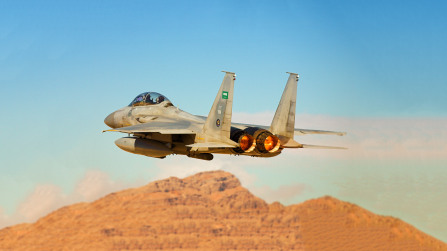
    A Saudi Air Force F-15. Image via Flickr

    Arms Sales to Gulf Arab States

    The six Arab monarchies that comprise the Gulf Cooperation Council (GCC: Bahrain, Kuwait, Oman, Qatar, Saudi Arabia, UAE) are enthusiastic consumers of weaponry, which they overwhelmingly procure from the US, UK and France. Saudi Arabia is by far the largest military spender and arms importer among them. According to the Stockholm International Peace Research Institute (SIPRI), the Kingdom’s record military expenditure of over $80 billion in 2014 made it the fourth highest military spender in the world, overtaking the UK and France. It is now the world’s second largest arms importer. The other GCC states are also major spenders: Oman is probably the world’s highest military spender by percentage of GDP, averaging 12% between 2010 and 2014; last year the United Arab Emirates’ military expenditure reached $23 billion and it has been the world’s fourth largest arms importer for a decade. Together, the GCC states account for about 12% of global arms imports. Only India imports more weapons.

    The Gulf States enjoy a close commercial and strategic relationship with the United States, which is manifested in the huge sums spent on US weaponry, and the fact that the US military overtly uses land, air and naval bases in at least five of the six Gulf Arab states; its ongoing presence in Saudi Arabia is much lower key. Despite this, there are limitations on the quality and quantity of weaponry that the US can sell to GCC states. This is because of the US’ ongoing commitment to maintain Israel’s ‘qualitative military edge’ (QME) over its regional adversaries.

    A term coined by Israel’s founding leader David Ben-Gurion in 1953, QME was formally written into US law by Congress in 2008. Legislation now states that the US President must carry out an ongoing ‘empirical and qualitative assessment’ of Israel’s QME over military threats to Israel, and this must be brought into consideration when assessing applications to provide military hardware or services to other countries in the Middle East. As the GCC states could in the future become adversaries to Israel, whose statehood none currently recognize and which Saudi Arabia and Kuwait opposed in the 1967 and 1973 wars, this has long restricted sales of the highest technology weapons, surveillance and targeting systems to Gulf Arab states.

    QME and anti-Iran Alignments

    Recent regional events, and the JCPOA in particular, have seen Israel and the Gulf States find themselves increasingly aligned against Iran. The Israeli leadership has been consistently critical of the deal while the Gulf States were hesitant to support it because of their fears that an economically, militarily and diplomatically resurgent Iran would dominate the Middle East region and potentially vie with them to become the US’ chief regional ally.

    Relations between Israel and the Gulf have long been shrouded in secrecy, although that does not mean they have not existed. From 1950 until Israel’s invasion of Lebanon in 1982, for instance, there was periodic Israeli involvement in the operation of the ‘Trans-Arabia Pipeline’ (Tapline), and throughout the 1990s Israel and various GCC states began to set up trade offices; various Gulf States have, at different times and to varying extents, had a hand in the Arab-Israeli peace process. In the last few years, Israel and the Gulf States have increasingly found their regional interests aligning; this came to the fore during the 2011 Arab uprisings when they argued that American policy was exacerbating regional instability.

    The coincidence of interests between Israel and the GCC was referenced by Israeli Prime Minister Binyamin Netanyahu in September; in a speech to the UN General Assembly he spent much of his time denigrating the Iran deal, but he also mentioned the ‘common dangers’ faced by Israel and Arab states, and his hope that they could build ‘lasting partnerships’ to counter such dangers. There has predictably been no discussion of any official agreement between Israel and any Gulf State, but rumours of potential partnerships have been germinating: one suggested that Bahrain, an island in the Persian Gulf, was looking to buy Iron Dome anti-missile defence systems from Israel; these reports were hotly denied by Bahraini officials.

    GCC Support for the Iran Deal

    Despite stiff and vocal opposition from the Republican majority in the Senate, Obama has recently signed waivers that would conditionally allow the lifting of US sanctions subject to Iran fulfilling its JCPOA obligations. An altogether different challenge for Obama was placating America’s allies in the Gulf.

    Although Obama was not reliant on the Gulf Arab States to approve the Iran deal, it was sufficiently controversial to dent relations between them and the United States. This was demonstrated in May of this year when Obama invited GCC leaders to Camp David, where he attempted to persuade them personally of the merits of the deal: new Saudi monarch King Salman pulled out of attending at the last minute. Those that remained were hoping for a formal security treaty that would bind the US to support the GCC militarily in the case of an attack, but the Obama administration eventually won their support with promises of ‘support and capacity-building’, which essentially boiled down to bigger, faster arms deals.

    King Salman has played a tough game with the Obama administration. After his no-show in May, the Saudis reminded the US that they do not rely exclusively on the American arms market when in June they conducted extensive talks with France, discussing the potential purchase of French civil nuclear technology and further arms deals, the immediate outcome of which was the French sale of $500 million worth of helicopters. Qatar and Egypt (likely financed by GCC patrons) have also made multi-billion dollar arms deals with France this year; as has Kuwait with Italy. There was also much talk of Saudi interest in Russian equipment during August.

    Salman eventually reconciled with the Obama administration during a lavish state visit to Washington in September. Before talks between the two heads of state, Obama administration officials confirmed that Israel would be the only regional recipient of the forthcoming F-35 stealth fighter; they can thus claim to be considering Israel’s QME. However, officials also said that Obama would discuss ‘a range of other options meant to bolster Saudi defences’. Salman ultimately professed to come away reassured that the Iran deal would ‘contribute to security and stability in the region’. His price for this statement was a reassurance from Obama that US weapons technology and systems would be fast-tracked to Saudi Arabia, and a free hand to use such weapons in the Saudi-led war in Yemen.

    Arms Sales and Geopolitics

    Obama’s solution to winning support for the Iran deal from the Gulf Arab States is inherently flawed. While Gulf Arab leaders, having been promised these deals, professed their conviction that the deal would lead to regional stability, the promise of further military hardware was nevertheless purported to be intended to help states repel potential attacks from Iran. Although the narrative of the Israeli and American right is that Iran wants nuclear weapons to destroy Israel, an alternative explanation is that it is the huge qualitative and quantitative superiority in conventional weapons by US-allied Sunni Arab states that has driven Iran’s desire to develop nuclear weapons capabilities.

    While the Iran nuclear deal may decrease the likelihood of a preemptive attack on Iran by either its Gulf Arab rivals or Israel, the escalating wars in Yemen and Syria indicate that Saudi Arabia and other conservative Arab monarchies (Morocco and Jordan have joined GCC allies in both interventions) are increasingly willing to employ a more interventionist approach in the region, both directly and via proxies, wherever they see the expansion of Iranian interests. This is facilitated by US weaponry, intelligence and diplomatic support.

    The war in Yemen has already had catastrophic humanitarian consequences, with at least 2,615 civilians killed and about 1.5 million people displaced. Reports suggest that larger quantities of US military hardware could be making their way to Syria after a 24 October meeting between US Secretary of State John Kerry and Saudi officials, including King Salman, to discuss greater support for ‘moderate’ Syrian rebels in response to Russian air strikes. The White House has claimed that Russia would not succeed in achieving a military solution to the conflict, but the United States is equally unlikely to enforce a military solution.

    The JCPOA is a diplomatic breakthrough that will likely be far more successful in reducing Iran’s capacity to develop nuclear weapons than air or missile strikes. However, while Iran can no longer look to the nuclear option to give it a military advantage, or parity, it may consider other options. The strategic alignment of Israel and the Gulf States means that Obama has greater leverage to use arms deals to maintain the support of his Gulf allies, but a result of these deals is that a huge amount of conventional weaponry is being poured into the Gulf and from there to regional conflicts.

    Many of these conflicts involve Iranian proxies, and Iran may compensate for its lack of either nuclear or conventional leverage by increasing military support for these proxies, including those in Syria and Yemen. The United States’ method of securing regional support for the JCPOA thus adds fuel to the fire of regional conflicts and humanitarian crises, and makes diplomatic outcomes, whether in Syria or Yemen, ever more distant.

    Finbar Anderson is Communications Intern with Oxford Research Group.  Having lived and studied in Egypt, he has recently completed a Master’s degree in History of International Relations, focusing on the politics of the Middle East, at the London School of Economics. 

  • Sustainable Security

  • Sustainable Security

  • Sustainable Security

    US Drone Strikes in Pakistan: ineffective and illegitimate

    Strikes by unmanned combat air vehicles, or armed drones, have become the tactic of choice in US counterterrorism efforts in Yemen, Somalia and, the topic of current controversy, Pakistan. The lack of transparency, dubious effectiveness, civilian casualties and negative consequences for US national security being highlighted by current debate means that Washington needs to re-evaluate its approach.

    Read Article →

  • Sustainable Security

    The ban on women serving in close combat units in the British military was recently lifted by former Prime Minister David Cameron. This marks a step towards bringing the British military into the modern age. 

    Background

    On 08 July 2016 at the NATO summit in Warsaw, then British Prime Minister David Cameron publicly announced a long awaited decision by the British military to remove all effective barriers for women to participate in combat jobs in the British Military. The decision came after a two-year in-depth study that examined multiple facets of the issue of women serving in combat related vocations, such as physiological problems, unit cohesion, recruiting, combat effectiveness, deployability, and survivability.

    The study determined that female physiology created a scenario that resulted in higher musculoskeletal injuries in physical training situations, but it also posited a solution.  The study further found that a decrease in injuries related to training has a direct impact on the ability for units to deploy and survive in combat situations. Moreover, the majority of injuries would be prevented by changing the way physical training is conducted and the way that combat gear is carried and used.  In an effort to “make the most of all their [women’s] talent”, while still retaining the high quality of the training of military forces, the British Military Service Chiefs have determined that operational standards will not be lowered to suit females who want to serve in combat roles.  They propose rigorous communication between soldiers and supervisors, specific training adapted to the physiology of all soldiers, the implementation of cultural change and cultural training, leadership training to increase unit cohesion, and a phased implementation of women in combat units.

    The move was hailed by many as a progressive step, bringing Britain into the 21st century while aligning the British military with their Canadian, Australian, and United States allies who have already moved to allow women to serve in combat roles.  Some critics, however, have cited long-held arguments, now largely disproven, as to why women should not serve in combat roles in the British military.  Retired Colonel Richard Kemp, former Commander of the British Forces in Afghanistan in 2003, claimed in several recent interviews that the inclusion of women in combat roles in the British Military will, inevitably, result in a lowering of training standards to ensure adequate female participation, despite definitive statements made to the contrary by the British Military Service Chiefs.  Critics of the move argue that currently only 4.5-5% of British women would be able to pass the requisite physical standards.  However, there is no comparable percentage for British males in the general population that would be able to meet the same standards.  Kemp further supposes that those women able to pass the inevitably lower training standards will “become the weak link in an infantry team” thus fostering resentment among their male colleagues, another claim that does not appear to hold up under serious and critical scrutiny.

    Arguments Women in Combat

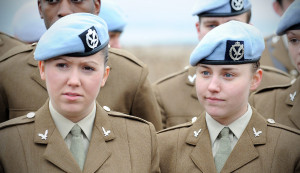
    Servicewomen of the Army Air Corps are pictured on parade at Middle Wallop airfield in Hampshire. The Army Air Corps (AAC) operates alongside the other Combat Arms of the Infantry and Royal Armoured Corps. Combat Arms are those forces that use fire and manoeuvre to engage with the enemy with direct fire systems. The forces providing fire support and operational assistance to the Combat Arms are called Combat Support Forces. ------------------------------------------------------- © Crown Copyright 2013 Photographer: Peter Davies Image 45156340.jpg from www.defenceimages.mod.uk Use of this image is subject to the terms and conditions of the MoD News Licence at www.defenceimagery.mod.uk/fotoweb/20121001_Crown_copyright_MOD_News_Licence.pdf For latest news visit www.gov.uk/government/organisations/ministry-of-defence Follow us: www.facebook.com/defenceimages www.twitter.com/defenceimages

    Servicewomen of the Army Air Corps on parade. Image (cropped) via Flickr.

    The first type of argument against women serving in combat roles cites the biological limitations of the female body in combat operations.  In the case of the British military, criticisms of the biological limitations of women are frequently related to physiology.  Essentially, the arguments against women serving in combat relate to the frequency of musculoskeletal injuries caused by disproportionate upper body strength and lower load bearing ability seen in training.  While raw data obtained from a two-year study tends to support the assertion that females are more prone to musculoskeletal injuries during training, the solution to the issue is not to deny women the opportunity to serve in combat roles, but to modify physical fitness training so that the potential for injury is minimized while the benefit to physical fitness is maximized.  Studies of modified physical fitness training has shown to reduce injuries by over 47% among both men and women.

    The second type of argument against women serving in combat roles cites the psychological limitations of female psyche in combat operations.  In particular, these arguments stress the sensitivity of women, their “natural” tendency to nurture, and an asserted inability to perform under intense pressure.  Setting aside the fact not all women are nurturers, it has been proven time and again that women can and do perform well in combat.  Women have seen combat in both Iraq and Afghanistan, largely due to guerilla warfare and insurgency tactics, and have performed well in those instances.  In one case, USMC 2nd Lieutenant Rebecca Turpin was directing a convoy that fell victim to multiple IEDs and an ambush but successfully escaped the situation with her convoy, receiving the Navy and Marine Corps Commendation Medal with a distinction for valor.  In another case, US Army PFC Monica Lin Brown was awarded the Silver Star for providing lifesaving medical care under direct mortar fire (6 women who fought in direct combat). Furthermore, studies in the US have shown that women and men who experience combat develop Post-Traumatic Stress Disorder (PTSD) at similar rates, but note that males disproportionately deal with this trauma by turning to alcohol and violence while females tend to take advantage of available mental health resources.

    A third type of argument against women serving in combat roles cites the biological effects that the physical presence of women will have on male soldiers.  Critics like Colonel Kemp have claimed that the presence of a female in a combat unit will distract male soldiers because the development of romantic feelings is inevitable in such circumstances.  These arguments rest on a few critical assumptions: 1) that all male soldiers are heterosexual (and not attracted to their male colleagues), 2) that male soldiers will find any female in their combat unit romantically attractive, and 3) that male soldiers will not be able to control their own desires when they encounter female soldiers.  Biological effects arguments also include arguments claiming that the inclusion of women in combat roles will increase incidences of sexual assault in combat units.  Some arguments further claim that, because many of the military actions in the world today are occurring in cultures that prize heteronormativity, female soldiers will not be accorded the same respect as male soldiers, and in fact, may be victims of sexual assault if captured.  This phenomenon that has anecdotally and repeatedly been shown to be a false assumption not based on an understanding of cultural practices in these regions that view all soldiers, regardless of sex, in a masculine sense.  These arguments are a shrouded attempt at victim blaming, in which it is the fault of the sexual assault victim that she (or he) was assaulted in the first place, rather than placing the onus for the act on the perpetrator.  The remedy for the phenomenon of combat rape is two-fold: develop reporting procedures that not only protect the victim but also vigorously prosecute cases of sexual assault if and when they occur, and work to change the pervasive masculinist and sexist culture that is pervasive in military units.

    The final strand of arguments against women serving in combat roles cites the psychological effects that the physical presence of women will have on male soldiers in combat.  These arguments tend to assume that males will see themselves in a chivalrously protective role over their fellow female soldiers, and will experience significant stress when and if those female soldiers are injured or killed in combat.  Given the large portion of male combat soldiers returning home with PTSD related to the trauma of seeing their male colleagues injured or killed, it may be that the issue with psychological trauma is not so much the biological sex of the injured soldier but the effect of witnessing the trauma happen in the first place.

    Notable Criticism

    Kemp’s arguments follow four familiar strands of objection that have been argued in all countries where the participation of women in combat has been the subject of consideration.  They assert rather archaic notions of physical and mental inability of women to work effectively with their male counterparts, and emphasize how the well-intentioned male combat soldiers will be forced to change their ways to accommodate females in combat.  Notwithstanding the fact that the basis of each of his arguments has been refuted by an intensive, multi-modal, scientific study of the effects of the participation of women in combat, Kemp and others sharing his sentiments continue arguing against proponents of inclusion considered to be “politicians desperate to be seen as ‘progressive’, feminist zealots, and ideologues hell-bent on equality of opportunity without exception”.

    Current Studies

    A study by Ellen Haring (What Women Bring) found that collective unit intelligence increased with an increase in the percentage of women in the military unit.  Her study further showed that, in cases where women were allowed to participate in combat vocations, they performed just as well as, or even better than their male colleagues, earning high distinctions while under direct fire from enemy combatants.

    Allowing and encouraging women to take on combat vocations in military units is a large step towards reducing rampant sexism and misogyny in the military.  But again, it is only one step.  Additional work will need to be done to change a military culture that is traditionally sexist and even misogynistic.  Time will tell if the British military will have the same success of integrating female soldiers into combat vocations as Australia, Canada, and to a lesser extent, the United States.  Two things are certain, however: The British military is well informed on how to make the transition as easy and as effective as possible, and they are not afraid of making the changes necessary to bring the British military into the modern age.

    Lisa DeLance is a Ph.D. Candidate at the University of California, Riverside studying Mesoamerican Archaeology. Her dissertation project examines the social and political implications for the use and deposition of ceramic figurines at the site of Cahal Pech, Belize. As a graduate student, she authored the entry for “Women in Combat” for the international Encyclopedia of Gender and Sexuality Studies, published in 2016. She obtained her Bachelor’s degree from the University of Minnesota in Sociology of Law, Crime, and Deviance where her research focused on gendered power relations during the Chinese Cultural Revolution. An Iraq War veteran, DeLance is especially interested in the institutionalized use of power and the intersections between the use of power, gender, and sexuality.

  • Sustainable Security

  • Sustainable Security

    This interview was conducted by the Remote Control project. 

    Tara McCormack is Lecturer in International Politics at the University of Leicester.

    In this interview, Dr McCormack discusses the British military interventions in Libya, Iraq and Syria, the shift that these interventions mark away from the longstanding Royal Prerogative on war-making and how the use of remote warfare is effecting the democratic oversight of the use of military assets in conflict.


    Q. In Britain, the power to declare war and deploy troops in conflict is one of the few remaining Royal Prerogatives. Recently, however, British military interventions in Iraq, Syria and Libya were all first put to a vote in the House of Commons. Did these cases mark a move towards greater democratic oversight of the decision to go to war in Britain?

    The Royal Prerogative (RP) is a set of (not fully defined) powers that used to belong to the Monarch but are exercised by the government and Prime Minister. In essence, the RP allows the Prime Minister to make a decision without consulting Parliament or even his/her Cabinet. The power to commit armed forces to a conflict is one important RP power. Since the end of the Cold War the RP has been seen to be increasingly problematic for a number of reasons to do with a decline in trust in government and broader problems of legitimacy.

    The power to take the country to war has been seen as particularly problematic and during the 90s and 00s there were a number of Parliamentary debates and reports that considered this question of the Prime Minister’s power to declare war without broader Parliamentary authorisation.

    However, historically when Britain has gone to war, although Parliament has not voted on the decision it has been customary for some kind of debate to take place, often as the military action has begun. This was so for the Kosovo (1999) war. In March 2003, under pressure from a number of MPs, Tony Blair agreed to a vote on a motion about British military intervention in Iraq on the eve of the American invasion.

    The Conservative Party pledged that if they came to power would make it a matter of course that Parliament would have a substantive vote on taking Britain to war, and this was done over the Libyan intervention and then Syria. The debate and vote to go to war in Syria received a great deal of media coverage and was reported on hour by hour as indeed was the vote to go to war and even the first military planes that flew.

    This new parliamentary convention on authorising military intervention is now well established.  It is a very important convention as, in principle, this new parliamentary convention gives democratic authority and legitimacy to decisions to commit British armed forces to war.

    However, at the same time there has been another significant trend in warfare, and that is that governments are increasingly using methods of intervention that are in essence ‘off the books’, for example the increasing use of special forces, or drones. Paul Rogers has called these modes of intervention ‘security by remote control’. This is an excellent phase as it highlights the way in which these methods of intervention allow governments to intervene militarily but without the clear lines of public and democratic accountability that more traditional methods entail.

    Q. Why do you think there was this shift towards making the process of going to war more democratic under the Conservative Party?

    The shift away from the Royal Prerogative (RP) has been an on-going process since the end of the Cold War for the reasons I mentioned in my first answer, in particular questions of trust and legitimacy combined with a number of observable changes in voting behaviour, e.g. falling voter turnout, increased voter volatility and so on. What we see from the mid-90s are a number of parliamentary debates and reports about what is perceived to be the problem of the RP in this context. Of course, the decision to take a country to war is something that is particularly problematic in a context in which there seems to be a loss of trust in the government.

    I think that the reason why the Conservative Party made it an explicit pledge was not that Hague and Cameron (for example) were greater democrats than Blair and New Labour, but because of this on-going debate within the political elite about the RP.

    Q. Could the high financial, human and regional geopolitical costs of the Iraq War may have also contributed to the shift away from the Royal Prerogative?

    I do think that the Iraq War has been significant in terms of British politics certainly. The Iraq War, the ‘dodgy dossier’ and Blair’s claims exacerbated the problem of trust and raised a question over British military intervention.

    However, I do want to stress that the underlying dynamics behind the new parliamentary convention are pre-Iraq, e.g. loss of trust in government, as is clear from the debates and discussions in the House of Commons.

    I think it is also worth remembering that many of our politicians have ‘mis-remembered’ the Iraq debate and the immense political support there was for this most disastrous intervention.   Tony Blair did hold a debate and vote on the Iraq intervention (albeit on the eve of military action). There was strong support for the intervention. But there were some brave voices arguing against the intervention whatever the ‘evidence’.

    It is easy now to blame Tony Blair and his ‘dodgy dossier’ for all the ills in British politics.

    Q. So how is this use of ‘remote warfare’ affecting the democratic oversight of armed conflict in the UK?

    I think that the shift towards what Paul Rogers has called ‘remote control warfare’ means that there is less democratic oversight of armed conflict in the UK. This is because methods of intervention such as the use of special forces, drones and also cyber warfare are carried out with little public scrutiny or political debate.

    It is not that information about these methods of intervention is impossible to find out, it can be found out through Freedom of Information requests, and sometimes Parliamentary questions and similar. However, compared to the very public political debate and media coverage about what might be called traditional modes of military intervention, there is very little public knowledge or scrutiny or indeed, crucially, parliamentary debate.

    Q. Due to remote warfare often being highly secretive, public knowledge of the UK’s use of this tactic may be limited. But is there any reliable data on the British public’s views of remote warfare and the democratic oversight of this practice? For example, are there any opinion polls on the British public’s attitudes to security, armed forces and democratic oversight?

    That is a really important question. As far as I am aware this is not something that has been fully investigated yet but it is something that needs to be looked at.

    There are polls and surveys that look at public attitudes to armed conflict. Basically, British people are reluctant to intervene militarily (the idea of the ‘post-heroic’ West is more or less true) in particular for ‘wars of choice’.  So for example, a recent Gallup International poll found that only 27% percent of British people would be willing to fight for their country. A YouGov poll found a minority in favour of Britain attempting to influence events around the world.

    Interestingly, however, the YouGov poll has found that whilst the majority of people oppose sending regular troops to somewhere like Syria, 60% support airstrikes or use of drones (note this is against ISIS not Assad).

    This suggests that public perception is that intervention by remote control is less consequential than conventional intervention. However, I would suggest that this is not the case and that the consequences of warfare by remote control need to be more openly discussed.

    Q. The Foreign Affairs Committee’s (FAC) recent report on the 2011 Libyan military intervention acknowledged the presence of UK special forces currently operating in Libya, which is arguably a surprising move given the ‘culture of no comment’ surrounding UK special forces. Looking to the future, do you feel that this may offer some grounds for optimism or do you think that the erosion of the democratic oversight of Britain’s military actions will continue?

    Yes I noticed that and also that the FAC report specifically mentioned that this is not really publicly scrutinised. The thing about ‘remote control warfare’ is not that it is totally unacknowledged, information does come out in reports (such as the FAC report on Libya), FoI requests (the website Drone Wars is very good on this) but it is very limited. Compare, for example, the high level of debate and discussion given to Britain’s decision to launch airstrikes on Syria, and of course the vote under the new Parliamentary Convention.

    I just do not know the answer to the final part of the question, it depends on so many factors. Certainly it is something that I think is very important to get into the public realm as much as possible.


  • The silent crisis: Global water scarcity reshaping future foreign policy

    The silent crisis: Global water scarcity reshaping future foreign policy

    Dr David Tickner & Josephine Osikena | The Foreign Policy Centre | September 2010

    Issue:Competition over resources

    Understandably, the world has become increasingly preoccupied with risk and insecurity. The uncertainties produced by global challenges such as financial crises, economic slowdowns, health pandemics, the international narcotics trade, terrorism and conflict and indeed the impact of climate change are just a few pressing examples causing concern. However, the earth’s environmental resources are increasingly under enormous strain and nowhere is this stress more apparent than in the case of the earth’s finite supplies of freshwater.

    WHY WATER? WHY NOW?

    Less than three per cent of the earth’s water is potable and 2.5 per cent of this freshwater is inaccessible, locked up in Antarctic and Arctic ice sheets and glaciers. In addition, fewer than 10 countries hold 60 per cent of the world’s available freshwater supplies: Brazil, Russia, China, Canada, Indonesia, U.S, India, Columbia and the Democratic Republic of Congo. The uncertainties, insecurities and scarcity produced by insufficient access to water and its poor management extends beyond national borders, generations and population groups, albeit in different ways. Without decisive collective action, access to freshwater will become increasingly limited and the growing risk of water scarcity more widespread.

    Water, which is such an integral part of the planet’s social, economic, political and environmental wellbeing, has for too long been overlooked as a major cause of global uncertainty and insecurity. This is despite the fact that its increasing scarcity has led to a silent crisis, which although many argue is preventable, continues to be ignored.

    THE CHALLENGES

    How can access to freshwater be secured when and where it is needed, and how can the competing demands for freshwater from the environment, agriculture, industry and households be more effectively managed? More importantly, in an increasingly interconnected world where co-operation is not just an option but an absolute imperative, how can future foreign policy tackle the challenges thrown up by the world water crisis?

    In a collection of essays recently published by the Foreign Policy Centre (FPC) in partnership with WWF-UK, a diverse range of authors endeavoured to explore the most significant foreign policy impacts created by water scarcity under the aegis of three overarching themes.

    1. TACKLING 21st CENTURY CHALLENGES

    WATER, PEACE AND SECURITY

    The potential disputes over shared water resources may not have produced outright conflict, but tension is often masked by cooperation between unequal powers which can fuel social and political instability and violence within and between states. All of this will be compounded by increasingly acute climate constraints. There are particular high risk regions such as Darfur, Yemen, Nepal and Bangladesh where the effects of too much (floods) or too little (droughts) water are testing peoples’ resilience and ability to adapt. In such cases good water management is an important part of peacebuilding and can only be delivered through insightful political leadership.

    WATER SCARCITY AND ENERGY SECURITY

    There is an inextricable link between energy and water. Water cannot be secured without employing energy and energy cannot be produced, transported or distributed without water. The interdependence of energy and water exists in a world confronted by an age where natural resources have become increasingly scarce due to pressures from the explosive growth in the earth’s population, as the world becomes rapidly industrialised and urbanised. The implications for securing affordable, reliable and sustainable access to water is momumental but not beyond reach with the help of new investment strategies to improve water use.

    FARMERS AND LIVELIHOODS

    About 70-80 per cent of freshwater taken from rivers or aquifers in the developed world is used for irrigation. In other words, the amount of water required for one hectare of irrigation in hot climates is about one litre per second every second of the day. Farmers are the main managers of water world-wide, employing 80 per cent of the water used by society. How can irrigation knowledge and affordable investment strategies be developed to produce more food with much less water? In addition, in regions such as West Africa where nine countries depend on the Niger River, the availability of water is not necessarily scarce, but effective governance is. Therefore an urgent priority is to identify how the most optimal water management investment choices can be made.

    2. GOVERNANCE AND INVESTMENT IN WATER MANAGEMENT

    WATER SECURITY AND TRADE

    In examining the economic imperative for managing water wisely there are a number of critical issues. Can international trade in food commodities deliver food and water security for the rural and urban poor in the developing world and does this process improve access to international markets and ultimately providing an exit out of poverty for poor people? Current evidence suggests this is not the case but the question is could it?

    WATER SCARCITY AND BIG BUSINESS

    Water scarcity has particular relevance for big business. The uniqueness of water as a natural and irreplaceable resource that is impossible to substitute, underlines a shared risk to business and other water users and a collective business case for better water managementpPrivate sector investment in a new approach to water stewardship needs to look beyond volumes of water used to consider the impact of water use on natural and economic systems. Such an approach supports the development of an locally-appropriate, equitable and transparent regulatory framework to help allocate water to different users. Above all however, such a stewardship ethic demands strong and autonomous political water management institutions that not only have the technical capacity to secure greater outputs for every litre of water used, but can also rigorously enforce fair and sustainable water allocation for all.

    3. WATER AND HABITATS FOR PEOPLE AND NATURE

    SHIT MATTERS!

    Every US$1 spent on water and sanitation yields a return of US$8- US$10 in economic development in poor countries. The impact of improving the provision of safe drinking water and appropriate sanitation facilities in poor countries is a cornerstone for economic development transformation. Yet, while the controversy surrounding the public and private sector provision of water and sanitation is complex, such issues need not be allowed to hijack the debate when improving provision for those most in need is an urgent challenge.

    WOMEN AND WATER

    The central role women play in tackling the crisis in global water management cannot be underestimated. Yet, women’s rights are often conspicuously absent from water management decision-making, be it on a local, national, regional or global level. The challenge is, how can women be supported to have a greater voice, commensurate with their knowledge and expertise as primary users of water resources in many communities around the world?

    GLOBAL MEGACITIES

    By 2030 water supplies will only satify 60 per cent of global demand. This will be compunded by the fact that by this year over 60 per cent of the world’s population will live in urban areas. The realities of water scarcity in the sprawling megacities that have sprung up across the developing world accelerate the need for better sustainable water management in emerging urban areas.

    THE NATURAL ENVIRONMENT

    Nature is being squeezed by humankind’s increasing demand for freshwater. In essence, the impact of water scarcity on species and on natural river, lake and aquifer systems is a phenomenally neglected priority requiring urgent action. After all, these rivers, lakes and aquifers are the very sources of our water. If they dry up, we do too.

    As Hilary Clinton has said, the challenge of tackling management of freshwater supplies in an age of growing scarcity will increasingly be a front-burner issue. The question is, can future foreign policy be reshaped and recasted to tackle this challenge?

    Dr David Tickner, is Head of Freshwater Programmes, WWF-UK.

    Josephine Osikena is Director of The Foreign Policy Centre.

    Article Source: The Foreign Policy Centre

    Image Source: darkpatator

    Comments

    Post new comment


  • Sustainable Security

    Summary

    The appalling attack on concert-goers in Manchester will be the defining news event of the 2017 general election campaign. Yet polls suggest that the attack has not shifted popular opinion in the predictable direction of a “strong” incumbent government characterised by muscular counter-terrorism interventions at home and abroad. After sixteen years of “war on terror” a clear difference has emerged between the leadership of the two main parties on the consequences of this open-ended war. Whoever wins the election, the longer term opening up of space for discussion on Britain’s security narrative can only be good for British democracy and wider security.

    Introduction

    In the middle of April 2017 the British Prime Minister, Theresa May, called a general election when the Conservative Party was more than 20 points ahead of the opposition Labour Party in the opinion polls. Mrs May already had a reasonable working majority in parliament and the election was essentially called over the issue of the Brexit negotiations, the stated aim being to provide a “strong and stable” government before the full negotiations started.

    Given that the Labour Party was riven with divisions over both policy and the leadership, and with leader Jeremy Corbyn widely characterised as unelectable by the majority of the print media, the expectation was that a landslide victory was highly likely. That outcome has diminished during the course of the campaign and at the time of writing (eight days before polling), the Conservatives do seem likely to be returned to power but with a much smaller than expected majority. Even a hung parliament is now regarded by some analysts as possible if rather unlikely.

    Following the Manchester Arena attack this briefing examines the election campaign so far with particular attention to security policy issues and considers whether some of the arguments raised will have a longer-term post-election influence on the debate around security, whichever party wins on 8 June.

    Manchester and after

    Image credit: Pimlico Badger.

    On the evening of 22 May and right in the middle of the election campaign, a bomb was detonated at a popular music concert at the Manchester Arena by a British Islamist of Libyan origins, killing 22 people and injuring over a hundred. Many of the casualties were young girls because the lead performer, Ariana Grande, was particularly popular with such an audience. The attack received world-wide media coverage and was the worst of its kind within the UK since July 2005 when 52 people were killed in four bomb attacks in London on three underground trains and a bus.

    Because of the severity of the attack and the terrible consequences, nation-wide election campaigning was suspended by the main parties for three days, resuming on 26 May. On that day the Prime Minister was at a G7 Summit at Taormina in Sicily and calling for increased support for cyber security, not least in response to terrorism. On the same day Mr Corbyn made a speech in which he suggested that a UK foreign policy involving substantial military interventions across the Middle East, North Africa and South West Asia was not necessarily the right approach and might even increase the risk of attack. The speech was roundly condemned by those of a conservative persuasion, but early opinion polling suggested that Mr Corbyn’s scepticism about the outcome of the war on terror resonates with many voters or, at least, has not been the electoral impediment that conventional wisdom has long assumed.

    Whatever the result of the forthcoming election, the terrible attack in Manchester and the subsequent discussion on how to make Britain more secure will have a long-term impact on security thinking, not just because of this difficult period but more because of a very clear difference that has emerged between the leadership of the two main parties. The Conservative Party has taken a traditional line on the need to maintain strong defences, to work to destroy the main terrorist movements such as the so-called Islamic State (IS) and to increase defence spending, not least in relation to what is seen as an emerging Russian threat. With Britain part of a coalition facing major challenges from IS and from Russia, a re-elected Conservative government is presented as essential.

    This approach is generally popular and would be expected to be a vote-winner, which makes it even more interesting that the Labour Party’s manifesto has put much more emphasis on an increased commitment to peacekeeping, conflict prevention and conflict resolution. Perhaps more significant in the long term was a speech made by Jeremy Corbyn at Chatham House on 12 May. This was his main foreign policy presentation of the whole election campaign – indeed, it followed a long period of near silence from the shadow cabinet on foreign and defence issues – and was notable for taking a very different view to the political norm. His approach was summed up early in the speech:

    “Too much of our debate about defence and security is one-dimensional. You are either for or against what is presented as ‘strong defence’ regardless of what that has meant in practice. Alert citizens or political leaders who advocate other routes to security are dismissed or treated as unreliable.”

    His views on the war on terror were unequivocal:

    “This is the fourth general election in a row to be held while Britain is at war and our armed forces are in action in the Middle East and beyond. The fact is that the ‘war on terror’ which has driven these interventions has not succeeded. They have not increased our security at home – many would say just the opposite. And they have caused destabilization and devastation abroad.”

    Corbyn’s speech represented a radically different position to that of the Conservatives with their very clear approach to international issues encapsulated in that core election theme of “strong and stable”, implying a continuing of the rigorous pursuit of a military victory against IS supported by a robust commitment to a well-funded counter-terrorism system at home. Corbyn’s further speech four days after the Manchester atrocity, while roundly condemning the appalling act, did not stray from the central theme of his Chatham House speech of the urgent need to rethink the UK’s approach to IS and like-minded paramilitary groups.

    In all normal circumstances in the current UK political environment, the government of the day would expect to gain plenty of electoral support for its security posture, and the Conservative government, especially, would expect increased support in the aftermath of the Manchester attack. That may well be the case as the last week or so of the election campaign plays out, but what happens in the longer term may prove to be much more significant.

    Mr Corbyn, essentially, has adopted a very different approach to international security and whether it will open up space for longer-term political discussion may not be dependent on the election result. This is no place to predict outcomes and there are, broadly, three possibilities – Labour gets a disastrous result in line with polls at the start of the campaign and Mr Corbyn stands down; the Conservatives win narrowly in which case he will almost certainly stay; or there is a hung parliament in which case he may succeed in forming a minority administration with a second election in the autumn the outcome.

    In all three cases, including the first, what the Chatham House speech may have done is to open up the debate on UK security in a manner which more truly reflects the unease that many people feel about the approach in recent years to responding to IS, al-Qaida and the like. It is the opening up of space that is significant here, combined with what is clearly the current prospect of very long drawn-out wars from Libya through to Afghanistan.

    Equally in all three electoral outcomes, but particularly the third, a serious reconsideration of the UK’s security narrative would probably receive backing from the other parties of the left and centre. The Greens have a particular interest in conflict resolution. The SNP, though strongly protective of Scottish military units and industries, is overt about combating IS by “more than military means”. The Lib Dems seem torn between counter-terrorism, liberal interventionism and conflict prevention narratives, albeit committed to multilateralism and human rights. There may therefore be something of a consensus across a significant part of the political spectrum that sees itself in different ways as the “progressive” wing of UK politics.

    If IS and like-minded groups were on the verge of a final defeat with no prospect of their being succeeded by other movements, then the current government approach would be largely accepted. Further debate would be unlikely and other approaches to security “dismissed or treated as unreliable” as Mr Corbyn put it.

    There are, though, plenty of indications that IS and the rest are not ceasing to pose a threat to the Levant or the West, the Manchester attack being just one grim example. In Iraq, Mosul has not yet fallen after eight months of intense fighting in spite of the Iraqi government expecting the operation to be finished within three months. In the process, the Iraqi Army’s elite Special Forces have taken severe casualties calling into question the ability of the government to maintain control once Mosul does fall. Elsewhere in central and northern Iraq, the government relies on some very dubious, often sectarian militia allies. In Egypt President Sisi faces a growing IS-linked insurgency, and the Libyan link with the Manchester bomb is a reminder of the parlous state of that country. There remain serious security concerns in at least a dozen countries, not least Afghanistan, Nigeria, Somalia, Yemen, Bangladesh, Thailand, the Philippines and Indonesia. Western coalition states involved in the fight against IS all fear internal attacks.

    Conclusion

    Thus, after more than fifteen years of the war on terror, failed or failing states in Iraq, Afghanistan, Syria, Libya, Yemen and Somalia, close to a million people killed and over eight million people displaced, the argument for some serious rethinking on Western approaches to security is hardly difficult to make.

    This is where Jeremy Corbyn’s Chatham House speech is so significant since it breaks away from a near-universal Western state consensus and may be much more in tune with what many millions of people may be thinking. Whatever the outcome of the general election next week, space has been opened up for much wider debate. Independent organisations such as Oxford Research Group that take a critical but constructive approach to security will have a particular responsibility to aid the quality of that debate.

    Paul Rogers is Global Security Consultant to Oxford Research Group and Professor of Peace Studies at the University of Bradford. His ‘Monthly Global Security Briefings’ are available from our website. His new book Irregular War: ISIS and the New Threats from the Margins will be published by I B Tauris in June 2016. These briefings are circulated free of charge for non-profit use, but please consider making a donation to ORG, if you are able to do so.