Blog

  • Iraq

    At the beginning of February, ISAF sources announced that a major military offensive was about to be mounted in Helmand Province in southern Afghanistan. This was Operation Moshtarak (“together”), involving 15,000 US, British and Afghan National Army troops, and would concentrate on clearing Taliban and other paramilitary groups from two areas, one of them centred on the town of Marja. The publicity given to the operation appeared designed partly to encourage civilians to evacuate areas under Taliban influence, but would also serve to highlight the capabilities of coalition forces at a time when support for the war in the United States and Britain was fragile.

    Given the size of the operation, it is likely that it will provide a major focus for western media attention for some weeks, but to get a full measure of its significance requires seeing it in the wider context of the conflicts in Iraq and Pakistan, and of the Status of the al-Qaida Movement. There have, in particular, been significant developments in both Iraq and Pakistan, with each likely to have an impact on what is now happening in Afghanistan.

    Photo courtesy of Helmandblog.

    Read more »

  • 4-Star Wars: Flashpoint in Kyrgyzstan

    Every Nato plane that either takes troops or runs missions into Afghanistan will leave Manas airbase, just north of the Kyrgyz capital Bishkek. In the month of March 2010 alone, the base transited more than 50,000 troops, with contracted companies supplying more than 12.5 million tonnes of fuel to the planes. Through its own tense recent history, Manas has mirrored the high geopolitical and financial stakes. In particular, contracts with two western fuel suppliers have proved so controversial that they became the subject of an investigative report by a sub-committee of the US House of Representatives. The report was published just before Christmas. 

    The Congressional investigation had been set up to investigate allegations that the two companies — “Red Star” and “Mina” — had paid bribes to former Kyrgyz presidents in order to secure fuel contracts. In the event, neither this nor a local investigation uncovered direct evidence that either company paid bribes. It was, however, shown that the contractors had carried out secret negotiations with the President’s sons and helped manufacture a paper trail to deceive Russians (who, it appears, believed the oil was for civilian rather than military purposes).

    For all the questionable activities, however, the issue of the two companies’ activities made no waves.  Kyrgyzstan continued to receive $60m a year from the US for the use of the base and further fees for allowing Nato planes to take off and land there. At different times, the US sweetened the deal with contributions to Kyrgyzstan’s development. Yet the companies and their entrepreneurs, opportunists who saw the American need for reliable supply of oil in the post 9/11 world, made much more considerable fortunes. 

    The size of the contracts was large by any standards. Every year, Red Star and Mina supplied $300 million of fuel to the base, aggregating to a sum of no less than $2 billion. They also supplied oil to Afghanistan’s Bagram airbase. 

    The contracts were justified on account of the high risk involved. Yet Scott Horton, a Washington-based lawyer who gave evidence to the sub-committee, dismisses this argument: “What did this company do? Where are its people? This company came from nowhere and has no experience. The Kyrgyz want to close them down and they have every right to do so”.

    As the extent of their wealth became clear,  hostility to the two companies built up inside Kyrgyzstan. It was during the latter days of the Bakiyev regime that claims circulated about the companies bribing the president and his son Maxim Bakiyev. These claims triggered the Congressional Committee investigation as well as a local Kyrgyz investigation. While neither investigation uncovered direct evidence of bribes — nor indeed of any substantial relationship between the companies and Presidential businesses — the smoke was regarded widely as proof that there must be fire. Horton says that the Congressional report leaves open the bribing issue.

    Political changes following the collapse of the Bakiyev regime raised the tempo in this long-running dispute. Not only is there a new president, Roza Otunbayeva, but recent parliamentary elections have produced some nationalist politicians and businessmen ready to use the issue to political advantage. 

    Otunbayeva visited President Obama recently to demand the Kyrgyz government be allowed a role in the supply of fuel to the base.  The country had its own oil company, she said, and it could handle the fuel supply just as well as Western companies.  The State oil company has connections with GazpromNeft [the oil arm of the hydrocarbon behemoth Gazprom], and its manager is a former GazpromNeft official. 

    Otunbayeva was pushing at an open door, it seems. Pakistan, the other country used by the US to supply fuel to US operations, was looking increasingly wobbly. When Hilary Clinton visited Bishkek recently, she told the President that the country’s national oil company could work alongside Red Star and Mina, and share the fuel supply with them. The new policy was laid out in the Department of Defense’s award in November of a 12-month contract to Mina, which specified that the DOD could involve another company in the fuel supply. The western companies, whose legal entities are domiciled in Gibraltar, but whose officials live in London and Dubai, accepted the inevitable.

    It seems the moment has also arrived for the Kyrgyz to push for the whole contract. Edil Baisalov, a former chief of staff to President Otunbayeva, and today an opposition politician pressed this argument with the author: “The state owned enterprise would do the business better. I don’t understand the Pentagon’s point about guarantees of uninterrupted supply. How can a Gibraltar-based offshore company guarantee more than the state of Kyrgyzstan and the state of Russia, that a trilateral agreement would provide for? The 50% arrangement with the State oil company is a foot in the door. The Americans are providing 50% of the supply, and the rest will be done by the state company. We believe this could be a great breakthrough in this trilateral settlement. 

    For Baisalov, it is a matter of principle that the companies are no longer operating in Kyrgyzstan: “They are controversial, we have been very critical of them as spoiling and corrupting. They are not transparent. So we don’t want them to have anything to do on our territory”.

    The message, it seems, was hammered home in late December, where Kyrgyz state tax police raided the offices of Mina in Bishkek, demanding documents. The Congressional sub-committee saw this as a matter of great concern, and included in its report the following remarkable comment:

    “Within days of this agreement, Mina came under legal pressure from Kyrgyz state authorities that could indicate an attempt to shut it down entirely, thereby making the Kyrgyz/Gazprom joint venture the exclusive supplier to the base. According to Mina and Red Star, political and business interests in Kyrgyzstan are coordinating with Russian interests to shut Mina out of the fuel supply at Manas altogether. […] Mina’s attorneys were able to forestall the raid, but they believe that, without political protection from the United States, it is only a matter of time before they are run out of business. If the companies’ fear comes true, the likely consequence would be that the Kyrgyz-Russian joint venture would control the entire Manas fuel supply.’

    Reports from Bishkek suggest that the company is currently locked in battle with the Kyrgyz authorities, which is attempting to close down its operations and exclude its staff.  The scene of the action is the Hyatt Hotel, now defended like a fortress. One local observer described the atmosphere in Bishkek as very tense: “Arrests are possible. Something has to give.’

    The implications of complete Russian control of oil supplies to Manas certainly gave the authors of the Congressional Report pause for thought. While they lambast the Department of Defense for not investigating Red Star and Mina’s ownership structure before giving them the initial contract, they also advise the American authorities to take some lessons from the events in Ukraine where Russian fuel suppliers used the lever of a monopoly oil supplier to force up prices. (In truth, Horton observes that the Russian Gazprom has been involved in the fuel supply since the outset of the Mina operation.)

    The wider lesson to be drawn from this tense battle between Western companies and the Kyrgyz does not relate to money or contracts, but to geopolitics. Some observers say that the contract has enabled Kyrgyzstan to add flesh [and profit] to its relationship with Russia. Under former Presidents, the country looked West rather than East. Today, the Kyrgyz authorties prefer to look East.

    Russia, certainly, is unlikely to attempt to cut off oil at a moment’s notice to American operations in Afghanistan. The Kremlin is too content for American money and for the US to continue fighting the Taliban. But it does mean that the Department of Defense will have to work with those whose business and political practices are no less murky than those of its former Western allies. Not for the first time, the war in Afghanistan has made strange bedfellows out of its participants.


    Nick Kochan is a writer specialising in the field of finance and financial crime.

    This article orignally appeared on openDemocracy. 

  • Sustainable Security

    Throughout the Muslim world, Islamic Feminism is taking shape. It presents alternative discourses on gender and Islam and aims to advance women’s rights within larger issues of social justice and minority rights.

    Throughout the Muslim world a counter discourse to western, mostly secular, feminism and Islamic fundamentalism is taking shape in the form of Islamic Feminism. While this is not a new phenomenon, having started primarily in Egypt in the 1950s, Islamic Feminism is increasingly gaining ground. The North African kingdom of Morocco and Malaysia form the bookends of this discourse that proposes to embed the advancement of women’s rights within larger issues of social justice and minority rights. It explores new readings of sacred scriptures that challenge historic patriarchy within Muslim tradition. At the forefront of this approach is Musawah (Equality in Arabic), an international network of scholars, activists, and lawyers. Musawah grew out of the groups Sisters in Islam and Karama (Dignity), both of which promote understandings of Islam that foster justice, equality, freedom, and dignity, especially for women. Founded in 2009 in Malaysia, Musawah’s headquarters moved to Morocco in 2015.

    The Moroccan King and Women’s Rights

    Islam is one of the pillars of Moroccan identity, and King Mohamed VI is a strong advocate of an “open, moderate Islam” based on the Maliki School of Islamic jurisprudence and Sunni Sufism. Since 2013, the Moroccan government has actively sought to train imam students from Tunisia and Libya as well as several West African countries, thus exporting Morocco’s Islam as a counterpoint to more radical or fundamentalist versions. In his dual capacity as Head of State and Commander of the Faithful (amir al mu’minin), the king is in the unique position of shaping religious discourse concerning women without resorting to authoritarian state-imposed feminism, as was the case in pre-revolution Tunisia. There, the government under dictator Zine El Abindine Ben Ali repressed religious discourse on women’s rights, a course that was reversed when, in the first free and democratic post-uprising elections in 2011, the religiously based Ennahda party was elected to government, allowing for a religiously inspired discourse on gender equality.

    Meanwhile in Morocco, under the auspices of the Moroccan King, a Center of Feminine Studies in Islam within the Rabita mohammadia des Oulémas (Royal Council of Religious Scholars) was established. Asma Lambrabet, a medical doctor and vocal proponent of Islamic Feminism, was the appointed director of this Center.

    Islam as a dynamic religion

    6444263899_3382108d6b_b

    Image by Iokha via Flickr.

    Islamic feminism is based on the idea that Islam is a dynamic religion, the eternal message of which needs to be adapted to changing historical circumstances. This interpretive process, called ijtihad (independent reasoning of the sources of Islamic law) involves the sacred texts of the Qur’an, sunnah (sayings and doings of the Prophet) and hadith (saying attributed to the Prophet). Islamic feminist ideas challenge predominant androcentric, absolutist theological concepts of authority. In so doing, women are appropriating religious authority, historically a domain controlled by men.

    The Moroccan Asma Lamrabet’s and U.S. scholar Amina Wadud’s writings enjoy wide popularity, especially among young Muslims who want to find answers to the question what it means to be a Muslim in the modern world. Faced with increasingly conservative and radical interpretations of sacred texts, these two scholars offer a religious perspective on modern identity formation that is not primarily western or secular. They exemplify how Muslim women can appropriate sacred texts, a fundamental strategy of their empowerment and personal development.

    Who holds religious authority?

    Lamrabet and Wadud address head-on an age-old question: Who has the authority to interpret the sacred texts? Each scholar in her own way is appropriating authority over textual analysis and, in doing so, is creating a new voice, a new way of approaching gender and women’s rights within an Islamic context. Together, their work exists within the larger context of challenges to conventional religious authorities in contemporary Muslim societies. Just as the role of the traditional ulama (Islamic scholars) has been challenged by the rise of alternative sources of religious authority – such as Internet fatwas and satellite TV imams – that claim equal legitimacy, Islamic feminists demand this right for themselves. If men with limited scholarly theological training can exert influence—uncontested by conservative scholars—why would alternative interpretations by women not fit into this colorful landscape of religious authorities?

    One of the earliest and most important pioneers of Muslim feminist scholarship is Morocco’s Fatema Mernissi (1945-2015). She was among the first to turn to the Qur’an to advance a reformist interpretation of the sacred texts with a view to supporting gender equality. In addition, Mernissi placed women’s rights within a larger context of social and economic justice. Today, Mernissi is Morocco’s most widely translated and internationally read author. Ironically, it was only after her death a year ago that she became widely known in her home country and finally gained publicly acknowledgement for her contributions.

    Islamic feminist hermeneutics considers the Qur’an as a historical text, revealed at a particular time and place. Over time, then, certain interpretations need to be reconsidered or refuted in accordance with the principles and egalitarian spirit of the texts. As Mernissi has repeatedly argued, sacred texts have been used as a political weapon to uphold laws that treat women as legal minors. This action is possible because traditional Islamic theological scholarship lacks fundamental historic contextualization, fails to acknowledge that knowledge production always occurs within a given historical context, and downplays the possibility of human fallibility in any hermeneutics. Recognizing such limitations is an important element of Islamic Feminist thought. Inasmuch as Mernissi critiqued the gender inegalitarian reality, she also was critical of promoting women’s rights without simultaneously advocating for social and economic justice.

    Pioneers of Islamic Feminism

    Thus, Mernissi, Lamrabet, and Wadud represent important alternative voices in scholarly discourses on gender and Islam. There certainly are other, important proponents of Islamic feminism. Margot Badran has written about Islamic Feminism for more than a decade, mostly focusing on Egypt. One of the founders of Musawah, the Malaysan Zainah Anwar, Iranian born scholar Ziba Mir-Hosseini and South African Farid Esack have also emerged as important advocates and scholars in re-interpreting concepts that traditionally have undergirded male superiority such as quiwamah (male authority), wialya (guardianship), mixed marriages and one of the cornerstones of inequality: inheritance laws.

    Thus, Islamic Feminism aims to liberate Muslim women from archaic and limited roles with negative social and economic consequences. Islamic Feminism argues for pluralistic interpretations of sacred scriptures, as a means by which global feminists can establish a dialogue based on the deconstruction of traditional knowledge that is masculine and patriarchal. It allows the reconciliation of Islam and modernity and goes beyond the false dichotomies of Muslim and secular, modernist and traditionalist, East and West.

    Dr Doris H. Gray directs the Hillary Clinton Center for Women’s Empowerment at Al Akhawayn University in Ifrane, Morocco where she is also Assoc. Professor of Gender Studies. She is the author of “Beyond Feminism and Islamism – Gender and Equality in North Africa” (I.B. Tauris 2102, second revised edition 2014) and “Muslim Women on the Move – Women of Moroccan and French Origin speak out (Rowman and Littlefield, 2008) and editor of “Gender, Law and Social Change in North Africa” (Cambridge University Press, 2017)

  • Global militarisation

    Image of Losing Control: Global Security in the Twenty-first Century

    • Purchase from Amazon:
    • Losing Control: Global Security in the Twenty-first Century
    • Author: Paul Rogers
    • Publisher: Pluto Press ()
    • Binding: Paperback, pages
    • Price: £15.99

  • Sustainable Security

  • How the Competing Security Needs of Caribbean Community Members have Crystallized Through Multilateralism and Consensual Decision-Making

    The global financial economic crisis continues to have significant bearing on small states in the areas of trade, tourism, remittances and aid and is compounding many of the challenges already confronting these countries, such as deepening unemployment, and budgetary pressures on critical areas of state expenditure. The latter include defense and internal security commitments. Caribbean economies have been particularly hard-hit by the global downturn, being vulnerable to perennial disasters such as hurricanes and particularly prone to shocks in tourist activity and international oil price fluctuations.

    In addition to these perils, the region’s political leaders have been racked by the economic and social effects of serious crime and violence associated with the increasingly insidious drugs and arms trade and gang-related violence. In response, some governments have resorted to the adoption of exceptional legal and security measures such as the co-opting of military forces to augment the manoeuvres of civil authorities.

    This paper provides an outlook of the imperative of Caribbean Community members to seek out and obtain foreign aid amidst a fiercely competitive global market in which traditional international donors are similarly challenged by their own domestic and strategic priorities. It draws upon a recently inaugurated multi-year program, the Caribbean Basin Security Initiative (CBSI) sponsored by the government of the United States to illustrate how the deployment of multilateralism and consensual decision-making as tools of statecraft have crystallized a reserve of otherwise competing and differential interests.

    Background

    The Caribbean Sea is one of a limited number of internationally dispersed sub-regions which include the South China Sea, the Horn of Africa, the Somalia Coast and the Gulf of Aden where extremely high levels of shipping activity is matched by correspondingly low levels of maritime policing. The region holds key routes and approaches to the continental US from the Atlantic Ocean – the Windward Passage and the Panama Canal. It is a reputed locale for hundreds of ports, marinas and harbors and facilitates the shipping of manufactured goods as well as petroleum, natural gas, ammonia and other primary products, such as copper out of South America. Many of these items are considered “high premium cargo” by global standards, throwing into focus the significance of locale and commercial linkages.

    The Panama Canal is a key choke point for international trade flows and has attained near maximum capacity. Major expansion work on the canal is scheduled for completion in 2012. Once this occurs some of the already existing tensions in the US logistics systems will be alleviated with the redirection of substantial volumes of the maritime trans Pacific route containership services between the US west coast ports of Los Angeles, Long Beach and Seattle/Tacoma, to the east coast. Significantly, Petro-China’s acquisition in 2010 of Aramco based in St. Eustacius, one of the largest oil storage and shipping corporations in the Caribbean, with an 11.3 million barrel capacity, has made lawful commerce the more prodigious for the region.

    The immediate challenge confronting Caribbean governments is securing territorial waters and airspace from the insidious passage of drugs and firearms and other illegal cargo. According to the United Nations 2010 Annual Drug Report, Colombia, Peru and Bolivia have endured as the world’s primary sources of cocaine while 36% of the world’s cocaine user population resides in North America.  Moreover, trafficking flows have continued to be dominated by market forces.

    The Maritime Analysis Operations Centre (MAOC-N) has reported that the most common source of drug seizures has occurred in sailing vessels traveling between the Caribbean and Europe followed by freight and other motorized vessels. Further, approximately 51% of intercepted shipments in the Atlantic begin their journey out of the Bolivarian Republic of Venezuela. The United Nations Office of Drugs and Crime has deemed drugs “ the highest value illicit commodity “ currently being trafficked internationally,  and representing the most dangerous flow of profits that feeds into the long-term income sources of organized crime.

    Two tiers of countermeasures have been spelled out by the UN to successfully tackle the problem. The first is the building of national and international capacity to track and respond to the pandemic. This is a long-term and collaborative venture in respect of which the region’s political leaders have registered their commitment. The other is the requirement for “special intervention” in particularly distressed parts of the world. Given the immediate imperative to suppress illicit traffic flows in the Caribbean Basin, this region undisputedly qualifies for the second category of intervention. Such a mandate inevitably exacts prohibitive demands on domestic treasuries due to the reserve of assets and trained manpower that would need to be harnessed.

    Most Caribbean economies are heavily reliant on their service sectors for generating national revenue.  Furthermore, the global economic downturn of 2008 followed in close succession by the sharp decline of service sectors, particularly tourism, pushed many countries into a sharp and sustained recession. Gross Domestic Product (GDP) by service sector recorded in 2008 when the downturn began seeping in was: Antigua and Barbuda – 71%; the Bahamas – 80%; Barbados – 80%; Belize – 68%; Dominica – 63%; Guyana – 48%; Jamaica- 71%; St Kitts and Nevis – 72%; St Lucia – 78%; St Vincent and the Grenadines – 70%; Trinidad and Tobago – 44%. Simultaneously, external debt portfolios were buckling.  Between 2007-2008, Jamaica’s already stood at $10.1 billion; Dominica- $290,000; Guyana -$734 million and St. Vincent and the Grenadines -$253 million.

    Amidst the specter of budgetary deficits and International Monetary Fund (IMF) intervention, governments have been overtly canvassing for various forms of aid among intergovernmental bodies of the donor community and long-standing allies.  To this end overtures were made to the United States, the United Kingdom and Canada- countries that have historically provided funding and in-kind support to international communities that are committed to fighting drugs and spurring human security and alternative development programs.

     A Caribbean-United States Security Framework was inaugurated in May 2010 around which inter-governmental consultations and dialogue have synthesized into common ground. This Framework comprises:

    1) Joint-Caribbean/United States Framework for Security Cooperation Agreement

    2) A Caribbean/United States Declaration of Principles; and

    3) A Caribbean/United states Program of Action

     Thus far, $45 million has been committed to the Partnership by the US government for the Fiscal Year 2010 with a further $79 million for Fiscal Year 2011.The 2011 Foreign Aid request has allocated no more than $73 million towards military and economic aid.

     The US government has drawn upon an array of sources for funding including the Development Assistance Fund, the Economic Support Fund, the International Narcotics Control and Law Enforcement and Foreign and Military Accounts. US support also goes toward non-monetary items such as the provision of command and control systems, radios, logistical and maritime support to increase maritime interdiction capability, information sharing and maritime support for the Regional Security System as well as technical assistance aimed at improving financial crime investigations.

    The under-listed CARICOM states have already benefited from CBSI endowments:

    NON-RANDOM SAMPLE OF FUNDS COMMITTED TO CARICOM MEMBER COUNTRIES FOR DOMESTIC PROGRAMS UNDER US-SPONSORED CBSI (Source: US Department of State)

    NAME OF COUNTRY

    ENDOWMENT IN US DOLLARS

    Antigua and Barbuda

    $1.7 million

    Dominica

    $1.7 million

    Grenada

    $1.7 million

    Guyana

    $3 million

    St Lucia

    $108,000

    St Vincent and the Grenadines

    $1.7 million

    Suriname

    $450,000

    Trinidad and Tobago

    $700,000

    Barbados

    $1.6 million


    The CBSI will eventually include a US vessel with an international crew deployed to the region while Caribbean Training Logistical Support Teams will commit themselves to a platform for leading US engagement and support for maritime interdiction. A fillip to this would be the capacity of the support vessel to deliver a mobile professional training program, limited onboard classroom berthing/messing for students, its possession of a centralized supply source for spare parts and a capability to deliver cargo.

     This Program is bolstered by three significant benchmarks

    1) Political consensus that heralds a “new era of partnership”

    2) A standardized legal regime, in which the internationally accepted vehicle continues to be the United Nations system of drugs and crime conventions; as well as region-specific accords including but not necessarily limited to – the Agreement Concerning Cooperation in Suppressing Illicit Maritime and Air Traffic in Narcotic Drugs and Psychotropic Substances in the Caribbean Area 2003; the 1996 Treaty Establishing the Regional Security System to which members of the Organization of Eastern Caribbean States are signatories and the 1989 Memorandum of Understanding Regarding Mutual Assistance and Cooperation for the Prevention and Repression of Customs Offences in the Caribbean Zone

    3) The collective assets of regional security forces, among these US Southern Command (SOUTHCOM); the British Royal Navy; the Regional Security System (RSS); the Trinidad and Tobago Coast Guard and Air Wing and the Venezuelan Escuardia, which when viewed in tandem, constitute a collective force presence.

    This is clearly a win-win for the Caribbean. Through consultation and dialogue Caribbean Community members have partnered with the US  and resolving common and competing priorities and concerns amidst the ebb and flow of resources at their disposal.

    Image source: Len@Loblolly

    Serena Joseph-Harris is a former High Commissioner of the Republic of Trinidad and Tobago.

  • Sustainable Security

    The ‘High Politics’ of Sustainable Security

    If events like those in Ukraine have taught us anything it is that, despite the predictions of many, the potential for conflict between the major powers is still one of the defining characteristics of world politics. Crisis diplomacy and inter-state rivalry is back on the global agenda. But if policymakers, analysts and civil society actors are to try and come up with ways of reversing the trend towards an increasingly competitive, militarised and crisis-driven inter-state order, then thinking carefully through the implications of a sustainable security approach to great power politics would appear to be a most useful starting point.

    Read Article →

    Can the Nuclear Non-Proliferation Treaty outrun its double standard forever?

    The recent walkout by Egyptian negotiators at UN talks have demonstrated that, like a building with rotten foundations, the nuclear non-proliferation regime is far less stable than many believe it to be. Egypt’s actions make clear that anything less than a regime specifically geared towards addressing the reasons why some states seek nuclear weapons is a regime existing on borrowed time.

    Read Article →

  • Sustainable Security

  • Sustainable Security

  • Sustainable Security

     (This piece was originally published by Channel 4 News on  January 22, 2013 and is the first of two parts by Anna Alissa Hitzemann and Ben Zala)

    France Mali smallBritain is on standby and the US is already transporting French troops into Mali. But a new paper says the west is “betting on the wrong horse” by intervening in the region.

    Now well over a decade after the beginning of the so-called war on terror, yet again, another western nation is leading a military intervention against Islamist paramilitaries based in a largely ungoverned region of a state in the Global South, write Anna Alissa Hitzemann and Ben Zala for the Oxford Research Group.

    The hostage situation in Algeria that developed late last week is just the latest in a series of western hostage takings in recent years, demonstrating the increasing radicalisation of elements in the region.

    The French-led intervention in Mali is only one of many in a growing list of attempts to control outbreaks of political violence and terrorism with military means.

    As the intervention gathers pace, it is worth reflecting on the lessons from similar operations over the past decade or so. From the US-led interventions in Afghanistan and Iraq to the attempts to control Islamist-inspired political violence in Yemen, Nigeria and Somalia and separatist rebellions in Burma, Indonesia and elsewhere, the resort to military force has singularly failed to achieve the aims set for it.

    Common to all of these examples is the reluctance to match military operations against rebel groups and insurgents with serious, long-term efforts to address the factors that underlie the feelings of resentment and marginalisation that drive such conflicts.

    As the commentary and analysis of events in Mali follow the fortunes of the military battles of France and its other western and African allies, it is worthwhile examining the political, socio-economic and cultural divisions which have sparked the uprising in the north of Mali.

    Background to the northern uprising

    The factors that led to the current Malian crisis are complex but can largely be attributed to unintended consequences of the war against Gaddafi. It is clear that the 2011 crisis in Libya, followed by foreign intervention and Nato’s military involvement, and the consequent fall of Gaddafi‘s regime, had a crucial role to play.

    After losing the war in Libya, hundreds of Malian mercenaries (many of whom had been recruited among former Tuareg rebels) who had been an integral part of Gaddafi’s army, returned home. They brought with them an arsenal of weapons and ammunition as well as experience.

    These soldiers who returned to Mali from Libya played a key role in the formation of the largely Tuareg-led secular MNLA (Azawad National Liberation Movement), which in a matter of months, took over several key towns in the north of Mali, declaring an independent Azawad state.

    The situation in the north of Mali led to widespread frustration within the military over the government’s incompetence or unwillingness to deal with the issue and reclaim their territory. Ultimately, it led to the April 2012 military coup by Amadou Sanogo against Mali’s elected government and president Amadou Toumanie Touré.

    Interestingly enough, Sanogo himself had received extensive training by the United States as part of the $600m (£380m) spent by the US government in efforts to train military of the region to combat Islamic militancy.

    The actions of the separatist MNLA group and the consequent military coup and inability of the Malian government and military forces to control the situation led to a violent conflict in Mali’s north which includes four main groups: the secular MNLA and the religiously motivated AQMI (Al-Qaeda of the Islamic Maghreb), Ansar Dine and MUJAO (Movement for Unity and Jihad in West Africa).

    AQIM, the group most closely linked to the international terrorist network Al-Qaeda, has been present in Mali for several years now, has taken several European hostages over the last few years and is said to be made up of mostly Algerians and Mauritanians with much financial support from abroad.

    Tuareg rebellion and the paths not taken

    The formation of the Tuareg-led MNLA movement and its desire for an independent Azawad state has in fact deep roots and a history going back to the first Tuareg rebellion of 1963. Tuaregs led significant armed struggle and resistant movements against colonisation by the French and later the central Malian government.

    Long-term sustainable security and stability for Mali will not be possible without seriously addressing the long-standing and deep-seated grievances that stem from the marginalisation of the northern territories and their peoples.

    The political, socio-economic, educational and cultural marginalisation of the north cannot be ignored. With the effects of climate change, increasing desertification and the government’s reluctance to implement meaningful development programmes, Tuareg and other nomadic communities see no viable future and feel abandoned by the Malian state.

    Grievances also stem from past brutal repressions of Tuareg movements, as well as the state’s failure to adhere to the Algerian brokered peace agreements between Tuareg rebels and the government.

    Even after the Tuareg rebellions of the early to mid 1990s, the Malian government still remained unwilling or unable to implement the education programmes and development projects which were promised and are necessary to alleviate poverty and a deep sense of disenfranchisement.

    The political, socio-economic, educational and cultural marginalisation of the North cannot be ignored.

    It would have been wise to negotiate and come to an agreement with the MNLA at the early stages of the current crisis. Both Burkina Faso and Algeria pushed for a diplomatic solution to this crisis instead of military intervention.

    Burkina Faso’s president, Blaise Compaore, West Africa’s mediator on the Malian crisis, had organised talks between MNLA, Ansar Dine and the Malian government in Ouagadougou in December. A ceasefire was agreed and all parties approved to adhere to further peaceful negotiations.

    The talks which had been planned to continue this January have now been interrupted due to the French military intervention in Mali.

    The chance of finding a solution to combating Islamic extremism in northern Mali would be significantly better if the Malian and French military sought a way of collaborating with the Tuaregs. This is a challenging task but a task that is unavoidable over the long-term.

    It is the resentment towards the central government over the marginalisation of the northern territories and its population that in part has helped Islamists gain strength.

    Dr Ben Zala is Ben Zala is a Lecturer in International Politics at the University of Leicester.

    Anna Alissa Hitzemann is a  Peaceworker with Quaker Peace and Social Witness. She currently works with Oxford Research Group as a Project Officer for the Sustainable Security Programme, with a focus on our ‘Marginalisation of the Majority World’ project.

    Image source: Defence Images

  • Sustainable Security

    DU-turn? The changing political environment around toxic munitions

    Is the US backpedalling on its use of depleted uranium (DU) rounds? There are indications that the use of these highly toxic munitions could increasingly be a political liability for the US, with countries affected by DU, like Iraq, other UN Member States, and populations in contaminated areas all expressing concerns over its use and impact. But stigmatisation, although important, is not enough on its own – in order to make sustained progress on accountability and in reducing civilian harm, a broader framework that addresses all toxic remnants of war is needed.

    Read Article →

    Too Quiet on the Western Front? The Sahel-Sahara between Arab Spring and Black Spring

    While the world’s attention has been focused on the US-led military interventions in Iraq and Syria a quieter build-up of military assets has been ongoing along the newer, western front of the War on Terror as the security crises in Libya and northeast Nigeria escalate and the conflict in northern Mali proves to be far from over. In the face of revolutionary change in Burkina Faso, the efforts of outsiders to enforce an authoritarian and exclusionary status quo across the Sahel-Sahara look increasingly fragile and misdirected.

    Read Article →

    Drone-tocracy? Mapping the proliferation of unmanned systems

    While the US and its allies have had a monopoly on drone technology until recently, the uptake of military and civilian drones by a much wider range of state and non-state actors shows that this playing field is quickly levelling. Current international agreements on arms control and use lack efficacy in responding to the legal, ethical, strategic and political problems with military drone proliferation. The huge expansion of this technology must push the international community to adopt strong norms on the use of drones on the battlefield.

    Read Article →

    Nuclear Weapons: From Comprehensive Test Ban to Disarmament

    Despite not yet entering into force, the 1996 Comprehensive Test Ban Treaty has succeeded in almost eliminating nuclear weapons testing and in establishing a robust international monitoring and verification system. A breakthrough in its ratification by the few hold-out states could have important positive repercussions for the Nuclear Non-Proliferation Treaty or nuclear disarmament in the Middle East.

    Read Article →

    From The Great War to Drone Wars: The imperative to record casualties

    The centenary of the First World War also marks the anniversary of the practice of recording and naming casualties of war. But a century on, new forms of ‘shadow warfare’ limit the ability to record casualties of conflict and thus threaten to allow states a free hand to employ dangerous new tactics without threat of individual or international accountability. Without verifiable casualty figures, – including information on who is being killed and how – we cannot evaluate the acceptability, effectiveness or impact of ‘remote control’ tactics as they are rolled out among civilian populations.

    Read Article →

    In Deep Water: China tests its neighbours’ patience

    Control of water, including navigation rights, resource extraction and the exploitation of shared watercourses is at the heart of today’s geopolitical tensions in Asia. China’s recent actions in the South China Sea and Himalayas have given rise to further—and at times violent—conflict over the region’s natural resources. So will water insecurity lead to greater partnership in Asia? Or will it lead to a revival of China’s traditional sense of regional dominance and undercut efforts to build a rules-based approach to growing resource conflicts?

    Read Article →

    Humanitarian Consequences of Nuclear Weapons: Five Reasons for the P5 to participate in Vienna

    The ‘humanitarian dimension’ initiative highlighting the consequences of nuclear weapons has evolved and consolidated itself in the non-proliferation regime since 2010. The five nuclear weapons states (NWS or P5) under the NPT – China, France, Russia, UK and US – boycotted the first two international conferences on the humanitarian consequences of nuclear weapons. A third conference will be held in Vienna on 8-9 December 2014. This article gives five reasons why the P5 should consider participating.

    Read Article →

  • Sustainable Security

    Environmental changes in the Arctic are making the region more accessible which many believe will lead to competition and conflict over its resources. But is this really the case?

    The Great Game moves North

    A battle to ‘carve up’ the Arctic

    ‘Ice Wars’ heating up the Arctic

    Melting ice caps open up Arctic for ‘white gold rush’

    Warming Arctic opens way to competition for resources

    Conflict ahead in Arctic waters

    The above are just some of the many headlines and titles that have described the state of the Arctic over the last decade. Ever since a Russian flag was planted on the seabed at the North Pole in 2007, media outlets, academics and policy-makers have been pondering the conflict potential of a warming Arctic.

    Their concerns surely have a dramatic background. The Arctic, the region commonly defined as all land and water areas above the Arctic Circle at 66 degrees north, has over the past 50 years warmed twice as fast as the global average. Consequently, the Arctic ice sheet has retreated significantly. In September 2012, the ice extend dropped to around half of what it was in the late 1970s, and is lingering on low extent numbers ever since. The diminishing sea ice has made the resources of the Arctic, such as oil and gas, increasingly accessible for exploration and exploitation.

    This increasing accessibility of the region combined with, thus far, inaccessible and high-in-demand resources and still existing boundary disputes between the Arctic coastal states, made (and still makes) many believe that we are heading towards a region of conflict.

    But is this really so? Should we expect the region in the north to erupt into hot conflicts about access to oil and gas, shipping lanes and fishing grounds that the retreating ice lays open? Does a warming Arctic inevitably mean increasing conflict potential with little hope for cooperation to emerge?

    Cooperation and conflict: a misleading dichotomy

    arctic

    Image credit: Fulbright Arctic Initiative/Flickr.

    Most of the debates aiming to answer these questions circle around the issue of whether the Arctic is a region of “conflict” or “cooperation”. The cardinal error of this debate is that “cooperation” and “conflict” are taken as two sides of the same coin. Taking cooperation and conflict as the two ends of a continuum inadequately twists the empirical perceptions and expectations as to future developments in the Arctic.

    As a matter of fact, cooperation and conflict are part of two different coins. Conflict is first of all a situation in which the interests of two or more actors overlap in the sense that they pursue different goals or that they prefer different means to achieve a specific goal. The opposite of conflict is then harmony, a situation in which actors’ interests do not touch each other. This is one coin.

    If there is a case of conflict, actors can react to this situation in different ways. Roughly speaking, they can either react with “cooperation” or “confrontation”. They can decide to solve the conflict through negotiation and looking for compromises, or they can revert to using force of some kind, such as sanctions or military actions. These possible options for actions in a situation of conflict are the second coin.

    Once one has understood the difference between these two coins, it is possible to analyze how actors have reacted to Arctic conflict cases in the past (like open boundary disputes, of which many have been solved since the 1970s), and which options for resolution exist in response to possible future Arctic conflict cases (like still open boundary disputes, competing interests for access to resources or shipping lanes etc.).

    Unfortunately, in the past and current Arctic conflict debate the existence of a conflict is usually treated the same as a confrontation– a situation in which breakdown of relations and even violent actions are imminent. But if we equalize conflict and confrontation, we face a very alarming situation in the Arctic since there are cases where the interests of Arctic actors (including those from south of the Arctic Circle) overlap. The open maritime delimitations around the area of the North Pole and the question how much of the Arctic is to be legally treated as a common heritage of mankind are just two examples of Arctic conflicts.

    But if we were to conduct a sound analysis with the two-coin understanding as outlined above, we would understand that conflict is the very prerequisite to make cooperation and confrontation happen in the first place. In other words, there is no cooperation or confrontation if there is no conflict (since actors do not interact in a situation of harmony). Then we can look at the Arctic world out there and check which options for action Arctic actors choose to react to conflict situations.

    The Arctic Council – A prime example of Arctic cooperation

    We find a multitude of examples for actors choosing cooperative options for actions, especially among the members of the Arctic Council, which are the eight Arctic states Canada, Denmark, Finland, Iceland, Norway, Russia, Sweden and the United States. Since the flag-planting in 2007, and also since Russia’s more recent assertive actions elsewhere in the world, cooperation in the preeminent political forum of the region, the Arctic Council, has been strengthened. The Council has evolved from a forum for debate to a policy-shaping body through the adoption of several intergovernmental agreements under its auspices. These range from provisions for preparedness and response for oil spills in Arctic waters, a search and rescue cooperation agreement, and will soon be added by an agreement on Arctic scientific cooperation.

    On the international level, an “International Code of Safety for Ships Operating in Polar Waters” or short “Polar Code” has been negotiated under the International Maritime Organization to regulate the increasing shipping activity in the Arctic. Arctic countries are working on their submissions to the UN to verify their extensions of their continental shelves, and have in unison pledged to settle any overlapping claims peacefully and in close consultation with each other.

    All these cooperative actions have included the Arctic states as well as many state and non-state actors beyond the region, for example in the form of observers to the Arctic Council. The short result of this analysis is: Yes, the Arctic is full of conflict but also full of cooperation since across the board actors are reacting cooperatively to cases of conflict.

    The crux is that these instances of cooperation can be observed. In contrast, most foreboding of a confrontation in the Arctic only refers to what could happen now that the Arctic is accessible and its resources up for grasp. In other words, these contributions can only be speculative.

    A lingering problem of the Arctic conflict debate is that a conflict over Arctic issues is usually very easily and quickly proclaimed and seldom reflected upon or questioned again. So once a conflict is said to exist, it is hard to get rid of again, even if observations show that there is no real ground for the conflict or if actors react cooperatively to it. A prominent example is the rising Chinese interest in Arctic issues, which peaked 2013 when China was admitted as an observer to the Arctic Council. Since then, many have depicted Chinese Arctic interests as a “conflict” since China as a powerful player would undermine other Arctic voices and generally would bring turmoil to Arctic affairs. In contrast, when talking to the members and Permanent Participants (the representatives of Indigenous Peoples’ Organizations) of the Council, one hears that after some initial concerns everyone is pretty happy about the presence of important players like China. Not least, China has to be part of the solution to the global climate change problem, which heavily affects the Arctic. And having China present at Arctic Council meetings is a rare opportunity for small, Indigenous organizations to get into a direct conversation with countries like China.

    Conclusion

    In sum, if we consider how often the “next Cold War” in the Arctic has been proclaimed now that we have entered the tenth (!) year after the Russian flag-planting, one keeps wondering why this war has failed to materialize. This may be sign that the assessment of the Arctic as a region of confrontational conflict is not for nothing predominantly based on speculation. In fact, the predication of a next Cold War in the Arctic may be exactly that: a wild guess.

    Dr. Kathrin Keil is Scientific Project Leader at the Institute for Advanced Sustainability Studies (IASS) in Potsdam, Germany, where she is leading the Arctic research work on Sustainable Arctic Futures: A Regional and Global Challenge. She is also Senior Fellow at The Arctic Institute – Center for Circumpolar Security Studies where she regularly writes about and comments on current Arctic developments. Further, Kathrin is part of the official German observer delegation to the Sustainable Development Working Group (SDWG) of the Arctic Council.

  • Sustainable Security

  • Sustainable Security

  • Sustainable Security

  • Sustainable Security

    Getting Older But Not Wiser: the Arms Trade Treaty’s First Birthday

    April 2nd marked the first anniversary of the adoption of the much celebrated Arms Trade Treaty (ATT), the world’s first treaty to establish common standards of international trading in conventional weapons and which in turn aims to ‘ease the suffering caused by irresponsible transfers of conventional weapons and munitions’. But with the continued irresponsible arms trading and an overall rise in the global arms trade, it seems that some states have yet to put the ideals of the ATT into practice.

    Read Article →

    The New Insecurity in a Globalized World

    Writing exclusively for SustainableSsecurity.org, Elizabeth Wilke argues that a new conceptualization of insecurity and instability is needed in a world with greater and freer movement of goods, services and people – both legal and illicit – greater demands on weakening governments and the internationalization of local conflicts. The new insecurity is fundamentally derived from the responses of people and groups to greater uncertainty in an increasingly volatile world. Governments, and increasingly other actors need to recognize this in order to promote sustained stability in the long-term, locally and internationally.

    Read Article →

    Human Security and Marginalisation: A case of Pastoralists in the Mandera triangle

    This paper seeks to bring out the relevance of human security in pastoral areas of Mandera triangle and the relationships and contradictions that exist between it and national security. The “Mandera Triangle” encompasses a tri-border region of Ethiopia, Somalia, and Kenya that exemplifies, in a microcosm, both a complex and a chronic humanitarian crisis that transcends national boundaries.

    Read Article →

  • Sustainable Security

  • Sustainable Security

    10 years of US Drone Strikes in Pakistan – What Impact Has it Had?

    This week marks 10 years since the first reported US drone strike in Pakistan. It has also seen the resumption of US drone strikes in the country following a five-month pause. Considering the length of time the CIA-led programme has been running, a number of questions deserve consideration: namely, how effective has the decade long covert drone programme been in Pakistan and what impact have drones had on wider Pakistani society? As the military technology for remote-control warfare spreads, there is a need to question whether drones provide significant tactical advantage or whether their proliferation could lead to greater long-term global insecurity.

    Read Article →

  • Sustainable Security

    A recurring feature of Western counter-radicalisation discourse is the ‘Muslim paranoia narrative’, a belief that resentment towards Western societies is motivated by a paranoid and conspiracy-riven worldview. This association between radicalisation and paranoia appears repeatedly through official statements and policy documents.

    Radicalisation is at the forefront of policy debates as ISIS continues to draw recruits from Western democracies. Recent summits in Washington and Sydney on countering violent extremism have highlighted the importance of undermining extremist narratives, mobilising moderate Muslims who oppose ISIS, and working to address underlying drivers of radicalisation. Yet representatives of Muslim communities have met this approach with considerable scepticism, both in Western states and across the Muslim world. A common complaint is that Muslims are singled out and caricatured as a unique danger, which only increases the level of vilification experienced by Muslims.

    The Muslim paranoia narrative

    islamic_center_of_murfreesboro_with_flag

    Image by Saleh M. Sbenaty via Wikimedia.

    In recent research published in Critical Studies on Terrorism, I explore the underlying ideological conditions that work against engagement with Muslim communities thought vulnerable to radicalisation. I examine what I call the “Muslim paranoia narrative”, a recurring feature of Western counter-radicalisation discourse that helpfully captures these underlying ideological dynamics. In the Muslim paranoia narrative, resentment towards Western societies is said to be motivated to some degree by a paranoid and conspiracy-riven worldview, which is thought to thrive in alienated and disempowered communities. Terrorist recruiters exploit distorted outlooks to fuel a sense of injustice about the plight of Muslims abroad. This association between radicalisation and paranoia appears repeatedly through official statements and policy documents, including those associated with ongoing counter-radicalisation strategies like the US State Department’s Digital Outreach Team.

    The Muslim paranoia narrative is worth examining because it is a clear tension point in contemporary radicalisation strategies that are increasingly focused on engagement and collaboration. The negative connotations associated with paranoia connect palpably with the sense of vilification often highlighted by Muslim critics of these programs. And the paranoia narrative can be connected to a broader ideological imaginary. Tracing the Muslim paranoia narrative from its ideological roots provides a window into the assumptions and priorities informing radicalisation discourse and contextualises the reticence of Muslim communities towards it.

    The Muslim paranoia narrative is especially intense in the United States where my research is focused. Richard Hofstadter is widely understood to have established the now commonplace account of political paranoia in his famous essay “The Paranoid Style in American Politics”, which identified a recurring strain in American politics characterised by a “sense of heated exaggeration, suspiciousness, and conspiratorial fantasy”. Hofstadter positioned political paranoia on the periphery of pluralistic American democracy as the irrational pathology of angry extremists, and contrasted it with a rational political centre where sensible politics occurred. Although Hofstadter wrote this seminal piece in 1964, it is difficult to overestimate its traction and influence. This is in large part due to the fact that Hofstadter deployed many of the most common conceptual features of post-War liberalism, which abhorred populism and focused on the mediation of competing interests through bargain and compromise. America was situated as a moderate democracy, pragmatic, centrist and non-ideological, in contrast to the radical politics sweeping the post-War Europe. Although liberalism has evolved significantly over the intervening years, the basic conceptual features set out by Hofstadter have remained pervasive in contemporary perspectives on political paranoia.

    One reason for this is that political extremism is still largely understood through the same centre/periphery framework. This dynamic is at the heart of radicalisation discourse in the US, where the political and religious beliefs of Muslim communities have emerged as a subject of concern. In this context, the Muslim paranoia narrative locates paranoia not just on the fringe of liberal democracies, but also on the periphery of international power and legitimacy from the point of view of political leaders and security experts. Here the pervasive perspective on political paranoia folds together with a long-running orientalist narrative about the supposedly dysfunctional characteristics of Muslim cultures, particularly in the Middle East, which has often framed America’s regional encounters.

    A problematic narrative

    The Muslim paranoia narrative is involved in a powerful process of ideological reproduction that works against engagement and collaboration with Muslim communities. Underlying liberal and orientalist frameworks situate Muslim cultures as dysfunctional and anti-modern, while associating Muslim resentment about Western foreign policies with problematic and potentially pathological modes of thought. Like post-War liberal orthodoxy secured by contrast with paranoid populism, contemporary liberal modernity is secured by contrast with the paranoia of alienated Muslims.

    At the same time, contemporary radicalisation discourse disciplines the wider public against consideration of Muslim grievances and associated criticisms of US policy. For instance, the identification of political paranoia as a subject of concern has the double effect of producing a strong general deterrent against the interrogation of elite power and political controversy, when the personal and professional costs of such engagements are potentially catastrophic. The taint of irrationality can be devastating, even by association – undermining credibility and calling motivations into question.

    In this sense, the Muslim paranoia narrative can be understood in terms of powerful ideological scripts in American political culture, rather than as an objective description of an ideational precursor to radicalisation in Muslim communities. The broader point is that potent narratives around extremism and oriental otherness have undermined the approach of successive US administrations to counter-radicalisation. These scripts have worked against a persuasive encounter with Muslims critical of American foreign policy, when such criticisms are framed as the product of a problematic thoughts and dysfunctional culture.

    This problem is clear enough in the practical setting of counter-radicalisation programs like the US State Department’s Digital Outreach Team (DOT), a group of bloggers tasked with confronting views critical of American policy on foreign language websites, and, more recently, discrediting ISIS affiliated users on social media. For our purposes it is interesting to note that according to the State Department “the Digital Outreach Team contrasts objective facts with the often emotive, conspiracy-laden arguments of US critics in the hope that online users will take a fresh at their opinions of the US”.  And this frame manifested in the online activities of the DOT where time was spent “ridiculing myths and conspiracy theories and calling users with extreme views radicals, but claiming to enjoy engaging with users who post objective views.” Perhaps unsurprisingly, a close analysis of DOT work following President Obama’s 2009 Cairo Address found that a large majority of people who expressed a view about the DOT were negative in their comments, with half openly “ridiculing and condescending”. Although there were no doubt many reasons for the widespread hostility to the DOT, it should be obvious that labelling people paranoid and irrational is highly antagonistic, particularly when considered in the context of the wider set of intimations that have historically been associated with such language.

    Indeed, it is critical to acknowledge that although the identities and relations highlighted in my analysis of the Muslim paranoia narrative exist within a specific policy discourse, they bear no necessary relationship to the lived experience of differentiated Muslim people, who often refuse classification in these terms. Moreover, it is critical to acknowledge that there is still no conclusive evidence for a particular terrorist profile; for a common pathway or pattern to radicalisation; or for predicting which holders of radical views will become violent. Without critical awareness of the ideological conditions identified here and a sustained attempt to move beyond them, the crucial work of engagement, partnership and community building will be likely ineffectual.

    Tim Aistrope is Lecturer in the School of Political Science and International Studies at the University of Queensland.

  • Human Security in practice

    One aspect of the global economic crisis that is rarely discussed is the hole in government budgets caused by the ongoing wars in Iraq and Afghanistan and by the mind-boggling expense of weapons systems like Trident or advanced combat aircraft or aircraft carriers. In the United States, the War on Terror enabled President Bush to double the military budget; excluding the supplemental cost of the wars in Iraq and Afghanistan. US military spending accounts for some $700 billion a year, roughly the same as Obama’s stimulus plan, and the cost of the wars may be as much as three trillion dollars. What makes this myopia worse is that conventional military spending does not appear to contribute to a sense of security, if it ever did. Indeed, conventional war-fighting in places like Iraq and Afghanistan has contributed to a cycle of violence and provided an argument for the mobilisation of young men around Islamic extremist causes. This pervasive and contagious insecurity is likely to become worse as the global economic crisis unfolds and the effects of climate change are increasingly felt.

    I use the term ‘human security’ to describe what is needed to address the every day insecurities experienced by people in different parts of the world – in violent conflicts, in mega cities riddled by criminal gangs as in Latin America, or even in seemingly safe places in Europe or North America. ‘Human Security’ offers an alternative to the binary language of allies and enemies that characterises the War on Terror. It is about the security of Afghans and Iraqis as well as the security of Americans and Europeans, about the security of individuals and not just states and borders. Human security also links the issues of violence to material deprivation and environmental risk. While my focus remains security in the traditional sense of personal safety, those traditional concerns cannot be disentangled from poverty and joblessness, or vulnerability to disease and natural or man-made disasters.

    One of the ways of thinking about human security is in terms of the extension of domestic security. We in the West are used to the idea that security at home is the result of an effective rule of law and the availability of emergency services like police, ambulances or firefighters. Indeed, these were the kind of agencies that responded to 9/11 or 7/7. Security abroad, on the other hand, is assumed to be the responsibility of military forces and to take the form of war or the threat of war. If the 9/11 suicide bombers had been American citizens, it would have been very difficult for President Bush to frame the tragedy as an attack by a foreign power on the United States and to initiate the War on Terror. In the case of 7/7 the suicide bombers were all British. It would have been very odd if the British government had responded by declaring war on, say, Huddersfield where they had all gone to school. The UN Charter prohibits war; nowadays peace should be assured by the enforcement of international law, rather than through war. So human security is about extending the way we do security at home globally.

    Read the full article here

    Image source: VinothChandar


  • Afghanistan: victory talk, regional tide

     A seductive narrative of military progress in Afghanistan is spreading among United States analysts. The real story is more complicated.

    There has in March 2010 been a cautious drumbeat of optimism about the United States’s military effort in Afghanistan. A series of briefings from senior military figures has begun to suggest that real progress on the ground is being made. A number of articles from astute observers confirms the picture of a turning-point having been reached (see Fareed Zakaria, “A Victory for Obama”, Newsweek, 22 March 2010)

    The more hopeful atmosphere among American strategists and analysts in the early spring of 2010 draws in particular on two developments: the apparent expulsion of Taliban elements from the centre of Afghanistan’s southern Helmand province (which in turn anticipates a probable move to take control of the city of Kandahar city in coming months); and the Pakistani security forces’ capture on 8 February 2010 of a senior Taliban leader, Mullah Abdul Ghani Baradar, and some of his close associates.

    At first sight, these two events do indeed support the argument that the United States and its Nato/International Security Assistance Force (Isaf) partners are making significant advances. It is appropriate then to assess them in the context of the broader military picture in Afghanistan and the region.

    An embedded enemy

    The first piece of evidence for a turning tide is the steady advance of American forces on areas where Taliban militias operate in Helmand. This fuels the consistent perception that the Taliban is a both a homogenous and an “external” entity: an integrated grouping which enters a region from elsewhere to occupy territory. The argument, which underpins much of the military analysis of recent operations, generates the conclusion that Taliban units can be or are being “expelled” from parts of Helmand; and that their comrades who must have similarly moved in to take control of most of Kandahar city can and must also be evicted.

    The mindset at work here is both enduring and notably impervious to contrary evidence. Its lineage can be traced to the mid- and late-1990s, when the view took hold among western agencies that the Taliban was composed of a network of militants trained in Pakistani madrasas who had then “inflitrated” across the border. The implication is that the Taliban are not ordinary Afghans but in essence outsiders; and that the US-led coalition is engaged less in counterinsurgency than in a fight to liberate much of Afghanistan from foreign (or at least non-local) forces.

    However, both experience on the ground and what is known of the longer-term history of the Taliban make this case hard to sustain. A truer understanding of the movement needs to take into account the mujahideen struggle against the Red Army in the 1980s, a decade before the name “Taliban” emerged to describe the new formation. A valuable source here is a new Taliban “memoir” which both describes a fascinating personal trajectory and reveals the deep Islamist motivation that from the start fired the anti-Soviet campaign (see Abdul Salam Zaeef, My Life with the Taliban, C Hurst, 2010).

    The evidence of Abdul Salam Zaeef’s account is that the mujahideen may have tended to live at a certain distance from the society around them – but they belonged fully to Pashtun society and were in no way “outsiders”. By the early 1990s, as much of Afghanistan was descending into rampant and brutal warlordism, they formed the core of an expanding Taliban movement. True, some militants did join the struggle from Pakistan and elsewhere – including the nucleus of what became al-Qaida – but the Afghan Taliban were always far more “embedded” in or close to their own communities than the dominant western perception assumed.

    The point is very relevant to the current campaign in central Helmand. There, many Taliban militants have indeed been dispersed into local communities – but (rather as they retreated from Kabul in November 2001) they have not been “defeated” in the conventional sense of that term. The same logic applies to the image of Kandahar city as a Taliban stronghold which will have to be besieged and “taken”; for if Taliban elements are immersed in the city’s very social fabric, the notion of defeat and eviction makes very little sense (see “Afghanistan: from insurgency to insurrection”, 8 October 2009).

    This suggests that the apparent political willingness among some western governments to envisage negotiation and compromise with “moderate” sections of the Taliban may be a more realistic way forward than the dream of vanquishing the enemy on the battlefield – if indeed this proposal were to be accepted on the other side (see Syed Saleem Shahzad, “War and peace: A Taliban view”, Asia Times, 26 March 2010). Some respected analysts (such as those associated with the of the International Crisis Group) in any case take a different view, arguing strongly that certain designated leaders at least – such as Abdul Ghani Baradar himself – be brought before the International Criminal Court to answer war-crimes charges (see Candace Rondeaux & Nick Grono, “Prosecuting Taliban War Criminals”, International Herald Tribune, 24 March 2010).

    An interested region

    The second piece of evidence adduced for optimism about the Afghan war is the newfound activism of Pakistani security agencies against members of the Afghan Taliban. This includes the detention of leading figures in the Quetta shura in northern Balochistan, and the arrest of Mullah Abdul Ghani Baradar (see Shibil Siddiqi, “’Strategic depth’ at heart of Taliban arrests”, Asia Times, 24 March 2010).

    The Pakistani operations have been interpreted as a welcome shift by the Pakistani army and the powerful Inter-Service Intelligence agency (ISI) towards greater collaboration with US/Nato forces in the “anti-terrorist” struggle.

    Here again, as with the perception of the nature of the Taliban, there is a misunderstanding. Pakistan’s fundamental calculation is the need to maximise its political influence in a future Afghanistan (see Shaun Gregory, “Pakistan and the “AfPak” strategy”, 28 May 2009). This would give the country its much-vaunted “strategic depth” to counter the regional superpower of India, and provide a buffer against Russian and other intrusions to the north and west. The Islamabad elite is particularly concerned about the close relationship that the Hamid Karzai regime has developed with India, including enhanced links with Indian military intelligence (see Kanchan Lakshman, “India in Afghanistan: a presence under pressure”, 11 July 2008).

    Pakistan’s military worries too that the Afghan president is reaching out to elements of the Taliban, perhaps even in ways that go further than what his United States overlords would wish. A pro-Indian Karzai regime that is dealing with the Taliban is simply not something that Pakistan can accept. In this light, the real aim of Pakistan’s policing actions is not to aid the United States and far less to help Karzai: it is to gain more leverage over the Taliban.

    These considerations of national interest also cast the US-led military operations in Helmand and elsewhere in a very different light. The US and it coalition partners are – following the new strategy outlined by Barack Obama in his West Point speech on 1 December 2009 – continuing to build up their troop-strength towards a total of around 140,000 on the ground; but this “surge” will not be the real dynamic of change in Afghanistan (see “Afghanistan: new strategy, old problem”, 3 December 2009).

    Rather, Afghanistan’s future will be decided by the evolving interaction between (principally) Kabul and Islamabad, with other regional powers – Delhi certainly, but also Tehran, Beijing and even Moscow – playing a role and seeking advantage. The US/Isaf’s massive financial and military commitments lead western states naturally to regard themselves as the masters of Afghanistan’s destiny; but the hard reality is that emerging regional geopolitics are consigning the west more and more to the sidelines (see Harry Reid, “We are doing all the fighting but China will win the peace”, Herald [Glasgow], 25 March 2010).

    This regional dimension accentuates the United States’s predicament. In Afghanistan, as in Iraq, the proclamation of approaching victory in a grinding war has often been followed by further reversals. And behind the noise and smoke of combat, other interested parties are quietly reordering the “grand chessboard”. A conflict now approaching its tenth year has more surprises to come.

  • Sustainable Security

    In June,  a judicial review into the legality of UK arms sales to Saudi Arabia was announced. This will be the first time that UK arms export policy has been put under the spotlight and scrutinised in this way. Campaign Against Arms Trade discuss this historic decision.

    On 30th June there was a heavy silence in the moments before High Court Judge Justice Gilbart announced that he was granting a judicial review into the legality of UK arms sales to Saudi Arabia. A quiet relief fell over those of us in the public gallery. Decorum ensured that the response was muted, but the decision was historic. This will be the first time that UK arms export policy has been put under the spotlight and scrutinised in this way. It is an unprecedented step that is likely to focus on not just the extent of UK arms sales to Saudi, but also the scale of collusion and government support that goes with it.

    Our claim calls on the government to suspend all extant licences and stop issuing further arms export licences to Saudi Arabia for use in Yemen while the court holds a full review into whether the weapons sales are compatible with UK and EU legislation. The UK’s arms export policy will thus now undergo a full three-day investigation in front of two judges, which must take place before February 1st 2017.

    Fuelling the flames in Yemen

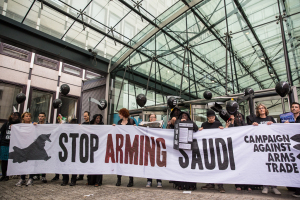
    London, UK. 11th July, 2016. Human rights campaigners protest against arms sales to Saudi Arabia outside the Defence and Security Organisation (DSO), the Government department responsible for arms export promotions.

    London, UK. 11th July, 2016. Human rights campaigners protest against arms sales to Saudi Arabia outside the Defence and Security Organisation building. Image by CAAT via Flickr.

    UK arms exports have been central to the ongoing Saudi-led bombardment of Yemen. As we write this, UK-licensed Eurofighter jets may well be over Yemeni airspace, guided by UK-trained military personnel and dropping UK-made bombs from the skies. It would be hard to overstate the humanitarian crisis that has been unleashed, with the UN having ranked the humanitarian situation in the war-torn country as a “Level 3” emergency – the highest possible emergency ranking. The bombing campaign has lasted over 15 months following a Saudi Arabian-led intervention into Yemen’s civil war. Saudi forces are acting alongside Yemen’s government against forces led by the former president, Ali Abdullah Saleh, and the Houthis, a northern Shia militia. There is no question that atrocities have been committed on all sides, although the UN has accused Saudi forces of killing twice as many civilians as all other forces.

    More than 2.5 million people have been displaced, and vital infrastructure, including schools, hospitals and cultural heritages sites have been destroyed. Of those who remain in Yemen, millions have been left without access to clean water or electricity, and 80% of the population has been left in need of aid. Even the Home Office has acknowledged the scale of the destruction, concluding that to allow people to return to Yemen could be a breach of their human rights.

    The need for legal accountability

    The destruction hasn’t only been immoral, it has also been illegal. A UN panel of experts, the European Parliament and many of the most respected humanitarian NGOs in the world, including Human Rights Watch and Amnesty International, have accused Saudi forces of serious breaches of international humanitarian law (IHL).

    The UN report “documented 119 sorties relating to violations of international humanitarian law” and reported “starvation being used as a war tactic.” More recently, Human Rights Watch has linked UK arms to specific attacks on businesses and civilian targets. The reports have been thorough and in-depth and their evidence has been compelling, but they have fallen on deaf ears in Whitehall.

    Arms exports control regulations are very clear: a licence should not be granted in the circumstances where there is a “clear risk” that it “might” be used to violate IHL. In spite of this, the UK has licensed over £3.3 billion worth of arms sales to Saudi Arabia since the bombing began, including fighter jets, bombs and missiles.

    There can be little, if any, control over how and when these arms will be used. A recent report from Amnesty International found that cluster bombs sold decades ago by the UK are being used in Yemen, a terrible reminder that the shelf life of arms is very often longer than the two year licence under which they are sold.

    Moreover, even if such control was possible, there is no reason to believe it would be applied. This is because if arms were found to be used in a way that violated the terms of their sale agreement this would result in licences being cancelled—which could affect the profitability of exports.

    Burying the truth

    In the last hours of the last day of the most recent session of parliament, the government performed a major U-turn by publishing written corrections that reveal, contrary to earlier claims, that there has been no oversight of how arms are being used. At best it represented staggering incompetence on the part of government ministers— at worst it was a cynically timed admission of how they had previously distorted the truth.

    Either way, it underpins the point that the Saudi government hasn’t just bought arms and military support, it has also bought silence, compliance and a seal of political approval. That’s why, only nine months ago, we saw the despicable, but ultimately unsurprising, revelations that UK diplomats had lobbied and campaigned behind the scenes for Saudi Arabia to Chair the UN Human Rights Council.

    So who benefits from the current situation? Certainly not the Yemeni people living under bombs, or the Saudi people being persecuted and oppressed. One obvious beneficiary is the arms companies. BAE Systems, for example, enjoys the full support of the UK government in its arms sales to Saudi. Earlier this year, BAE Chairman Roger Carr told Channel 4 News that he sees Saudi Arabia as “a very important customer with which we have a very strong relationship.” This point is alluded to in the last BAE annual report. The ‘principal risks’ section of the report identifies the commercial risk that state buyers may consider cutting their military budgets, before suggesting this will be mitigated in part because “in Saudi Arabia regional tensions continue to dictate that defence remains a high priority.”

    BAE and the UK’s special relationship

    For decades now, UK governments of all political colours have worked hand in glove with the arms companies and Saudi authorities, continuing to sell arms and provide political support while turning a blind eye to the grotesque human rights abuses that are being carried out every single day.

    Regardless of who has been in charge, the Saudi Royal Family’s influence and interests have been core to Whitehall’s approach to arms sales and the Middle East. Over recent years we have seen Tony Blair intervening to stop a corruption investigation into arms exports to Saudi, David Cameron flying out to Riyadh to meet with Royalty, and the outlandish and humiliating spectacle of Prince Charles sword dancing to secure sales for BAE Systems.

    The government’s inability to uphold its responsibility in regards to human rights and domestic law is evidence of just how far it is willing to go to maintain this toxic relationship. Despite the legal action, there has been no change to the government’s policy. Only two weeks after the judicial review was ordered, Saudi military representatives were in the UK for the Farnborough Airshow where they were shopping for weapons.

    Stop arming Saudi Arabia

    At a time when the UK should be using its close relationship with Saudi to apply pressure and push for meaningful peace negotiations and vital reform, it is instead carrying on with business as usual. The government’s refusal to act responsibly underlines the enormous power of the arms trade lobby and the pernicious nature of the UK-Saudi relationship, a relationship that fuels instability and repression and corrupts our political system.

    Whatever the outcome of the review, the campaign will go on. As long as terrible crimes are being committed with UK weapons and with our government’s support, we will continue. The UK’s shameful relationship with Saudi Arabia and the terrible examples above show just how far (and how low) the machinery of government will go to protect the Saudi Royal Family’s interests.

    The UK-Saudi alliance has boosted the Saudi regime while lining the pockets of arms company executives, but it has had devastating consequences for the people of Saudi Arabia and Yemen. For the sake of those people, the UK government must finally stop arming and empowering the brutal Saudi monarchy.


    Andrew Smith and Vyara Gylsen are writing on behalf of Campaign Against Arms Trade (CAAT). Andrew Smith is Head of Media for Campaign Against Arms Trade. Vyara Gylsen is an anti arms-trade campaigner that volunteers and works with Campaign Against Arms Trade. You can follow CAAT on Twitter at
    @CAATuk.

  • Sustainable Security

    Much has been written about the prevalence of sexual violence in the Democratic Republic of Congo (DRC), and in particular about the use of rape as a “weapon of war”. The horrific stories of rape and sexual violence published worldwide have led to the DRC being labeled the “worst place in the world for women” and the “rape capital of the world”. Feminists have long decried the silence which has historically surrounded rape and sexual violence during conflict, and so the fact that political leaders and world media are now talking about sexual violence in the DRC and pushing for solutions to this problem should be applauded. However, much of the discourse and reporting reduces this to a simple narrative of “bestial” or uncontrolled soldiers or militias raping the women and girls in villages which they attack. This narrative, in addition to employing colonialist and racist stereotypes about the behaviour of Congolese men and women, fails to grasp the complexities of gender relations in the DRC, the multiple and varied nature of sexual and gender-based violence, and of the social structures and norms which underlie this violence.

    One of the common perceptions about gender-based violence in the DRC, is that rape is the prevalent form of this violence and that sexual violence committed as a direct consequence and/or a strategy of war. It is undeniable that Forces Armées de la République Démocratique du Congo (the official army of the DRC) soldiers as well as numerous other rebel fighting groups have committed acts of sexual violence during the multiple and ongoing conflicts in the country, and continue to do so, as demonstrated by an attack in 2015 on the town of Kikamba in South Kivu during which over 100 women were raped. But to think of gender-based violence only as war rape is to miss the multiple other forms of violence, and the fact that these persist not only in areas of the country most directly affected by the conflict (notably the Eastern Regions) but across the whole country.  Common barriers to reporting GBV, such as stigma and fear of reprisals of the survivors, as well as poor infrastructure within the DRC mean that there is a lack of accurate statistics on GBV. But studies that do exist have shown that most of the incidences of GBV recorded in recent years are committed by civilians and not by soldiers, and that the most prevalent forms of GBV are domestic or intimate partner violence. A recent study by UNFPA listed multiple forms of GBV which are common in DRC including domestic  violence, rape and sexual violence, forced and early marriage, mistreatment of widows, psychological violence, economic violence and deprivation of resources.

    Meeting of victims of Sexual violence in the Democratic Republic of the Congo.

    Meeting of victims of Sexual violence in the Democratic Republic of the Congo. Image by USAID via Wikimedia.

    So although armed conflict has exacerbated gender-based forms of violence in the DRC, it cannot be the only explanation for the existence or persistence of this violence. Instead, we should look to the country’s underlying gender norms, discriminatory laws and policies, and socio-economic structures. Although the new  2006 constitution of the DRC has made some progress towards recognizing gender equality, such as in article 14 which states that the public authorities should ensure the promotion and protection of women’s rights,  discriminatory laws still remain, which reinforce persistent norms and beliefs about the roles of men and women in society. The Family Code of the DRC still maintains that a man is the head of the household who has authority over all other members of the household including his wife who must obey him. Women must obtain their husband’s permission before performing any legal act such as selling or leasing property, opening a bank account or applying for a visa or passport. The idea that men are heads of the household is strongly engrained and supported by many Congolese who see it as a part of the national “family values”. This persistence of a family code which legitimates men’s control over women and the symbolic and normative values which it perpetuates are key barriers to the achievement of gender equality. Further, research has shown that prevalent gender norms seem to accept a certain level of violence within couples as normal and even desirable.

    A new law on sexual violence passed in 2006, showed progress in criminalizing forms of violence not previously recognized such as sexual harassment, sexual slavery or forced pregnancy, but it still fails to recognize marital rape. This reflects that fact that many men and women think it is part of a woman’s duty to have sex with her husband whenever he wishes. And, for many, a certain level of violence within couples is “normal”, so that a man giving a “light tap” to his wife or girlfriend to keep her in line is perfectly acceptable.  Some even share the belief that if a man does not hit his partner, then he does not really love her. This normalization of a certain level of violence in intra-personal relationships is just part of a wider continuum of gender-based violence which is normalized and accepted. There are also various forms of violence which are condoned or encouraged by customary law which remains strong in some areas of the country, such as the rules of sororate and levirate under which women may be forced to marry the brother of their dead husband or the widow of their dead sister.  The continuum of these different forms of violence, which are accepted and normalized within Congolese society, can be seen to provide the context within which the rape and sexual violence, that has occurred during the armed conflicts, should be understood.

    The normalization of GBV also contributes to the continuing impunity of perpetrators, as do the weak police and judicial systems in the country. As noted above, many incidences of GBV are not even recognized as such, and even when it is acknowledged that an act of gender-based violence has been committed, it is unlikely that he perpetrator will be prosecuted or punished. And in the absence of a robust judicial system, many cases are still settled through “amicable” arrangements between perpetrator and victim.

    Gender inequalities are also obvious in many areas of public life, such as the lack of women in decision making positions in the government. Women make up only 8.9% of representatives in the National Assembly, 5.5% of Senators and 14.8% of government ministers (despite a strong recommendation from the national consultation held in Kinshasa in 2013 to appoint at least 30% of women to the government). Although a law on gender parity in political representation was passed by the National Assembly in April 2014, so far it has not had any noticeable impacts. There is still widespread opposition to women’s participation in public and political life because this is equated with a threat to the “traditional” family life and culture of the DRC. Women have also been under-represented in all of the various peace negotiations which have taken place to try and end the conflicts in the DRC, and remain a very small minority in the armed forces, the police and the judiciary.

    Much more can be written about the various forms of gender inequality which persist in the DRC and which provide foundations for the various forms of GBV which exist in the country. The necessary links between broader social gender inequalities and GBV are vital to understand if there is to be any effective response to the problem of GBV, and effective policies for prevention. The Women, Peace and Security agenda, has a focus on not only prevention of violence, but also of increased participation of women in public life and decision making. Increasing participation means considering women not only as “vulnerable victims” of sexual violence, but as actors should be given an equal role in political life.  All of the many complexities and layers of gender inequality need to be taken into account if real solutions to the problem of GBV are to be found, and in doing so Congolese women need to be actively engaged in making decisions and finding the solutions.

    Jane Freedman is Professor at the Université Paris 8, and member of the Centre de recherches sociologiques et politiques de Paris (CRESPPA). She has researched and published widely on issues relating to gender, violence, conflict and forced migration.

  • Sustainable Security

  • Sustainable Security

    Over 10 years ago, the Cathedral Peak Hotel, which nestles among the peaks of South Africa’s majestic Drakensburg Mountains, played host to what was, at the time, a unique gathering. Scholars from around the globe (the United States, Britain, Switzerland, Australia, Germany, South Africa, and Israel) met with representatives of international NGOs (the International committee of the Red Cross and the Geneva Center for the Democratic Study of Armed Forces, among others) and members of the private military and security industry to discuss and debate the growing role of private contractors in contemporary conflict zones. I was the convener of that conference and co-editor of the subsequent volume of the same title, Private Military and Security Companies: Ethics, Policies and Civil-Military Relations (Routledge 2008).

    Though the modern private military company can be traced back to companies such as David Stirling’s WatchGuard International in the 1960’s, and though there was some related early scholarly research, it was the massive use of contractors by the United States in Iraq in the civil war that emerged after the 2003 invasion which ultimately sparked serious public and scholarly interest in the sector. Just a year before the conference, the killing and gruesome mutilation of four Blackwater contractors by insurgents had been a major cause of the bloody and ultimately fruitless first battle of Fallujah. Given the context, it’s particularly interesting that Doug Brooks – then the President of the largest industry body for PMSCs, the International Peace Operations Association (now the International Stability Operations Association) – chose to focus his contribution to the conference, and his co-authored contribution to the book, on peacekeeping operations.

    Brooks argued then that, with the growth of what he called ‘Westernless peacekeeping’ (i.e. UN and African Union peacekeeping operations carried out without major support from NATO and ‘NATO-class’ military forces) PMSCs should have an increasing role in peacekeeping operations, contributing capabilities not possessed by the military forces of developing world countries like Bangladesh, Ethiopia, Nepal, Indonesia and Rwanda, who contribute the bulk of peacekeepers for UN operations.  Contractors, Brooks contended, offer ‘faster, better and cheaper’ solutions to capability challenges in peacekeeping operations, operate with a smaller and less culturally sensitive footprint than equivalent military forces, and act as a force-multiplier through the provision of specialist and niche capabilities.

    private-miltary

    Private military contractors in Baghdad, Iraq. Image by Babeltravel via Flickr.

    A decade on and Iraq is still in the news, but Western boots on the ground are largely absent, and the previously booming market for contractors there and in Afghanistan has shrunk dramatically. As Molly Dunigan and Ulrich Petersohn and their collaborators show in a recent edited collection, the once-championed ‘global market for force’ has proven itself to be, in fact, a conglomeration of quite different markets for force, and it is a mistake to conflate the legitimate with the illegitimate. The United States, Britain and other nations continue to employ the services of private military contractors for lower priority tasks where doing so is (or at least appears to be) cost and manpower effective.

    The US State Department’s five-year $10.2 billion Worldwide Protective Services contract, the next phase of which was announced in mid February, is distributed largely among companies like SOC, Triple Canopy and Aegis Services which made their names during the Iraq post-invasion boom. And the old stomping ground is showing signs of a revival – according to a report by Bloomberg Business week, “Operation Inherent Resolve, the Pentagon’s anti-Islamic State initiative, employed 7,773 contractors in the second quarter of 2016, up from 5,000 in the first quarter of 2015.” Many of those contracts are for logistical, training and advisory roles in conflict and post-conflict environments in Africa and the developed world. And, quietly, the United Nations has also become a significant employer of PMSCs, as a careful reading of the UN Department of Procurement’s list of registered vendors reveals. As long ago as 2011 the Geneva Center for the Democratic Control of Armed Forces (DCAF) released a report showing that, despite the sensitivities involved, “the UN has increasingly paid private military and security companies (PMSCs) for a range of services in the areas of humanitarian affairs, peacebuilding and development.” The companies themselves have become increasingly corporatized and professional in their structures and practices, an evolutionary necessity for those companies which survived the ‘gold rush’ days of post-invasion Iraq.

    The more dramatic pronouncements by both proponents and opponents of the PMSC industry have failed to come to pass. Contractors have neither rendered state-based peacekeeping and stability operations obsolete, nor have they radically undermined the monopoly on force of the states that employ them or created greater instability in the international sphere.

    Looking to the future, what might we expect regarding the involvement of PMSCs in peacekeeping and stabilization operations? Despite their popularity as ‘bad guys’ in television dramas and Hollywood films, and an uncomfortable legacy of past serious human rights abuses committed by contractors, the evidence suggests that in the real world the use of PMSCs is increasingly becoming normalized, and that in policy circles there is a growing understanding of the potential value contractors can provide if properly employed. While there are still contractors operating in the global periphery who better fit the old ‘mercenary’ moniker, we can expect this process of normalization to lead to an increase in the employment, and more open employment, of PMSC’s in peacekeeping operations (though the term ‘PMSC’ will likely decline in usage).

    The improved clarity about the status and responsibilities of contractors in zones of armed conflict that resulted from the publication of the ICRC sponsored Montreaux Document of 2008 has played an important role in this process of normalization. Though this was unquestionably not the intended purpose of the creation of the document (which carries no legal weight but summarizes the status of contractors under international law and gives recommendations to both PMSCs and the states that contract them), the Montreaux process cleared up numerous misconceptions and provided a firm framework to which companies could attach their claims to legitimacy.

    Over the past decade there has been much debate and discussion over what functions ought to be considered by states to be ‘inherently governmental’ and which therefore ought not to be contracted out. A similar discussion will likely occur as the outsourcing of peacekeeping functions becomes more publicly acknowledge. However, it will likely be pragmatic factors which establish the limits of outsourcing.  Whatever those limits turn out to be in practice, it is certain that there will be limits. Even in today’s complex and spoiler afflicted environment, effective peacekeeping relies heavily on the perception of legitimacy, and that means blue UN helmets or the green berets of the African Union, not beards and Oakley sunglasses.

    Dr Deane-Peter Baker is a Senior Lecturer in the School of Humanities and Social Sciences at UNSW Canberra, located at the Australian Defence Force Academy. He is also a Researcher in the Australian Center for the Study of Armed Conflict and Society. His research interests include military ethics, private military and security companies, special operations, military strategy and the ethics of public policy. He is the author of Just Warriors Inc.: The Ethics of Privatized Force and Citizen Killings: Liberalism, State Policy and Moral Risk.

  • Sustainable Security

    The Global Land Rush: Catalyst for Resource-Driven Conflict?

    Michael Kugelman of the Woodrow Wilson International Center, argues that the factors that first sparked many of the land acquisitions during the global food crisis of 2007-08 — population growth, high food prices, unpredictable commodities markets, water shortages, and above all a plummeting supply of arable land — remain firmly in place today. He writes that land-lusting nations and investors are driven by immediate needs, and they have neither the incentive nor the obligation to slow down and adjust their investments in response to the wishes of distant international bureaucrats. This, he argues, has serious consequences for global security.

    Read Article →

  • Sustainable Security

    Over the past two decades, the United Nations Security Council has responded more strongly to some humanitarian crises than to others. This variation in Security Council action raises the important question of what factors motivate United Nations intervention.

    The United Nations (UN) selective response to humanitarian crises—as evidenced most recently by the organisation’s uneven reaction to the conflicts in Libya and Syria—is arguably among the most contentious issues in international politics. Some scholars and observers heavily criticize this practice, arguing that the selectiveness of humanitarian interventions undermines their legitimacy and ultimately their success; that the uneven response to humanitarian emergencies suggests that these intervention are motivated not by humanitarian concerns but by the military and economic interests of powerful states; and that the selective enforcement of human rights norms undermines the emerging rule of law in international politics (for examples see Archibugi 2004, Chomsky 1999)

    Others disagree and claim that selectivity is not only unavoidable for the UN but also desirable. The selectivity of humanitarian intervention, so the argument goes, reduces the risk of over commitment; it helps to maintain cooperation among the great powers; and it prevents the UN from becoming involved in ill-conceived operations (see Roberts and Zaum 2008)

    But what explains why UN humanitarian interventions remain selective in the first place? Why is it that the UN has taken strong action to respond to some crises, like those in Northern Iraq, Somalia, Bosnia, Sierra Leone or—more recently Libya—but not to other like those in Colombia, Myanmar, Sudan, or—currently—Syria?

    The scholarship on humanitarian intervention often argues that each humanitarian crisis (and the responses to them) is historically unique and therefore requires a case-by-case explanation. While I agree that attention should be paid to the specificities of each crisis, my research shows that the UN’s response to them is not random but follows remarkably consistent patterns (see Binder 2015, 2017). More specifically, I argue that a combination of four factors explains whether the United Nations does or does not take strong action (sanctions, ‘robust’ peacekeeping operations, military action) in response to a humanitarian crisis. This explanation has been developed and tested through a systematic comparative analysis of the UN’s response to more than 30 humanitarian crises after the end of the Cold War combined with several in-depth case studies of intervention decisions in the UN Security Council.

    • The first explanatory factor is the extent of human suffering in a crisis. In a humanitarian crisis people suffer and die while human rights norms are massively violated. This generates a morally motivated pressure to come to the rescue of threatened populations and to defend international norms.
    • Secondly, whether the UN intervenes depends on the extent to which a crisis spills over to neighbouring countries and regions. Humanitarian crises often affect neighbouring countries or regions in negative ways. Spill over effects include regional conflict diffusion, refugee flows, terrorism or economic downturn. Spill over effects create a material interest to intervene.
    • The third explanatory factor for UN intervention is the ability of a target state to resist outside intervention. Militarily strong target states, or target states that have powerful allies, can raise the costs and risks of UN intervention and affect its chances of success.
    • Fourth and finally, UN intervention is explained by the level of material and reputational resources the UN has committed to the resolution of a crisis in the past (sunk costs). To the extent that the UN have invested time, money, and diplomatic prestige in the resolution of the crisis, this creates the wish to protect these investments through continued or escalated involvement.

    None of these explanatory factors is sufficient in itself to explain selective intervention. In combination, however, they provide a powerful explanation for the UN’s uneven response to humanitarian crises.

    When does the UN take strong action?

    Image credit: Bernd Untiedt/Wikimedia.

    The UN can be expected to take strong action—coercive measures including economic sanctions, ‘robust’ peacekeeping operation or (the authorization of) military action—if the extent of a humanitarian crisis (in terms of victims and internally displaced persons) is large, and if the organisation has committed substantial resources to its resolution. This, however, leads to intervention only when the crisis also generates substantial negative spill over effects (e.g., refugee flows) or when the target state of an intervention is weak and therefore unable to resist to outside intervention.

    Explaining limited UN action (or inaction)

    A limited response of the UN to a humanitarian crisis, such as UN observer missions, humanitarian assistance, or even complete inaction of the UN, is best explained by the ability of a potential target state to resist outside intervention (e.g., through military capabilities). However, other factors must be present as well. Military capabilities must be either complemented by a low level of previous UN involvement; or by a relatively low level of human suffering and spill over effect to neighbouring countries.

    A few brief examples may help to illustrate how these four factors interact to lead to strong or limited UN action.

    Bosnia

    UN intervention in Bosnian crisis was clearly driven by a combination of motivational factors. For one, UN members were strongly concerned by the large-scale plight of the Bosnian civilian population and the grave human rights violations committed by the parties to the conflict (ethnic cleansing, the installation of concentration camps, the siege of Sarajevo, and the massacres at Srebrenica). Second, the intervention was motivated by the wish to prevent the crisis from spilling over to Western European countries, most notably in form of refugee flows, and to stop a more generalized destabilization of the Balkan region. A third important driver of UN intervention in Bosnia was the wish of UN member states to protect the tremendous investments both material (through humanitarian assistance and peacekeeping) and reputational (diplomatic efforts) the UN had made over the course of the conflict. However, when the Bosnian Serbs took hundreds of UNPROFOR blue helmets hostage, this brought the UN to the brink of failure and put the UN’s efforts in the Bosnian crisis in jeopardy. In this situation, rather than withdraw, the organisation escalated its response. Finally, outside intervention was facilitated by the inability of the Bosnian Serbs and the Serbian government to generate sufficient resistance against outside intervention by the UN (and later by NATO).

    Cote d’Ivoire

    Very similar motivational patterns can be observed with respect to the UN’s decision to authorize military intervention in the context of post-election violence in Côte d’Ivoire in 2010. The dramatic levels of internal displacement and the fears of genocide, given the xenophobic politics of ‘Ivoirité’ that characterized the conflict, raised strong humanitarian concern in the UN. At the same time, UN members wished to prevent the conflict from spilling over to other Western African countries, most notably to Liberia which was slowly recovering from a long and brutal civil war. Moreover, the substantial and longstanding involvement of the UN in the country generated an additional institutional dynamic pushing towards intervention. The UN had invested heavily in the resolution of the crisis in Côte d’Ivoire—most notably through peacekeeping and peacebuilding. UN members wished to protect these investments they saw at stake, should country relapse into civil war. Finally, former President Laurent Gbagbo and his supporters were too weak to effectively resist outside intervention in in the country. By the time the UN decided to authorize military action, large parts of the country were controlled by forces loyal to Gbagbo’s opponent Alassane Ouattara.

    Libya

    As in the crises in Bosnia and in Côte d’Ivoire, humanitarian intervention in Libya was driven by more than one factor. Muammar al Gaddafi’s public announcement to commit a massacre in the town of Benghazi generated particular pressure on the part of UN members to act. Concerns to prevent spill over effects also played an important role. In addition to destabilizing effects for neighbouring Egypt and Tunisia—both of which are undergoing important political change in the wake of the ‘Arab Spring’—Western UN members feared that hundreds of thousands of Libyan refugees would cross the Mediterranean towards Europe. At the same time, the Gaddafi regime was not in a strong position to resist outside intervention. Not only was there a capable opposition movement in the country, but also Tripoli had managed to alienate nearly all of its former Arab and African allies. Libya also lacked partners in the Security Council who might have opposed or blocked UN intervention. However, the Libyan case fails to provide strong support for the previous institutional involvement explanation in that the UN did not invest substantial material and immaterial resources to the resolution of the crisis prior to the intervention.

    Syria

    The ongoing crisis in Syria illustrates how a combination of factors prevents strong UN action. The available evidence suggests that massive human rights violations, the spiralling violence in the country as well as the severe spill over effect of the Syrian conflict for neighbouring countries, most notably Lebanon, raised strong concerns on the part of UN members. A majority of UN members have pushed for sanctions against the Assad regime in the UN Security Council. That the UN has nevertheless not taken strong action in Syria can be explained by two factors. First, unlike the cases discussed before, Syria is more able to resist outside intervention—most notably because the Assad regime enjoys the continued support of its Russian and Chinese allies, who block any coercive measures against Syria in the UN. Second, the UN has not been substantially involved in Syria in the past and has not committed substantial resources to the resolution of the crisis. As such, a complementary dynamic of escalating commitment could not unfold in the UN to push towards coercive measures.

    Summary

    Whether the UN intervenes or does not intervene in a humanitarian crisis cannot be explained by a single factor. Rather, a combination of conditions – the extent of human suffering, the level of spill over effects, the military strength of a target state and the extent to which the UN has been involved in a crisis before – accounts for this variation in UN action to a large extent. While the explanation I suggest here does not account for all UN responses to humanitarian crises, it covers more than 80% of the UN humanitarian interventions after the Cold War.

    Martin Binder is Associate Professor in International Relations at the University of Reading. His research focuses on humanitarian intervention, the authority and legitimacy of international institutions, and rising powers. His work has been published in the Journal of Peace Research, International Studies Quarterly and International Theory, among others. His recent book The United Nations and the Politics of Selective Humanitarian Intervention has been published in 2017 with Palgrave Macmillan.

  • Moving Beyond Crisis: Survival 2100 and Sustainable Security

    In a piece for the International Movement for a Just World, William Rees maps out a vision for what he calls ‘Survival 2100.’ The goal of such a strategy would be “to engineer the creation of a dynamic, more equitable steady-state economy that can satisfy at least the basic needs of the entire human family within the means of nature.” The alternative, Rees argues is to “succumb to more primitive emotions and survival instincts abetted by cognitive dissonance, collective denial, and global political inertia.”

    The call from Rees echoes the sentiment coming from many different – and often unusual – quarters that are responding to the major implications for security and survival of the combined ecological, political and economic crises that either characterise or are looming in the international system.

    While some of the ideas in the piece may need some further thinking through (eg. “The world community will have to agree to fund worldwide social marketing programs to ameliorate “pushback” and bring the majority of citizens on board” – ie. people will need to fund a campaign to convince themselves!), the fundamental focus is sound. Rees identifies the need for a genuinely strategic approach to the governance and management of the global environment and the global economy. Once one thinks through the real costs of inaction on issues like climate change (global insecurity and a greater potential for conflict is but one such cost), the costs that we account for in global market failures take on a different character. Rees argues that “As any good economist will acknowledge, government intervention is legitimate and necessary to correct for gross market failure. Indeed, resistance to reform makes hypocrites of those who otherwise tout the virtues of market economies. Truly efficient markets require the internalization of heretofore hidden costs so that prices tell consumers the truth.”

    Such ideas are not radical at all, simply a reflection of doing the sufficient cost-benefit analysis that planning for long-term survival requires. Therefore the message for national defence planners is clear –attempting to ‘maintain control’ over global insecurity is ultimately futile, the time to put the principles of prevention and sustainability at the heart of national security planning is now.

    The full article on the JUST website is available here.

    Image source: hundrednorth.

  • Climate change

    An IPI policy forum launched a new joint study by a UN office and a prominent Norwegian group showing that 36 million people were displaced in 2008 by sudden onset natural disasters — 20 million of them by climate-related disasters such as storms and floods.

    Read more »

  • Sustainable Security

    Too Quiet on the Western Front? The Sahel-Sahara between Arab Spring and Black Spring

    While the world’s attention has been focused on the US-led military interventions in Iraq and Syria a quieter build-up of military assets has been ongoing along the newer, western front of the War on Terror as the security crises in Libya and northeast Nigeria escalate and the conflict in northern Mali proves to be far from over. In the face of revolutionary change in Burkina Faso, the efforts of outsiders to enforce an authoritarian and exclusionary status quo across the Sahel-Sahara look increasingly fragile and misdirected.

    Read Article →

    The Costs of Security Sector Reform: Questions of Affordability and Purpose

    In considering security sector reform, questions of affordability have often been subordinated to questions of effectiveness and expediency. A recent series of reviews of security expenditures by the World Bank and other actors in Liberia, Mali, Niger and Somalia has highlighted several emerging issues around the (re)construction of security institutions in fragile and conflict-affected states.

    Read Article →

    Beaux Gestes and Castles in the Sand: The Militarisation of the Sahara

    Whatever the benefits for Mali, the French-led eviction of jihadist groups from northern Mali may have made the wider Sahara a less safe place, and has done little to lower the capacity of such groups to threaten European interests.. In 2014, France is implementing a major redeployment of its forces in Africa into the Sahel and Sahara. Meanwhile, the US has been quietly extending its military reach from Djibouti to Mauritania. However, as elsewhere, the western military approach to countering Islamist insurgency in the Sahel rests on very unsteady foundations and the potential to provoke wider alienation and radicalisation is strong.

    Read Article →

  • Sustainable Security

    Summary

    Despite considerable disarray continuing into its third month, the new US administration is showing more consistent, if not coherent, signs of how it will try to implement Donald Trump’s campaign proposals. In large part, these may be assessed as antithetical to a more sustainable security agenda, given that they promote military confrontation, undermine attempts to address climate change, and are, at best, incoherent in their response to economic inequality. Little of this translation to reality is likely to endear Trump to voters or his party. Greater policy turbulence, at home and abroad, should be expected ahead of mid-term elections next year.

    Introduction

    The Trump administration has been in power for 75 days; following the election campaign and the post-election transition it is now possible to get a reasonably clear picture of how its policies relating to security are taking shape. There has been much speculation that the United States will take a very different path to that of the Obama era, not least in relation to security and climate change, and since the United States is the world’s most powerful state it is appropriate to make an initial assessment of the changes as they may affect the sustainable security thinking with which ORG has been concerned for the last decade. Is the Trump era likely to make a major difference to the global security outlook or is it more likely that realities of international relations will limit the capacity for the change Trump seeks?

    Sustainable Security

    The ORG approach to security may be summarised:

    Security challenges such as terrorism, crime and weapons proliferation cannot be successfully contained or controlled without understanding and addressing their root causes. ORG’s Sustainable Security concept takes a comprehensive, long-term approach that encompasses climate change, resource scarcity, militarisation, poverty, inequality and marginalisation.

    As the thinking has developed it has tended to group the challenges into three main areas, economic relations, climate change, and militarisation, and these are convenient headings with which to make an initial assessment of the Trump era.

    The issue of economic relations is seen as having as its greatest challenge the failure of the neoliberal approach to deliver economic justice, equity and emancipation, and the consequent growing divide between a relatively small minority of rather more than a billion people and the majority of the world’s population, with a clear rise in frustration and resentment among that majority at relative marginalisation and lack of life prospects.

    In the environmental context, while a number of resource limitations and regional environmental impacts are important, the emphasis in the ORG analysis has to be on the most significant trend – climate change and especially its impact on human well-being especially as a result of severe effects on food production.

    Finally, militarisation is seen partly in terms of a particularly entrenched and powerfully influential economic sector but most significantly as a culture in which the early use of military force is essential in maintaining the status quo, however unequal, unjust or unstable that order is.

    In all cases, the ORG view is that these approaches are thoroughly inappropriate if we wish to avoid an unstable and violent world, and much more emphasis must be placed on the underlying causes of the problems and how they may be addressed. The failure of the current 15-year war on terror is the most grievous example, having led to hundreds of thousands of deaths, millions of displaced people, at least three failed or failing states and a continuing perception of the threat of political violence in western countries. The question, simply, is how does the new Trump era affect the possibility of taking the wider view?

    Economic Issues
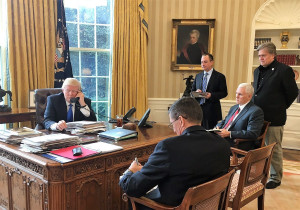
    Image credit: PressSec/Wikimedia.

    The early indications are that the Trump administration is a potentially unstable mix of those best described as economic nationalists and others, especially in the wider Republican Party, who are convinced neoliberals. The latter may be dubious about any trend towards protectionism and believe that in a free market which already favours the wealthy such protectionism may turn out to be counter-productive. In this view, transnational corporate organisation is a fact of life and no country, not even the United States, can go its own way for long.

    The economic nationalists, who are dominant within Trump’s inner policy circle, are very strongly convinced that the United States has sufficient power to dominate the markets that matter most. Furthermore, the whole Trump election platform was predicated on strong opposition to the perceived elite, an establishment that “ran” Washington. His appeal to those left behind, especially in the post-industrial American Mid-West, was probably the most important element in his successful election and it is an approach that will not readily be abandoned. At the same time, he was committed to policies that would reduce taxes while scaling down the Obamacare reforms – initially both popular with his supporters.

    In the short-term Trump’s policies may be popular but it may be as little as a year before those left behind find that their predicament simply does not ease. Indeed, it is already becoming clear that health provision reforms will lead to many millions of Americans facing higher costs, including many of those who voted for Trump. More generally, economic nationalism may turn out to provide little gain for the country as the power of China and other major economies becomes more apparent. “America first” is simply not sustainable in a globalised world.

    Even so, what has to be faced is that the Trump era will not see any fundamental challenge to the neoliberal system, precisely in a period when that system is proving unfit for purpose. What may perhaps be more relevant is how long the Trump approach in its present form persists. The degree of disorganisation currently apparent in so many areas within the White House is hardly encouraging in terms of stability, and it may well be that as the 2018 mid-sessional elections to the House and Senate draw nearer, Trump’s singularly soft Republican majority support in both Houses of Congress will lead to sudden changes of policy. These may not directly address core issues of inequality but could take much of the remaining lustre off the Trump approach.

    Climate Change

    This month has seen the very clear enactment of a number of policies that confirm that the Trump approach on climate change is one of denial coupled with the strong promotion of domestically-sourced fossil fuel resources. This is a highly negative approach for two reasons – there will be an increase in carbon emissions from the United States and a lack of leadership within the international community for addressing the considerable dangers stemming from climate change. This would seem disastrous for any hope of effectively preventing climate change but there are other very interesting factors at work.

    Firstly, the reality of the dangers of uncontrollable climate change is far more recognised across the world than a decade ago. Many more states are accelerating their moves towards renewable energy sources, with the biggest emitter, China, making remarkable strides. Indeed, China may well see its way to playing a global leadership role. Secondly, the rapid developments in renewable energy technologies are making renewable sources far more economic, with many further developments coming closer to fruition. The effect of this is that renewable energy utilisation is now competing much more closely with fossil carbon sources and, as a consequence, there is a rapid increase in investment in renewables. More than half of all investment in electricity generation is now in renewables and in the United States and elsewhere there is far greater potential for employment in renewables than in fossil carbon sources.

    Major problems remain including historic underinvestment in energy storage technologies and the need to cut carbon emissions by even more than most states currently accept, but the point here is that this is one area where there is every sign that Trump’s policies are obsolete and likely to ensure that the United States is left high and dry. Even in the face of that, though, the ideological certitude of the climate change deniers close to Trump means that the administration is unlikely to change. In short, the advent of the Trump era may limit the prospects for countering climate disruption but at least this will be another area where the Trump approach may be singularly counterproductive to any aim to make the United States the world leader.

    Security

    As with climate change, the first two-and-a-half months of the Trump administration have shown the translation of rhetoric into policy: control of migration, increased military spending and the more frequent use of force. Here, though, it is necessary to recall that the eight years of the Obama administration may have seen the withdrawal of US troops from substantial parts of the Middle East and Afghanistan but also saw the quiet transition to remote warfare with much greater use of air power, armed drones and Special Forces, not least in Libya and Iraq. The early signs are that Trump is expanding such operations rather than radically changing the posture and this includes even greater use of air power in the war against Islamic State (IS), as well as the deployment of even more Special Forces in Iraq, Syria and Yemen.

    These kinds of changes are being reflected in the manner in which the Pentagon is being given a much freer hand to conduct operations, but there are already consequences. A major raid in Yemen in late January failed to achieve its objective while also killing many civilians, and the much-expanded use of air strikes in Mosul in the past month has led to such an increase in civilian casualties that they are even being reported in the mainstream western media. Even so, such consequences are unlikely to carry any weight with Trump unless there are serious disasters involving US military personnel.

    The risk of this has been limited until now but one factor that has received little attention is that Trump’s Pentagon is advocating, and indeed already initiating, a substantial increase in the number of “boots on the ground”. In Iraq this is no longer just Special Forces but regular troop deployments which include, for example, units from the 82nd Airborne Division. Trump has also just agreed to give US forces in East Africa much more open powers to operate assaults on suspected al-Qaida-linked groups in southern Somalia, and there are also repeated calls for the Pentagon to expand its deployments in Afghanistan.

    As with economic issues, such actions may be popular with Trump supporters in the short term, examples of forceful action in the task of “Making America Great Again”, but based on the failures of the last fifteen years, the longer-term impact may be very different. What it does mean, though, is that as the United States seriously expands in overseas military operations then its close allies such as Britain will have to face up to whether they are willing to maintain their commitments.

    Conclusion

    These are, indeed, different times and with all three aspects of the sustainable security challenge the election of Trump is likely to exacerbate ingrained problems. At the same time, his policies may become increasingly irrelevant concerning climate change and his economic popularity with his supporters may also erode quickly. This may well increase the temptation to use foreign military action to distract voters from domestic discontents. However, even in the military dimension there are unlikely to be any quick wins and Trump’s direction of travel means that his allies could quickly come under domestic political pressure if they were to stay closely aligned with the United States. In any case, the need to rethink our attitudes to security remains critical and it is best to see the advent of the Trump era as a period when even more opportunity for creative, critical and independent rethinking of security will be essential.

    Paul Rogers is Global Security Consultant to Oxford Research Group and Professor of Peace Studies at the University of Bradford. His ‘Monthly Global Security Briefings’ are available from our website. His new book Irregular War: ISIS and the New Threats from the Margins will be published by I B Tauris in June 2016. These briefings are circulated free of charge for non-profit use, but please consider making a donation to ORG, if you are able to do so.

  • Sustainable Security

    The inclusion and participation of young people in societies is a necessary condition for sustainable peace. The neglect of young people’s current needs and future livelihoods is a recipe for renewed conflict.

    Despite all the sermonizing on the important role of young people for a society’s future and the United Nations Security Council Resolution 2250 (December 2015) on the importance to include youth in peacebuilding, the active and independent participation of youth is rarely welcomed. Across the globe youths are criticized either for their political apathy or their open political protest that travelled around the world in 2011 and 2012. In the debate on peace and conflict especially there is a significant divide: children are mostly seen as victims and the United Nations have an important advocacy role. At the same time, many governments perceive youths (age 15 to 25) as perpetrators of violence and potential troublemakers. While there have been calls to include youths in peacebuilding by giving them voice and agency, the inclusion of youth in current peacebuilding programs rarely includes elements other than education or training.

    Colombia’s comprehensive peace accord is an example. Youths appear 13 times in the 310 pages but only as part of other marginalized or excluded groups such as women, elderly, or the indigenous people. Under a broader perspective of peace being defined as more than the mere absence of war and armed conflict, this lack of youth’s political citizenship is counterproductive for sustainable peace. Neglected and/or criminalized young people either leave their countries and seek a better life elsewhere or they use violence to survive or to get attention from adults. They do not develop trust in the government and its institutions.

    The mismatch between formal possibilities and realities

    Image credit: wjgomes/Pixabay.

    A research project of the German Institute of Global and Area Studies on youth participation in postwar societies funded by the Federal Ministry of Economic Cooperation and Development  has provided interesting evidence for there being a significant mismatch between increasing formal possibilities of political participation of youths and their neglect and criminalization by adult society. In a first step, we collected data on the risks and opportunities for youth social, economic, and political participation – such as education, elections, employment– in 21 post-war societies (10 in Sub-Saharan Africa, six in Asia, four in Latin America, one in the Middle East). Many post-war societies liberalize their political regimes after the end of war.

    Political and civil rights are expanded, elections are introduced as a means of formal participation at the national as well as the local level. Consequently, young people in these countries – often the first generation that grew up and was socialized after the end of war –  should have bright perspectives. While youths participate in society, they do so overwhelmingly in civil society organizations (sports clubs, religious organizations and cultural activities) but to a much lesser extent in the political system. In a second step we conducted field research in three countries – El Salvador, Nicaragua, and South Africa – all perceived as rather successful cases of liberal peacebuilding at least in the first decade after war’s end. But even there young people feel marginalized.

    Youths in El Salvador, Nicaragua, and South Africa face a set of common challenges: The most pressing problem is finding decent work. While the first post-war generations have a significantly better formal education than their parents, youth unemployment is higher than adult unemployment. Even if young people can find work, available jobs offer low pay, long working hours, short contracts and few social benefits. Many youths are not able to make the important transition to adulthood and are unable to form a family. Political activism and citizenship should provide perspectives for change in demographically young societies. But a set of structural conditions influences youth political participation negatively: Poverty and inequality limit youth political activism, most of all in the rural areas and especially for young women.

    Overall, young people confront a generational bottleneck due to the war generation remaining in power, dominating economy, society, and politics, shaping the rules of post-war order and the possibilities for youth political participation. Although young people are interested in political participation they do not trust politicians and existing institutions. They do not “see benefits in participating” as change does not happen; they feel existing political parties only approach them during campaigns for their votes; and that they have neither real voice nor impact. Hence, they do not trust in elections as a mechanism of change. If and where young people organize as autonomous and independent actors, adults and elders view their political activism as problematic and as a challenge to their own status. They aim at integrating young people in a subordinate position for example in youth wings of political parties or other forms of controlled and supervised participation.

    Blocked transitions

    How do young people cope with these problems? Based on A.O. Hirschman’s classic book we can distinguish various strategies of exit, voice, and loyalty. Confronted with little future options and opportunities many youths exit through inner migration as well as out of country. El Salvador is an extreme example as a fifth of the population lives outside of its borders. While this may be an option for individual survival and upward social mobility, its potential for promoting change is limited. Other forms of exit are related to individual withdrawal from society via apathy, drug abuse or by joining a gang.

    Nicaraguan and South African youths have fewer options to leave. In these cases, the majority of young people are mostly muddling through taking the few chances they have to survive. South African participants in our project’s focus group discussions stated that change was only possible through the ruling African National Congress. Becoming a member is not necessarily a sign of confidence in the party but could rather signal high levels of realism regarding existing power relations. In this sense, the strategy of displaying loyalty might not be the best but a viable way of getting along regarding access to the labor market and other important public goods.

    Last but not least, there is the possibility of youth acquiring a voice. While political citizenship through the existing formal channels does rarely allow for significant changes, young people opt for non-violent as well as violent protest.  Salvadorian and Nicaraguan youths are at the forefront of ecological protests about problems such as water scarcity and the canal project linking the Pacific and the Atlantic.

    In South Africa, youths protest against corruption. While most young people prefer non-violent protest, they also acknowledge that violence can be used to get attention by the governmental institutions. As a girl living in a high crime area stated: “If you want to get the attention of the government you have to ‘toi toi’ – make a lot of noise”. But protesting also bears the risk that young people and their claims are criminalized and repressed.

    Youth needs to be included for sustainable peacebuilding

    The active and participatory inclusion of young people is a necessary condition for sustainable peace. Post-war societies produce high risks for sustainable peace if the society fails to integrate young people into the political system and to allow them to participate in political decisions and actions. Where the war-time generation has an exclusive control of social and political resources generational conflict will arise. This might lead to renewed armed conflict and war or shift violence from the political arena to society and crime.

    El Salvador provides evidence of the escalation of violence due to a lack of social and economic integration of young people. Despite a formally democratic political system the country remains one of the most violent worldwide. These changing patterns of violence provide important lessons for other processes of peacebuilding. Where protest is criminalized and violence is answered with state repression, armed groups tend to institutionalize. Giving young people a chance to voice their concerns as well as express their hopes – and acting on them in concert with them – is much cheaper and provides an important pattern of conflict prevention and sustainable peace. Implementation of UN  Resolution 2250 at different levels thus needs to open space for youth active participation and shared decision making for a peaceful future.

    Sabine Kurtenbach is a Senior Research Fellow at the German Institute of Global and Area Studies.

  • Sustainable Security

    The centenary of the First World War also marks the anniversary of the practice of recording and naming casualties of war. But a century on, new forms of ‘shadow warfare’ limit the ability to record casualties of conflict and thus threaten to allow states a free hand to employ dangerous new tactics without threat of individual or international accountability. Without verifiable casualty figures – including information on who is being killed and how – we cannot evaluate the acceptability, effectiveness or impact of ‘remote control’ tactics as they are rolled out among civilian populations.

    A Humanizing Legacy

    Image of the name of Sgt. Robert O'Connor of The Leinster Regiment on the Menin Gate wall, who was killed on 31 July 1917 during the First World War. Source: Wikipedia

    Image of the name of Sgt. Robert O’Connor of The Leinster Regiment on the Menin Gate wall, killed on 31 July 1917 during the WWI. WWI saw the start of practice of recognizing by name each and every soldier killed during battle. Source: Wikipedia

    As the world marks the centenary of the commencement of the First World War,  we remember not the war that ended all wars, but instead the war that changed them forever. Introducing new forms of mechanized warfare – including the machine gun, u-boat, tank and airplane – WWI increased exponentially the lethal force of the individual soldier, bringing about an era of death and destruction on an industrial scale.  Yet, even as it ushered in the means of mass and impersonal killing, the ‘Great War’ also initiated the humanizing practice of recognizing by name each and every soldier who lost their lives, burying them in marked graves alongside those of their officers. Not only does such identification and public acknowledgement of victims dignify their memory, in today’s conflicts it can also provide vital information for humanitarian response and for monitoring compliance with – or tracking violations of – international law.

    Today we are again witnessing the introduction of new forms of warfare – including armed drones, lethal autonomous weapons, special operations forces and use of private military and security companies.  Like their WWI counterparts, these new tactics will reshape the face of conflict, yet as they do so they also threaten to destroy the humanizing legacy of casualty recording. Pushing global warfare deep into the shadows, these new ‘remote-control’ tactics are replacing public military campaigns with covert and contracted force. This shift to a ‘light-footprint’ approach, primarily by the United States, but also by France, Russia and the United Kingdom, reflects not only the changing nature of security threats, which have become mercurial at best, but also the lessening appetite for long military campaigns with high military casualties. A recent report from the Every Casualty Programme at Oxford Research Group and the Remote Control Project finds that the prioritisation of ‘remote control’ tactics presents serious obstacles to the recording of casualties, and subsequently, accountability for the civilians impacted by their use.

    Issues of capacity, political will, and access challenge efforts to record the casualties of any type of conflict. Yet, in conventional warfare, where identifiable or recognised conflict parties conduct attacks, such recording is not impossible: militaries generally record their own fatalities in these instances, while civilian deaths are often recorded by small civil society organizations around the world.  One need only look to the names of the hundreds of civilians killed in recent conflict in Gaza published by major news outlets to see the result of such efforts. In covert conflicts, however, or in conflicts where ‘remote control’ tactics are used, the ability to record casualties – including information on who is killed and how – is greatly diminished.

    The merging of intelligence operations with the use of force – seen currently in countries such as Yemen, Pakistan and Afghanistan with the use of armed drones and special operations forces by the United States – is a particularly problematic trend for casualty recorders. By greatly increasing the opacity – or outright deniability – of state force, covert operations erect a seemingly impenetrable wall of ‘classified information’, impeding recorders’ ability to conduct field investigations and verify their data. In 2010, the United Nations Mission in Afghanistan (UNAMA), which has conducted systematic casualty recording since 2007, reported that due to “tactical reasons and deliberate lack of information about such operations” they found it “very difficult to monitor and adequately document the activities of Special Forces” operating in the country. Gathering data on civilian and combatant casualties of drone strikes has also proved problematic – with ORG’s report finding that recorders are challenged by a lack of official disclosure of information about strikes, blocking of access to strike sites, and a near monopoly of information by anonymous officials on information coming from affected areas.

    The consequent lack of reliable casualty data impedes the impartial evaluation of the tactics’ impacts on civilian populations. It also limits the ability to scrutinise the tactics acceptability and effectiveness using evidence-based analysis. The United States – the primary user of armed drones – has repeatedly claimed that drones allow for precision targeting, capable of surgically eliminating targets with minimal civilian casualties. Yet, as a recent report from the Bureau of Investigate Journalism on drone use in Afghanistan has shown, “the armed forces that operate drones publish no data on casualties to corroborate these claims.” Although the United States claims to record data on casualties itself, its failure to make such records transparent not only prevents an analysis of the acceptability of drone strikes, but also denies the victims and their families the opportunity for accountability or redress.

    Bringing Remote-Control warfare out of the shadows

    People of Narang district mourning for the students killed in a night raid in the village Ghazi Khan on December 27, 2009. Although the operation was authorised by NATO, it is still not publicly known who carried out the attack. Source: Wikipedia

    People of Narang district mourning for the students killed in a night raid in the village Ghazi Khan on December 27, 2009. Although the operation was authorised by NATO, it is still not publicly known who carried out the attack. Source: Wikipedia

    Data documenting the casualties of particular weapons – from chemical gas in WW1 to landmines and cluster munitions more recently – has been instrumental in evaluating these weapons’ impact and acceptability, and ultimately ensuring their regulation through international treaty. Yet, as new tactics are employed under the cloak of ‘covert action’, the ability of the international community to measure and regulate their impact is increasingly limited. Without verifiable casualty figures, states may be given a free hand to employ dangerous new tactics without threat of individual or international accountability. Indeed a recent report from Amnesty International has found that as a result of an almost complete lack of transparency from the US government regarding civilian casualties in Afghanistan – specifically around those killed in night raids by SOFs or by missiles from drones strikes – victims are already facing a major accountability vacuum.

    States must take greater responsibility for recording and acknowledging the casualties – both civilian and combatant – of these new tactics. They must not seek to block public investigation and accountability, even though these tactics may be adopted for the lower profile they afford armed force. Furthermore the United Nations, alongside civil society groups or other entities, must enhance their recording efforts so as to provide independently verifiable data on casualties. Such data is essential for developing an accurate, complete and impartial record, and for facilitating scrutiny in circumstances where casualties are highly politicized. Civil society-led casualty recording and analysis, despite its limitations, has already highlighted policies within the use of remote control tactics that need greater examination: for example, the practice of ‘double-tap’ or rescuer drone strikes in Pakistan on those coming to the assistance of individuals at the site of a previous strike. Only by ensuring that casualty recording is conducted systematically and to a high standard can we bring the impact of remote control warfare out of the shadows and into the public eye.

    If we are to take a lesson from the commemoration ceremonies resounding across Europe it is simply that to learn from the past, and to honor it, we must first know that past. Details regarding the identites of those killed in conflict, both on the battlefield and in their homes, are essential to understanding the impact of violence, and to telling the full story of a conflict, to both current and future generations. The risks, then, of wars waged in secret, their battles and casualties concealed, are profound. Not only will there be no monuments at which to mourn their dead, there will be no lessons to be gleaned from their history: the wisdom of hindsight – both for policymakers deploying force and the public – may be lost completely.

    Kate Hofstra is Research and Communications Consultant of the Every Casualty Programme at Oxford Research Group and co-author of Losing Sight of the Human Cost: Casualty Recording and Remote Control Warfare. Kate previously worked for TLG,a London-based communications consultancy, where she was the editor of a digital magazine on business and development. She has also worked with the OSCE Mission to Bosnia and Herzegovina in Sarajevo and hasa background in transitional justice. Kate has an MSc in Human Rights from the London School of Economics.

    Featured Image: Deputy chief minister of Pakistan’s North West Frontier Province and tribesmen offer funeral prayers in front of dead bodies who were killed in army operation in Khar, the main town in Bajaur tribal agency, 30 October 2006. Source: The Bureau of Investigative Journalism, Naming the Dead Project

  • Sustainable Security

    Getting Older But Not Wiser: the Arms Trade Treaty’s First Birthday

    April 2nd marked the first anniversary of the adoption of the much celebrated Arms Trade Treaty (ATT), the world’s first treaty to establish common standards of international trading in conventional weapons and which in turn aims to ‘ease the suffering caused by irresponsible transfers of conventional weapons and munitions’. But with the continued irresponsible arms trading and an overall rise in the global arms trade, it seems that some states have yet to put the ideals of the ATT into practice.

    Read Article →

    A top-down approach to sustainable security: the Arms Trade Treaty

    2012 has been hailed as a potential landmark year in the push for greater regulation of the global trade in conventional arms. After more than a decade of advocacy to this end, negotiations took place throughout July towards the world’s first Arms Trade Treaty (ATT), which is intended to establish the highest possible common international standards for the transfer of conventional weapons. However, although significant progress was made during the month of intense negotiations, the ATT is not yet open for signature. In this article, Zoë Pelter explores what role a potential treaty – if reopened for further negotiation – could play in a move towards sustainable security.

    Read Article →

  • Rushing Carefully in Libya

    Over the weekend the Obama administration was greeted by a chorus of commentators urging the United States to respond militarily to the situation in Libya. But the choices now facing the administration are complex and demand both speed of response and common sense.

    The negative scenarios are easily sketched out. The administration does not want a failed state, a protracted civil war, a major disruption in oil supplies, a humanitarian catastrophe, or to look feckless at a moment of great import. Nor does it want to make the hopefully democratic transitions across other parts of the Middle East more daunting.

    In foreign policy, however, it is always easy to sketch out what you don’t want to happen. Putting a positive agenda on the table is much trickier business. This explains why President Barack Obama’s National Security Council staff has been pulling some very late nights.

    We shouldn’t kid ourselves. Blowing up a runway or imposing a no-fly zone are not silver bullets. And one would hope that after the experience of both Afghanistan and Iraq—and earlier interventions such as Kosovo and Bosnia—we understand that war is a dangerous, uncertain business. This is not to minimize the brutality of Moammar Qaddafi’s attacks on his own people or to urge inaction. It is to counsel thoughtful action designed with an endgame firmly in mind.

    Consider the following questions. If we arm the opposition, what happens if some of those weapons fall into unfriendly hands? Do we really think that the situation in the Middle East requires more weapons on the ground? Or what if we impose a no-fly zone and attacks on the ground continue or escalate? Do we consider resorting to a ground offensive? Do we want the United States involved in three ground wars in three Islamic countries at the same time? Neither the rebels nor our national interest would benefit from a half-hearted intervention that does not achieve its goals.

    With this in mind, here are the things that the administration should do right now. Fortunately, they appear to be trying to work through them already:

    • Leave all options on the table. We should not immediately commit to the use of force. But we shouldn’t take it off the table, either. There are scores of options beyond a no-fly zone or arming the rebels that might be appropriate—from jamming Libya’s communications system to making clear to Libya that any further aerial attacks will mean significant parts of its air force will be destroyed on the ground. The president needs to take a hard look at the full range of options available and creatively employ the best mix likely to achieve the best results.
    • Quickly build a consensus with other nations. It is imperative that the United States find common cause with other nations about the best course of action. This might be through the United Nations, NATO, the African Union, the Arab League, or the European Union—or some combination of any of the above. There needs to be a broader umbrella of states that are vested in the outcome beyond the United States.
    • Explain the course of action. President Obama, in consultation with Congress, needs to make a clear and compelling case to the American public about what he believes to be the best option before using military force or ruling it out. He needs to articulate the potential risks and rewards of this strategy, and how this is tied to our fundamental interests as a nation and a people. We would far prefer a president who is brutally honest about the hard choices ahead than one who blithely paints a rosy scenario that evaporates in the hot desert sun.
    • Keep trying to peel away Qaddafi’s inner circle. Through every channel possible—the State Department, the Pentagon, the CIA, and beyond—the administration needs to get the message to Qaddafi’s coterie that they are on the wrong side of history and that the only way to potentially save themselves is to get out now. Further defections will further rattle the regime and help restore some of the momentum robbed from the rebels as they are bombarded with air strikes and attacks from a mad—and power mad—government.

    Given Qaddafi’s instability and absolute irresponsibility there is a chance that his forces will commit some atrocity that is so far beyond the pale—bombing a grade school or hospital, openly gunning down scores of unarmed protestors in front of an television crew—that the administration will feel that it has no choice but to act immediately regardless of the state of its planning. Let’s hope the rebels and their supporters in the outside world can find common cause and some practical plans before that happens.


    John Norris is the Executive Director of the Sustainable Security and Peacebuilding Initiative at the Center for American Progress.

    This article originally appeared on the CAP website.

  • Socio-Political Factors and National Security

    National security in the traditional sense is connected with the idea of sovereignty; territorial security means freedom from risk of danger of destruction and annihilation by war, physical violence and/or aggression from outside. Traditional threats emanate from inter-state conflict and cross-border aggression. Since the nation state is supposed to have a monopoly of power for protecting the life and property of the members of the nation, they are deprived of power to defend themselves against aggression. The focus therefore previously being on external threats, state security has dominated the national security agenda.

    With progressing globalisation, borders have become increasingly irrelevant, thus reducing the probability of external aggression. Conversely threats to a country’s security emanate internally because of lack of economic development, unemployment, failing internal security because of religious, sectarian and/or ethnic strife, shifting of identities in the wake of globalisation, radicalisation of society and growing terrorism thereof being recent additions. It has not been possible in our relatively new nation state to properly work out the national identity and borders, both traditional (external) and internal security threats have started to overlap. Societal security is the prime responsibility of the state; our rulers have generally cold-shouldered this to our lasting detriment, as we can now see on graphic display.

    Societal threats undermine national cohesion and identification with the state, the resultant radicalisation and extremism results in law and order situations, rioting, rise of criminal gangs and gang wars, due to money-laundering and easy availability of weapons because of the nexus between corruption, organised crime and terrorism. A credible accountability system is missing, without proper investigation, effective prosecution and delivery of swift, untainted justice is not possible. Perjury is not only rampant but is the order of the day, credible witnesses are in short supply and even they are susceptible to influence, by use of money and/or the force of public office. Our Supreme Court (SC) has become captive to endless bureaucratic manoeuvring, fighting a losing battle against a virtual bag of administrative tricks to defy and/or frustrate their judgments and instructions. Both the NICL and Haj cases are likely to enter the “Guinness Book of Records’, sophisticated filibustering making them into an endless exercise without a likely outcome. Failure to fulfil the main function of maintaining law and order to protect lives and properties of its citizens and ensure impartial, even-handed justice hastens the deterioration of the state and its institutions.

    The failing identification with the state impacts negatively on the connection between citizen, the government and the army. This dissolution of the Pakistani identity results in growing influence of foreign interests, this spawns intervention and support for secessionist movements like in Balochistan. Duly fanned by a well-meaning but immature media, paying little attention to core national interests, the vacuum provides a robust platform for promoting radical ideas, readymade for religious exploitation by extreme elements, making an alternative form of a purely Islamic state with all its ramifications resonating with the public.

    The spread of terrorism is detrimental to economic growth, the bad investment climate and the lack of development is extremely detrimental to the economy. The diminishing value of individual lives makes killing condonable and justifiable (Karachi killing, collateral damage). Despite the so-called truce between the warring political parties within the coalition government, hundreds of people have died during the past month alone.

    The consequent ugly cycle of unemployment and high inflation leads to stagflation. There is flight of both capital and manpower from the country, weakening the economy further. The failing economy destroys jobs and incomes, creates more poverty and destabilises society leading to fuel riots, electricity riots, water riots, food riots, etc, desperation in the mass psyche of citizens, suicides, destruction of families, etc. This creates favourable conditions for criminals and terrorists, further impacting negatively on the overall security. This diverts the right amount of attention and the material support necessary for external security.

    A whole process of cataclysmic changes is taking place in the political, economic and social transformation in South Asia. The structures of governance being diversified and differentiated, only lip-service is given to poverty reduction and improving governance. In such conditions corruption is rampant. The Anna Hazare backlash we are seeing in India was waiting to happen, the more violent form being manifest in the four decades-old Maoist Naxalite movement. With an economic transition in the region, the majority of countries have inculcated globalisation to address their economic crisis. This has accelerated the process of growth but the impact of globalisation has not been accompanied by the reduction in poverty or improvement in human development through the formation of social capital. Increases in population growth is by itself a time-bomb.

    Pakistan’s security interests can be best served if elements having disruptive potential to our socio-political profile are contained, thereby giving no excuse or opportunity to our detractors and enemies to take undue and adverse advantage. Factors responsible for the declining social and human security and strengthening of extremism have to be identified. The human element remains the biggest resource for Pakistan, the government must utilise this to promote safety of the population and counter the threat of extremism engulfing this nation.

    The political leadership and all other stakeholders (who have a vital role to play) must agree to cooperate and formulate a national strategy to eradicate this menace. To cope with external threats, Pakistan has to keep up both conventional and nuclear deterrence necessary but should at the same time aim at socio-political solutions for long-term sustainable alleviation of our problems.

    The army has had increasingly to deal with internal strife instead of securing the borders. Other than drawing crucial reserves away from countering the aggressive defence postures of the Indians, they are forced to devote time and effort to burgeoning internal problems of different dimensions. Fighting against ones own population can put stress on any army in the world, raising adverse perceptions among the populace, extremely dangerous for a country that thrives on glorifying its armed forces.

    The international media is fully mobilised against Pakistan’s critical national security assets, but of more serious concern is not only the erosion of local media support, but rather an antagonistic view from some motivated sections. The compromise of the media’s integrity is extremely detrimental to the national aims and objectives. The concerted campaign against the ISI, and by extension the army, is deliberately motivated despite our sacrifices not being matched in the war against terror by all the coalition partners in Afghanistan put together.

    The unfortunate irony is that an instrument of war – the armed forces – is also the ultimate guarantor of internal peace. One can understand it not being part of the decision-making process where democracy is institutionalised, in less developed countries this is a paradox. This leaves absolute power, at least in democratic theory, in the hands of a pre-modern feudal and agrarian mindset elected through a tainted process on fraudulent votes, as the ultimate arbiters of nation security and societal society, and by default, the destiny of the nation. Who will make the change?

    (Extracts from Part-II of the Talk on ‘Linkages between Socio-Political Factors and National Security” given recently at the National Defence University (NDU), Islamabad).

    Article source: EastWest Institute

    Image source: NB77

  • report

    Sub-Saharan Africa is too readily dismissed from the outside, but the regional perception is often one of optimism. It is an area rich in natural resources: ranging from oil and natural gas to other minerals such as chrome, nickel and zinc. Nearly half the population are under the age of 14, making the region free from the demographic burden of an ageing workforce prevalent in other parts of the world. Read more »
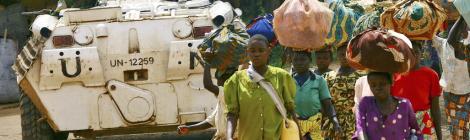
  • Sustainable Security

  • Sustainable Security

  • Climate change

    Accelerating climate change and competition for limited supplies of water, food and energy are poised to ignite long-simmering conflicts in fragile states, monopolising the world’s military resources and hampering development efforts, security experts say. Defusing these new 21st century conflicts – or at least preparing governments and citizens to cope with them – will require a broad range of innovative interventions, a gathering at Britain’s Department for International Development (DFID) heard earlier this month.

    Image source: Images.Defence.Gov.au

    Read more »

  • Sustainable Security

    Losing control over the use of force: fully autonomous weapons systems and the international movement to ban them

    Later this month, governments will meet in Geneva to discuss lethal autonomous weapons systems. Previous talks – and growing pressure from civil society – have not yet galvanised governments into action. Meanwhile the development of these so-called “killer robots” is already being considered in military roadmaps. Their prohibition is therefore an increasingly urgent task.

    Read Article →

    From The Great War to Drone Wars: The imperative to record casualties

    The centenary of the First World War also marks the anniversary of the practice of recording and naming casualties of war. But a century on, new forms of ‘shadow warfare’ limit the ability to record casualties of conflict and thus threaten to allow states a free hand to employ dangerous new tactics without threat of individual or international accountability. Without verifiable casualty figures, – including information on who is being killed and how – we cannot evaluate the acceptability, effectiveness or impact of ‘remote control’ tactics as they are rolled out among civilian populations.

    Read Article →

  • Sustainable Security

    Losing control over the use of force: fully autonomous weapons systems and the international movement to ban them

    Later this month, governments will meet in Geneva to discuss lethal autonomous weapons systems. Previous talks – and growing pressure from civil society – have not yet galvanised governments into action. Meanwhile the development of these so-called “killer robots” is already being considered in military roadmaps. Their prohibition is therefore an increasingly urgent task.

    Read Article →

    From The Great War to Drone Wars: The imperative to record casualties

    The centenary of the First World War also marks the anniversary of the practice of recording and naming casualties of war. But a century on, new forms of ‘shadow warfare’ limit the ability to record casualties of conflict and thus threaten to allow states a free hand to employ dangerous new tactics without threat of individual or international accountability. Without verifiable casualty figures, – including information on who is being killed and how – we cannot evaluate the acceptability, effectiveness or impact of ‘remote control’ tactics as they are rolled out among civilian populations.

    Read Article →

  • Sustainable Security

    In our two-part discussion ‘Countering Militarised Public Security in Latin America’,  Sarah Kinosian and Matt Budd explore the roots of the increasing trend towards militarisation of  public security across Central and South America and ask what lessons can be learnt from alternative methods. Part 1 is available here.

    Armed forces being transported in Mexico, where they are being used to fight the 'war on drugs'. Source: The Daily Gumboot

    Armed forces being transported in Mexico, where they are being used to fight the ‘war on drugs’.
    Source: The Daily Gumboot

    Over the past decade there has been a sharp and sustained increase in crime and violence across Central America. Fuelled by a rise in organised crime, the growth and expansion of domestic gangs, poor socioeconomic conditions and State institutions lacking in terms of their capacity and territorial coverage, crime and violence have rocketed. Homicide rates, taken as the main measure of insecurity in public debates in the region, have soared. In the Northern Triangle, where socioeconomic conditions and institutional capabilities are generally worse, a figure of 85.5 per 100,000 inhabitants makes Honduras the most dangerous country in the world, whilst figures of 34.3 and 41.5 for Guatemala and El Salvador place them within the upper echelons.

    In response to public and media pressure, there has been a notable tendency to resort to militarised responses focused on reactionary and repressive policies that seek immediate short-term results. This is particularly true of the Northern Triangle countries, which have an established history of involving the military in public security tasks. In El Salvador, following the ‘New Dawn’ campaign (Campaña Nuevo Amanecer), initiated in 2009 to reinforce security in response to the high incidence of crime, 39% of the Armed Forces are currently involved in public security tasks. This involves, for example, their collaboration in patrols to increase security in border areas and unofficial border crossings, the provision of perimeter security in penitentiary centres, and task forces that carry out patrols, apprehensions and joint operations with the national police. In Guatemala, the assistance, collaboration and coordination of the Armed Forces in public security has been further institutionalised through the Protocol for Inter-institutional Action, which regulates these activities. This approach is perhaps best epitomised, however, by the case of Honduras. Characterising a lack of political will to fully engage in the long and difficult task of reforming and developing existing police institutions, Honduras has placed its military at the centre of public security, and, with the recent creation of the Military Police of Public Order, located within the Ministry of Defence, a permanent policing role has effectively been handed to the institution. As such, prevention and reconciliation often take a back seat behind reactive and militarised approaches.

    A better way?
    Nicaragua National Police

    Nicaragua National Police
    Source: Insight crime

    While Nicaragua does not depart from this pattern of engaging the Armed Forces in public security tasks[1], the government has simultaneously invested in the long term development of a policing model that stands out due to its grass roots focus on prevention, and for the results it has achieved as a consequence (in 2010, in Panama, it was pronounced as the best in the region by a panel of public security experts). Closely linked to the Sandinista Revolution out of which it grew, Nicaragua’s community policing model has developed through a process of continual reform in the light of the identification of good police practice. As such, what began as a routine focus on community relations has since developed into a model characterised by broad and deep relations between the community and the police. These permeate not only the actions of individual police officers, but also guide the structure, organisation, deployment and entire philosophy of the institution. This is combined with a proactive focus on attention, which involves the continual identification of social factors driving crime and insecurity combined with the constant evaluation of police competencies to respond to them. By monitoring the relationship between security phenomena and police competences in an anticipated rather than reactive fashion, it allows for a concerted analysis, and response to, the conditions and circumstances that are driving crime and insecurity.

    The decentralised approach of the Nicaraguan National Police (PNN) is one of the keys to its success. It places emphasis on the local drivers and manifestations of both local and national security challenges. It does this by establishing broad and permanent channels of communication with the community, both through participation in community assemblies and maintaining direct links with local residents. One such example is the use of heads of sectors specialised in public security. They are police that are located in a particular territorial area, and their functions include cultivating close community ties through activities such as frequent door-to-door visits to speak to local residents.

    Similarly, the Social Prevention of Crime Committees, which are made up of 40,000 members, and the Cabinets of Citizen Power, which number 143 across the country, also provide a direct link with the community. Amongst their functions, they organise assemblies, work with local public and private institutions to find solutions to security problems, and collaborate on working plans to prevent crime.  These fluid links with the community allow the police to cultivate a close and trusting relationship with them, gain an understanding of the security perceptions of local residents and actors, and extract useful information regarding crimes, particularly regarding drugs, robberies and violence between groups of youths. Community policing therefore provides police with a specialised knowledge of the local situation and the drivers of insecurity.

    Tackling social drivers of crime
    http://www.policia.gob.ni/prensa_nota4.html

    On patrol in the community
    Source: Policía Nacional de Nicaragua

    The prevention of crime requires targeting the social conditions that cause it and instead, cultivating conditions which reduce it. In order to achieve this, the PNN has created specialist bodies that focus on two major causes of insecurity: youth violence and intra-family or sexual violence (20% of crimes).

    Specialised Police Stations for Women and Children were created as specialist units for prevention and attention to victims of intra-family, psychological or sexual violence. To combat these problems, attention is focused on the particular drivers of these forms of violence: the economic and social vulnerability of women and children, the attitudes of males in the community, and the lack of comprehensive victim support, which contributes to an unwillingness to denounce such crimes. Work is therefore carried out in a 3 stage response:

    1)      Transformation of the local environment, using education and training in detection and response to increase awareness of the problems and how to report them;

    2)      comprehensive victim support, through a leading role in coordinating with NGOs, health centres, shelters for victims, state institutions etc,  in the provision of health, psychological and legal support, in addition to the investigation and prosecution of crimes;

    3)      and empowerment of women and children through vocational training and education.

    By combining an understanding of local conditions driving insecurity with an integral response to them, the Police are better placed not only to respond to manifestations of intra-family violence, but to also reduce occurrences through preventive measures.

    The Directorate of Youth Affairs uses the same logic in its attention to at-risk youth, those with established links to gangs, or those who have previously been incarcerated. Through a highly personal and humanistic approach, it seeks to change the attitudes and values of these young people, increase their bonds with the local community, and create opportunities for them to reintegrate into society. Recipients begin by making a commitment to change and handing over any weapons they possess, with social and psychological support applied within the family environment to deal with personal issues, such as low self-esteem or personal identity. Training and education programmes are provided through private and public scholarships, as well as through the National Police’s Centre of Youth Training and Development, through which they gain skills to assist them in finding employment, and that contribute to the development of their community. Recipients also engage in community leisure and social activities and are assisted in finding work as part of their social reintegration. As a result, the number of gangs recorded in Managua has decreased from over 200 to approximately 20, according to the PNN, with a total of 42 gangs registered across the country in February 2012, and reductions in gang-related crime have been registered in neighbourhoods such as Bello Amanecer. By engaging in prevention programmes that focus on those conditions that drive youth into gangs and violence, and by coordinating these programmes within the family and community environment, the PNN has developed a model that seeks to reduce crime and insecurity in a sustainable and long term manner.

    Lessons to guide police reform in Latin America

    Whilst the contextual origins of the model and the particularities unique to each country would make attempts to duplicate the model in the region futile, the Nicaraguan model provides a number of clear lessons that can be extracted. At the foundation of each of these lessons is the community-police relationship, which has come to permeate throughout the institution and its programmes. It acts as a tool to both gain an understanding of the underlying drivers of insecurity and to provide a comprehensive response to them, through a combination of preventive strategies and comprehensive victim attention programmes. While the efficacy of involving special military units to target particular security challenges should not be negated, the benefits of a police force with strong community roots and a community policing philosophy are clear. For lasting gains to be made, these lessons, together with those to be extracted from other successful experiences in the region, should underpin reform processes.

    Matt Budd is a security analyst at RESDAL (Red de Seguridad y Defensa de America Latina – Latin American Security and Defense Network) in Buenos Aires, where he focuses on public security issues in Central America. Matt holds an honours degree in International Relations from the London School of Economics. Matt has most recently been working on RESDAL’s  Public Security Index, which provides information on public security challenges and institutional responses to them in Central America.


    [1] The Armed Forces of Nicaragua engage in a range of public security tasks, including rural security, border security, protection of the coffee harvest, and tasks against organised crime and drug trafficking.

    Featured Image:  Policeman consulting with a member of the local community in Managua, Nicaragua. Source:  John Holman, YouTube

  • Competition over resources

    In a small village along the waters of Lake Turkana in northwestern Kenya, two fishermen were murdered last month as they were putting out their nets.

    A cascade of retaliatory violence between the Kenyan Turkana and Ethiopian Daasanach (sometimes called Merille) has led to the deaths of at least four Ethiopians and 20 Kenyans ethnic groups, though some Kenyan government officials place the toll as high as 69, according to the Kenya-based Daily Nation. Though the fighting has been localized, it has put pressure on both nations to deal with strife between nomadic groups who are competing for diminishing resources.

    Image source: Aocrone

    Article source: Circle of Blue

    Read more »

  • Sustainable Security

  • Sustainable Security

  • The United States, Niger & Jamaica: Food (In)Security & Violence in a Globalised World

    The United Nations Development Programme (UNDP) defines food security as “all people at all times having both physical and economic access to the basic food they need”. However, due to a complex range of interconnected issues from climate change to misguided economic policies, political failure and social marginalisation, over 2 billion people across the world live in constant food Insecurity. It is important to take a sustainable security approach to look at the importance of “physical and economic access to basic food” by exploring the links between food insecurity and violence.

    A recent article published by the journal Conflict, Security & Development examines food riots as representations of insecurity and looks at the relationship between contentious politics and human security.

    Thomas O’Brien, author of the article, argues “the upheaval caused by a food riot can lead to lasting instability and violence as social and political structures are challenged”. Global rises in basic food prices triggered demonstrations and often violent protests in “over 30 countries across Africa, Asia, Latin America and the Middle East in 2007-08”. The article puts recent food riots and the current global food crisis in historical perspective. Food riots are about more than “just access to food”.  They represent dissatisfaction with political structures and perceived injustices.

    It is important to note that “the extreme nature of the rise in food price in the absence of much evidence of food shortages, left a sense of something unnatural about the way food markets were working”. Although poverty, weak states, ineffective civil society and lack of political freedom all contribute to food insecurity and the possibility of violent food riots, we cannot ignore to challenge underlying transnational and global power structures: “146 protests in 39 countries over the 1976-92 period were linked to the imposition of International Monetary Fund and World Bank structural adjustment policies.” Food security is fundamental to human security and needs to be approached by addressing underlying causes and drivers. A sustainable response to food insecurity would take global cooperation, justice and equity as key requirements.

    An often mentioned driver of food insecurity is climate change. Climate change already has a great impact on global security concerns and the physical, social and economic effects will undoubtedly only be exacerbated in the near future. Increasingly high temperatures and little or inconsistent rainfall have devastating effects on crop yields in places such as India, Africa’s Sahel region and the mid-western United States.

    The catastrophic food crisis in Niger in 2005 for example was largely attributed to the effects of climate change and competition over limited resources. Years of too little and too inconsistent rainfall have meant devastating droughts and diminishing harvests in this Sahel country of west Africa which has the highest birth rate in the world. Increasingly advanced desertification due to climate change means competition and potentially violent conflict, over limited resources such as water and arable land, intensifies.

    In the 2005 food crisis however, although thousands of children died of malnourishment, Niger had produced enough food to feed its population. The real issue was a food shortage in neighbouring Nigeria. Nigeria has an economy based primarily on oil exports with a significantly weakened agricultural sector. Instead of Niger feeding its own population, much of the harvest was sold to wealthier Nigeria at prices much higher than anyone in Niger could have afforded. This is a good example of why free market economy and trade liberalisation do not necessarily benefit all parties involved. Writing about the great famines of the last century, Nobel laureate Amartya Sen noted “a drought is natural but famine is man-made”. What this tells us is that although the challenges we face by climate change are serious threats, there is much that can be done to ensure more food security through political and economic policies.

    Farmers in Niger are struggling. But so are farmers in Jamaica. In contrast to Niger, Jamaica has a wealth of fruit, vegetables, fish and an abundance of fertile land. About one fifth of this island’s population is employed in the agricultural sector. Still, farmers are struggling to survive because they cannot compete with the much lower prices of subsidised agricultural imports from the USA. As cheap foreign products flood the market, Jamaican prices are driven down which makes local food production by and large unprofitable. As they rely more on foreign food imports, Jamaicans will be increasingly vulnerable to price volatility on the global marketplace. With the average Jamaican spending about half of household income on food, such vulnerability to price changes is a real danger to food security.

    Importing less foreign food products is a difficult matter for Jamaica because of the strict trade liberalisation policies imposed on the country through its debt relief agreements. One could also argue that if it is cheaper for Jamaica to import food than to produce its own, why should it still encourage its local agricultural sector? When a country is dependent on food imports, it cannot assure food security for its population.

    So far US imports have been much cheaper than local Jamaican produce. 2012 however has seen the “worst US drought in 50 years” according to last month’s Aljazeera article entitled Food riots predicted over US crop failure. “Grain prices have skyrocketed and concerns abound the resulting higher food prices will hit the world’s poor the hardest- sparking violent demonstration” says the newspaper. Corn is a primary staple in Sub-Saharan Africa, Central and South America, and prices have already gone up 60 per cent since June because “the United States accounts for 39 per cent of global trade in corn and stockpiles are now down 48 per cent” due to the drought.

    Price fluctuations on the global food market do not affect all people in the same way as “people in wealthy industrialised countries spend between 10 to 20 per cent of their income on food. Those in the developing world pay up to 80 per cent. According to Oxfam, a one per cent jump in the price of food results in 16 million more people crashing into poverty.”

    A sustainable approach to food security would address underlying forces such as climate change, economic and political policies and social marginalisation.

    Paul Rogers, expert on global conflict and consultant to the Oxford Research Group on global security, was recently featured on the BBC Radio 4 programme Costing the Earth. When asked whether free markets can help feed us, he replied:

    “It will contribute in some way, but I think it is fairly minimal. There are far more important things to consider. Look at it this way: Back in the world food crisis in the early 1970s, which was the worst for about 80 years, there were about 450 million people malnourished.  Now the figure is closer to 800 million. Now, that malnourishment and lack of food is not generally because there isn’t enough food to go around. Even at the height of that crisis there was still half the normal reserve. It is because people cannot afford to get the food or to buy the food. […]  If you are looking at the situation of poor people across the majority world, there has to be some way in which we can actually improve the production of food in and around those areas to provide greater resilience in the face of what is coming because beyond all of this is the whole issue of climate change. I think we will have a wakeup call this year in terms of what might come.” 

     
    The Conflict, Security and Development article Food riots as representations of insecurity is available for paid download here
     
    The AlJazeera article Food riots predicted over US crop failure is available here
     
    The Pulitzer Center for Crisis Reporting project Agriculture and Jamaica’s rural poor is available here
     
    Paul Rogers’ Monthly Global Security Briefings can be read and subscribed to here
     
     
    Image source: Dioversity International
  • Petroleum and its Impact on Three Wars in Africa: Angola, Nigeria and Sudan

    This article focuses on the complex role that oil has played in many conflicts on the African continent. It begins by highlighting oil’s influential role within war at a wider international level and provides a brief theoretical base from which to explore oil’s role in the African continent. Then, the article provides evidence of petroleum’s impact on violent conflicts in three African countries, namely Angola, Sudan and Nigeria, in order to highlight oil’s multi-faceted role on war in Africa.

    The full article can be accessed here.

    Image source: Maks Karochkin

  • Sustainable Security

    Nuclear Weapons: From Comprehensive Test Ban to Disarmament

    Despite not yet entering into force, the 1996 Comprehensive Test Ban Treaty has succeeded in almost eliminating nuclear weapons testing and in establishing a robust international monitoring and verification system. A breakthrough in its ratification by the few hold-out states could have important positive repercussions for the Nuclear Non-Proliferation Treaty or nuclear disarmament in the Middle East.

    Read Article →

    Humanitarian Consequences of Nuclear Weapons: Five Reasons for the P5 to participate in Vienna

    The ‘humanitarian dimension’ initiative highlighting the consequences of nuclear weapons has evolved and consolidated itself in the non-proliferation regime since 2010. The five nuclear weapons states (NWS or P5) under the NPT – China, France, Russia, UK and US – boycotted the first two international conferences on the humanitarian consequences of nuclear weapons. A third conference will be held in Vienna on 8-9 December 2014. This article gives five reasons why the P5 should consider participating.

    Read Article →

    Building the Case for Nuclear Disarmament: The 2014 NPT PrepCom

    The humanitarian impact of nuclear weapons, highlighted by a wide-ranging, cross-grouping, multi-aim initiative which continues to consolidate itself in the non-proliferation regime, has come to the fore in the 3rd Prepatory Committe for the 2015 NPT Review Conference. Frustrated with the lack of progress towards NPT Article VI commitments to complete nuclear disarmament, the initiative has invigorated attention to the urgency of nuclear disarmament and a need for a change in the status quo. NPT member states and civil society continue to engage actively in publicizing the humanitarian consequences of nuclear weapons as an impetus to progress towards nuclear disarmament.

    Read Article →

    In piaffe: multilateral nuclear disarmament dialogue in the year of the horse

    Shortly after the lunar New Year, UN Secretary-General Ban Ki-moon challenged the Conference on Disarmament to run with the ‘spirit of the blue horse’ towards substantive engagement on multilateral nuclear disarmament in 2014. While the regime may not achieve this speed, there are initiatives underway this year that may well help nuclear disarmament dialogues pick up speed ahead of the 2015 NPT review conference.

    Read Article →

  • Libya: Where Are the BRICs?

    Following the vote at the UN Security Council, the United Kingdom, France, and the United States have embarked on military action against Gaddafi’s forces in Libya. They have been careful to include a few Arab states in this new coalition of the willing. But these three countries are the driving force behind the imposition of a no-fly zone and the attacks on the government’s military positions and forces. Yet among the permanent and non-permanent member of the Council who were asked to authorize “all necessary measures” to protect civilians rebelling against the regime, the BRIC powers of Brazil, Russia, India, and China were conspicuously absent. The implications of this Security Council vote will be far greater than just what happens to the Gaddafi regime for it also tells us something about the role of the new candidates for global leadership.

    Brazil, Russia, India, and China are all represented on the Council at the moment — Brazil and India currently hold non-permanent seats — and collectively have become the face of what has been presented as the irreversible shift in global power toward a multipolar world. Goldman Sachs, for instance, has breathlessly ascribed to these four countries the ability to dramatically alter the global economic landscape over the next 50 years. If such projections are accurate, the key question is whether these new powers will seek to overturn the existing US-led order or simply join it as more equal partners. This question extends to China’s “peaceful rise,” the way that India and Brazil climb their way to the top-tier of global politics, and Russia’s re-emergence on the back of sustained high energy prices.

    China and Russia are not surprisingly reluctant to engage in Western-led military action under the principle of the “responsibility to protect.” Both countries have significant internal turmoil and both prefer to hold on to the option of responding with brute force to domestic opposition if push comes to shove. For India and Brazil the story is not quite so straight forward. Although neither country has been particularly enthusiastic about the concept of a responsibility to protect, both have spent considerable political capital to appear like responsible stakeholders and serious players on the world stage. Both would dearly love a permanent seat on the UN Security Council with its power of veto and prestige of higher social status. Both look to the United States to facilitate such a move and assist with dampening the protests of their respective regional rivals, Pakistan and Argentina. So far India has been very successful in winning U.S. and UK support, and Brazil is hoping that a visit by President Obama this past weekend will spur the United States to join France in publicly supporting a Brazilian seat.

    In the short term, however, the Brazilian and Indian abstentions on the Libya vote will not likely have helped to advance their plans for permanent membership of the Security Council. President Obama’s strategy for dealing with America’s relative decline and the rise of these new centers of power has been to try and co-opt potential challengers wherever possible into existing structures rather than set up showdowns for the decades to come. Yet this strategy is not fool-proof and leaves plenty of room for new powers to resist the liberal foundations of the U.S.-led order painstakingly constructed since 1945.

    The uprisings across the Arab world have thrown up a number of problems for Western powers. Their time-honored position of attempting to ignore the deep marginalization of large swathes of the “majority world” and to contain or manage corrupt regimes for the sake of assured energy supplies and intelligence cooperation has come apart at the seams. The brutality of the Gaddafi regime and the belated and chaotic response of rightly incensed countries such as Britain, France, and the United States have forced the hands of these reluctant interveners at the 11th hour.

    The Western response to the Libyan crisis has not addressed how this fundamental tension between a responsibility to protect vulnerable people and a global order based on the principle of national sovereignty can be resolved with the full participation of the emerging BRIC powers as well as the established trans-Atlantic ones. The people of Libya may be glad that such a large and difficult question has not been allowed to prevent outside assistance as they face down Gaddafi’s forces. But the United States and its allies will not be able to ignore this problem for long if a peaceful transition to a new global order is to be achieved in the years to come.


    Foreign Policy In Focus contributor Ben Zala manages the Sustainable Security Programme at the Oxford Research Group. He works on issues of global security and great power politics and is also a member of the editorial team of the academic journal Civil Wars (published by Routledge).


    This article originally appeared on Foreign Policy in Focus.