Blog

  • Sustainable Security

    With skills and expertise in fighting insurgencies and drug trafficking networks, Colombia’s armed forces are increasingly being sought for engagement in similar security challenges in West Africa. But increasing Colombian engagement gives rise to a number of important questions – not least of which is the goal and expected outcomes of replicating militarised approaches to the war on drugs that have already failed in Latin America.
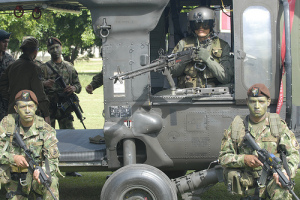
    Colombian National Army Soldiers. Source: US Department of Defense (Flickr)

    Colombian National Army Soldiers. Source: US Department of Defense (Flickr)

    Colombia has become an exporter of defence cooperation, including operational support, training and capacity building in national security and the fight against insurgencies, drug trafficking networks and terrorism. The skills and expertise of their security forces are in demand and, with strong US support and funding, and through intense diplomatic activism (the ‘Diplomacy for Security’ initiative), the country is building a wide array of bilateral and multilateral agreements for these activities. West African countries suffering from drug trafficking related problems are among the recipients of this support. Although extensive information on these ties and specific programmes is not publicly available, this involvement is evident and therefore raises a number of questions.

    Colombian Engagement in West Africa

    Between 2005 and mid-2013, Colombia trained 17,352 military staff from approximately 47 countries in various areas of assistance. In 2009, officials from Guinea Bissau, Cape Verde, Gambia, Ghana, Togo and Senegal attended training on operations and intelligence-gathering in Colombia under the auspices of the European Union and the UN Office on Drugs and Crime. The head of the Colombian police then announced that he would send ten anti-narcotics police to Africa, to be based in Sierra Leone.

    Colombian and African officials met again in March 2012 in Bogotá at a seminar on transnational organised crime. The same year, the US State Department announced that both countries were providing direct operational support and indirect capacity building efforts to countries throughout the hemisphere and West Africa. And police from 10 African countries, including Cameroon, Guinea Bissau, Senegal and Sierra Leone attended in January 2013 a Colombian National Police-hosted port and airport security seminar.
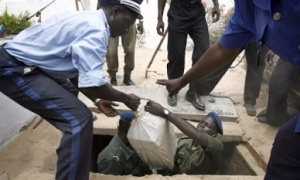
    Police officers remove bags of drugs found in the Senegalese town of Nianing, 50 miles south of Dakar. Source: africablogs.wordpress.com

    Police officers remove bags of drugs found in the Senegalese town of Nianing. Source: africablogs.wordpress.com

    Colombian involvement in West Africa (and Africa more generally) should not come as a surprise. West Africa is increasingly affected by the illegal narcotics trade and associated problems on governance and security. In this trend there are pull and push factors. It has become a transit hub and intermediate point for drugs making their routes from South America to European and other markets,  at a time when border –particularly maritime – security has improved in some European countries, making it more difficult for drugs to reach their territories using the traditional direct routes. The West African coastline is situated at the shortest travel distance from some Latin American departure points, and networks shifted to it while looking for new routes. From West Africa, drugs can continue to Europe or elsewhere by sea or by diverse land routes. Some countries with problems of territorial and border control, corruption and weak governance have been particularly vulnerable to this shift in international narcotics routes. One case in point is Guinea Bissau, where “the combination of a corrupt and centralized leadership and an inadequate and underfunded justice system in a country riven by upheaval and abject poverty” are among the driving factors.

    US Reliance on Colombian forces – Advantageous for Both Sides
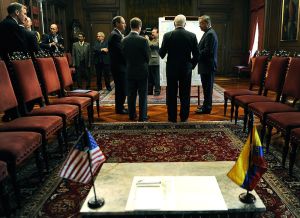
    Colombian Defense Minister Gabriel Silva, U.S. Defense Secretary Robert M. Gates, center right, and U.S. Ambassador to Colombia William R. Brownfield talk to one another at the Presidential Palace before meetiing with President Alvaro Uribe in Bogota, April 15, 2010.

    Colombian and U.S. Defense Ministers and  Ambassador  William R. Brownfield meet in Bogota, 2010. Source: Wikimedia

    The reliance of the US on Colombia to export security policies makes sense for both countries. For the former, it is a way to maintain indirect military support and training programmes at a lower cost and through a reliable partner. “It is cheaper for us to have Colombia do the training than us do it ourselves,” Ambassador William Brownfield (Assistant Secretary for the Bureau of International Narcotics and Law Enforcement Affairs) told Congress, later adding that “it’s a dividend that we get for investing over $9 billion in support for Plan Colombia.” The SOUTHCOM Posture Statement 2014 describes Colombia as a clear example of a sizeable return on relatively modest investment and sustained engagement.

    For their part, the Colombian security forces face uncertainty about the future. They have undergone an important growth in personnel (up to 450,000 now) and operational capacities, parallel to increases of a defence budget that reached $12 billion in 2012. Their air power and deployment capacities have become more sophisticated; and the Police now have highly vetted units trained in intelligence-gathering on drug trafficking organizations. A significant part of those advancements can be attributed to US support through Plan Colombia. But this is an untenable situation provided that a peace deal with the FARC has been reached and in the event of a post-conflict scenario. Not surprisingly, they are in search of new missions within and outside Colombia.

    US Focus on West Africa… From Narrative to Policies

    Africa is for the US “the new frontier in terms of counterterrorism and counternarcotics issues,” according to Jeffrey P. Breeden, the chief of the DEA Europe, Asia and Africa section. The US narrative on this region is one of intertwined and convergent threats and actors, where illicit trafficking feeds the crime-terror continuum and criminal insurgencies become players in illicit markets, using the profits to finance terror campaigns. A member of the State Department remarked that “If we do not act decisively, the region will remain an exporter of terror and a provider of safe havens where terrorists from other conflicts all over the world find refuge, illicit trafficking will continue to expand, (…) and drugs and illicit enterprise will corrode the rule of law and the gains of globalization.”

    There is a boom of academic and policy literature about the ‘continuum’ and other modalities of confluence among terrorism, illicit traffic networks and armed conflict. But the relations between these actors are complex, multifaceted and non-linear. Oversimplification of this complexity,  reducing the problem to a ‘merger’ of different types of groups makes an ideal argument to gain media attention and push for kinetic policies and strong military involvement. For the US, any link to terrorism or crime-terror nexus makes it easier to gain political support for engagement. But this ‘merger’ is hardly supported by operational evidence, with cross-overs between terrorist groups and drugs cartels, for example, remaining more like opportunistic agreements and less as structural and permanent. This argument also leaves aside other root causes of crises such as lack of governance, corruption, underdevelopment and marginalisation.

    The reason for abundant use of this narrative may be hidden in plain sight. According to the criminal code, US agencies are authorised to pursue and prosecute drug offences abroad provided that a link to terrorism is established, even if there is no connection with US consumption markets. This is the case for West Africa.

    In 2011, Ambassador Brownfield led a delegation of senior U.S. officials to West Africa to begin formulating a strategic approach to undermine transnational criminal networks and  reduce their ability to operate. The response is the West Africa Cooperative Security Initiative (WACSI). US counter narcotics assistance for West Africa soared from $7.5 million in 2009 to $50 million each of the past to years, according to the State Department. The budget and operational constraints limiting direct US engagement in West Africa’s drugs and organised crime problems include AFRICOM, an agency that relies on around 2,000 personnel to manage coordination of defence programmes for 38 African countries, plus around 5,000 soldiers deployed at any time. The response to scarce resources increasingly takes the form of reliance on special operations teams and cooperation with close allies, with Colombia playing a prominent role.

    Colombia in West Africa: More Questions Than Answers

    The strategic partnership between both countries is expressed in several instruments, notably the bilateral High-Level Strategic Security Dialogue (HLSSD), periodic meetings of the Security Cooperation Coordinating Group (SCCG) and the US-Colombia Action Plan on Regional Security Cooperation. These instruments are used to formalise security cooperation activities and assistance programs to partner nations affected by transnational crime, including West Africa.

    There is no doubt that the shift in trafficking routes is affecting security in some West African countries. Again, Guinea Bissau is among the most obvious cases, due to the ties among senior government, military officials and criminal groups that have played into upheaval and instability. Northern Mali has experienced drug related violence among armed groups involved in different degrees in the drug trade. Beyond these, the connection between drugs and overt violence is less evident, but a focus exclusively on drugs and violence ignored the important connections of the drug trade and criminal networks with political and business elites. These less studied but structural relationships have potentially grave destabilising effects.

    A Colombian cooperation undertaken by the Police (not the military), focusing on capacity building to strengthen national capacities in law enforcement, and improved intelligence and information–sharing mechanisms, could make sense. International cooperation is certainly needed to address this truly transnational problem. But due to the lack of information available, it is not clear what kind of responsibilities different parts of the Colombian security forces (Police, military, intelligence) are currently assuming.

    Therefore, the involvement in West Africa raises a number of important questions. The security forces, with US support, have managed well in counter-insurgency but the overall impact of Plan Colombia and associated policies on the illegal drug economy remains doubtful. What kind of capacity building and operational support can the Colombian forces provide in countries at peace, provided that their expertise has been acquired in armed conflict? What insurgencies might be fought in West Africa?

    What is the goal and the expected outcomes of replicating ‘drug war’ policies and approaches already failed in Latin America, such as militarisation of the fight against drugs? In particular, one of the unintended consequences of this approach is the ‘balloon effect’, through which crop cultivation, routes and transit points shift to new places as the old ones become more controlled. Indeed, this is already an important factor in current West African problems. In terms of fight against corruption and involvement of powerful figures in the drug economy, the results have been mixed in Colombia (considering both national and regional levels).

    Last but not least, all the relative Colombian successes have come at the untenable cost of grave human rights violations. The security forces, particularly the military, remain very active in trying to avoid accountability for past misbehaviour and crimes. In one of the latest scandals in civil military relations, sections of Colombian military intelligence have been found to have spied on delegations of the recent peace process, including spying on the President’s representatives. What kind of human rights and democracy messages are being sent through this US backed Colombian defence activism?

    International Law enforcement cooperation can be asset in dealing with criminal networks like those involved in drug trafficking, particularly where corruption and involvement of state officials is a factor. But approaches that confuse different non-state actors, their roles and potential levels of threat and attempt to provide a one-size-fits-all response, generate more risk than certainty with regards to potential outcomes and consequences. Militarised approaches to the drug war and public security have been extensively tried in Latin America with limited impact on the drug trade, while worsening the situation of violence. In the Colombian case, the results have been remarkable in counter-insurgency, but the country is still one of the main sources of cocaine for international markets, and there have been widespread violations of human rights.

    These approaches are being increasingly questioned in Latin America and continue to lose support even among high Government representatives and Presidents. Replicating them without further evaluation and careful reflection about what has worked  – and what has not – is not a promising approach. Instead, approaches to drugs and organised crime in West Africa must be based on lessons learned, to avoid the repetition of past ineffective policies and their harmful effects.

    Mabel González Bustelo is a journalist, researcher and international consultant specialized in international peace and security, with a focus on non-State actors in world politics, organized violence, conflict and peacebuilding. You can follow her at her blog The Making of War and Peace, her webpage, and Twitter (@MabelBustelo).

    Feature image: Colombian Marines, 2009. Source: Wikimedia

  • Climate Wars

    Global warming is moving much more quickly than scientists thought it would. Even if the biggest current and prospective emitters – the United States, China and India – were to slam on the brakes today, the earth would continue to heat up for decades.

    At best, we may be able to slow things down and deal with the consequences, without social and political breakdown. In this three-part series for Canadian radio, Gwynne Dyer examines several radical short- and medium-term measures now being considered – all of them controversial.

    Listen to the podcast here:

    • Part 1
    • Part 2
    • Part 3
  • Sustainable Security

    This article was first posted on 15 October 2012 and has been featured this week in light of renewed tensions in the region.

    East China Sea smallAs the long running tensions over the set of islands in the East China Sea appear to be coming to a head, the time for thinking through the alternatives to the militarisation of this conflict seems to be well and truly upon us.

    The conflict raises interesting issues about sovereignty claims based on offshore territories, particularly as we face a climate-constrained future as well as the increasing importance of competition over scarce resources. The latter is fast becoming one of the most important global trends if one thinks about the potential ‘drivers’ of conflict and even war.

    Spiralling naval spending in the region has been tracked by analysts for some years now, and flashpoints such as the dispute over the Senkaku/Diaoyu islands could show rampant military spending and arms racing for the dangerous trends that they are if things deteriorate rapidly. Arms racing helps to reinforce security dilemmas (the problems of interpreting the motives of potential adversaries and responding in-kind by arming yourself thus creating a spiral towards ever increasing militarisation). Arms racing also discourages the development of what Ken Booth and Nicholas Wheeler refer to as ‘security dilemma sensibility’ – the ability to “perceive the motives behind, and to show responsiveness towards, the potential complexity of the military intentions of others. In particular, it refers to the ability to understand the role that fear might play in their attitudes and behaviour, including, crucially, the role that one’s own actions may play in provoking that fear.”

    But what is particularly important to note in relation to this crisis is the interaction between the trends of increasing militarisation and competition over resources. The potential hydrocarbon resources beneath the ground around the islands as well as the rich fishing grounds in the surrounding waters gives the competing claims to sovereignty a particular strategic bite.

    Imposed on top of this is the effect of unresolved historical tensions and fierce nationalist sentiment in some quarters of both Japan and China. The coverage of the dispute in the media has been particularly important. Kevin Clements and Ria Shibata have noted that “this might be expected in China, which has a state-run media. In democratic Japan and Taiwan, however, the media have also promoted official and unofficial nationalist positions on the conflict. This has been accompanied by a marginalising or silencing of moderate voices favouring negotiated non-violent solutions to the conflict.” Interestingly, the most constructive voices calling for calm who have been able to cut through the jingoism and sabre rattling have been the business community concerned with the bigger picture issues of losing trade and tourism between China, Taiwan, Japan and South Korea.

    Clements and Shibata have outlined five initial steps that could be used to de-escalate the issue and begin the difficult but unavoidable process of a negotiated solution. In the longer-term, both regional powers and important external players will need to put addressing the inter-linked trends of militarisation and increasing competition over strategic resources at the heart of any attempts to avoid the worst case scenarios playing out.

    Ben Zala is a Lecturer in International Politics at the University of Leicester.

    Image source: Al Jazeera English.

  • Sustainable Security


    In our two-part discussion ‘Countering Militarised Public Security in Latin America’,  Sarah Kinosian and Matt Budd explore the roots of the increasing trend towards militarisation of  public security across Central and South America and ask what lessons can be learnt from alternative methods.

    Homeland Secure Plan already has over 40 000 military personnel deployed to ensure peace Source: Prensa Presidencial

    Plan Patria Suegura (Safe Homeland Plan)  already has over 40 000 military personnel deployed to ‘ensure peace’
    Source: Prensa Presidencial

    Across Latin America, governments are sending their militaries into the streets to act as de facto police forces in the face of disproportionally high crime and violence rates. This trend has been going on for several years, but has accelerated in 2013. With the move to deploy over 40,000 troops for citizen security in Venezuela, President Nicolás Maduro joined a growing list of leaders throughout the region – in Honduras, Guatemala, Mexico, and Dominican Republic, to name a few– that have relied on their militaries to carry out police duties. Yet, in the past 20 years, there are no regional examples in which relying on soldiers for the security of citizens for an extended period of time has brought crime rates down.

    Aside from being ineffective, there are other problems associated with militarization of law enforcement. This tactic might offer short-term political or security gains, but it does not provide a long-term solution to the causes of crime. While the presence of the armed forces can slow violence initially, it often just displaces crime to another area, which can return once the troops leave. Sending soldiers to the streets also raises human rights concerns, as the armed forces are trained to track and kill an enemy with as much force as necessary.

    Police, on the other hand, are theoretically trained to use minimal force, investigate crimes, and respect the rights of citizens. When governments deploy troops, the differences between the functions of the police and the military get lost and the line between citizen and enemy becomes blurred. Yet each of the countries mentioned above has weak, corrupt, public institutions, particularly penal and justice systems, which have yielded high rates of impunity and crime. Shifting tides in the drug trade, the expansion of organized crime and rampant inequality, has exacerbated these problems. While police reform efforts are underway, they are flagging, largely due to a lack of funding and/or political will.

    So why, instead of heavily investing in police reform, have governments in Latin America increasingly turned to the military to solve public security problems? With the highest murder rate in South America, and a corrupt government with a strong military tradition, Venezuela provides an ample case study.

    The shadow of Chávez

    When Hugo Chávez died in March, he left behind an economy in shambles, a dysfunctional judicial system, a broken prison system, security forces rife with corruption, and a politicized government bureaucracy incapable of tackling the resulting spike in organized crime, violence and drug trafficking. In the two decades since Chávez took power, murder rates doubled  – or tripled according to some sources  – and in 2012, Venezuela had the second-highest homicide rate in the world[1]. Caracas, the country’s capital, on its own registers one of the highest murder rates globally, as gang warfare and high levels of street crime plague most urban centers. The country also has become a major hub for drugs transiting from Colombia to the United States and Europe.

    In a post- Chávez Venezuela, the dire security situation appears to be getting worse. In May, just two months after taking office, Chávez’s handpicked successor, President Nicolás Maduro, sent 3,000 members of the military and police to man roadblocks, carry out raids and patrol the streets of Caracas. The deployment was part of an initiative known as “Plan Patria Segura,” (or “Safe Homeland Plan”) which has been expanded to include over 40,000 members of the security forces. Soon, about 80,000 security forces will have been deployed and the military will have an active role in every state. Although the initiative was set to end this October, it looks like troops will be on the streets well past 2013.

    Police Corruption
    Riot police line up at a student protest in Caracas Source: Rodrigo Suarez, Flickr

    Riot police line up at a student protest in Caracas Source: Rodrigo Suarez, Flickr

    One reason Maduro has turned to the troops is that Venezuela’s police are among the most corrupt in Latin America. As in Guatemala, Mexico and Honduras, police in Venezuela have been dismissed by the public as ineffective, corrupt, abusive and complicit with organized crime. In 2012, a Transparency International survey found Venezuelans considered the police to be the most corrupt entity in the country.

    This is not a recent problem – even before Chávez’s reign, the country’s police forces were accused of excessive use of force, unlawful killings of civilians, extortion, torture, forced disappearances and involvement in organized crime. By 2009, even the government admitted police were responsible for up to 20 percent of all crimes. In one poll, 70 percent of respondents agreed with the statement: “Police and criminals are practically the same.”

    As with many forces throughout Latin America, police are underfunded, poorly trained and many times outgunned by criminals. This, compounded by high levels of impunity for officers and officials and a lack of central government control over the country’s 134 police units, has allowed organized crime to penetrate state institutions at every governing level.

    Reform measures put into motion by Chávez in 2009 aimed to centralize law enforcement and create a professionalized national police force. The new body, the National Bolivarian Police (PNB), would be less militarized and given human rights training from a civilian-run policing university. Officers would be vetted and their salaries would be doubled while a council that included human rights activists would oversee the reform’s implementation.

    According to Venezuela experts David Smilde and Rebecca Hanson, while “Venezuelans do not seem to think police corruption or inefficiency are major causes of crime, they do seem to believe that a professional police force and improved judicial and penal system could reduce crime.”

    However, challenges still exist. With just under 14,500 officers, the reformed force lacks manpower, as well as the funding and political will necessary to tackle the spiraling violence. Also, several of the reforms, such as the increased wages, have yet to be implemented.

    Despite Venezuelans support for the idea of citizen security reform, public support for the PNB appears to be one of its obstacles. For many citizens, the PNB’s tactics appear ineffective and “soft,” according to Smilde. While many residents prefer the humanist theory behind the force, many people in poor, crime-heavy areas see a more hard-line approach as the only option to target the sky-high levels of insecurity.

    A History of Military culture 

    Part of this public acceptance lies in the country’s entrenched military culture. The military dominated politics in Venezuela throughout the 19th century until the fall of a military dictatorship in 1958. The institution’s role then subsided, until Hugo Chávez was elected in 1998. Under Chávez’s “Bolivarian Revolution,” strong civil-military ties were forged, with troops being deployed to oversee social projects like food distribution and housing construction. Military members also gained personal voting rights and were placed in top positions in the government.

    Although Chávez initiated police reform, he focused even more attention and resources on the armed forces. Around the same time that he created the PNB, he set up two more militarized initiatives: the Bolivarian National Militia, a military-trained group of civilians that would act as liaisons between the army and the people, and the Bicentennial Security Dispositive, a military unit intended to target high-crime areas.

    Maduro has continued the military’s social and political role by surrounding himself with former and current military members, increasing the armed forces’ salary budget, creating new “Bolivarian militias” headed by former military members and pledging $4 billion (USD) to “increase the defensive capacity of the country.” He has also announced the creation of a new bank, television channel and cargo company, all for the armed forces.

    Given this context, as Smilde has noted, it is no wonder that for the average Venezuelan citizen, the military “represents order and efficiency against a background of chaos and dysfunction, and giving it an important social role appears logical.”

    Political motivations
    President Maduro visit and meets with Aviation High Command Source; Prensa Presidencial

    President Maduro visit and meets with Aviation High Command
    Source: Prensa Presidencial

    Maduro also has political motivations for sending in the military. Stuck in Chávez’s image, Maduro has been parroting his predecessor’s strategies and playing up the tight links between the military and the “Bolivarian Revolution.” In part, the troop deployment is a way to continue Chávez’s legacy and rally support for the government. Because of lingering popular support for Chávismo, the public has not turned on him and despite high inflation, shortages of basic goods, power blackouts, soaring murder rates, and corruption scandals, most polls indicate Maduro maintains a 45-50 percent approval rating.

    By deploying the military, Maduro has shown the public he is responding to the security problem. In general, amid calls for security improvement, it becomes politically difficult to wait for the gradual progress of police reform. “It is a political response to a political problem” according to Venezuelan expert and NYU professor Alejandro Velasco.

    What impact?

    Although the Maduro administration claims murders have dropped by over 30 percent, the Venezuelan Observatory of Violence projects the country will record 25,000 homicides in 2013 – 4,000 more than in 2012. Even in the areas where military presence has mitigated crime, what happens when the military leaves?

    Another concern is the lack of accountability for the military in Venezuela. Unlike the PNB, the armed forces are given no civilian human rights training and there is no mechanism for civilians to report incidents of abuse. There have been at least ten incidents of violations since July, including the shooting of a mother and her daughter by the National Guard. And while Maduro’s approval ratings have barely dipped, those for Plan Patria Segura show a downward trend.

    What now?

    In Venezuela and elsewhere, there are not a lot of hopeful choices to curb the immediate high crime levels. However, police reform is a key part of improving the security situation. As one U.S. State Department official recently said of Honduras, where a military police unit was just created, “the creation of a military police force distracts attention from civilian police reform efforts and strains limited resources.” This same logic applies to Venezuela – Maduro must politically and financially invest in police reform to strengthen and expand the role of the PNB. Police must also receive sufficient training, resources and supervision to ensure transparency. The public can begin to trust the police when they are the ones enforcing the rule of law.

    A line must be drawn between civilian and military leadership, and the role of the armed forces clearly defined and distinct from that of the police. To curb corruption, improved mechanisms for investigating police and military criminality must be established while civilian-led vetting and oversight systems put in place for police and military members. Finally, strong justice and penal systems are fundamental, otherwise those committing crimes will have little reason to stop doing so and prisons will continue to be violent bastions of criminal education. Police reform must not be pushed aside due to short-sighted politics; without a concerted effort to get troops off the streets, Venezuela is vulnerable to descending into an unchecked cycle of criminality, both in society and within its security forces.

    Sarah Kinosian is a program associate for Latin America at the Center for International Policy, a nongovernmental organization based in Washington D.C. that promotes transparency and accountability in U.S. foreign policy and global relations. She works on their Just the Facts project, monitoring U.S. defense and security assistance to Latin America and the Caribbean. 


    [1]  The Venezuelan government reports a rate of 56 homicides per 100,000 people in 2012. The Venezuelan Observatory of Violence (Observatorio Venezuelano de Violencia), a respected non-governmental security organization, estimates the rate was 73 per 100,000.

  • Public opinion favours greater government action to tackle climate change

    A new poll conducted by WorldPublicOpinion.org, a University of Maryland initiative, has found that, in 15 out of 19 nations, a majority of those surveyed felt that their national government should give a higher priority to tackling climate change.

    18,578 respondents in nations that comprise 60 percent of the world’s population were polled. However as Sam Roggeveen at the Lowy Institute, an Australian think-tank, suggests, those surveyed were not asked what action they wanted their governments to take or how much they would be willing to pay for it. When the Lowy Institute polled Australians in 2008, more than half suggested they would only be willing to spend $10 (AUD) or less per month on top of their existing electricity bill. Although it is positive that public opinion regarding the need for action on climate change is building, in the months leading up to the UN Climate Change Conference in Copenhagen more must be done in order to couple the desire for action with the reality of the costs involved.

  • Climate change

    As reported by Agence France Presse, the UN Intergovernmental Panel on Climate Change has produced a draft summary of a report that warns of a predicted increase in the number and intensity of extreme weather events.  The 800-page report goes some way to addressing a subject largely untouched by their landmark 2007 report on climate change, and adds to the growing body of evidence outlining the potential security implications of a warmer planet.

    Article Source: AFP

    Image Source: Nasa

    Read more »

  • Sustainable Security

    Carefully Managing Water Resources to Build Sustainable Peace

    Carefully planned interventions in the water sector can be an integral part to all stages of a successful post-conflict process, from the end of conflict, through recovery and rebuilding, to […]

    Read Article →

  • Sustainable Security

    Myanmar: peaceful transition to democracy or storm clouds on the horizon?

    Analysing a recent report by International Crisis Group, Anna Alissa Hitzemann argues that in order for the transition from authoritarian rule to democracy to be stable, and for peace and security to be sustainable, the government of Myanmar will have to face and resolve major challenges such as idespread militarization and the political and social marginalization (past and present) of ethnic and religious groups.

    Read Article →

    Sustainable Finance and Energy Security

    General volatility in financial markets – fuelled by irresponsible lending and trading practices, as well as evidence of market manipulation – have had an effect on oil prices. Although the specific effects of the finance sector on oil prices requires further investigation, we can already understand that a sustainable and secure future will require the development of a wider energy mix to meet rising demand. To this end, more sustainable financial systems must be developed to service the real needs of citizens

    Read Article →

    A top-down approach to sustainable security: the Arms Trade Treaty

    2012 has been hailed as a potential landmark year in the push for greater regulation of the global trade in conventional arms. After more than a decade of advocacy to this end, negotiations took place throughout July towards the world’s first Arms Trade Treaty (ATT), which is intended to establish the highest possible common international standards for the transfer of conventional weapons. However, although significant progress was made during the month of intense negotiations, the ATT is not yet open for signature. In this article, Zoë Pelter explores what role a potential treaty – if reopened for further negotiation – could play in a move towards sustainable security.

    Read Article →

  • Sustainable Security