Blog

  • Sustainable Security

    Summary

    Despite considerable disarray continuing into its third month, the new US administration is showing more consistent, if not coherent, signs of how it will try to implement Donald Trump’s campaign proposals. In large part, these may be assessed as antithetical to a more sustainable security agenda, given that they promote military confrontation, undermine attempts to address climate change, and are, at best, incoherent in their response to economic inequality. Little of this translation to reality is likely to endear Trump to voters or his party. Greater policy turbulence, at home and abroad, should be expected ahead of mid-term elections next year.

    Introduction

    The Trump administration has been in power for 75 days; following the election campaign and the post-election transition it is now possible to get a reasonably clear picture of how its policies relating to security are taking shape. There has been much speculation that the United States will take a very different path to that of the Obama era, not least in relation to security and climate change, and since the United States is the world’s most powerful state it is appropriate to make an initial assessment of the changes as they may affect the sustainable security thinking with which ORG has been concerned for the last decade. Is the Trump era likely to make a major difference to the global security outlook or is it more likely that realities of international relations will limit the capacity for the change Trump seeks?

    Sustainable Security

    The ORG approach to security may be summarised:

    Security challenges such as terrorism, crime and weapons proliferation cannot be successfully contained or controlled without understanding and addressing their root causes. ORG’s Sustainable Security concept takes a comprehensive, long-term approach that encompasses climate change, resource scarcity, militarisation, poverty, inequality and marginalisation.

    As the thinking has developed it has tended to group the challenges into three main areas, economic relations, climate change, and militarisation, and these are convenient headings with which to make an initial assessment of the Trump era.

    The issue of economic relations is seen as having as its greatest challenge the failure of the neoliberal approach to deliver economic justice, equity and emancipation, and the consequent growing divide between a relatively small minority of rather more than a billion people and the majority of the world’s population, with a clear rise in frustration and resentment among that majority at relative marginalisation and lack of life prospects.

    In the environmental context, while a number of resource limitations and regional environmental impacts are important, the emphasis in the ORG analysis has to be on the most significant trend – climate change and especially its impact on human well-being especially as a result of severe effects on food production.

    Finally, militarisation is seen partly in terms of a particularly entrenched and powerfully influential economic sector but most significantly as a culture in which the early use of military force is essential in maintaining the status quo, however unequal, unjust or unstable that order is.

    In all cases, the ORG view is that these approaches are thoroughly inappropriate if we wish to avoid an unstable and violent world, and much more emphasis must be placed on the underlying causes of the problems and how they may be addressed. The failure of the current 15-year war on terror is the most grievous example, having led to hundreds of thousands of deaths, millions of displaced people, at least three failed or failing states and a continuing perception of the threat of political violence in western countries. The question, simply, is how does the new Trump era affect the possibility of taking the wider view?

    Economic Issues
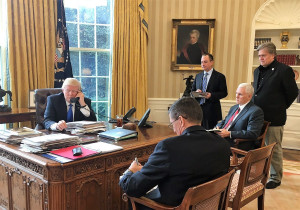
    Image credit: PressSec/Wikimedia.

    The early indications are that the Trump administration is a potentially unstable mix of those best described as economic nationalists and others, especially in the wider Republican Party, who are convinced neoliberals. The latter may be dubious about any trend towards protectionism and believe that in a free market which already favours the wealthy such protectionism may turn out to be counter-productive. In this view, transnational corporate organisation is a fact of life and no country, not even the United States, can go its own way for long.

    The economic nationalists, who are dominant within Trump’s inner policy circle, are very strongly convinced that the United States has sufficient power to dominate the markets that matter most. Furthermore, the whole Trump election platform was predicated on strong opposition to the perceived elite, an establishment that “ran” Washington. His appeal to those left behind, especially in the post-industrial American Mid-West, was probably the most important element in his successful election and it is an approach that will not readily be abandoned. At the same time, he was committed to policies that would reduce taxes while scaling down the Obamacare reforms – initially both popular with his supporters.

    In the short-term Trump’s policies may be popular but it may be as little as a year before those left behind find that their predicament simply does not ease. Indeed, it is already becoming clear that health provision reforms will lead to many millions of Americans facing higher costs, including many of those who voted for Trump. More generally, economic nationalism may turn out to provide little gain for the country as the power of China and other major economies becomes more apparent. “America first” is simply not sustainable in a globalised world.

    Even so, what has to be faced is that the Trump era will not see any fundamental challenge to the neoliberal system, precisely in a period when that system is proving unfit for purpose. What may perhaps be more relevant is how long the Trump approach in its present form persists. The degree of disorganisation currently apparent in so many areas within the White House is hardly encouraging in terms of stability, and it may well be that as the 2018 mid-sessional elections to the House and Senate draw nearer, Trump’s singularly soft Republican majority support in both Houses of Congress will lead to sudden changes of policy. These may not directly address core issues of inequality but could take much of the remaining lustre off the Trump approach.

    Climate Change

    This month has seen the very clear enactment of a number of policies that confirm that the Trump approach on climate change is one of denial coupled with the strong promotion of domestically-sourced fossil fuel resources. This is a highly negative approach for two reasons – there will be an increase in carbon emissions from the United States and a lack of leadership within the international community for addressing the considerable dangers stemming from climate change. This would seem disastrous for any hope of effectively preventing climate change but there are other very interesting factors at work.

    Firstly, the reality of the dangers of uncontrollable climate change is far more recognised across the world than a decade ago. Many more states are accelerating their moves towards renewable energy sources, with the biggest emitter, China, making remarkable strides. Indeed, China may well see its way to playing a global leadership role. Secondly, the rapid developments in renewable energy technologies are making renewable sources far more economic, with many further developments coming closer to fruition. The effect of this is that renewable energy utilisation is now competing much more closely with fossil carbon sources and, as a consequence, there is a rapid increase in investment in renewables. More than half of all investment in electricity generation is now in renewables and in the United States and elsewhere there is far greater potential for employment in renewables than in fossil carbon sources.

    Major problems remain including historic underinvestment in energy storage technologies and the need to cut carbon emissions by even more than most states currently accept, but the point here is that this is one area where there is every sign that Trump’s policies are obsolete and likely to ensure that the United States is left high and dry. Even in the face of that, though, the ideological certitude of the climate change deniers close to Trump means that the administration is unlikely to change. In short, the advent of the Trump era may limit the prospects for countering climate disruption but at least this will be another area where the Trump approach may be singularly counterproductive to any aim to make the United States the world leader.

    Security

    As with climate change, the first two-and-a-half months of the Trump administration have shown the translation of rhetoric into policy: control of migration, increased military spending and the more frequent use of force. Here, though, it is necessary to recall that the eight years of the Obama administration may have seen the withdrawal of US troops from substantial parts of the Middle East and Afghanistan but also saw the quiet transition to remote warfare with much greater use of air power, armed drones and Special Forces, not least in Libya and Iraq. The early signs are that Trump is expanding such operations rather than radically changing the posture and this includes even greater use of air power in the war against Islamic State (IS), as well as the deployment of even more Special Forces in Iraq, Syria and Yemen.

    These kinds of changes are being reflected in the manner in which the Pentagon is being given a much freer hand to conduct operations, but there are already consequences. A major raid in Yemen in late January failed to achieve its objective while also killing many civilians, and the much-expanded use of air strikes in Mosul in the past month has led to such an increase in civilian casualties that they are even being reported in the mainstream western media. Even so, such consequences are unlikely to carry any weight with Trump unless there are serious disasters involving US military personnel.

    The risk of this has been limited until now but one factor that has received little attention is that Trump’s Pentagon is advocating, and indeed already initiating, a substantial increase in the number of “boots on the ground”. In Iraq this is no longer just Special Forces but regular troop deployments which include, for example, units from the 82nd Airborne Division. Trump has also just agreed to give US forces in East Africa much more open powers to operate assaults on suspected al-Qaida-linked groups in southern Somalia, and there are also repeated calls for the Pentagon to expand its deployments in Afghanistan.

    As with economic issues, such actions may be popular with Trump supporters in the short term, examples of forceful action in the task of “Making America Great Again”, but based on the failures of the last fifteen years, the longer-term impact may be very different. What it does mean, though, is that as the United States seriously expands in overseas military operations then its close allies such as Britain will have to face up to whether they are willing to maintain their commitments.

    Conclusion

    These are, indeed, different times and with all three aspects of the sustainable security challenge the election of Trump is likely to exacerbate ingrained problems. At the same time, his policies may become increasingly irrelevant concerning climate change and his economic popularity with his supporters may also erode quickly. This may well increase the temptation to use foreign military action to distract voters from domestic discontents. However, even in the military dimension there are unlikely to be any quick wins and Trump’s direction of travel means that his allies could quickly come under domestic political pressure if they were to stay closely aligned with the United States. In any case, the need to rethink our attitudes to security remains critical and it is best to see the advent of the Trump era as a period when even more opportunity for creative, critical and independent rethinking of security will be essential.

    Paul Rogers is Global Security Consultant to Oxford Research Group and Professor of Peace Studies at the University of Bradford. His ‘Monthly Global Security Briefings’ are available from our website. His new book Irregular War: ISIS and the New Threats from the Margins will be published by I B Tauris in June 2016. These briefings are circulated free of charge for non-profit use, but please consider making a donation to ORG, if you are able to do so.

  • Sustainable Security

    The inclusion and participation of young people in societies is a necessary condition for sustainable peace. The neglect of young people’s current needs and future livelihoods is a recipe for renewed conflict.

    Despite all the sermonizing on the important role of young people for a society’s future and the United Nations Security Council Resolution 2250 (December 2015) on the importance to include youth in peacebuilding, the active and independent participation of youth is rarely welcomed. Across the globe youths are criticized either for their political apathy or their open political protest that travelled around the world in 2011 and 2012. In the debate on peace and conflict especially there is a significant divide: children are mostly seen as victims and the United Nations have an important advocacy role. At the same time, many governments perceive youths (age 15 to 25) as perpetrators of violence and potential troublemakers. While there have been calls to include youths in peacebuilding by giving them voice and agency, the inclusion of youth in current peacebuilding programs rarely includes elements other than education or training.

    Colombia’s comprehensive peace accord is an example. Youths appear 13 times in the 310 pages but only as part of other marginalized or excluded groups such as women, elderly, or the indigenous people. Under a broader perspective of peace being defined as more than the mere absence of war and armed conflict, this lack of youth’s political citizenship is counterproductive for sustainable peace. Neglected and/or criminalized young people either leave their countries and seek a better life elsewhere or they use violence to survive or to get attention from adults. They do not develop trust in the government and its institutions.

    The mismatch between formal possibilities and realities

    Image credit: wjgomes/Pixabay.

    A research project of the German Institute of Global and Area Studies on youth participation in postwar societies funded by the Federal Ministry of Economic Cooperation and Development  has provided interesting evidence for there being a significant mismatch between increasing formal possibilities of political participation of youths and their neglect and criminalization by adult society. In a first step, we collected data on the risks and opportunities for youth social, economic, and political participation – such as education, elections, employment– in 21 post-war societies (10 in Sub-Saharan Africa, six in Asia, four in Latin America, one in the Middle East). Many post-war societies liberalize their political regimes after the end of war.

    Political and civil rights are expanded, elections are introduced as a means of formal participation at the national as well as the local level. Consequently, young people in these countries – often the first generation that grew up and was socialized after the end of war –  should have bright perspectives. While youths participate in society, they do so overwhelmingly in civil society organizations (sports clubs, religious organizations and cultural activities) but to a much lesser extent in the political system. In a second step we conducted field research in three countries – El Salvador, Nicaragua, and South Africa – all perceived as rather successful cases of liberal peacebuilding at least in the first decade after war’s end. But even there young people feel marginalized.

    Youths in El Salvador, Nicaragua, and South Africa face a set of common challenges: The most pressing problem is finding decent work. While the first post-war generations have a significantly better formal education than their parents, youth unemployment is higher than adult unemployment. Even if young people can find work, available jobs offer low pay, long working hours, short contracts and few social benefits. Many youths are not able to make the important transition to adulthood and are unable to form a family. Political activism and citizenship should provide perspectives for change in demographically young societies. But a set of structural conditions influences youth political participation negatively: Poverty and inequality limit youth political activism, most of all in the rural areas and especially for young women.

    Overall, young people confront a generational bottleneck due to the war generation remaining in power, dominating economy, society, and politics, shaping the rules of post-war order and the possibilities for youth political participation. Although young people are interested in political participation they do not trust politicians and existing institutions. They do not “see benefits in participating” as change does not happen; they feel existing political parties only approach them during campaigns for their votes; and that they have neither real voice nor impact. Hence, they do not trust in elections as a mechanism of change. If and where young people organize as autonomous and independent actors, adults and elders view their political activism as problematic and as a challenge to their own status. They aim at integrating young people in a subordinate position for example in youth wings of political parties or other forms of controlled and supervised participation.

    Blocked transitions

    How do young people cope with these problems? Based on A.O. Hirschman’s classic book we can distinguish various strategies of exit, voice, and loyalty. Confronted with little future options and opportunities many youths exit through inner migration as well as out of country. El Salvador is an extreme example as a fifth of the population lives outside of its borders. While this may be an option for individual survival and upward social mobility, its potential for promoting change is limited. Other forms of exit are related to individual withdrawal from society via apathy, drug abuse or by joining a gang.

    Nicaraguan and South African youths have fewer options to leave. In these cases, the majority of young people are mostly muddling through taking the few chances they have to survive. South African participants in our project’s focus group discussions stated that change was only possible through the ruling African National Congress. Becoming a member is not necessarily a sign of confidence in the party but could rather signal high levels of realism regarding existing power relations. In this sense, the strategy of displaying loyalty might not be the best but a viable way of getting along regarding access to the labor market and other important public goods.

    Last but not least, there is the possibility of youth acquiring a voice. While political citizenship through the existing formal channels does rarely allow for significant changes, young people opt for non-violent as well as violent protest.  Salvadorian and Nicaraguan youths are at the forefront of ecological protests about problems such as water scarcity and the canal project linking the Pacific and the Atlantic.

    In South Africa, youths protest against corruption. While most young people prefer non-violent protest, they also acknowledge that violence can be used to get attention by the governmental institutions. As a girl living in a high crime area stated: “If you want to get the attention of the government you have to ‘toi toi’ – make a lot of noise”. But protesting also bears the risk that young people and their claims are criminalized and repressed.

    Youth needs to be included for sustainable peacebuilding

    The active and participatory inclusion of young people is a necessary condition for sustainable peace. Post-war societies produce high risks for sustainable peace if the society fails to integrate young people into the political system and to allow them to participate in political decisions and actions. Where the war-time generation has an exclusive control of social and political resources generational conflict will arise. This might lead to renewed armed conflict and war or shift violence from the political arena to society and crime.

    El Salvador provides evidence of the escalation of violence due to a lack of social and economic integration of young people. Despite a formally democratic political system the country remains one of the most violent worldwide. These changing patterns of violence provide important lessons for other processes of peacebuilding. Where protest is criminalized and violence is answered with state repression, armed groups tend to institutionalize. Giving young people a chance to voice their concerns as well as express their hopes – and acting on them in concert with them – is much cheaper and provides an important pattern of conflict prevention and sustainable peace. Implementation of UN  Resolution 2250 at different levels thus needs to open space for youth active participation and shared decision making for a peaceful future.

    Sabine Kurtenbach is a Senior Research Fellow at the German Institute of Global and Area Studies.

  • Sustainable Security

    The centenary of the First World War also marks the anniversary of the practice of recording and naming casualties of war. But a century on, new forms of ‘shadow warfare’ limit the ability to record casualties of conflict and thus threaten to allow states a free hand to employ dangerous new tactics without threat of individual or international accountability. Without verifiable casualty figures – including information on who is being killed and how – we cannot evaluate the acceptability, effectiveness or impact of ‘remote control’ tactics as they are rolled out among civilian populations.

    A Humanizing Legacy

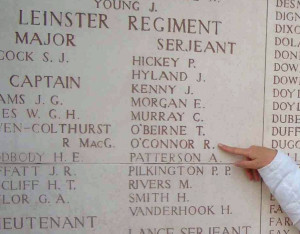
    Image of the name of Sgt. Robert O'Connor of The Leinster Regiment on the Menin Gate wall, who was killed on 31 July 1917 during the First World War. Source: Wikipedia

    Image of the name of Sgt. Robert O’Connor of The Leinster Regiment on the Menin Gate wall, killed on 31 July 1917 during the WWI. WWI saw the start of practice of recognizing by name each and every soldier killed during battle. Source: Wikipedia

    As the world marks the centenary of the commencement of the First World War,  we remember not the war that ended all wars, but instead the war that changed them forever. Introducing new forms of mechanized warfare – including the machine gun, u-boat, tank and airplane – WWI increased exponentially the lethal force of the individual soldier, bringing about an era of death and destruction on an industrial scale.  Yet, even as it ushered in the means of mass and impersonal killing, the ‘Great War’ also initiated the humanizing practice of recognizing by name each and every soldier who lost their lives, burying them in marked graves alongside those of their officers. Not only does such identification and public acknowledgement of victims dignify their memory, in today’s conflicts it can also provide vital information for humanitarian response and for monitoring compliance with – or tracking violations of – international law.

    Today we are again witnessing the introduction of new forms of warfare – including armed drones, lethal autonomous weapons, special operations forces and use of private military and security companies.  Like their WWI counterparts, these new tactics will reshape the face of conflict, yet as they do so they also threaten to destroy the humanizing legacy of casualty recording. Pushing global warfare deep into the shadows, these new ‘remote-control’ tactics are replacing public military campaigns with covert and contracted force. This shift to a ‘light-footprint’ approach, primarily by the United States, but also by France, Russia and the United Kingdom, reflects not only the changing nature of security threats, which have become mercurial at best, but also the lessening appetite for long military campaigns with high military casualties. A recent report from the Every Casualty Programme at Oxford Research Group and the Remote Control Project finds that the prioritisation of ‘remote control’ tactics presents serious obstacles to the recording of casualties, and subsequently, accountability for the civilians impacted by their use.

    Issues of capacity, political will, and access challenge efforts to record the casualties of any type of conflict. Yet, in conventional warfare, where identifiable or recognised conflict parties conduct attacks, such recording is not impossible: militaries generally record their own fatalities in these instances, while civilian deaths are often recorded by small civil society organizations around the world.  One need only look to the names of the hundreds of civilians killed in recent conflict in Gaza published by major news outlets to see the result of such efforts. In covert conflicts, however, or in conflicts where ‘remote control’ tactics are used, the ability to record casualties – including information on who is killed and how – is greatly diminished.

    The merging of intelligence operations with the use of force – seen currently in countries such as Yemen, Pakistan and Afghanistan with the use of armed drones and special operations forces by the United States – is a particularly problematic trend for casualty recorders. By greatly increasing the opacity – or outright deniability – of state force, covert operations erect a seemingly impenetrable wall of ‘classified information’, impeding recorders’ ability to conduct field investigations and verify their data. In 2010, the United Nations Mission in Afghanistan (UNAMA), which has conducted systematic casualty recording since 2007, reported that due to “tactical reasons and deliberate lack of information about such operations” they found it “very difficult to monitor and adequately document the activities of Special Forces” operating in the country. Gathering data on civilian and combatant casualties of drone strikes has also proved problematic – with ORG’s report finding that recorders are challenged by a lack of official disclosure of information about strikes, blocking of access to strike sites, and a near monopoly of information by anonymous officials on information coming from affected areas.

    The consequent lack of reliable casualty data impedes the impartial evaluation of the tactics’ impacts on civilian populations. It also limits the ability to scrutinise the tactics acceptability and effectiveness using evidence-based analysis. The United States – the primary user of armed drones – has repeatedly claimed that drones allow for precision targeting, capable of surgically eliminating targets with minimal civilian casualties. Yet, as a recent report from the Bureau of Investigate Journalism on drone use in Afghanistan has shown, “the armed forces that operate drones publish no data on casualties to corroborate these claims.” Although the United States claims to record data on casualties itself, its failure to make such records transparent not only prevents an analysis of the acceptability of drone strikes, but also denies the victims and their families the opportunity for accountability or redress.

    Bringing Remote-Control warfare out of the shadows

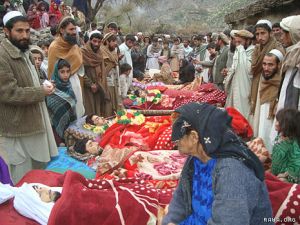
    People of Narang district mourning for the students killed in a night raid in the village Ghazi Khan on December 27, 2009. Although the operation was authorised by NATO, it is still not publicly known who carried out the attack. Source: Wikipedia

    People of Narang district mourning for the students killed in a night raid in the village Ghazi Khan on December 27, 2009. Although the operation was authorised by NATO, it is still not publicly known who carried out the attack. Source: Wikipedia

    Data documenting the casualties of particular weapons – from chemical gas in WW1 to landmines and cluster munitions more recently – has been instrumental in evaluating these weapons’ impact and acceptability, and ultimately ensuring their regulation through international treaty. Yet, as new tactics are employed under the cloak of ‘covert action’, the ability of the international community to measure and regulate their impact is increasingly limited. Without verifiable casualty figures, states may be given a free hand to employ dangerous new tactics without threat of individual or international accountability. Indeed a recent report from Amnesty International has found that as a result of an almost complete lack of transparency from the US government regarding civilian casualties in Afghanistan – specifically around those killed in night raids by SOFs or by missiles from drones strikes – victims are already facing a major accountability vacuum.

    States must take greater responsibility for recording and acknowledging the casualties – both civilian and combatant – of these new tactics. They must not seek to block public investigation and accountability, even though these tactics may be adopted for the lower profile they afford armed force. Furthermore the United Nations, alongside civil society groups or other entities, must enhance their recording efforts so as to provide independently verifiable data on casualties. Such data is essential for developing an accurate, complete and impartial record, and for facilitating scrutiny in circumstances where casualties are highly politicized. Civil society-led casualty recording and analysis, despite its limitations, has already highlighted policies within the use of remote control tactics that need greater examination: for example, the practice of ‘double-tap’ or rescuer drone strikes in Pakistan on those coming to the assistance of individuals at the site of a previous strike. Only by ensuring that casualty recording is conducted systematically and to a high standard can we bring the impact of remote control warfare out of the shadows and into the public eye.

    If we are to take a lesson from the commemoration ceremonies resounding across Europe it is simply that to learn from the past, and to honor it, we must first know that past. Details regarding the identites of those killed in conflict, both on the battlefield and in their homes, are essential to understanding the impact of violence, and to telling the full story of a conflict, to both current and future generations. The risks, then, of wars waged in secret, their battles and casualties concealed, are profound. Not only will there be no monuments at which to mourn their dead, there will be no lessons to be gleaned from their history: the wisdom of hindsight – both for policymakers deploying force and the public – may be lost completely.

    Kate Hofstra is Research and Communications Consultant of the Every Casualty Programme at Oxford Research Group and co-author of Losing Sight of the Human Cost: Casualty Recording and Remote Control Warfare. Kate previously worked for TLG,a London-based communications consultancy, where she was the editor of a digital magazine on business and development. She has also worked with the OSCE Mission to Bosnia and Herzegovina in Sarajevo and hasa background in transitional justice. Kate has an MSc in Human Rights from the London School of Economics.

    Featured Image: Deputy chief minister of Pakistan’s North West Frontier Province and tribesmen offer funeral prayers in front of dead bodies who were killed in army operation in Khar, the main town in Bajaur tribal agency, 30 October 2006. Source: The Bureau of Investigative Journalism, Naming the Dead Project

  • Sustainable Security

    Getting Older But Not Wiser: the Arms Trade Treaty’s First Birthday

    April 2nd marked the first anniversary of the adoption of the much celebrated Arms Trade Treaty (ATT), the world’s first treaty to establish common standards of international trading in conventional weapons and which in turn aims to ‘ease the suffering caused by irresponsible transfers of conventional weapons and munitions’. But with the continued irresponsible arms trading and an overall rise in the global arms trade, it seems that some states have yet to put the ideals of the ATT into practice.

    Read Article →

    A top-down approach to sustainable security: the Arms Trade Treaty

    2012 has been hailed as a potential landmark year in the push for greater regulation of the global trade in conventional arms. After more than a decade of advocacy to this end, negotiations took place throughout July towards the world’s first Arms Trade Treaty (ATT), which is intended to establish the highest possible common international standards for the transfer of conventional weapons. However, although significant progress was made during the month of intense negotiations, the ATT is not yet open for signature. In this article, Zoë Pelter explores what role a potential treaty – if reopened for further negotiation – could play in a move towards sustainable security.

    Read Article →

  • Rushing Carefully in Libya

    Over the weekend the Obama administration was greeted by a chorus of commentators urging the United States to respond militarily to the situation in Libya. But the choices now facing the administration are complex and demand both speed of response and common sense.

    The negative scenarios are easily sketched out. The administration does not want a failed state, a protracted civil war, a major disruption in oil supplies, a humanitarian catastrophe, or to look feckless at a moment of great import. Nor does it want to make the hopefully democratic transitions across other parts of the Middle East more daunting.

    In foreign policy, however, it is always easy to sketch out what you don’t want to happen. Putting a positive agenda on the table is much trickier business. This explains why President Barack Obama’s National Security Council staff has been pulling some very late nights.

    We shouldn’t kid ourselves. Blowing up a runway or imposing a no-fly zone are not silver bullets. And one would hope that after the experience of both Afghanistan and Iraq—and earlier interventions such as Kosovo and Bosnia—we understand that war is a dangerous, uncertain business. This is not to minimize the brutality of Moammar Qaddafi’s attacks on his own people or to urge inaction. It is to counsel thoughtful action designed with an endgame firmly in mind.

    Consider the following questions. If we arm the opposition, what happens if some of those weapons fall into unfriendly hands? Do we really think that the situation in the Middle East requires more weapons on the ground? Or what if we impose a no-fly zone and attacks on the ground continue or escalate? Do we consider resorting to a ground offensive? Do we want the United States involved in three ground wars in three Islamic countries at the same time? Neither the rebels nor our national interest would benefit from a half-hearted intervention that does not achieve its goals.

    With this in mind, here are the things that the administration should do right now. Fortunately, they appear to be trying to work through them already:

    • Leave all options on the table. We should not immediately commit to the use of force. But we shouldn’t take it off the table, either. There are scores of options beyond a no-fly zone or arming the rebels that might be appropriate—from jamming Libya’s communications system to making clear to Libya that any further aerial attacks will mean significant parts of its air force will be destroyed on the ground. The president needs to take a hard look at the full range of options available and creatively employ the best mix likely to achieve the best results.
    • Quickly build a consensus with other nations. It is imperative that the United States find common cause with other nations about the best course of action. This might be through the United Nations, NATO, the African Union, the Arab League, or the European Union—or some combination of any of the above. There needs to be a broader umbrella of states that are vested in the outcome beyond the United States.
    • Explain the course of action. President Obama, in consultation with Congress, needs to make a clear and compelling case to the American public about what he believes to be the best option before using military force or ruling it out. He needs to articulate the potential risks and rewards of this strategy, and how this is tied to our fundamental interests as a nation and a people. We would far prefer a president who is brutally honest about the hard choices ahead than one who blithely paints a rosy scenario that evaporates in the hot desert sun.
    • Keep trying to peel away Qaddafi’s inner circle. Through every channel possible—the State Department, the Pentagon, the CIA, and beyond—the administration needs to get the message to Qaddafi’s coterie that they are on the wrong side of history and that the only way to potentially save themselves is to get out now. Further defections will further rattle the regime and help restore some of the momentum robbed from the rebels as they are bombarded with air strikes and attacks from a mad—and power mad—government.

    Given Qaddafi’s instability and absolute irresponsibility there is a chance that his forces will commit some atrocity that is so far beyond the pale—bombing a grade school or hospital, openly gunning down scores of unarmed protestors in front of an television crew—that the administration will feel that it has no choice but to act immediately regardless of the state of its planning. Let’s hope the rebels and their supporters in the outside world can find common cause and some practical plans before that happens.


    John Norris is the Executive Director of the Sustainable Security and Peacebuilding Initiative at the Center for American Progress.

    This article originally appeared on the CAP website.

  • Socio-Political Factors and National Security

    National security in the traditional sense is connected with the idea of sovereignty; territorial security means freedom from risk of danger of destruction and annihilation by war, physical violence and/or aggression from outside. Traditional threats emanate from inter-state conflict and cross-border aggression. Since the nation state is supposed to have a monopoly of power for protecting the life and property of the members of the nation, they are deprived of power to defend themselves against aggression. The focus therefore previously being on external threats, state security has dominated the national security agenda.

    With progressing globalisation, borders have become increasingly irrelevant, thus reducing the probability of external aggression. Conversely threats to a country’s security emanate internally because of lack of economic development, unemployment, failing internal security because of religious, sectarian and/or ethnic strife, shifting of identities in the wake of globalisation, radicalisation of society and growing terrorism thereof being recent additions. It has not been possible in our relatively new nation state to properly work out the national identity and borders, both traditional (external) and internal security threats have started to overlap. Societal security is the prime responsibility of the state; our rulers have generally cold-shouldered this to our lasting detriment, as we can now see on graphic display.

    Societal threats undermine national cohesion and identification with the state, the resultant radicalisation and extremism results in law and order situations, rioting, rise of criminal gangs and gang wars, due to money-laundering and easy availability of weapons because of the nexus between corruption, organised crime and terrorism. A credible accountability system is missing, without proper investigation, effective prosecution and delivery of swift, untainted justice is not possible. Perjury is not only rampant but is the order of the day, credible witnesses are in short supply and even they are susceptible to influence, by use of money and/or the force of public office. Our Supreme Court (SC) has become captive to endless bureaucratic manoeuvring, fighting a losing battle against a virtual bag of administrative tricks to defy and/or frustrate their judgments and instructions. Both the NICL and Haj cases are likely to enter the “Guinness Book of Records’, sophisticated filibustering making them into an endless exercise without a likely outcome. Failure to fulfil the main function of maintaining law and order to protect lives and properties of its citizens and ensure impartial, even-handed justice hastens the deterioration of the state and its institutions.

    The failing identification with the state impacts negatively on the connection between citizen, the government and the army. This dissolution of the Pakistani identity results in growing influence of foreign interests, this spawns intervention and support for secessionist movements like in Balochistan. Duly fanned by a well-meaning but immature media, paying little attention to core national interests, the vacuum provides a robust platform for promoting radical ideas, readymade for religious exploitation by extreme elements, making an alternative form of a purely Islamic state with all its ramifications resonating with the public.

    The spread of terrorism is detrimental to economic growth, the bad investment climate and the lack of development is extremely detrimental to the economy. The diminishing value of individual lives makes killing condonable and justifiable (Karachi killing, collateral damage). Despite the so-called truce between the warring political parties within the coalition government, hundreds of people have died during the past month alone.

    The consequent ugly cycle of unemployment and high inflation leads to stagflation. There is flight of both capital and manpower from the country, weakening the economy further. The failing economy destroys jobs and incomes, creates more poverty and destabilises society leading to fuel riots, electricity riots, water riots, food riots, etc, desperation in the mass psyche of citizens, suicides, destruction of families, etc. This creates favourable conditions for criminals and terrorists, further impacting negatively on the overall security. This diverts the right amount of attention and the material support necessary for external security.

    A whole process of cataclysmic changes is taking place in the political, economic and social transformation in South Asia. The structures of governance being diversified and differentiated, only lip-service is given to poverty reduction and improving governance. In such conditions corruption is rampant. The Anna Hazare backlash we are seeing in India was waiting to happen, the more violent form being manifest in the four decades-old Maoist Naxalite movement. With an economic transition in the region, the majority of countries have inculcated globalisation to address their economic crisis. This has accelerated the process of growth but the impact of globalisation has not been accompanied by the reduction in poverty or improvement in human development through the formation of social capital. Increases in population growth is by itself a time-bomb.

    Pakistan’s security interests can be best served if elements having disruptive potential to our socio-political profile are contained, thereby giving no excuse or opportunity to our detractors and enemies to take undue and adverse advantage. Factors responsible for the declining social and human security and strengthening of extremism have to be identified. The human element remains the biggest resource for Pakistan, the government must utilise this to promote safety of the population and counter the threat of extremism engulfing this nation.

    The political leadership and all other stakeholders (who have a vital role to play) must agree to cooperate and formulate a national strategy to eradicate this menace. To cope with external threats, Pakistan has to keep up both conventional and nuclear deterrence necessary but should at the same time aim at socio-political solutions for long-term sustainable alleviation of our problems.

    The army has had increasingly to deal with internal strife instead of securing the borders. Other than drawing crucial reserves away from countering the aggressive defence postures of the Indians, they are forced to devote time and effort to burgeoning internal problems of different dimensions. Fighting against ones own population can put stress on any army in the world, raising adverse perceptions among the populace, extremely dangerous for a country that thrives on glorifying its armed forces.

    The international media is fully mobilised against Pakistan’s critical national security assets, but of more serious concern is not only the erosion of local media support, but rather an antagonistic view from some motivated sections. The compromise of the media’s integrity is extremely detrimental to the national aims and objectives. The concerted campaign against the ISI, and by extension the army, is deliberately motivated despite our sacrifices not being matched in the war against terror by all the coalition partners in Afghanistan put together.

    The unfortunate irony is that an instrument of war – the armed forces – is also the ultimate guarantor of internal peace. One can understand it not being part of the decision-making process where democracy is institutionalised, in less developed countries this is a paradox. This leaves absolute power, at least in democratic theory, in the hands of a pre-modern feudal and agrarian mindset elected through a tainted process on fraudulent votes, as the ultimate arbiters of nation security and societal society, and by default, the destiny of the nation. Who will make the change?

    (Extracts from Part-II of the Talk on ‘Linkages between Socio-Political Factors and National Security” given recently at the National Defence University (NDU), Islamabad).

    Article source: EastWest Institute

    Image source: NB77

  • report

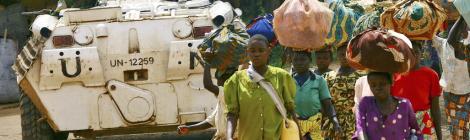
    Sub-Saharan Africa is too readily dismissed from the outside, but the regional perception is often one of optimism. It is an area rich in natural resources: ranging from oil and natural gas to other minerals such as chrome, nickel and zinc. Nearly half the population are under the age of 14, making the region free from the demographic burden of an ageing workforce prevalent in other parts of the world. Read more »
  • Sustainable Security

  • Sustainable Security

  • Climate change

    Accelerating climate change and competition for limited supplies of water, food and energy are poised to ignite long-simmering conflicts in fragile states, monopolising the world’s military resources and hampering development efforts, security experts say. Defusing these new 21st century conflicts – or at least preparing governments and citizens to cope with them – will require a broad range of innovative interventions, a gathering at Britain’s Department for International Development (DFID) heard earlier this month.

    Image source: Images.Defence.Gov.au

    Read more »