Blog

  • Sustainable Security

    Hybrid warfare has become a popular term in academic, military and policy circles. But what does the term actually mean and how is this approach to warfare harnessed by state and non-state actors in practice?

    The term hybrid warfare (HW) came into prominence in 2014, when Russia annexed the Crimea, part of the Ukraine, proceeded to support autonomist Russian-speakers in the Ukraine, and crushed some Ukrainian regular battalions in border clashes. Barely six months later, hundreds of miles to the southeast, a revitalized non-state actor, the Islamic State of Iraq and Syria (ISIS) trounced the Iraqi Army in a ‘blitzkrieg’ that unraveled four Iraqi army divisions in the most humiliating defeat of an army since the Six Day War of June 1967. ISIS forces seized Iraq’s second largest city, Mosul located in the north, and proclaimed their caliphate there on June 29, 2014. These events were seen by many to be hybrid warfare in practice.

    Since 2014 there has been an explosion of op-eds, policy statements, policy papers and academic papers on the concept of hybrid war. Despite this plethora of literature, there is still a serious need to establish a better definition of HW, to describe its characteristics, assess the term’s relevance, and address the distinction between hybrid warfare as it is practiced by states and by non-state actors. This article addresses such issues.

    What is hybrid warfare?

    Image credit: Vitaly V. Kuzmin/Wikimedia.

    Despite gaining prominence since 2014, HW has been used to describe changes in the character of warfare since around 2005. The term was used to describe Hezbollah’s strategy in the 2006 Lebanon War. But some observers and strategic analysts have even argued that its contemporary origins lie in the Balkan War and the unraveling of Yugoslavia. Others have argued that elements of hybridity have occurred in many wars since the rise of ‘civilized’ warfare. In other words, there is nothing ‘new under the sun,’ except yet another term to describe the familiar.

    Defining HW has also been a matter of debate. While there are not as many definitions of HW as there are gainfully employed strategic thinkers (although at times it feels like it), it would be safe to say that there are as many definitions of the term and concept as there are countries worried by it or seeking to practice it. But even this is contestable too because a number of countries deny that what they actually practice hybrid warfare. Indeed, for Moscow ‘gibridnaya voina’ is what others (Western powers) have done to Russia. The definition I offer here derives largely from the various iterations of it by Frank Hoffman and others and from a variety of doctrinal manuals from the United States of America and those of other countries.  The term hybrid means something heterogeneous, multi-shaped or multi-varied. With respect to warfare, what does this mean? HW occurs when an actor practicing it against an opponent brings into play a ‘cocktail’ of conventional military capabilities, political warfare, terrorism, subversion, guerrilla warfare, organized crime, and, in contemporary times, cyber warfare. It may also include violations of international laws of war by the practitioner of hybrid warfare.

    However, haven’t nations in the past used a ‘cocktail’ of measures against their opponents? Is it not true that Russia, which stands accused of using HW, is successor to a nation, the Union of Soviet Socialist Republics, which used all kinds of measures and ‘skullduggery’ to advance its interests even times of peace? Hoffman argued that even though wars in the past, even the recent past, could also include both regular and irregular elements, these occurred in different places, were not coordinated, and often occurred in sequence or one after the other. In contemporary HW, all the above-listed elements are orchestrated to act in coordinated, coherent and often simultaneous ways. Hence, for the person or persons watching from outside as well as for the enemy, this ‘cocktail’ of measures – some designed to kill and others not to do so but just as deadly to morale and cohesion of the target — may become blurred into a unified force acting in a single and comprehensive battle-space. Thus, the practitioner of hybrid warfare achieves a synergistic effect against which the target is rendered hors de combat in lieu of a shooting war, before a shooting war starts, and during an actual war.

    When the term first appeared to describe what a certain number analysts like Hoffman saw as emerging trends some of their colleagues literally sighed because they wondered – politely and often not so politely — whether the term added anything new to describe wars other than the purely conventional or symmetric force on force clashes between like armies. Others wondered whether the term added much to the existing plethora of terms that describe wars other than purely conventional: irregular, guerrilla, low-intensity, fourth generation, asymmetric, new wars, forever war, etc. I argue that each term has a purpose and most should have a specified life-span before gracefully disappearing into the shadows instead of lingering on like an unwanted guest. Each term brings out certain aspects of indirect war associated with particular technologies, operational art, tactics, environment and cultural context. The same holds true for HW; if it still in existence a decade from now, then strategists are a dull lot indeed. Indeed, HW is not a prediction of what future warfare is going to be like. In this context, we need to avoid the ‘reification’ of HW.

    HW is also ‘transcultural.’ There are ways of warfare to be sure, but HW is not just Eurasian – Russian – or Oriental. This would be strategic ethnocentrism to borrow a recognized term from international relations scholar, Ken Booth. Russia is, indeed, right in arguing that the West, which sees itself as the target of HW, as being as much perpetrators of the genre as they are the victims. Russia perceives the West, rightly or wrongly, as making a ‘big issue’ of it in the last half decade because of the events in Ukraine where Moscow believes it has successfully blocked Western-inspired or even led HW against Russia’s resurgence. Ultimately, HW is a useful term because it draws out/highlights certain characteristics of contemporary warfare by states and non-state actors.

    HW is not replacing inter-state conventional warfare. The dominance of inter-state conventional warfare between roughly 1645 and 1945 has always been buffeted by forms of warfare that have been given various names throughout this three hundred year history. Many of these forms have actually been nothing more than appendages to conventional warfare; and HW is but one of the latest terms to describe certain characteristics of the contemporary conflict environment.

    Ultimately, though, HW is a useful term because it draws out/highlights certain characteristics of contemporary warfare by states and non-state actors.

    State and non-state hybrid war

    There are clear-cut differences between state and non-state hybrid warfare characteristics. Indeed, even the definition for state hybrid warfare might not fit what non-state actors do in terms of hybrid warfare. Russia is not the only state that has developed hybrid warfare capabilities; Iran, North Korea and China come to mind. Even here, we can see wide disparities in military power between these states that are alleged to be at the forefront of hybrid warfare developments. Similarly, IS was not the first to develop non-state hybrid warfare capabilities (nor will it be the last). In fact, when several American theorists, of whom the indefatigable former United States Marine Corps officer, Frank Hoffman, was in the lead in developing the concept, the focus was on groups like Hamas and Hezbollah.

    The output on hybrid warfare in 2014 and thereafter was almost overwhelmingly focused on the alleged hybrid warfare capabilities of these two distinctly different entities. This was, in fact, a huge problem: Russia on the one hand, and Islamic State are certainly not similar entities. Without meaning to state the obvious, one is a large and powerful legitimate state with a military establishment that has come out of the doldrums of the 1990s. Historically, the Russian military has engaged in some very innovative thinking, about which only a few Western experts are cognizant. For example, in the 18th century the great soldier, Frederick the Great of Prussia, was derisive of Russian military prowess. The Russians quickly disabused him of this derision when the Russian army trounced him in a major battle. In the 1920s and 1930s, Soviet officers formulated some very innovative military ideas, which those interested in current Russian military theorizing are revisiting. A considerable amount of literature has appeared in the West to address the matter of Russian hybrid warfare over the course of the past three years. This has elicited some humor and denials on the part of the Russians. Russian commentators argue that Russia, does not wage hybrid warfare, and that it is actually the West that is waging war against Russia. Russia is responding and developing its own approach to contemporary warfare, which Russians refer to as ‘New Generation.’

    For a state like Russia, hybrid warfare entails the composition of different elements of ways to wage war used simultaneously and in a coordinated manner to achieve one’s goals. If the measures work without leading to an extended or large-scale war or indeed lead to the achievement of the goals at stake below the threshold of the legal definition of war with the victim or the victim’s allies all the better as far as the state practitioner of hybrid war is concerned. Though the debate about evidence for Russia seeing contemporary warfare as being hybrid is still ongoing, for the sake of argument Russia’s hybrid capabilities as exhibited in the Ukraine and Crimea can be described as a ‘cocktail’ of measures that were used to achieve one’s goals in lieu of going to full-scale war, in shaping the theater of operations to one’s advantage, and as a force multiplier if need be in an actual exchange of violence with an enemy.

    HW is different for IS and entities like it. The literature on IS is now huge and almost unmanageable. Most of it, however, concentrates on its personalities, ideology and organizational structure. Very little deals with the military ideas or strategy of this entity, which is surprising because there remains the puzzle of explaining its military rise during the first Iraqi insurgency (2003-2011), its demise, which proved to be temporary, and then its rapid re-emergence from 2012 to 2015. Between 2016 and early 2017, it suffered enormous losses and has lost Mosul. However, the consensus is that the collapse of the caliphate in Iraq (and soon in Syria) will not be the end of that entity. How do we explain its military trajectory? Some analysts have argued that this is hybrid threat or hybrid entity. Unfortunately, the analysis of IS as a hybrid warfare has mainly been descriptive rather than analytical in that most of the literature narrates the trajectory of IS’ war fighting over the years without conceptualization or context. The underdevelopment of the literature on the hybrid threat posed by most dangerous current non-state actor then raises the question of how can we distinguish between the hybrid warfare capabilities of a state actor and that of a non-state actor.

    HW for a non-state actor also involves building a ‘cocktail’ of hybrid capabilities. Among these capabilities are political warfare techniques for propaganda against enemies, recruitment of supporters and shaping the ‘human terrain’ on the ground in the conflict zone in their favor. However, while states have the resources to develop robust hybrid capabilities only a few non-state actors in the contemporary conflict environment have been able to develop and maintain effective revolutionary political warfare infrastructures. These include the FARC in Colombia, the LTTE in Sri Lanka, Hezbollah in Lebanon, and of, course, Islamic State in Iraq and Syria. These groups have also incorporated terrorism to target civilians and to intimidate and terrify opponents or even force them to overreact. The practice of terrorism has, of course, been a subject of controversy even among its practitioners, some of whom have even distinguished between discriminate, which targets specific individuals or categories of people, and indiscriminate terrorism, which targets people collectively or whole communities. Indeed, indiscriminate terrorism became a source of contention even within the global constellation of violent jihadist groups such as al-Qaeda and Islamic State during the course of the war in Iraq between 2003 and 2011. These entities also develop robust guerrilla hit and run tactics for attacking small-scale enemy units. Finally, this limited set of non-state actors have moved up the spectrum of warfare to develop impressive semi-conventional forces, which have been able to conduct both offensive and defensive operations against seemingly more formidable conventional forces.

    Conclusion

    For an advanced and well-developed non-state actor hybrid warfare is part and parcel of their arsenal of war whereas for states it can be used in lieu of outright war. For a super-empowered non-state actor, hybrid warfare is scalar manner, defined as having ways of war – terrorism, guerrilla tactics, and semi-conventional war coupled with the requisite capabilities for each – necessary to go up and down the spectrum of conflict in accordance with environmental factors, enemy faced, operational art and tactics needed at a particular time.  When a non-state actor like IS first emerges, it is invariably weak, lacking in resources, personnel, and territory to control. This leads them down the path of using the most primitive and illegitimate form of political violence, namely terrorism. As such an entity develops it moves ‘up the chain’ of violence, as it were, to guerrilla warfare, which is more ‘advanced.’ As it acquires territory, which is both a sanctuary and a base, this enables it to develop semi-conventional ways of war. This has almost Hegelian march up the ladder of progress was, indeed, the trajectory of people’s revolutionary war as espoused by Mao Zedong and Vo Nguyen Giap in China and Vietnam respectively. So what is the difference?

    The key difference with hybrid warfare by contemporary non-state actors, like IS or the Liberation Tigers of Tamil Eelam, and state actors is that the progression towards a higher form of warfare is not one way; the lesser forms are not discarded. Indeed, they remain integral to the entity so that they can slide up and down the spectrum of violence when needed or when necessary. IS has its territory and Mosul, it will now revert to guerrilla warfare and terrorism. The ‘happy days’ of having a quasi-conventional military and a ‘state,’ are over, at least for now.

    The future is likely to witness the further evolution of HW; it will be developed both by states, including powerful and weak ones, as well as non-state actors. If HW is really nothing more than the effective, efficient, and often simultaneous use of a set of measures, military and non-military to achieve one’s goals before or during a war and if the use of these measures ultimately ensures that the lines between peace and war are blurred to the point of irrelevance, then we will see states scrambling to deal with this situation by devised offensive and defensive measures.

    Ahmed S. Hashim is Associate Professor in the Military Studies Programme at the Institute of Defence and Strategic Studies, RSIS, and specialises in Strategic Studies. He received his B.A. in Politics and International Studies from the University of Warwick, Great Britain and his M.Sc and Ph.D from the Massachusetts Institute of Technology (MIT). He has worked extensively in the fields of Strategy and Policy dealing in particular with irregular war and counter-terrorism for the past 20 years prior to taking up his current position at RSIS in 2011 where he teaches courses on insurgency and counterinsurgency, terrorism, and defense policies at RSIS and SAFTI Military Institute (SAFTI MI).
  • Sustainable Security

    Author’s note: For further analysis on this topic, see the following publications: Kai Michael Kenkel and Cristina Stefan, “Brazil and the ‘responsibility while protecting’ initiative: norms and the timing of diplomatic support”. Global Governance, Vol 22, No. 1 (2016); pp. 41-78; and Kai Michael Kenkel and Felippe De Rosa). “Localization and Subsidiarity in Brazil’s Engagement with the Responsibility to Protect.” Global Responsibility to Protect. Vol. 7, No. 3/4 (2015); pp. 325-349.

    Since Libya, the Responsibility to Protect (R2P) has been a hotly debated concept. Previously a nation exhibiting strict non-interventionist principles, Brazil has recently contributed to the R2P debate with its Responsibility while Protecting initiative.

    Introduction

    Inspired by what it saw as the excesses of NATO’s intervention in Libya and their potentially disastrous effects on the credibility of the “Responsibility to Protect” (R2P) norm, in November 2011 Brazil launched the corollary concept of a “Responsibility while Protecting” (RwP) at the United Nations. While essentially reiterating its endorsement of key principles of R2P, Brazil admonished R2P implementing states to avoid discrediting the norm by exercising restraint while operationalizing R2P. Brazil, itself at that time a rising power seeking more global influence—and particularly participation in shaping the rules of the international system—saw the divisions created by the Libyan intervention as an opportunity to act as a norm entrepreneur. Meant to bridge the gap between R2P supporters in the North and sceptics in the South, RwP was initially criticized by both. Over time, however, certain R2P supporters began to see the concept’s value as a means of reviving R2P after Libya and as a means of attaining crucial Global South buy-in. By this time, however, Brazil—lacking experience in the role of norm entrepreneur—had backed away from its initiative. Though the specific initiative has not been taken forward, RwP has had a clear effect in structuring the contours of subsequent R2P debates at the UN.

    Rising Brazil: between beliefs and expectations     

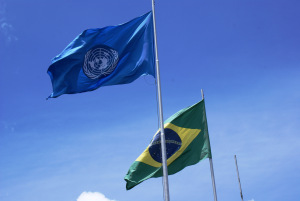
    UN brazil

    Image by Ben Tavener via Flickr.

    Under the Lula da Silva administration, Brazil began to actively seek a larger profile in international politics, ostensibly with a view to a permanent, veto-endowed seat on an eventually reformed UN Security Council. This presented the country with a conundrum: in UN praxis, particularly among established powers, there is a clear connection between global relevance, military capacity, and the willingness to use force remedially, beyond self-interest, to help those in need—as foreseen by R2P as implemented by the UN. Brazil’s historical normative commitments, however, are rooted in a combination of a highly traditional regional security culture—which equates sovereignty exclusively with non-intervention—and a healthy postcolonial scepticism of multilateral initiatives born in the North. Arguably, the most strongly held of these commitments is a profound aversion to the use of force. Faced with a choice between staying true to its original traditions and fulfilling the expectations placed on global players—as exemplified for example in R2P’s acceptance of the use of force in defence of human life—Brazil launched RwP as an attempt to reconcile these factors, remain active on the international stage, and render R2P both more relevant and less prone to misuse.

    The Libya effect

    NATO’s 2011 Libyan intervention created a trust deficit between its leaders and the BRICS countries, who had been excluded as non-permanent UNSC members from the elaboration process for its enabling Resolution 1973. These states emerged from the experience highly doubtful of Western motives, and they took as a lesson from the Libya intervention that the use of force could have an opposite effect from that intended, effectively distancing a crisis situation from a lasting solution.

    Beyond the immediate concerns related to the intervention’s mandate, the debate over the Libyan case took on contours that resonated with the larger tension between the established powers and emerging players such as the other BRICS countries and Brazil. Substantial divergences remain over R2P’s implementation and particularly its third pillar, which can be used to authorize military force. R2P’s shift in emphasis between understandings of sovereignty has become symbolic of some emerging powers’ resistance to the normative dominance of established powers, making the principle a key rallying point in the ideational skirmishes resulting from a changing global distribution of power. This expands the debate over the RwP initiative beyond its immediate link to the Libyan case and links it firmly to broader issues of global governance. The R2P debate has become a not only a key element of some emerging powers’ challenge to the established distribution of power, but a key locus for increased targeted consultation and cooperation in mounting that challenge. In addition, the intervention debates have become an important stage for emerging powers constructively to give normative content to their challenge to the established order, allowing them to move beyond what some have termed an obstructionist stance.

    The “Responsibility while Protecting” concept

    The RwP concept was launched on 9 November 2011 and floated explicitly as a touchstone for further debate within the United Nations. This targeting would become important later on, as it meant that in characterizing R2P and mobilizing its history, the note limited itself to the concept’s course within the United Nations system, referring for example to its inclusion in paragraphs 138-139 of the World Summit Outcome Document but not to the principle’s original formulation by the International Commission on Intervention and State Sovereignty (ICISS). As such the RwP note was intended less as a normative innovation than as an attempt to shape the norm in terms acceptable to the Global South.

    The primary contribution of the note was its establishment of a set of guidelines to orient the Security Council in contemplating an R2P-based intervention. These guidelines focused on two main topics: limiting the use of force, and the strict chronological sequencing of R2P’s three pillars. The RwP note posits that force should only be used as a last resort (an item already included in the 2011 ICISS Report that launched R2P), and subject to a limited and well-defined mandate implemented under conditions of complete accountability in the field. Brazilian diplomats attempted to appropriate the “do no harm” principle, known from the Hippocratic oath, even arguing that one death from an intervention is too many. These reservations were read correctly by many Western states as a reaction to the perceived excesses of NATO’s foray into Libya, and an attempt to put strict limits on the level and type of force authorizeable under R2P.

    The document’s real element of innovation, and the eventual centre of the debate it created, is its call for the strict political and chronological sequencing of R2P’s three pillars. This was viewed by Western states as too limiting, both in the field, and of the flexible diplomatic responses required of the Council in dealing with a crisis. The threat of force, it was argued, is often subjacent in making diplomatic initiatives work, and taking this option off the table could tie the international community’s hands. Indeed, the note’s Brazilian authors later replaced strict chronological sequencing with the toned-down notion of “prudential sequencing”.

    The reception of RwP

    Initially received coolly by both Western and Southern states, the RwP note nonetheless played a crucial part in both moving R2P forward normatively and in stimulating the inclusion of Southern states into the intervention debate. Despite initial strong criticism, the initiative did shape how established and rising powers interacted in the ensuing UN debates on R2P and intervention more broadly. There are four main criticisms:

    1. that the concept bears little value added, merely repeating provisions already present in the 2001 ICISS Report;
    2. that the initiative was a Trojan horse, designed to limit Western powers’ autonomy and to prevent the further institutionalization of R2P;
    3. specific elements regarding feasibility of RwP’s concrete suggestions, such as sequencing, proactive monitoring, and further limitations on the use of force;
    4. the contention that RwP’s confuses jus ad bellum (R2P’s main focus) and jus in bello (rules for conduct once war has broken out);

    Despite these criticisms and Brazil’s abandonment of its role as a norm entrepreneur, the RwP note has continued to structure global diplomatic debates on intervention, with a focus on reigning in Western action through stricter guidelines in the wake of R2P’s crisis of legitimacy after Libya. It has done so in three main areas:  advancing the importance of some form of relational sequencing of R2P’s pillars; increased restrictions on the use of force; and more proactive monitoring by the Security Council of the following of guidelines by ongoing missions.

    Brazil’s role as a norm entrepreneur on intervention issues remains tied to the RwP concept. The initiative was withdrawn after it did not elicit the desired level of support, and by the time its potential had been realized, internal changes in Brazil and its Foreign Ministry had made continued advocacy politically unviable. Despite attempts to revive a strong role for Brazil in the R2P conversation through efforts in the General Assembly in 2015-2016, crippling fiscal austerity and the paralyzing political crisis which began in April 2016 have temporarily but severely limited Brazil’s ability to proactively advance normative initiatives. Nevertheless, the desire remains to fulfill the country’s natural function as a bridge-builder between North and South on intervention issues, and Brazil is sure not to remain absent for long from the ranks of those crafting R2P’s future contours.

    Kai Michael Kenkel is Associate Professor in the Institute of International Relations at the Pontifical Catholic University of Rio de Janeiro and Associate Researcher at the German Institute of Global and Area Studies. He has published extensively on R2P, with a focus on Brazilian policy, including three edited volumes and articles in Global Governance, Global Responsibility to Protect and  International Peacekeeping.

  • Sustainable Security

    The Global Land Rush: Catalyst for Resource-Driven Conflict?

    Michael Kugelman of the Woodrow Wilson International Center, argues that the factors that first sparked many of the land acquisitions during the global food crisis of 2007-08 — population growth, high food prices, unpredictable commodities markets, water shortages, and above all a plummeting supply of arable land — remain firmly in place today. He writes that land-lusting nations and investors are driven by immediate needs, and they have neither the incentive nor the obligation to slow down and adjust their investments in response to the wishes of distant international bureaucrats. This, he argues, has serious consequences for global security.

    Read Article →

  • Sustainable Security

  • Sustainable Security

    From The Great War to Drone Wars: The imperative to record casualties

    The centenary of the First World War also marks the anniversary of the practice of recording and naming casualties of war. But a century on, new forms of ‘shadow warfare’ limit the ability to record casualties of conflict and thus threaten to allow states a free hand to employ dangerous new tactics without threat of individual or international accountability. Without verifiable casualty figures, – including information on who is being killed and how – we cannot evaluate the acceptability, effectiveness or impact of ‘remote control’ tactics as they are rolled out among civilian populations.

    Read Article →

  • Sustainable Security

  • Influential European Figures Issue Unprecedented Statement on Nuclear Dangers

    Influential European Figures Issue Unprecedented Statement on Nuclear Dangers

    Top Level Group of UK Parliamentarians For Multilateral Nuclear Disarmament and Non Proliferation | http://toplevelgroup.org/ | April 2010

    Issue:Global militarisation

    Tagss:nuclear disarmament, nuclear non-proliferation

    The recently signed arms control treaty between the United States and Russia brings welcome reductions in deployed nuclear warheads and an agreed ceiling on the number of delivery vehicles that each side may possess. We applaud the new agreement and the acts of political leadership required in both countries to bring it about. The breakthrough is all the more welcome, coming just weeks before both the Washington Summit on Nuclear Security and the Review Conference of the Non-Proliferation Treaty. Across Europe, and at this moment of diplomatic opportunity, we have joined together to declare our unequivocal support for President Obama’s vision of a world without nuclear weapons, to declare our desire to re-set the security relationship between Europe, the US and Russia, and to show strong European support for the measures necessary to deliver these goals.

    Let no-one doubt the importance of this endeavour. The risks of proliferation are growing. India, Israel and Pakistan have already entered the nuclear club. If Iran gets the bomb, others certainly will follow.  We know that terrorist groups want to acquire nuclear materials, making the security of those materials an issue of truly global significance. Nuclear armed states inside the NPT have not been disarming fast enough, straining the confidence of their non-nuclear partners in the credibility of the NPT grand bargain. Without further action, there is a real danger that the world will be overwhelmed by proliferation risks and incidents of nuclear weapons use, with all their catastrophic consequences.

    The strategic implications of this are profound. Nuclear deterrence is a far less persuasive strategic response to a world of potential regional nuclear arms races and nuclear terrorism than it was to the Cold War.

    The circumstances of today require a shift in thinking. We must, through further multilateral agreement, reduce the role and the number of nuclear weapons in the world, deepen confidence in the non-proliferation regime, and improve the security of existing nuclear weapons and materials. We must achieve these goals while at the same time helping those countries that wish to go down the civil nuclear energy route do so safely.

    The practical steps necessary to achieve our goals are clear. In Washington, we must demonstrate wider international ownership of the issue of nuclear security. This is not just a concern for those fearing a nuclear terrorist attack. Any major nuclear security incident anywhere is likely to derail the civil nuclear renaissance everywhere. Regardless of whether we as individuals support the idea of more nuclear power, this may ultimately undermine global attempts to meet the challenge of climate change, an outcome we all have a stake in avoiding.

    The Washington Summit also must agree practical action on programmes to control and destroy nuclear materials and ready-made weapons within four years; and participants must agree to rationalise the many complex overlapping international conventions, initiatives and resolutions that are the current institutional architecture aimed at addressing this issue.

    In May, at the NPT Review Conference in New York, the Treaty, for 40 years the foundation of counter-proliferation efforts, must be overhauled and reinforced. All signatory nations should accept the strengthened monitoring provisions of the Additional Protocol. The IAEA needs that strengthened inspection power if it is to provide effective monitoring of declared and undeclared nuclear material and activities. Nations wishing to develop a civil nuclear capability must first agree to proper verification procedures and unimpeded access for the IAEA.

    Progress of this nature will not be possible without a credible process for nuclear disarmament. Beyond START follow-on we need urgent and more radical initiatives from the nuclear weapons states. Increasingly it is becoming more challenging to explain why some countries should have, and others should not be allowed to possess nuclear weapons.

    All nuclear weapons, including tactical ones, must be included in disarmament talks. Where this necessitates discussion of conventional force imbalances, these too must be included. States that now possess nuclear weapons must work together to reduce their importance to national and international security.

    The establishment of nuclear free zones in Latin America, sub-Saharan Africa and Central Asia is very encouraging. By the end of the NPT Review Conference there must be a credible process for the discussion of a Weapons of Mass Destruction Free Zone in the Middle East.

    After May, attention must also return to other issues. The countries that have not yet ratified the Comprehensive Test Ban Treaty including the US, China, Israel, Pakistan, India and North Korea should do so urgently, allowing it to come into force. The stalemate in the Geneva Disarmament Conference on a Fissile Material Cut-Off Treaty must also be overcome. We need a treaty-sanctioned prohibition of the production of the basic materials required to manufacture nuclear explosive devices.

    Europe, through NATO, is central to the security relationship with Russia and can influence it through NATO diplomacy and the ongoing revision of NATO’s Strategic Concept. The UK and France, working with other nuclear weapons states, can play their full part in discussions on disarmament, and in efforts to implement any internationally agreed and verifiable reductions in warhead numbers. In addition to that leadership Europe is a key player in civil nuclear power and nuclear security.

    In short, Europe can and must play a vital role in building the cooperation necessary for meeting the global nuclear challenge. All our futures depend on it.

    Signed:

    Kåre Willoch, Former Prime Minister of Norway

    Kjell Magne Bondevik, Former Prime Minister of Norway

    Oddvar Nordli, Former Prime Minister of Norway

    Dr Gro Harlem Brundtland, Former Prime Minister of Norway

    Thorvald Stoltenberg, Former Minister of Defense and Minister of Foreign Affairs of Norway

    Wlodzimierz Cimoszewicz, Former Prime Minister and Foreign Minister of Poland

    Ruud Lubbers, Former Prime Minister of the Netherlands (author of “Moving beyond the stalemate”)

    Jean-Luc Dehaene, Former Prime Minister of Belgium and current MEP

    Guy Verhofstadt, Former Prime Minister of Belgium and current MEP,

    Lord Geoffrey Howe of Aberavon, Former British Deputy Prime Minister, Chancellor of the Exchequer and Foreign Secretary

    Laurens Jan Brinkhorst, Former Deputy Prime Minister and Minister of Economic Affairs of the Netherlands

    Jan Kavan, Former Deputy Prime Minister and Foreign Minister of the Czech Republic

    Volker Rühe, Former Defence Minister of Germany

    Elisabeth Rehn, Former Defence Minister of Finland, Former UN Under-Secretary-General, SRSG

    Hans Blix, Former Minister for Foreign Affairs of Sweden

    Wolfgang Ischinger, Former Deputy Foreign Minister of Germany

    General Bernard Norlain, Former French General, Former commander of the French Tactical Air Force and military counselor to the Prime Minister

    Lord George Robertson of Port Ellen, Former British Defence Secretary and Secretary General of NATO

    Sir Malcolm Rifkind, Former British Defence Secretary and Foreign Secretary

    Admiral the Lord Michael Boyce, Former British Chief of the Defence Staff

    Lord Charles Guthrie of Craigiebank Former British Chief of the Defence Staff

    Lord Douglas Hurd of Westwell Former British Foreign Secretary

    Margaret Beckett, Former British Foreign Secretary

    Des Browne, Former British Defence Secretary

    Lord Tom King of Bridgwater Former British Defence Secretary

    Louis Michel MEP Former, Minister for Foreign Affairs of Belgium

    Mogens Lykketoft MP, Former Minister for Foreign Affairs of Denmark

    Niels Helveg Petersen MP, Former Minister for Foreign Affairs of Denmark

    Uffe Ellemann-Jensen, Former Minister for Foreign Affairs of Denmark

    Frits Korthals Altes, Former President of the Senate and Minister of Justice of the Netherlands

    Michael Ancram, Former British Shadow Foreign Secretary and Shadow Defence Secretary

    Dr. John Reid, Former British Defence Secretary

    Sir Menzies Campbell, Former British Leader Liberal Democrat Party and Liberal Democrat Shadow Foreign Secretary

    Shirley Williams (Baroness Williams of Crosby) Former Adviser on Nuclear Proliferation to British Prime Minister Gordon Brown

    Charles Clarke, Former British Home Secretary

    James Arbuthnot, Former British Chair of the Defence Select Committee

    Adam Ingram, Former British Defence Minister of State (Armed Forces)

    Prof. Ivo Šlaus, Former Croatian MP, former member of Foreign Affairs Committee and current Emeritus Professor of Physics

    Francesco Calogero, Italian theoretical physicist & former Secretary General of Pugwash

    Giorgio La Malfa MP, Former Italian Minister of European Affairs

    Federica On. Mogherini Rebesani, Member of the Italian Parliament


    Source: Top Level Group of UK Parliamentarians For Multilateral Nuclear Disarmament and Non Proliferation

    Image source: BlatantNews.com


    Comments

    Post new comment


  • Arms Flows to Sub-Saharan Africa

    Arms Flows to Sub-Saharan Africa

    Pieter D. Wezeman, Siemont T. Wezeman and Lucie Béraud-Sudreau | Stockholm International Peace Research Institute | December 2011

    Issue:Global militarisation

    SIPRI has published a policy paper examining arms flows into sub-Saharan Africa. The summary of the report below indicates that even legal transfers into the continent have implications for peace and security, not only because many SALW (small arms and light weapons) make their way illicitly to rebel groups or countries under UN embargo, but also because, “The supply of arms can be argued to to have been an incentive for the recipients to try to achieve their goals via violence instead of dialogue.”  The summary also touches on the motives behind supplier countries’ weapons sales, which include securing access to natural resources in the mineral-rich continent.

    There is a general need for more clarity throughout the arms-transfer process, as African governments themselves are not necessarily forthcoming in their reasons for wishing to purchase weapons, despite regular expressions of support for international arms control initiatives. With the waters this muddied, arms purchased both legally and illegally pose a serious threat to security in Africa.

    (To view or purchase a copy of the full policy paper, please go to the Publications page on the SIPRI website)


    Pieter D. Wezeman, Siemon T. Wezeman and Lucie Béraud-Sudreau, SIPRI Policy Paper 30 – Summary, December 2011

    Concerns regarding arms transfers to sub-Saharan Africa are widespread and have motivated worldwide efforts to control arms flows. Sub-Saharan Africa (excluding South Africa) accounted for 1.5 per cent of the volume of world imports of major arms in 2006–10. Although this is low by global standards, with little indigenous arms-production capacity in the region, most countries are fully dependent on arms imports.

    States in sub-Saharan Africa have received major arms from a wide variety of countries all over the world. China, Russia and Ukraine are consistently among the largest suppliers. Other countries that play a relatively modest role as arms exporters globally are significant arms suppliers to individual countries in sub-Saharan Africa or provide a significant proportion of the major arms supplied to the region as a whole. Due to a lack of accurate information, no comprehensive picture of transfers of small arms and light weapons (SALW) and other military equipment to the region can be given, but available open source information shows that transfers of such equipment to the region in 2006–10 was common.

    The motives for arms transfers to sub-Saharan African destinations are diverse, including direct financial revenues—even if they are small compared to revenues from sales to other regions—and strengthening political influence in sub-Saharan Africa in order to gain access to natural resources and to further the security interest of the supplier.

    Intergovernmental transparency is necessary for an informed debate about how the military needs of sub-Saharan Africa states should be taken into account in discussions on arms control in the region. While countries in the region regularly express support for conventional arms control initiatives, their low level of participation in the United Nations Register of Conventional Arms (UNROCA)—the key intergovernmental reporting instrument on conventional arms—casts doubts on their willingness to actively control arms. Public debate about arms procurement is often based on incomplete and confusing information which emerges only after key decisions have been made. Even those governments that have been more forthcoming with public information about their arms procurements tend to remain reluctant to discuss the rationale and underlying threat assessments in public or in the parliament.

    Case studies show that supplies of SALW and major arms play a role in armed conflict in sub-Saharan Africa; even supplies of relatively small quantities of older weapons can have a notable impact on conflicts. The uncertainty about the impact of arms transfers to conflict areas in sub-Saharan Africa is reflected in the experience of 2006–10. In several cases it could be argued that arms supplies have contributed to a government’s ability to legitimately maintain or restore stability in its country, including with the use of force against rebel groups. In a number of cases, exporting countries have supplied arms to governments in the region which supported efforts to achieve these objectives and in line with UN statements or actions. The least controversial arms supplies are those aimed at improving African states’ capabilities to participate in peace operations, even though these supplies remain insufficient to fulfil the needs of regional peacekeepers.

    However, in many cases arms supplied to sub-Saharan Africa have had clearly undesirable effects.

    1. The supply of arms can be argued to have been an incentive for the recipients
    to try to achieve their goals via violence instead of dialogue.
    2. Arms have been used in human rights violations.
    3. Arms recipients often do not have the capability to secure their stockpiles
    and weapons have been lost or stolen, including by rebel groups.
    4. Arms recipients have deliberately diverted weapons to targets of UN arms
    embargoes or rebel groups in neighbouring countries.
    5. Arms supplied to governments have been turned against those governments
    in military coups d’état.

    As a result of ambiguity about the impact and desirability of arms transfers, arms export policies by individual supplier countries vary widely. Some suppliers appear reluctant to supply arms to most countries in the region; others seem to consider only UN arms embargoes as a reason not to supply arms. The ambiguity is also reflected in the inconsistent approach of the international community to conflicts in sub-Saharan Africa: whereas arms embargoes have been agreed in relation to some conflicts, in other cases no embargo has been imposed.

    Weapons used in conflicts in sub-Saharan Africa by government forces have in general been delivered with the consent of the governments both in the supplier and recipient countries. Nonetheless, it appears that the illegal arms trade continues to play a role in the procurement of arms by both government and rebel groups in the region even though there is no hard evidence of widespread large illegal supplies from outside the region into sub-Saharan Africa in 2006–10. However, there have been regular instances of weapons flows within the region to, in particular, rebel groups in violation of UN embargoes. To better understand the nature of the illegal arms trade in sub-Saharan Africa, information about interceptions by government authorities of illegal arms transfers and related legal activity should be centrally collected, for example in the annual national reports
    on the UN Programme of Action on SALW.

    The lack of transparency in arms flows to sub-Saharan Africa obstructs an informed debate on the proposed arms trade treaty (ATT) and would be a serious obstacle to its verification. A starting point for improving transparency would be to support initiatives on corruption in the arms trade. Interest in the corruption issue and increasing willingness by governments to discuss it could be a stepping stone towards more transparency in arms procurement. If sub-Saharan African states want to persuade arms suppliers—which regularly hinder arms exports by refusing export licences—that they have legitimate reasons to procure arms, they should be more forthcoming about their motives.

    Article Source: Stockholm International Peace Research Institute

    Image Source: Enough Project


  • New Films on Nuclear Threats and the Prospects for Disarmament

    New Films on Nuclear Threats and the Prospects for Disarmament

    Issue:Global militarisation

    Two new films in TalkWorks’ series about nuclear disarmament have been released. In the latest instalments, Baroness Shirley Williams and Sir Jeremy Greenstock give their personal perspectives on the current state of affairs regarding nuclear dangers and progress with the multilateral nuclear disarmament agenda.

    Baroness Williams is a Liberal Democrat Peer and former advisor to the British Prime Minister on Nuclear Proliferation. She is also a member of the UK Top Level Group and was part of the International Commission on Nuclear Non-Proliferation and Disarmament.

    Sir Jeremy Greenstock is the former British Ambassador to the United Nations and was the UK’s Special Representative for Iraq. He has recently taken over as chair of the United Nations Association of Britian and also joined BASIC’s newly formed independent Trident Commission.

    The two films can be viewed here.


    Comments

    Post new comment


  • Sustainable Security