Blog

  • Competition over resources

    In 1985, Oran Young anticipated that the international community was ‘entering the age of the Arctic … in which those concerned with international peace and security will urgently need to know much more about the region and in which policy makers in the Arctic rim states will become increasingly concerned.’ Young’s insights were extremely acute and much international attention is being directed to the geographic ‘North,’ where much resource wealth lies under a rapidly thinning layer of ice.

    Image source: Vishnu V

    Article source: CEJISS

    Read more »

  • Sustainable Security

  • The UK and the NPT: Rhetoric, Simulations and Reality

    The importance of distinguishing between nuclear weapon state’s rhetoric- and the reality of what they’ve actually accomplished- has been a recurring theme for disarmament activists at the Nuclear Non-Proliferation Treaty Review Conference (NPT), held at the United Nations in New York during May. There are long-standing benchmarks by which we may assess progress towards disarmament and the goal of a nuclear weapons free world. These benchmarks allow us to clearly assess what the UK has brought to the negotiating table- and what it continues to withhold, in defiance of international law, public opinion (the majority of whom wish to see Trident scrapped) and the many states calling for nuclear abolition now.[i]


    For example, at the NPT conference, civil society activists and several non-nuclear weapon states have repeatedly emphasised that nuclear weapons states are, under Article VI of the NPT, legally obliged to:


    ‘pursue negotiations in good faith on effective measures relating to cessation of the nuclear arms race at an early date and to nuclear disarmament, and on a Treaty on general and complete disarmament under strict and effective international control’.[ii]


    As unanimously affirmed by the International Court of Justice in its 1996 advisory opinion on the illegality of nuclear weapons, this means that NPT members must not only ‘pursue’ negotiations for disarmament- they must achieve that goal.[iii] Thus, by its continued deployment of nuclear weapons, Britain has, for decades, failed to comply with its NPT obligations. Furthermore, by planning to renew the Trident nuclear weapons system and breathe new life into the arms race, the government would not only waste tens of billions of pounds, but defy international law.[iv] The UK is acutely conscious of such perceived failings and has recently tried to fend off growing demands for disarmament by presenting itself as a paragon of nuclear virtue.


    For example, UK Ambassador for Arms Control and Disarmament John Duncan’s statement at the NPT cited ‘UK progress towards the “13 practical steps for the systematic and progressive efforts to implement Article VI”’.[v] As Rebecca Johnson observed, such recitations (similar in style to those of China, France, Russia and the US) are simply inadequate as they refer to ‘reductions and closures of nuclear facilities undertaken in response to the end of the cold war twenty years ago’.[vi] It is also important to recognise, as Ireland did in an open committee meeting, that ‘reductions in nuclear weapons…do not necessarily equate to a commitment to the complete elimination of nuclear weapons’. Thus, whilst nuclear weapons reductions are welcome, they ‘may be undertaken for a wide variety of reasons’, including ‘financial considerations, safety and security, preventing weapons from falling into the hands of terrorists, environmental reasons and so on’.[vii]


    The UK has also made much of the joint research project it has undertaken with Norway, to verify the dismantlement of nuclear weapons.[viii] Such simulations to achieve best practice are laudable and help prepare the UK for the strong verification and trust-building measures that will be necessitated by a global nuclear weapons abolition treaty. But they remain simulations, whereas the threat to international security posed by Trident- and its replacement- are all too real. Such concerns were reflected by Norway itself, when it argued, on Day 9 of the NPT, that states parties must ‘establish a new international nuclear agenda with an action plan for nuclear disarmament with clear benchmarks and deadlines holding us all accountable’.[ix]


    The realisation of nuclear weapons state’s commitments under the NPT to disarm and lift the nuclear shadow could indeed be achieved through a legally-binding, verifiable and time-bound treaty which will- irreversibly- abolish nuclear weapons. With this in mind, in addition to strong support from UN Secretary General Ban Ki-Moon, the nations supporting a Nuclear Weapons Convention have increasingly made themselves known at the 2010 NPT. They include, in no particular order- and to name but a few- Indonesia, Switzerland, Brazil, Chile, Mexico, Austria, New Zealand, Senegal, Iran, Yemen, Egypt, Costa Rica, Lebanon, Colombia and Malaysia. The reason why these countries and civil society groups from around the world back a Nuclear Weapons Convention is because they realise the need to, as Mexican Ambassador Claude Heller puts it, ‘prohibit these weapons with a timeframe that provides certainty to the international community’.[x]


    Certainty is, indeed, a rare commodity in international affairs. If agreements are to succeed, trust and confidence must be built, in order to construct relationships based on mutual interests and collective security. Multilateral mechanisms such as the treaties outlawing anti-personnel landmines, cluster munitions, biological weapons and chemical weapons should thus be held up as the truly ‘special’ relationships between states. Such successful examples of states legislating for security in a combined effort to make the world a safer place for all, requires us to ask- why should it not also be possible to negotiate a treaty banning nuclear weapons, the most destructive weapons ever invented?


    One answer is that many among the powerful elites who control nuclear arsenals feel threatened by the prospect of having to kick their nuclear weapon addiction. President Obama can say he wants a world free of nuclear weapons, and agree nuclear arms reductions with Russia, but what lessons will Iran, North Korea and other weaker states draw from his recent call for $80 billion to upgrade the US’s nuclear arms complex (described as the largest funding request since the Cold War) and the planned investment, over the next decade, of ‘well over $100 billion in nuclear delivery systems’?[xi] As Paul Rogers has noted, such a ‘fearful embrace of intense security measures’ is undertaken ‘in pursuit of the illusion of control’.[xii] An illusion also because nuclear weapons create insecurity and steal resources from spending on health, education and green energy.


    The addiction will therefore remain until the nuclear weapons states realise they must relinquish their drive for global power and control. The alternative is stark. If the majority of the 184 non-nuclear weapon states at the NPT, who want the review conference to agree to a legally-binding timeframe for disarmament, do not see sufficient progress, the current window of opportunity for nuclear abolition may not only close, but a new era of nuclear proliferation and terror may be opened.


    Tim Street is UK Co-ordinator of the International Campaign to Abolish Nuclear Weapons.


    For more information:

    www.icanw.org.uk


    Notes:
     
    [i]    Julian Glover, ‘Voters want Britain to scrap all nuclear weapons, ICM poll shows’, The Guardian, http://www.guardian.co.uk/politics/2009/jul/13/icm-poll-nuclear-weapons
     
    [ii]    ‘Treaty on the non-proliferation of nuclear weapons’, Federation of American Scientists, http://www.fas.org/nuke/control/npt/text/npt2.htm
     
    [iii]    ‘Legality of the threat or use of nuclear weapons’, The Lawyers Committee on Nuclear Policy, http://www.lcnp.org/wcourt/opinion.htm
     
    [iv]    Greenpeace UK, ‘Trident replacement may be illegal under international law’, http://www.greenpeace.org.uk/blog/peace/trident-replacement-may-be-illegal
     
    [v]    ‘UK statement to the 2010 Non-Proliferation Treaty Review Conference’, UK FCO, http://www.fco.gov.uk/en/news/latest-news/?view=News&id=22266131
     
    [vi]    Rebecca Johnson, ‘NPT conference: half time glass half full’, Open Democracy, http://www.opendemocracy.net/5050/npt-conference-half-time-glass-half-full
     
    [vii]    The Acronym Institute, ‘Day 9 at NPT’, http://acronyminstitute.wordpress.com/
     
    [viii]    John Duncan, ‘Arms Control Blog’, UK FCO, http://blogs.fco.gov.uk/roller/duncan/
     
    [ix]    Tim Wright, ‘If students can do it, why not the diplomats?’, International Physicians for the Prevention of Nuclear War, http://peaceandhealthblog.com/2010/05/12/if-students-can-do-it-why-not-the-diplomats/
     
    [x]    The Acronym Institute, ‘Day 9 at NPT’, http://acronyminstitute.wordpress.com/
     
    [xi]    Phil Stewart, ‘Obama wants $80 billion to upgrade nuclear arms complex’, Reuters, http://www.reuters.com/article/idUSTRE64C5KP20100513 and ‘The New START Treaty- Maintaining a Strong Nuclear Deterrent’, White House, http://www.whitehouse.gov/sites/default/files/New%20START%20section%201251%20fact%20sheet.pdf
     
    [xii]    Paul Rogers, ‘A world on the margin’, Open Democracy, http://www.opendemocracy.net/paul-rogers/world-on-margin
  • Sustainable Security

    Too Quiet on the Western Front? The Sahel-Sahara between Arab Spring and Black Spring

    While the world’s attention has been focused on the US-led military interventions in Iraq and Syria a quieter build-up of military assets has been ongoing along the newer, western front of the War on Terror as the security crises in Libya and northeast Nigeria escalate and the conflict in northern Mali proves to be far from over. In the face of revolutionary change in Burkina Faso, the efforts of outsiders to enforce an authoritarian and exclusionary status quo across the Sahel-Sahara look increasingly fragile and misdirected.

    Read Article →

    VIDEO – Militarisation of the Sahel: An interview with Richard Reeve

    Sustainable Security programme Director Richard Reeve discusses our latest report ‘From New Frontier to New Normal: Counter-terrorism operations in the Sahel-Sahara’. The report, commissioned by the Remote Control project, finds that 2014 is a critical year for militarisation of the Sahel-Sahara and the entrenchment of foreign powers there.

    Read Article →

    Exporting (in)Security? Questioning Colombian Military Engagement in West Africa

    With skills and expertise in fighting insurgencies and drug trafficking networks, Colombia’s armed forces are increasingly being sought for engagement in similar security challenges in West Africa. But increasing Colombian engagement gives rise to a number of important questions – not least of which is the goal and expected outcomes of replicating militarised approaches to the war on drugs that have already failed in Latin America.

    Read Article →

    Beaux Gestes and Castles in the Sand: The Militarisation of the Sahara

    Whatever the benefits for Mali, the French-led eviction of jihadist groups from northern Mali may have made the wider Sahara a less safe place, and has done little to lower the capacity of such groups to threaten European interests.. In 2014, France is implementing a major redeployment of its forces in Africa into the Sahel and Sahara. Meanwhile, the US has been quietly extending its military reach from Djibouti to Mauritania. However, as elsewhere, the western military approach to countering Islamist insurgency in the Sahel rests on very unsteady foundations and the potential to provoke wider alienation and radicalisation is strong.

    Read Article →

  • Mutually Assured Destruction: Fifty Years and Counting

    Writing for the BBC, Tom de Castella explores the reasons why the fear of a nuclear exchange has receded in the public imagination. Marking the fiftieth anniversary of Robert McNamara’s speech to the American Bar Foundation that outlined the official US position on mutually assured destruction (MAD), de Castella talks to a number of experts about the continuing threat from nuclear stockpiles around the world.

    Christopher Laucht from Leeds University reflects on the importance of the fact that under MAD (as opposed to a conventional war), the public had no control. “You were at the mercy of political decision makers. Apart from the fear that one side would do something stupid, there was also the fear of technology and the question of ‘what if an accident happened?’.”

    Professor Paul Rogers from the University of Bradford notes that the most serious stand-off today is “the prospect of a nuclear exchange between India and Pakistan in which tens of millions would die.”

    The article notes that “the end of the Cold War hasn’t removed the nuclear warheads. Relations between Russia and the West have deteriorated in recent years. China, whose nuclear programme is little understood in the West, is doubling its military spending. India and Pakistan remains a potential flashpoint. So why don’t people fear nuclear war as they used to?”

    The full article with some associated data is available here.

    Image source: Leeks.  

  • Sustainable Security

    One year on from the French intervention in Mali, Saharan jihadist groups continue to threaten not only Mali but Algeria, Libya, Niger, Nigeria and Tunisia. Will French and US plans to expand their military presence in the Sahel combat, contain or exacerbate the threat from militants displaced from Mali?

    Fragmentation, Displacement and Reconsolidation:  The AQIM Threat in 2014
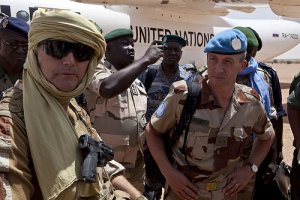
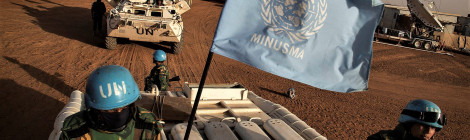
    French General Pillet, Chief of Staff of the MINUSMA Kidal, during the visit of the Joint Security Committee in charge of the observance of the cease-fire between the Malian army and armed groups from the north. Source: MINUSMA (Flickr)

    French General Pillet, Chief of Staff of MINUSMA, Kidal, during the visit of the Joint Security Committee in charge of the observance of the cease-fire between the Malian army and armed groups from the north. Source: MINUSMA (Flickr)

    Last January, the French military, supported by African troops and 10 non-African air forces, intervened militarily in Mali at the request of its transitional government. Over the following four weeks they recaptured all of the towns in the northern half of Mali. This vast desert region had been seized by Islamist and separatist militia in March-April 2012 and declared independent as the ‘State of Azawad’, the Tuareg name for their homeland in northeast Mali. Since then, French troops have continued to conduct security operations across northern Mali to locate and ‘neutralise’ militants associated with Al-Qaida in the Islamic Maghreb (AQIM), a jihadist group of Algerian origin, and its West African splinter groups. Reduced numbers of French forces now support Malian and African forces within the United Nations Multidimensional Integrated Stabilization Mission in Mali (MINUSMA).                                                                                                                                                                                                                                                                                                                                                                                                                                                                                                                                                                                                                                                                                             However, the final quarter of 2013 saw an increase in violence in northern Mali, including terrorist attacks, violent protests and inter-communal violence. Moreover, the French advance into northern Mali displaced rather than destroyed AQIM and its two local allies, the Movement for Unity and Jihad in West Africa (MUJAO) and Ansar Dine, a Tuareg Islamist group. Their impact has been particularly felt in Niger and Libya and may also have bolstered jihadist groups operating in northern Nigeria, Tunisia and Egypt’s Sinai. The lawless desert of southwest Libya is believed to be the new stronghold of AQIM.

    A new group, al-Murabitun, combining MUJAO and the most active elements of AQIM’s Saharan front, now appears to pose more of a threat to western and West African interests than AQIM. This is because its strategic direction is towards the weak states of West Africa, including Niger, Mali and Mauritania, where critical infrastructure and individuals are more difficult to protect. It is also better connected to the kidnapping and trafficking enterprises that fund Saharan militancy, and more deadly. During 2013, its militants were behind frequent raids on Gao (northern Mali’s main town), on a prison, garrison and French-owned mine in Niger, and on the Algerian gas plant at In-Amenas. These audacious operations attest to its range, training, discipline and cosmopolitan membership. If it finds common purpose with the larger jihadist groups in northern Niger, as some analysts suggest, it could represent a severe threat to stability in the already shaky regional power.

    French Repositioning in the Sahel

    In recognition of the expansion of jihadist groups, France announced a major repositioning of its forces in Africa in January. The new French military posture will refocus from large coastal bases, designed to train, transport and supply African Union and regional rapid reaction forces, to smaller forward deployments in the Sahel and Sahara. 3,000 French troops will now be based indefinitely in Mali, Niger and Chad.
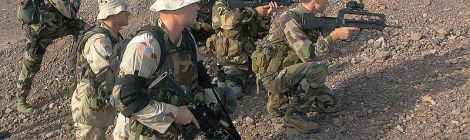
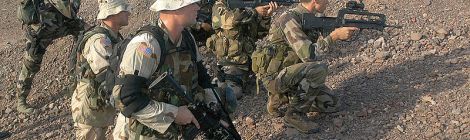
    U.S. soldiers and French commandos marine conduct a reconnaissance patrol during a joint-combined exercise in Djibouti. Source: Wikipedia

    U.S. soldiers and French commandos marine conduct a reconnaissance patrol during a joint-combined exercise in Djibouti. Source: Wikipedia

    The new posture is heavily influenced by US ‘War on Terror’ strategy in Africa, Yemen and south-west Asia, relying heavily on Special Forces, air strike capacities and unmanned aerial vehicles (UAVs). French and US forces (including contractors) already share facilities in Djibouti, Niger, Burkina Faso and Mauritania, and there is a small US liaison detachment with the French Combined Air Operations Centre in Chad. The French repositioning is explicit about confronting Islamist terrorist groups and the threat to regional security posed by the security vacuum in southern Libya. While the repositioning focuses on Mali, Niger and Chad, supplied via a coastal base in Côte d’Ivoire, it will actually include deployments to over a dozen small bases and elite detachments in the Sahel and Sahara, covering at least seven countries. In some cases it will mean French Special Forces reoccupying desert forts long abandoned by the Foreign Legion.

    There will also be greater use of aerial reconnaissance and targeting. French Navy patrol aircraft already criss-cross the Sahara and two MQ-9 Reaper UAVs arrived with French forces at Niamey airport in December after the US fast-tracked French acquisition of and training on these ‘hunter-killer’ drones. These double the effective range of the Harfang target-acquisition UAVs formerly used by the French in the Sahel, bringing all of Mali, Niger, almost all of the rest of West Africa and much of Algeria, Chad and southwest Libya into range.

    France also makes greater use of combat aircraft in the Sahel-Sahara, deploying fighter aircraft from its long-term base in N’Djamena, Chad to Bamako and Niamey airports. This brings northern Mali into range. Since October, French fighter-reconnaissance aircraft have deployed to Faya-Largeau in northern Chad, which brings southern Libya well within range. French Special Forces and armed helicopters have also operated from Burkina Faso, Niger and Mauritania in pursuit of AQIM.

    US and China Extend Their Presence

    French and US Reapers now operate from the same facility at Niamey airport, set up by the US in February 2013. While US UAVs in Niger are unarmed, it is unclear if French Reapers will be used for strike missions. US armed UAV bases in Djibouti, Ethiopia and Seychelles currently bring all of the Horn of Africa, East Africa and most of Arabia within range. US private military contractors have also flown unarmed, unmarked light aircraft on surveillance flights all across the Sahel belt since at least 2007. Using covert hubs in Burkina Faso and Uganda and smaller airfields in Mauritania, Niger and South Sudan, they have sought AQIM and the Ugandan Lord’s Resistance Army (LRA).

    Since 2011, US Special Forces have established small bases in the Central African Republic (CAR), South Sudan and the Democratic Republic of Congo (DRC) to assist Ugandan forces seeking the LRA there. They also provide training to several African militaries countering the LRA. As with programmes in Mauritania, Mali, Niger and Chad, these programmes have focused on creating elite counter-terrorism units. Unfortunately, all of these countries plus the CAR and South Sudan have experienced coups d’état or major army mutinies since this assistance began.

    In order to combat Boko Haram, a Nigerian Special Operations Command was announced on 14 January with the US military providing advice, training and equipment. Massive attacks by Boko Haram since December suggest that the Nigerian army’s use of indiscriminate force in the northeast has not weakened the insurgency. Rather, the state of emergency is likely to have strengthened the recruitment base of Boko Haram since May.

    China and Japan are also increasingly active in the Sahel. Chinese parastatals are the dominant actors in the oil industries of Sudan/South Sudan, Chad/Cameroon and Niger. They also mine uranium in Niger, and China is the primary buyer of iron ore from Mauritania’s vast desert complexes. So far, China is the only non-African state to deploy more than a few dozen troops with MINUSMA.  Japan, which saw ten of its nationals killed in the January 2013 militant attack on Algeria’s In-Amenas gas plant, has pledged $1 billion to stabilise the Sahel, including training of counter-terrorism units.

    Compromised Alliances

    This expansion of deployments and offensive operations relies on the status of forces agreements between western powers and’ friendly’ states such as Algeria. France, for example, depends on an air corridor across the Algerian Sahara. Securing such access puts host governments in a position of greater power. The highly authoritarian regime in Algiers – the world’s fifth or sixth largest arms importer – no longer faces western pressure to improve its dismal human rights record. Indeed, it has received friendly visits from the leaders of France and the UK and the US Secretary of State since late 2012. Mauritania’s military-based government faced little criticism over its unfair elections in November.

    Chad, Uganda and Ethiopia may be the biggest regional beneficiaries of the militarisation of the Sahel. Each has been governed for a quarter-century by a former armed movement. They face little censure of their authoritarian and undemocratic internal policies and have become more assertive as regional military powers. Ethiopia has forces in Somalia while Uganda now has combat troops in operation (by agreement) in Somalia (under AU command), South Sudan, the DRC and the CAR.

    Boosted by expanding oil revenues, French alliance and the demise of Libya’s Gaddafi regime, Chad has greatly expanded its military reach into Mali, Niger and the CAR, where its troops and citizens now face a violent backlash. It is also a Security Council member for the next two years and will be expected to help guide decisions on UN peacekeeping operations in Mali, South Sudan and potentially the CAR and Libya.

    Burkina Faso, long relied on by Paris to negotiate with armed groups in francophone West Africa, is also facing unaccustomed turbulence in 2014 as its president seeks to permit himself an additional term of office. Algeria, which is wary of France’s military deployments on its southern border, is set to take over from Burkina the mediation of talks between Mali’s government and secular Tuareg and Arab rebels.

    Foundations in Sand

    In some respects, the eviction of AQIM and its allies from northern Mali has made the wider Sahara a less safe place, without obviously impeding the capacity of jihadist groups to threaten Europe. In 2014, southwest Libya and parts of Niger are not necessarily less safe havens than northern Mali was in 2012. The insurgency has moved closer to the Mediterranean and closer to critical European energy infrastructure in Algeria, Libya, Tunisia and Niger (uranium). Unlike heterodox Mali, controlling Libya’s chaotic state is likely to be of interest to Arab Salafist groups, including AQIM.

    As elsewhere, the western military approach to countering Islamist insurgency in the Sahel rests on very unsteady foundations. This applies to the political legitimacy of allied regimes, the stability and security of locations hosting French and US bases, the traumatic historical legacy of France as the former colonial power, and the potential for counter-insurgency tactics to provoke wider alienation and radicalisation. However asymmetric its military technology, reinforcing a new line of castles in the Saharan sand may be as futile a gesture in France’s long retreat from empire as the UK’s last stand in Afghanistan.

    Richard Reeve is the Director of the Sustainable Security Programme at Oxford Research Group. He has researched African peace and security issues since 2000, including work with ECOWAS and the AU. Richard’s most recent security briefing ‘Security in the Sahel (Part II): Militarisation of the Sahel is available here.

  • A Backwards Step for Sustainable Security in the US

    National Security Regressives: A New Vocal Constituency Among Conservatives

    The ratification of the New START nuclear arms treaty with Russia marked a defeat for an influential faction among America’s right that can best be described as national security regressives. These are “conservative” voices who oppose strengthening and utilizing the full range of traditional tools of American statecraft, including assertive diplomacy, smart and balanced national security spending, and precise and targeted measures to combat terrorist groups. They may have lost on New START, but they are not likely to go away anytime soon.

    The fact that a modest arms control measure such as New START took so much time to ratify is a harbinger of tensions to come in 2011—a year in which conservatives face significant challenges reconciling competing national security agendas in their ranks. The starting bell on the Republican presidential primary fight is about to ring, and more foreign policy regressives have joined the ranks of the new Congress—so look for some sharp battles to emerge among conservatives on national security. This internal conservative debate could have a major impact on how America conducts its foreign policy in 2011 and beyond.

    Conservatives today are more divided on foreign policy than they have been in decades. The 2010 Republican Party “Pledge” manifesto for the midterm elections, however, papered over these divisions, briefly mentioning national security as an afterthought. It contained few ideas on how to keep America secure and strong.

    The debate over the New START treaty exposed some of the conservative divisions on national security. Traditional foreign policy conservatives such as Sen. Richard Lugar (R-IN) and several former secretaries of state supported the treaty while other national security regressives such as Senate Minority Leader Mitch McConnell (R-KY) and former Massachusetts Gov. Mitt Romney, a likely 2012 presidential primary candidate, famously called the treaty “Obama’s worst foreign policy mistake” in this article for The Washington Post. Another key division exists on defense spending. Tea Party advocates, for example, are geared up to fight defense hawks.

    The biggest challenge for conservatives in reconciling the divisions on foreign policy in their ranks comes from the regressive camp. National security regressives are usually described as conservatives, but the positions they have staked out on foreign policy make them undeserving of the conservative label.

    The dictionary defines conservatives as “disposed to preserve existing conditions and institutions.” What sets regressives apart from traditional conservatives is that they are not interested in preserving existing foreign policy conditions and institutions. In fact, they have eschewed many of the key tools of statecraft that have made America a global leader—assertive diplomacy, smart and balanced national security spending, support for international institutions serving as force multipliers to address some of the world’s most pressing security challenges, and agreements like New START that demand other countries live up to commitments aimed at enhancing global security.

    Read the full article here.

  • Sustainable Security

    Tackling South African water insecurity will require addressing the technical deficiencies, governance gaps and social inequality that are currently having a dangerous and environmentally devastating impact. The links between environmental health and socio-political stability are clear in South Africa, where there has been an exponential increase in violent protests over poor or privatized service delivery, social marginalization, and unequal access to water. South Africa must act  to solidify the links between resilient societies and resilient ecosystems.

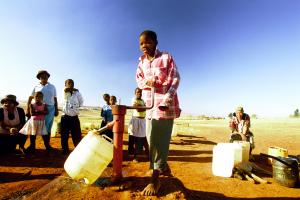
    Rural water pump near Ulundi, South Africa. Source: Trevor Samson / World Bank (via Flickr)

    Rural water pump near Ulundi, South Africa. Source: Trevor Samson / World Bank (via Flickr)

    Last month, the Intergovernmental Panel on Climate Change (IPCC) unveiled the third and final Working Groupreport from its from its landmark Fifth Assessment. This, together with the Second Working Group Report released on 31 March, 2014, is required reading for those wishing to examine the societal impacts of climate change and the potential pathways for twenty-first century resilience. For the first time, the IPCC included a chapter on human security. This is a significant achievement that should increase understanding of the increased threat and impacts on individual livelihoods that climate change is bringing, particularly in the developing world. It is clear that the connections between environmental security and human security run deep, but it is less clear just how societies can build resilience and whether the political will exists to pursue it.

    Adding to the complexity is the fact that these challenges manifest themselves uniquely across the world. Due to factors of geography, history, politics, and social development, each region and country experiences climate change in a distinctive way. For Africa, the picture is predictably bleak. The region as a whole has contributed the least to greenhouse gas emissions, faces some of the worst consequences of climate change, and has the weakest capacity to cope with the impacts.

    The country of South Africa provides a fascinating example of how difficult building ecological resilience can be. Already the 30th driest country in the world, it is expected to experience further drying trends, and an increase in extreme weather events, including cycles of extreme drought and sudden excessive rains. In relative terms, the country has in fact been a significant contributor to global climate change due to its energy-intensive economy. As such, the country has a global responsibility to engage fully with the IPCC reports and begin developing robust responses to environmental insecurity. However, doing so presents major challenges for a country that remains a “dual economy” with one of the highest rates of income inequality (and inequality of opportunity) in the world.

    This is all the more troubling given the country’s progressive stance on environmental issues. In fact, environmental security has been, and will remain, a vital component of the evolving South African identity following the end of apartheid in 1994. The issue of environmental security in South Africa is one that has for years resonated across diverse sections of the population. There are strong cultures of conservation and environmentalism running throughout the country. However, the “Rainbow Nation” continues to suffer from sustained environmental degradation in ways that alter the natural landscape, destroy necessary biodiversity, and hinder social development.

    Promises to Keep: water legislation and service delivery

    Take for instance the issue of water security. South Africa has long been seen as a world leader in progressive water policy, particularly given its need to address unequal water policies of the Apartheid era. Its Constitution and its National Water Act explicitly declares the human right to water, guaranteeing a minimum allocation of 6000 litres of free, clean water a month for every South African. Nelson Mandela championed the cause, claiming that access to water is “central in the social, economic and political affairs of the country, [African] continent and the world. It should be a lead sector of cooperation for world development.” The guiding vision for South African water policy is eloquently summed up by the former slogan for the Department of Water Affairs and Forestry: “some, for all, forever.” The progressive language of water rights enshrined in the country’s legal frameworks is a point of pride amongst South African citizens, but also a flashpoint around which grievances often converge.

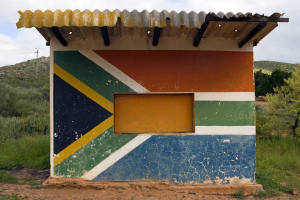
    Unused farm stall on the road between Clanwilliam and Citrusdal. Source: John Hogg/World Bank (via Flickr)

    Unused farm stall on the road between Clanwilliam and Citrusdal. Source: John Hogg/World Bank (via Flickr)

    However, while the Constitution and the National Water Act overturned the discriminatory water policies of the Apartheid era, they remain vague and non-committal on the delivery of their lofty promises. Given all the competing priorities and demands for investment, the country has neglected to invest the necessary resources to create, maintain and upgrade its water infrastructure and to adequately promote water conservation in the face of increased demands on the precious resource.

    In addition, the continued failure of sustainable agricultural practices and the promotion of economic growth in a business-as-usual and water-intensive manner have severely degraded South Africa’s water resources. All told, 48% of South Africa’s wetlands are critically endangered. Another telling example comes from the province of KwaZulu-Natal, where the pursuit of economic development and social advancement has led to a rapid rate of environmental transformation. The rate of loss of unprotected natural areas is approximately 1% per annum, meaning that if it continues at this rate they (and all of the attendant services they provide) will be lost by 2050. Pushing back against these trends requires significant efforts on the part of many different actors. This will be, of course, a very difficult task.

    Beyond technical deficiencies and economic tradeoffs, there remains a governance gap within the country that exacerbates the problems. The management of its water is largely disjointed and erratic. The various levels of government and the disparate non-state actors involved in water conservation and distribution are often arranged in Unsurprisingly, this leads to the multiplication of environmental stresses because stakeholders often lack technical knowledge, fail to adapt best environmental practices, contribute to spoiling common-pool resources, and contribute to social alienation from the natural world. This impedes economic development and hardens social cleavages between the rich, whose water flows freely and cheaply, and the poor, who suffer the debilitating effects brought upon by a lack of access to adequate water supplies. Thus, what is often lost in the discussion are the ways in which healthy ecosystems deliver valuable services to people. In essence, we are surrounded by ecological infrastructure.

    The social component of South African water security combines with technical deficiencies and governance gaps to create a dangerous and environmentally devastating impact. This reflects the connections between environmental health with socio-political stability. Unfortunately, for South Africa, the picture is troubling. Non-violent resistance has been a common tactic, but even more concerning has been the recent exponential increase in violent protests over poor service delivery, privatization of service delivery, social marginalization, and the persistent inequality in access to water. One of the ways that could assist the country avoid further civil strife is to significantly increase sustainable environmental management and adjust its governance priorities to deliver upon the laudatory promises of its environmental legislation.

    The Resilience of South Africa

    On May 7th, 2014, South Africans will head to the polls for national elections. This will be the fourth election since the fall of Apartheid, and the first for the “born frees” – the generation of young South Africans born and raised in a democratic South Africa. Most opinion polls indicate that the ruling African National Congress (ANC) party will be re-elected by a sizeable margin, though its support has dropped significantly in recent years. This is due in part to widening perceptions that the ANC has grown entrenched in its own privilege, reflected by ongoing corruption scandals and ineffective economic policies.

    As South Africa moves further away from the legacy of Apartheid, it must confront continued social alienation, the pervasive effects of deep inequality, and the monumental challenge of building ecological resilience and sustainability. As service delivery protests increase, it is clear how the social cleavages of modern-day South Africa often manifest themselves around issues of water, sanitation, the environment, and human dignity.

    The latest IPCC reports are remarkable achievements for a number of reasons. Not least, they clearly acknowledge the continued connections between human and environmental security. In this sense they reflect the growing awareness that to build resilient societies means to invest in resilient ecosystems, and vice versa. For South Africa, in possession of arguably the most progressive water legislation in the world, this requires actively investing in the ecological systems that builds and sustains human dignity. This will require the country to reconcile its rhetoric with its practice. A tall order to be sure, but one that is absolutely crucial for the country to fulfill the promise of its recent past.

    Cameron Harrington is a Post-Doctoral Fellow in the Global Risk Governance Programme at the University of Cape Town. His work is based upon research supported by the National Research Foundation of South Africa. Any opinion, findings and conclusions or recommendations expressed in this material are those of the author(s) and therefore the NRF does not accept any liability in regard thereto.


  • Sustainable Security

  • How small arms and light weapons proliferation undermines security and development

    The proliferation of small arms and light weapons is an immediate security challenge to individuals, societies, and states around the world and an enormous hurdle to sustainable security and development. Small arms fuel civil wars, organized criminal violence, and terrorist activities. They also undermine multimillion dollar development programs and other assistance to fragile states. Fragile and failing states should be of particular strategic interest to the United States because even small insurgencies, if unchecked, can erupt into larger civil wars and possibly destabilize entire regions. In some cases fragile and failing states can also become bases for terrorist groups directly hostile to the United States.

    In many conflict zones small arms and light weapons are the weapon of choice, the main instrument of death and destruction, and are often used to forcibly displace civilians, impede humanitarian assistance, prevent or delay development projects, and hinder peace-keeping and peace-building efforts. When conflicts end or abate small arms often remain in circulation, which may lead to additional violence and suffering since fighting can resume or conflicts may erupt in neighboring regions. In nonconflict areas small arms may be used in criminal violence or may be used in homicides, suicides, and accidents. And they are frequently the primary tools of terrorists bent on sowing chaos and discord.

    The weapons can exact a staggering toll. For example, in January 2010 narco-traffickers armed with assault rifles massacred 16 people—mostly teenagers—attending a birthday party in Ciudad Juarez on the U.S. border. In November 2008 roughly two dozen terrorists from Lashkar-e-Taiba with AK-47-type assault rifles, 9 mm pistols, and grenades killed nearly 200 people and wounded 350 in Mumbai, India.

    Approximately 875 million small arms are in circulation worldwide, and only about a third are in the hands of legally constituted security forces. Because small arms are simple to use, durable, and easy to conceal they are especially prone to misuse, and their misuse directly and indirectly affects hundreds of thousands of people and severely undermines sustainable development in scores of countries around the world.

    As we’ll show in this report, the Horn of Africa exemplifies the challenges the proliferation of small arms and light weapons pose for sustainable regional security and development. Somalia is the quintessential failed state that illustrates the cost of small arms and light weapons proliferation and the challenges of recreating the conditions for sustainable development in a heavily armed environment. Despite numerous internationally sponsored peace conferences and billions of dollars in assistance, much of Somalia remains engulfed in civil war and has become a breeding ground for international terrorism.

    The insecurity also spreads across borders. In neighboring Kenya (a close ally of the United States), armed violence is common in the pastoralist areas of the northern and northeastern regions of the country. Access to guns has also exacerbated urban crime and political violence in Kenya.

    But small arms and light weapons are not only a problem for poor countries. Mexico is an example of how small arms can plague a medium-income country. Small arms are widely used there by organized criminal groups involved in the drug trade and kidnapping. Their use in Mexico has led to large numbers of homicides, undermined local authority, and greatly increased the cost of security for Mexican citizens. The violence is fed by a stream of readily available and powerful weapons from the United States—Mexico’s main source for small arms. At the same time, the U.S. government is spending hundreds of millions of dollars to help the Mexican government combat arms trafficking and criminal violence.

    A wide body of international and regional agreements and initiatives has been developed to tackle small arms proliferation, and national small arms policies, programs, and standards vary from country to country. The United States has wide-ranging small arms laws, regulations, and policies, and is often hailed as the “gold standard” for comprehensive policies and practice concerning the transfer, management, and control of small arms and light weapons produced, maintained, and exported within its borders.

    But even though the U.S. government has sophisticated laws, regulations, and controls for the legal arms trade, permissive gun ownership laws and lax supervision of certain gun markets have made the United States a significant source of illegally diverted guns, especially in Mexico and other countries in Central America.

    The Obama administration has ample opportunities to shape a new and more assertive U.S. position on small arms, but it must navigate the complex domestic political realities of small arms in the United States. A new approach should include greater engagement on small arms issues internationally and stronger domestic efforts to prevent illegal gun trafficking. The United States should actively participate in existing and proposed processes and negotiations and promote meaningful and practical approaches to countering small arms proliferation and misuse.

    The administration, Congress, and the public also need to be better educated about the costs and consequences of small arms proliferation and a commitment to develop appropriate U.S. programmatic and policy responses must be cultivated. Raising awareness would counter confusion and misinformation about efforts to address small arms proliferation and misuse and assist real and sustainable progress. Such awareness promotion would include increasing dialogue, through interagency meetings, reports, and statements, on how small arms proliferation and misuse can undermine U.S. security and development goals. This could then encourage policy initiatives and budgetary support for efforts to combat the illegal spread of small arms.

    There are four specific steps the United States can take in the short term at the national, regional, and global level to help promote strategic engagement on the small arms issue.

    First, at the national level, the United States should increase its assistance for programs that prevent the proliferation and misuse of small arms and light weapons. Export controls, responsibility, and appropriate vetting of end users are important steps, but it is equally important for the United States to ensure that surplus, obsolete, and potentially destabilizing weapons are removed from circulation. It is these weapons that are most often used in brutal conflicts in countries such as Colombia, Darfur, the Democratic Republic of the Congo, Sri Lanka, and Somalia.

    Second, at the regional level, the Senate should ratify the OAS Convention—the 1997 Inter-American Convention Against the Illicit Manufacturing of and Trafficking in Firearms, Ammunition, Explosives and other Related Materials, which aims to combat illicit small arms trafficking in the Western Hemisphere. The United States played a key role in drafting the OAS Convention and made sure it was in line with U.S. laws and regulations. But for more than a decade the convention has languished in the Senate. Ratifying it would send an important and powerful message to the Western Hemisphere that the United States is serious about halting illicit arms trafficking, and it would provide another tool to deal with the flow of weapons between the United States and Mexico.

    Third, at the global level, the United States should lead the development of a legally binding arms trade treaty that would establish common international standards at the highest level on the export of conventional weapons, including small arms. Under the Obama administration, the United States has already reversed the Bush administration’s position on small arms and demonstrated it is willing to be a constructive partner in developing a treaty and in the U.N. process to control small arms. U.S. laws and regulations comply with or exceed the vast majority of principles that have been proposed in a potential international arms trade treaty, and the United States should ensure its national arms export control system serves as an example for other states.

    Finally, the Obama administration should build small arms initiatives into development programs. When the United States undertakes programs on security sector reform and judicial sector reform, particularly in fragile states, the action plan should include steps to address small arms proliferation and misuse. General U.S. support for programs that address weapons demand is critical and requires several key integrated measures, starting with the reform of law enforcement agencies and military forces to ensure they are representative and provide security to all their citizens as well as adhere to international human rights and humanitarian laws.

    Download the full report here.