Blog

  • Sustainable Security

  • Minority Youth Bulges and the Future of Intrastate Conflict

    The global distribution of intrastate conflicts is not what it used to be. During the latter half of the 20th century, the states with the most youthful populations – a median age of 25.0 years or less – were consistently the most at risk of being engaged in a civil war or in an internal conflict, where either ethnic or religious factors, or both, came into play (an ethnoreligious conflict). However, the tight relationship between demography and intrastate conflict has loosened over the past decade. Ethnoreligious conflicts have gradually, though noticeably, increased among a group of states with a median age greater than 25.0 years, including Thailand, Turkey, Sri Lanka, Indonesia, and Russia.  The salient feature of these intrastate conflicts has been an armed struggle featuring a minority group that is age-structurally more youthful than the majority populace. The difference in age-structural maturity reflects a gap in fertility between the minority and majority, either in the present or in the recent past.  

    Most social scientists are likely to explain a minority-majority gap in median age and fertility as the product of history and culture, an artifact of income differences, and/or the result of discriminatory policies or inadequate protections on the part of the state. While political demographers recognize these as contributing factors, they also argue that the political volatility and rapid population growth that are associated with youthful minorities are central features in a dynamic relationship known as the demographic security dilemma.

    The demographic security dilemma, first described by Christian Leuprecht, arises when a state permits or promotes the political, economic, and social marginalization of an ethnoreligious minority. The more states marginalize a dissonant minority, turn a blind eye to a minority’s exclusion from mainstream social and economic participation, or allow minorities to exclude themselves, the wider the majority-minority fertility gap and the more rapidly those youthful minorities grow as a proportion of the state’s population. Minority youth bulges naturally lead to political tensions. Notably, minority-state tensions do not naturally emerge out of the opposite circumstance: when the majority is youthful and the ethnoreligious minority is not.

    What can governments do to prevent the minority-majority fertility gap? Make sure that health, family planning, and educational programs are extended equitably to minorities. An absence of proactive policies to bring youthful communities into the economic, social, and political mainstream tends to strengthen radical and traditionalist religious political organizations, which often take advantage by filling in gaps in local services and governance. Typically, they restrict girls’ access to education, thwart women’s attempts to gain social and economic autonomy, restrict speech, and campaign against modernization and secularization.

    How can foreign affairs analysts forecast risks associated with youthful minorities? That’s easier said than done. Due to restrictions associated with ethnic and religious data collection and the political sensitivities surrounding conclusions drawn from these data, relatively few countries currently provide public access to data that are disaggregated by ethnic and religious affiliation. For now, analysts attempting to estimate qualities of a minority’s age structure must approximate from related measures, such as estimates of minority birth and death rates, fertility rates, and school attendance. Rather than being accessible from a central source, these are published in scattered government reports and in the international demographic and public health literature.

    Despite ongoing high fertility across sub-Saharan Africa and the Arabian Peninsula, UN demographers foresee a world in the not-too-distant future that will be dominated by states with populations near or below replacement-level fertility (just above two children per woman). In that future, analysts can expect the ethnoreligious composition of many states to be extremely sensitive to minority-majority fertility gaps.

    However, understanding the implications of minority demographic trends could hinge on the ability of researchers to gain access to sub-national ethnoreligious data. For this to happen, some governments will have to overturn laws that currently prohibit identification by ethnicity or religion, while data collectors will need to promote conditions that encourage survey participants to self-identify their ethnic and religious affiliations anonymously, and without fear.

    Article Source: The Stimson Center

    Image Source: CharlesFred

  • Sustainable Security

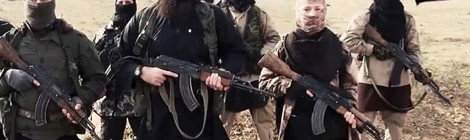
    Foreign fighting in Syria is not driven primarily by devotion to Islam, nor is it motivated mainly by socioeconomic grievances. Rather, foreign fighters join the Syrian civil war to defend their Muslim brethren. Framing the war as a threat to the Muslim (Sunni) community, transnational Islamist movements offer alternative identities and a sense of belonging for alienated people from across the Muslim world.

    In recent years the conflict in Syria has become a lodestone for young Muslims who travel to join the fight. According to estimates from the U.S. National Counterterrorism Center, and reports by The Soufan Group (TSG), foreign fighters from more than 90 countries have joined the Syrian civil war since its inception in 2011, and their numbers already exceed the rate of volunteers who went to Afghanistan, Pakistan, Iraq, Yemen or Somalia at any point in the last 20 years. While the actual figures of foreign fighters in these and other sources vary, and though we do not know how many of them actually engage in the fighting, there are consistent estimates of the numbers of volunteering fighters and the distribution of their countries of origin.

    To be sure, volunteering fighters join various parties in the complex war, like Hezbollah combatants who fight for the Syrian army and foreigners who fight for the Kurdish YPG forces, yet, the concept of foreign fighters relates here to those volunteers joining jihadi movements, mainly the Islamic State and Jabhat Fath al-Sham (formerly known as Jabhat al-Nusra) organizations. Special attention is afforded to the growing stream of European Muslims to these jihadi groups in Syria, and their potential extremist actions upon return to their home countries. However, most foreign volunteers have come from Muslim countries in the Middle East and North Africa. The recruitment process is generally conducted on an individual basis. Taking place across the world, the recruitment relies largely on social media, with videos and appeals produced in a range of languages, describing the caliphate as a utopian political venture, and providing young men and women with an adventurous trip. Salafi mosques and associations also seem to take an active role in recruiting and trafficking volunteers to fight the Syrian war in the name of Islam.

    Although by no means a new phenomenon, the causes of the widening spread of foreign fighting remain unclear. As most of these foreigners are utterly detached from the events in the countries to which they journey, and have little political and material benefit to gain from these wars, the opportunity to attain martyrdom in the next life appears to be a major appeal. Yet, Islam in and of itself is not the primary factor behind foreign fighters joining the jihad. Examination at the individual level indicates that many of those who choose to join extremist groups in Syria have only basic knowledge of Sharia. Islamic State entry forms leaked in early 2016, also demonstrate that while some characteristics of the volunteers (like age and marital status) can be traced, there are no discernible demographic and socioeconomic profiles of foreign fighters in Syria.

    An inspection of the foreign fighters’ countries of origin adds to this confusion, as the spate of volunteering warriors does not originate primarily in countries dominated by radical Islamist movements, nor is it confined to countries where economic and political conditions are the worst. Rather, foreign fighters join the Syrian civil war from countries with different profiles in terms of both the role of Islamism in socio-political life, and the political authority of the regime. Four countries are notable among the home countries of the foreign fighters in Syria: Tunisia, Saudi Arabia, Morocco and Jordan. Tunisia, where the “Arab Spring” revolt was initially ignited, has become the largest source of foreign fighters joining the jihadi groups in Syria, with roughly 3,000 Tunisian warriors recorded between 2011 and 2014; Saudi Arabia is next with estimates of 2,500 fighters during that period. On the other hand, countries like Egypt, Yemen and Sudan produced far fewer volunteering fighters.

    The role of identity

    Image (cropped) credit: Freedom House/Flickr.

    Why then do foreign fighters travel from the Muslim world to fight in Syria? Foreign fighters are motivated by the quest for identity and belonging. Their recruitment is based on religious sentiments, sparked by Islamist movements striving to defend cultural and religious values of the Muslim community. Alienated individuals who seek alternative identities and a sense of belonging find them in their transnational communities. The combination of these factors has stimulated the shift from nationalist identities to pan-Islamist orientations, promoted through a fear-provoking discourse.

    This process was coupled with the emergence of transnational jihadi networks, which carried out political activism aimed at defending the Muslim nation. Recruitment of Muslim fighters thus relies on established messaging practices, by which the recruiting groups frame distant civil conflicts as posing a direct threat to the larger transnational community. Interestingly, these messages are most effective in countries like Tunisia and Saudi Arabia where major Islamist movements are co-opted, taking part in negotiated relations with the ruling elite vis-à-vis implementing Islamic norms in socio-political life. In these countries, legal or semi-legal Islamist movements embrace relatively moderate discourses of sectarian identity, remaining pragmatic and non-violent toward the state. Under such restrained relationships, Islamist sentiments of alienated groups evolve into transnationalist inclinations.

    Alienated individuals then aim their rage and frustration at external enemies. That is, restrained relations between the state and Islamist movements at the national level may well explain the relatively large number of foreign fighters recruited from subnational regions that are alienated from the state, as these fighters see transnational jihad as a way to vent socio-political rage and Islamic sentiments that find limited local opportunities for expression.

    Possible solutions

    To counter the appeal of transnationalist messages, home countries need to establish civic identities and offer competing national narratives. Governments should encourage the inclusion of alienated groups in national discourses and strengthen their sense of belonging to the state. To be sure, the establishment of civic identities is conditioned by state effectiveness and legitimacy — it can be achieved only if the state reconstitutes its position as an institution that provides the needs of its citizens.

    Indeed, state ideology and policies also affect people’s choice to join foreign fighting. Preferring to allow troublesome elements to leave the country, some governments turn a blind eye to efforts to recruit their citizens to join transnational wars. Some countries even encourage the phenomenon. Consider for example the dual policy vis-à-vis Islamism which is well-embodied in the Saudi stance toward foreign fighting in the Syrian civil war. While actively involved in the regime’s domestic de-radicalization efforts, Saudi clerics offer contradicting messages about fighting jihad in foreign countries, with some of them openly calling upon the Muslim world to fight Bashar al-Assad’s supporters, including Syrian Alawites, Iran and Hezbollah. Egypt’s clerics, on the other hand, promote clear anti-jihadist ideology, with multiple campaigns launched by Al-Azhar to renounce the radical ideas spread among young people by groups like Islamic State. Directed by Egyptian President al-Sisi, Al-Azhar leaders hold talks with religious leaders in other countries in the region to thwart Islamic State ideology and to diminish the phenomenon of foreign fighters’ volunteering in the Syrian civil war.

    The policy implication from the multifaceted causes of foreign fighting in Syria is that governments in the Muslim world should not only raise the constrains on going to Syria but also take preventive measures including information campaigns aimed at radicalized and alienated young people, offering opportunities for local expression of their socio-political needs and encouraging their sense of belonging to the state.

    Meirav Mishali-Ram is a lecturer at Bar Ilan University. Her research interests focus on international conflict and civil war, particularly in the Middle East and South Asia. She is the author of many articles and a forthcoming book on the Arab-Israel and India-Pakistan protracted conflicts. Her most recent article on foreign fighting in Syria is available at Taylor and Francis Online: “Foreign Fighters and Transnational Jihad in Syria,” Studies in Conflict & Terrorism.

  • Conflict

    At the beginning of February, ISAF sources announced that a major military offensive was about to be mounted in Helmand Province in southern Afghanistan. This was Operation Moshtarak (“together”), involving 15,000 US, British and Afghan National Army troops, and would concentrate on clearing Taliban and other paramilitary groups from two areas, one of them centred on the town of Marja. The publicity given to the operation appeared designed partly to encourage civilians to evacuate areas under Taliban influence, but would also serve to highlight the capabilities of coalition forces at a time when support for the war in the United States and Britain was fragile.

    Given the size of the operation, it is likely that it will provide a major focus for western media attention for some weeks, but to get a full measure of its significance requires seeing it in the wider context of the conflicts in Iraq and Pakistan, and of the Status of the al-Qaida Movement. There have, in particular, been significant developments in both Iraq and Pakistan, with each likely to have an impact on what is now happening in Afghanistan.

    Photo courtesy of Helmandblog.

    Read more »

  • Marginalisation of the majority world

    The Middle East and North Africa is a region of great diversity. It encompasses Arab and many other ethnic populations, theocratic and secular states, democracies and authoritarian regimes. A region of immense wealth and crippling poverty; it is blessed (some might say cursed) with vast resources, not least oil, but has not always proved able to manage them for the benefit of ordinary people. Read more »

  • Sustainable Security

    RC_long_logo_small_4webThis article is part of the Remote Control Warfare series, a collaboration with Remote Control, a project of the Network for Social Change hosted by Oxford Research Group.
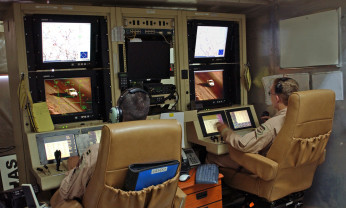
    Capt. Richard Koll, left, and Airman 1st Class Mike Eulo perform function checks after launching an MQ-1 Predator unmanned aerial vehicle Aug. 7 at Balad Air Base, Iraq. Captain Koll, the pilot, and Airman Eulo, the sensor operator, will handle the Predator in a radius of approximately 25 miles around the base before handing it off to personnel stationed in the United States to continue its mission. Both are assigned to the 46th Expeditionary Reconnaissance Squadron. https://en.wikipedia.org/wiki/General_Atomics_MQ-1_Predator#/media/File:MQ-1_Predator_controls_2007-08-07.jpg

    Drone pilots perform function checks after launching an MQ-1 Predator unmanned aerial vehicle Aug. 7 at Balad Air Base, Iraq. Source: Wikipedia

    Over-burdened in its requests for continuous surveillance of an expanding battlefield, the US military is increasingly turning to private contractors to fill key roles in its drone operations.

    In March this year, US Air Force Secretary Deborah James appeared before the Senate Armed Services Committee, looking for a $10 billion funding hike. “I can tell you the number one thing that the combatant commanders say they want from our Air Force is more ISR, ISR, ISR,” she told the committee. “That is the number one priority.”

    ISR is Intelligence, Surveillance, Reconnaissance, and encompasses a complex array of functions. It includes spyplanes and drones with special sensors and cameras, the satellites which control them, and the analysts who turn this information into “products”.  It also includes the “distributed common ground system”, an unwieldy term for the network of devices which allows personnel to access this information and the “products” derived from it.

    The volumes of data being passed back from surveillance flights is now so vast that the military can no longer deal with it in-house. So, The Bureau of Investigative Journalism (‘The Bureau’) found in a six-month investigation, the Pentagon has turned to the private sector to plug the gaps, employing contractors as imagery analysts or “screeners”.

    Screening

    The screener’s task is not a simple one. Like much of military life, it involves long spells of tedium – twelve hour shifts in front of a screen – interspersed with occasional spikes of activity. But it demands high and continuous levels of concentration. As one screener told us: “A misidentification of an enemy combatant with a weapon and a female carrying a broom can have dire consequences.”

    Screeners can have an important safety function in reducing collateral damage – the proverbial “busload of nuns” which appears out of nowhere into the field of fire. But their interpretations of video imagery – “calls”, in military parlance – can also influence drone pilots to take shots. As one screener commented, once you’ve influenced the mentality of the pilot by indicating the presence of something hostile, it’s hard to retract it.

    In one notorious incident, the crew of a MQ-1 Predator drone flying over Afghanistan’s Uruzgan province in February 2010 ignored ambiguities in their screeners’ assessments as to whether the trucks they were tracking contained combatants. As a result, at least 15 civilians were killed.

    “When you mess up,” The Bureau was told, “people die.”

    Contractors

    The companies being paid to undertake this work range from industry leviathans like BAE to specialist tech firms like Zel Technologies and Advanced Concepts Enterprises.

    Finding out who was performing this work was itself an arduous task. The Department of Defense records thousands of procurement transactions most days every year. From 2009 to the end of 2014 there have been over 8 million transactions between the Pentagon and the private sector. The Bureau analysed these transactions through its own specially constructed database, which allowed it to identify activities relating to ISR and then build up profiles of the contracts and companies carrying out those activities.

    Table: US Military Imagery Analysis Contracts since 2010 (click to enlarge)
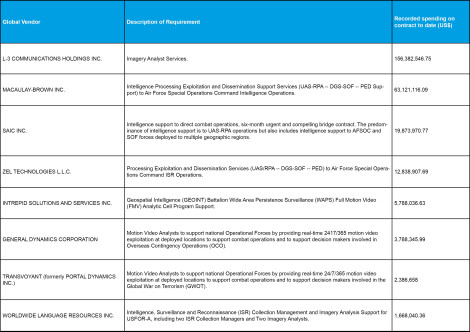
    Data in this table is drawn from public sources including the Federal Procurement Data System (fpds.gov), Federal Business Opportunities (fbo.gov) and contractual material released under the Freedom of Information Act. Business information is taken from Bloomberg, Hoovers and Orbis. Companies named in the reporting but not included in this table are BAE, Booz Allen Hamilton and Advanced Concepts Enterprises. The Bureau has documented evidence of their involvement in ISR from sources other than contracts and transaction records. For the full dataset please see https://docs.google.com/spreadsheets/u/1/d/1WpSvDKGyraU5koQheFIgO7fUCIrSUxG5o7R9cS042_I/pubhtml

    Data in this table is drawn from public sources including the Federal Procurement Data System (fpds.gov), Federal Business Opportunities (fbo.gov) and contractual material released under the Freedom of Information Act. Business information is taken from Bloomberg, Hoovers and Orbis.
    Companies named in the reporting but not included in this table are BAE, Booz Allen Hamilton and Advanced Concepts Enterprises. The Bureau has documented evidence of their involvement in ISR from sources other than contracts and transaction records.
    Click here for the full dataset

    The Bureau identified over $260 million of screening transactions. But this is a niche market compared to the wider outsourced ISR effort. The private sector has been operating smaller surveillance drones over Afghanistan and other countries, managing communications between drones and their bases in the US and elsewhere, maintaining data collection systems and servicing sensors, to name just some functions. Procurement costs for these services run into billions of dollars.

    Questions of accountability come to the fore in this type of outsourced warfare. Following considerable pressure, the military now publishes figures of contractors on the ground in Iraq and Afghanistan. But this transparency does not extend to ISR missions conducted in those countries – or elsewhere – from behind computer screens in Florida and Nevada.

    From Screening to Targeting?

    Although contractors are so far not supposed to have their fingers on the drones’ triggers, fears have been expressed that this distinction might be harder to maintain in practice. One military outsourcing specialist, Laura Dickinson, told us that if the ratio of contractors to government personnel swells, “oversight could easily break down, and the current prohibition on contractors making targeting decisions could become meaningless.”

    Shortly after The Bureau published its investigation in The Guardian, the Pentagon announced that it would ramp up the number of ISR missions with ten new contractor-operated MQ-9 Reaper Combat Air Patrols. This puts contractors into the driving seat of large, combat-capable drones for the first time, although the Pentagon says these will be “ISR only”. The private sector’s involvement in drone warfare, it seems, is just taking off.


    Crofton Black is a researcher, journalist and writer with extensive experience of complex investigations in the field of human rights abuses and counter-terrorism. He is a leading expert on the CIA’s rendition, detention and interrogation programme and a specialist in military and intelligence corporate contracting. He has a PhD in the history of philosophy from the University of London.

    Crofton completed a report for the Remote Control Project last year on the use of contractors in US special forces operations.
  • Sustainable Security

  • Sustainable Security

    The beginning of the Arab Awakening and its mass-based social and political mobilizations has spurred a dynamic debate about whether and how the international community should support and back the revolutions across the Middle East and North Africa region. An especially thorny and controversial issue has been that of armed intervention: are there circumstances under which external parties should become militarily involved on the ground? If yes; with what goal? Debates over the legitimacy of direct external intervention have been widely discussed in the past few years; often with a specific reference to the emerging ‘responsibility to protect’ (R2P) norm.

    The concept itself began to be employed in the early 2000s as a term of reference to replace the more ambiguous and controversial ‘humanitarian intervention’ framework. The idea of R2P broadly posits that sovereignty, beyond rights, also encompasses duties; and specifically the obligation for each state to guarantee the safety and protection of its citizens. If the state is unable or unwilling to do so, the international community has a responsibility to assist it, and if these efforts also fail, outside intervention—including but by no means limited to military action—can become justifiable. Since the endorsement of the concept within the international community, first by the United Nations General Assembly and then by the UN Security Council (UNSC), the principle of R2P has been used to both stress individual countries’ obligations towards their own people, as well as to argue in favor of international intervention to uphold the principle.

    In this context, the UNSC’s authorization of the use of force in Libya is often cited as a watershed moment in the development of R2P. But did military intervention in Libya assist or hinder in the strengthening of a global ‘responsibility to protect’ norm?

    A Royal Air Force Typhoon pilot enters the cockpit as the sun sets over Gioia del Colle, southern Italy. As RAF Typhoon aircraft play a greater part in deliberate targeting operations, where targets are pre-planned, more are carrying four of the 1000lb Enhanced Paveway II bombs. The aircraft's ability to use its Litening III targeting pod to direct the highly accurate bombs means that a single Typhoon can have a devastating effect on Qadhafi regime targets. This image is available for non-commercial, high resolution download at www.defenceimages.mod.uk subject to terms and conditions. Search for image number 45152844.jpg ---------------------------------------------------------------------------- Photographer: Sgt Pete Mobbs Image 45152844.jpg from www.defenceimages.mod.uk

    Image of RAF Typhoon pilot climbing into the cockpit before a mission over Libya by Defence Images via Flickr.

    To some observers, the Libyan intervention gave R2P the boost it needed. They argue that the principle itself was invoked to support external military intervention. Accordingly, this gave R2P ‘teeth’ whilst showing its growing international legitimacy and acceptance. Yet, a closer reading of the international community’s reliance on R2P in the weeks preceding Operation Unified Protector may lead to lesser enthusiastic evaluation. On the one hand, it is true that both UNSC 1970 (2011) and 1973 (2011) urged the government of Libya ‘to meet its responsibility to protect its population’ thus openly referring to R2P. On the other hand, when it came to justifying the use of force, the UN Security Council grounded its authorization on Chapter VII of the UN Charter, after labeling the violence taking place in Libya a threat to international peace and security.

    On balance, while the period leading up to NATO’s Operation Unified Protector did show a growing role and relevance for the R2P norm in the international arena; still it would be an exaggeration to say that military intervention was grounded solely (or even predominantly) on R2P. This is the case even though it is possible to justify Operation Unified Protector according the ‘R2P’ criteria: the intervention came in response to the Qaddafi government’s manifest brutality and unwillingness to halt targeting of its population and it was encouraged not only by prominent internal defections but also backed by significant regional support. The use of force was also directly authorized by the UNSC, though Resolution 1973 (2011). Finally, the official mandate of the operation, which included employing all ‘necessary means’ to protect ‘civilians and civilian populated areas under threat of attack’ was—despite being quite broad in its scope—was similarly in line with the R2P framework.

    But whether it would be correct to state that R2P was revitalized in the discussions leading up to the beginning of Operation Unified Protector, it is important to look at both the conduct and the legacy of the intervention to make a more long term assessment of its impact on R2P.

    Here the record is decidedly mixed. Operation Unified Protector’s mandate was about civilian protection, while explicitly excluding a military occupation of Libya and reiterating the international community’s commitment to ‘Libya’s ‘sovereignty, independence, territorial integrity and national unity.’ Yet in its actual military operations it is possible to see how the military mandate was gradually stretched beyond the original (or intended) boundaries, leading to the de facto pursuing of regime change in Libya. By the spring of 2011, military sorties against the regime’s military and communication gradually went beyond merely disabling the government’s capacity to harm the civilian population and directly focused on weakening the regime’s military capabilities, in turn key to shifting the balance of power against Qaddafi. This is especially the case as NATO’s military operations, including air-cover provision for opposition forces, went hand-in-hand with coalition members, like France or the UK, active train and equip programs of rebel groups.

    While these actions were not blatantly disregarding UNSC Resolution 1973—they indeed be seen as necessary to prevent and halt targeting of the civilian population—still they certainly stretched the mandate to ‘the absolute limit’—as argued by Gareth Evans. While such ‘mission creep might have been inevitable and dictated by the changing realities on the ground, still in NATO’s gradual expansion of its operations went de facto well beyond the UNSC 1973.

    In turn, this fueled criticism from countries like Russia or China, states that were already skeptical about the merits of the R2P framework and championing a much stricter interpretation of state sovereignty and the right to non-interference. Put simply, the ‘generous’ interpretation of the mandate in Libya contributed to further curb the international enthusiasm for the emerging R2P norm. It allowed countries like China to become even more skeptical and reluctant to authorize future ‘R2P’ operations, citing the risk that the limited mandate will be then extra-judicially expanded to pursue regime change. Criticism has also come from countries lacking a strong pro-state sovereignty stance. For example, Brazil has argued for the creation of stricter guidelines and monitoring mechanisms to prevent future unauthorized expansion of the norm.

    In this context, the Libyan experience has certainly not helped making the case for R2P or strengthening its popularity on the global stage. The general skepticism towards R2P in Libya undermined the level of international consensus for the R2P norm and laid the basis for the reluctance to authorize a similar mission in Syria. At the same time, it is important not to over-emphasize the link between Libya and Syria. Geopolitics explains the lack of R2P intervention and UNSC agreement on Syria better than international law. Here factors like the Syrian regime’s better air-defense system and military apparatus, the strong economic and political interests of countries like Russia in supporting the Assad regime, the more fractionalized nature of the anti-Assad opposition, and the far less prominent direct national interests of NATO member countries in Syria all help understanding the lack of agreement and decisive strategy to deal with the protracted and blood conflict.

    Still, Operation Unified Protector did not strengthen the overall stance of R2P on the global arena, while underlining some of the pre-existing dilemma related to humanitarian intervention, including how to prevent its politicization (or whether that is possible at all); how to ensure strict adherence to the mandate and how to remain engaged in the ‘day after’—another key shortcoming of the Libyan intervention.

    Dr. Benedetta Berti is a foreign policy and security researcher, analyst, consultant, author and lecturer. Her work focuses on human security and internal conflicts, as well as on post-conflict stabilization (specifically integration of armed groups, democracy/governance and crisis management and prevention) and peacebuilding. Dr. Berti is the author of three books, including Armed Political Organizations. From Conflict to Integration (Johns Hopkins University Press, 2013) and her work and research have appeared, among others, in Al-Jazeera, Foreign Policy, Foreign Affairs, the Wall Street Journal and The New York Times. She is a fellow at INSS, a TED Senior Fellow, a FPRI Senior fellow, a Young Atlanticist Fellow, a Körber Foundation’s Munich Young Leader and a member of the UN Alliance of Civilizations “Global Experts.” In 2015 the Italian government awarded her the Order of the Star of Italy (order of Knighthood).

  • Marginalisation of the majority world

    This paper examines the context of the decision to go to war after 9/11 and the anticipated results. It goes on to analyse the actual  consequences and seeks to explain why they have been so radically different to original expectations by the United States and its closest coalition partners such as the UK. The paper then updates the analysis of the major global challenges that Oxford Research Group has previously discussed and the need for a new paradigm focused on sustainable security. It concludes by assessing how the experience of the eight years that have followed the 9/11 atrocities might make a change of paradigm more likely.

    Read more »

  • Sustainable Security