Blog

  • Sustainable Security

  • Sustainable Security

  • Sustainable Security

    South Sudan, the world’s newest country, currently risks slipping into a violent malaise. The crisis in South Sudan highlights very clearly some of the key problems surrounding the practical implementation of the Responsibility to Protect. 

    Five years after seceding from Sudan, South Sudan is about to collapse into its second civil war since 2013. Marauding bands of informally constituted ethnic groups contribute to a climate of vigilantism.  UN diplomats debate the utility of an arms embargo in a state awash in arms.  The threat is meant to leverage Juba’s permission to allow a four thousand peacekeeper regional protection force into the country.  But Juba’s complaint about its exclusion from negotiations, contributes to a climate of distrust about the international community and its intentions. The crisis represents a serious challenge for the Responsibility to Protect (R2P) doctrine and the international community to forestall a humanitarian disaster that is well underway.

    The Responsibility to Protect

    A 2001 report by the International Commission on Intervention and State Sovereignty introduced the idea of R2P, creating a new international norm that made the formerly autonomous allowances of absolute sovereignty contingent on each state’s responsibility to protect its population from genocide, war crimes, crimes against humanity, and ethnic cleansing.  Its controversial pillar two seized the international community with subject matter jurisdiction to intervene as the residual stop-gap agency to prevent internal abuse when states were incapable or unwilling to do the same.  Two other pillars addressed a responsibility to prevent (addressing root causes of catastrophe) and a responsibility to rebuild (to assist with reconstruction and reconciliation).

    The development of the norm has been controversial and it has been reworked, principally along lines of nurturing states to live up to their internal responsibilities and tethering it to actions of the UN Security Council.  But its proactive charge of intervention has also been embraced by scholars and norm entrepreneurs as a progressive development. In its 2007 judgment in the Prevention and Punishment of Genocide Case, the International Court of Justice (ICJ) supported the duty of states to prevent atrocity beyond their borders if they have the capacity to influence persons likely to commit such acts; the ICJ acknowledged that this obligation extended beyond the competent organs of the UN.  The International Law Commission’s 2001 Draft Articles on State Responsibility provided that states cooperate to end through lawful means serious and systematic breaches of peremptory norms.  R2P’s normative development indicates that the idea of a collective responsibility to protect now informs the legalect of international courts and tribunals, suggesting a growing receptivity to and maturation of the doctrine.

    R2P, Africa and South Sudan

    UN Juba

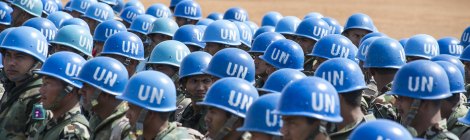
    Image of peacekeepers in Juba by UN Photo via Flickr.

    Africa was the first region where the R2P was meant to be applied.  It grew out of the idea of responsible sovereignty, first articulated by Francis Deng and others in 1996.  Responsible sovereignty suggested benefits to cooperation among states.  These benefits went beyond the avoidance of international conflict or the mere ‘tending to’ of sovereign fences.  Responsible sovereignty suggested sovereignty could imply joint action and joint benefits.  It grew into the idea of R2P.

    Nowhere has R2Ps reception been stronger than in Africa, having been well received by the African Union, the Economic Community of West African States, (ECOWAS), the Southern African Development Community (SADC), and a litany of African elites, including South Africa’s Thabo Mbeki, Nigeria’s Olusegun Obasanjo, Tanzania’s Salim Ahmed Salim, South Sudan’s Francis Deng, Ghana’s former UN Secretary-General Kofi Anan, and Algeria’s Mohamed Sahnoun.  Cases within the African context indicated its time had come: The UN Security Council validated ECOWAS’ interventions in Liberia (1990/92) and Sierra Leone (1997), offering praise in the face of its own inaction to these humanitarian crises.  R2P received the unanimous support of one hundred and seventy Heads of State in two provisions of the 2005 UN World Summit final document, presaging the incorporation of the doctrine by the African Union in its 2005 Ezulwini Consensus report.

    But nowhere has its implementation been more problematic than in the world’s newest country, South Sudan.  Sudan, and now South Sudan, have been beset by internecine violence over the last sixty years.  South Sudan teetered on implosion almost immediately after achieving statehood in July 2011.  South Sudan devolved into civil war in December 2013, when its President Salva Kiir Mayardit accused former Vice President Riek Machar of plotting against the regime.  An improbable rapprochement, fortified by an internationally mediated agreement, was signed in August 2015, resulting in Machar’s much delayed return to the capital, Juba in April 2016, and the formation of a most tenuous unity government, which collapsed in July in a wave of bloodshed and atrocity in Juba.  Kiir has now rejected a US proposal to insert the four thousand peacekeepers, claiming it is an attempt to turn South Sudan into a UN protectorate.

    Kiir and Machar’s mutual distrust until the most recent violence in July was outweighed only by a common need for more money to support their factions and a mutual interest in avoiding a personal accounting of atrocities allegedly committed by their respective factions.  Interpreted alternatively as an explanation or a threat to the international community, the two allegedly wrote on the Op Ed page of the New York Times in June 2016 that any disciplinary justice meted out “even under international law” would destabilize unity efforts.  Translation:  If you try to bring us to justice, we will bring back war.  They invoked the name of the international community, calling on it to back their non-punitive plan for a mediated reconciliation.   Four days after publication, the New York Times appended an Editor’s Note to the South Sudan leaders’ world-wide call for reconciliation; Machar had disavowed the Op Ed piece, claiming his views had been fabricated. But not completely.  One month later, he and Kiir brought back bloodshed.

    The episode highlights the complexities facing South Sudan.  If the international community is to facilitate a solution to the ongoing crisis, only cosmetically concealed by an unravelling claim of unity, the fundamental normative problem of R2P must be addressed:  where in the international community does R2P reside?

    Transmuting the international community’s abstract but coercive cause of action to prevent domestic abuse into something other than high-minded rhetoric requires either a fully functioning UN Security Council or another agency with the legitimacy and authority to pierce sovereignty’s veil.  The UN Charter system created a jus ad bellum regime that placed monopoly power over all uses and threats of force (except in cases of self-defense) in the hands of the Security Council.  But that authority is often addled by inaction due to the veto-wielding interests of the big powers, exposing the fundamental weakness of the UN system and provoking the elusive international legal and political pursuit for a better or supplementary normative solution.

    Internationalists have wrestled with the poor choice between supporting the legality of the Charter system, which often stood silent in the face of atrocity, or supporting the legitimacy of humanitarian intervention, which only problematized consideration of hidden agendas pertaining to regime change, remedial secession, and self-determination.  Establishing the international community as the ex ante entity vested with such a remedial power came as something of a surprise, and, after fifteen years of ontological development, remains in dispute.  In theoretical terms, R2P marked a return to and modern expression of Christian Wolff’s eighteenth century Republican idea of the civitas maxima (a ‘grand republic’ of nations), the meta-expression of community virtue that upholds the common good, secures the pluralistic interests of the state, and protects the solidarist interests of humanity by presenting a means to prevent internal atrocity.  But even Wolff, who had no understanding of the modern state system as we know it, thought it could not function without a rector.

    Kiir and Machar embrace this much of Wolff’s eighteenth century mindset; they view the international community as a rhetorical trope that lacks a headmaster; they invoke its name to lend a fictive air of moral authority to their pieties on reconciliation, when they do not employ it as blackmail.  Much of the doctrinal disarray surrounding R2P’s non-appearance in South Sudan conforms to an uncertainty about the international community itself:  Is it an unwitting continuation of the mission civilisatrice – the persistently failed and resented attempt to make sub-Saharan Africa more European; does it embrace or dismiss African notions of community, which present a humanistic understanding different than contractarian models of liberal institutionalism (Ubuntu); is it an updated form of colonialism?  Perhaps it is an expression of Carl Schmitt’s Political Theology (1922), allowing its claimants the power to decide on the exceptions to legal rules.  Schmitt was wary of the keepers of humanity’s interests.  Paraphrasing Proudhon, he wrote:  whoever invokes humanity’s name wants to cheat.  Kiir and Machar would doubtless agree.

    Equally problematic has been locating the international community’s headmaster amid South Sudan’s turmoil.  Does the international community fundamentally reduce to a sanctions policy orchestrated by the US and its allies?  Should it claim a regional identity in the form of mediations sponsored by the Intergovernmental Authority for Development (IGAD) or IGAD-Plus (an amalgam of states associated with the African Union Peace and Security Council), or non-African agencies of the EU, the so-called Troika (US, UK, and Norway), or perhaps China?

    An Emergent Dark Side

    South Sudan’s misery teaches us something about the emergent dark side of R2P.  It reveals a heteronomous will of a fragmented international community, which, in South Sudan’s case finds expression in a variety of cross-cutting alliances.  Tensions exist within IGAD, certainly between Uganda and Sudan and possibly due to reports of Eritrean and Sudanese military support of South Sudanese opposition forces.  These tensions diminish IGAD’s mediation efforts and reputation as an honest broker.  Key sectors of South Sudan’s limited civil society (specifically Church leaders) are overlooked; an array of venues and sponsors compete for influence, contributing to complaints of forum-shopping, which allow Kiir and Machar to play components of the international community against each other.  The center of this unity government in South Sudan has not held; war is around the corner and famine is spreading.

    Conclusion

    Locating R2P within the international community would be daunting enough were questions of its authorization or operationalization in South Sudan settled matters of fact; but its non-appearance in the continuing misery of the country suggests the doctrine, fifteen years in the making, is neither thickly representative of historical process nor thinly embodied as an aspiration.  R2P, in the context of South Sudan, turns the international community into an ethical referent, a conceptual archetype that satisfies saints and sinners alike.

    Christopher Rossi has a Ph.D. in international relations from The Johns Hopkins University School of Advanced International Studies and an LL.M in public international law from the University of London.  He lectures on international law and relations at the University of Iowa College of Law.

  • A War Gone Badly Wrong – The War on Terror Ten Years On

    The atrocities in New York and Washington on 11 September 2001 led to protracted wars in Afghanistan and Iraq. Ten years after the attacks, this briefing assesses the consequences of the response from the United States and its coalition partners. It questions whether the response was either appropriate or wise and whether the results so far have been counterproductive and may indicate the need for a changed security paradigm.

    Such a fundamental rethink of the way western governments respond to insecurity must go beyond the current approach in which intelligence, counterinsurgency and counter-terrorism are all beginning to merge into a seamless web of a single security posture. Such a posture is likely to be no more successful than the policies adopted in 2001.

    The Context of 9/11

    Prior to the Bush administration being formed in January 2001, the Republican Party had become strongly influenced by neoconservative thinking, much of it embodied in the Project for the New American Century. This saw the United States playing a role of sustained world economic and political leadership in the unipolar world of the 21st Century. With the fall of the Soviet Union and with China embracing many elements of a mixed economy, the view from Washington was that free market democracy was the only way forward and that the United States had a duty to lead.

    After the election, the administration made a series of decisions that demonstrated that in foreign and defence matters there would be a strongly unilateral approach when this was considered in US interests. In the early months of 2001, it became clear that there would be no ratification of the Comprehensive Nuclear Test Ban Treaty, the United States would withdraw from the Anti-Ballistic Missile Treaty and there would be reduced support for strengthening the Biological Weapons Treaty. Caution over negotiations on preventing the weaponisation of space and establishing an International Criminal Court were evident, and, in a move that surprised many European governments, the US withdrew from the Kyoto Climate Change Protocols. By September of that year, the determination of the Bush administration to pursue the idea of a New American Century was clearly established, and there seemed little to hinder what was honestly seen as a noble aim that would benefit the world community.

    In such a context, the 9/11 attacks were particularly visceral in their impact and there was little doubt that the administration would respond with great vigour, including large-scale military action against the defined enemy of the al-Qaida movement and its Taliban hosts in Afghanistan. Those few analysts and organisations that counselled caution, including Oxford Research Group, received scant attention. Their view was that the 9/11 attacks should be seen as appalling examples of transnational criminality, the response being rooted in policing and international legal processes aimed at bringing to justice those behind the attacks. Furthermore, to see the attacks as requiring a major military response – a “war on terror” – would be assigning to the perpetrators precisely the attention that they sought, and would likely prove deeply counter-productive.

    Military Responses

    The initial intentions of the coalition military action in Afghanistan were to terminate the Taliban regime and destroy the core of the al-Qaida movement, with the Taliban leader, Mullah Omar, and the head of al-Qaida, Osama bin Laden, being key targets. While neither was killed nor captured during the successful termination of the Taliban regime, the early fall of that regime and the dispersal of al-Qaida meant that considerable success had been achieved by the end of 2001. In his first State of the Union address, in January 2002, President Bush was able to point to this success as proof of the rightness of US policy, and he went on to extend the war on terror to encompass an “Axis of Evil” of three states. These were Iraq, Iran and North Korea, with all three seen as sponsors of terrorism and seekers of weapons of mass destruction. In this address and in his graduation speech at the West Point Military Academy five months later, President Bush argued forcefully that the United States had the right to pre-empt future threats, with this even including further regime terminations.

    In March 2003, coalition operations to terminate the Saddam Hussein regime in Iraq commenced and the regime fell within three weeks. Once again, some independent analysts, including Oxford Research Group, warned of the dangers of enforced regime termination, and there was much public opposition in Europe, but the determination of the Bush administration, aided by support from some allies, notably the Blair government in Britain, ensured that the war would proceed. By 1 May 2003, the combination of the success in Afghanistan and the apparent military victory in Iraq meant that President Bush could deliver his “Mission Accomplished” speech on the flight deck of the USS Abraham Lincoln.

    War Aims

    By the middle of 2003, there were clear US policy aims in terms of the military action to respond to the 9/11 atrocities. These can be summarised as follows:

    • Maintain control in Afghanistan, including the development of two large military bases at Bagram and Kandahar.
    • Facilitate Afghanistan’s transition to a pro-western developing society while expecting most of the support for this to come from European allies.
    • Consolidate basing arrangements established during the Afghan War with Central Asian republics, ensuring a US military presence in a geo-strategically important region.
    • Continue counter-terror operations against the remnants of al-Qaida and similar movements.
    • Develop a long-term military presence in what would become a peaceful pro-Western Iraq, not least to limit Iranian influence in the region.
    • Ensure that the Coalition Provisional Authority in Iraq oversees the development of a free-market economy with wholesale privatisation of state assets, especially oil facilities, a flat-rate tax system and minimal financial regulation.

    Three elements of these aims deserve elaboration. One is that there was a confidence in Washington that the Afghan War was over, that the Taliban would not re-emerge and that European allies would bear the brunt of reconstruction and development. The second was the emphasis on creating a model free market society in Iraq, an ideological project that was seen as providing an example that would prove so successful that other states in the region would surely follow suit. The third, and possibly most important, was that by maintaining a substantial military presence in Iraq and Afghanistan and controlling the Persian Gulf and Arabian Sea through the US Navy’s Fifth Fleet, Iran would be thoroughly constrained. Given that Iran was seen as the most serious of all threats to US interests in the region, this would be a hugely positive outcome.

    The 9/11 attacks had a deep and persistent impact within the United States, and many of the subsequent actions, including regime termination in Iraq, could be presented as utterly necessary responses to the atrocities. The confidence of the administration in mid-2003 stemmed from the belief that the terrible setback for US security demonstrated by the attacks had been turned round. Indeed, the Middle East and South-West Asia were being made safe in a manner which would clearly get the New American Century back on track, an outcome that was sure to prove very positive for world security.

    Consequences

    Al-Qaida. For the first five years after 9/11, the loose affiliates clustered around the al-Qaida movement were actually far more active than in the five years before. As well as many incidents in Pakistan, Afghanistan and Iraq, the movement was involved in attacks in Istanbul, Jakarta, Bali, Sinai, Amman, Mombasa, Casablanca, Saudi Arabia, Yemen, northern Tunisia, Madrid and London. There were failed attempts at major attacks in France, Italy, the UK and the United States, and many of the actual attacks involved overseas US interests, especially hotels. The death of Osama bin Laden in May of this year was seen in the United States as marking the end of a long war, but there are still active paramilitary groups with regular attempts at attacks on western interests. Islamist paramilitaries based in Pakistan and Yemen are of particular concern, and the Mumbai attack nearly three years ago had a profound effect on Indian perceptions of security. Groups linked loosely to the al-Qaida movement have been particularly active in Iraq in recent months, and the attack on the UN offices in the Nigerian capital, Abuja, by Boko Haram paramilitaries is an indication of the growth of yet another movement, as was the attack on the Algerian Military Academy at Cherchell in August.

    Iraq. Far from seeing Iraq make a transition to a peaceful pro-western state, the outcome was a bitter seven-year insurgency combined with persistent inter-communal violence. At times during the war coalition forces had close to 200,000 troops in the country with many thousands of private security contractors also deployed. While the violence lessened in 2009 and 2010, recent reports, in mid-2011, point to a deteriorating security environment, with increased losses among US troops and the likelihood that a substantial military presence will have to be maintained. Moreover, the war has left a potent legacy of large numbers of young paramilitaries with experience of insurgency in urban environments against well-trained and well-armed professional US troops.

    Afghanistan. By 2006, Taliban and other armed opposition groups (AOG) had re-emerged and established control of substantial parts of the country, leading to a steady increase in NATO forces from a base figure of around 30,000. By mid-2010, numbers had risen to 140,000, all but 40,000 being US troops. In spite of this massive surge in troops, Taliban and other AOG paramilitaries maintained control of substantial parts of the country and, when pushed back, turned to other tactics including assassinations of Afghan government officials and security personnel. The extensive use of Special Forces in night raids and of armed drones both in Afghanistan and Pakistan became tactics of choice for the US forces. While many paramilitaries were killed or captured, both tactics were deeply controversial, not least because of civilian deaths and injuries. With the 2012 re-election campaign approaching, the Obama administration declared a willingness to negotiate with Taliban and AOG elements in order to draw down force levels, but by mid-2011 it was far from clear that the opponents were serious about such engagement. Moreover, there were reports that some senior US military commanders were critical of troop withdrawals, fearing another Taliban resurgence.

    Iran. Perhaps the most significant aspect of the post-9/11 wars has been the increased influence of Iran. Far from being constrained by US actions in Afghanistan and Iraq, the problems that arose in both countries have meant that Iran has more freedom to exert influence. While this is noticeable in western Afghanistan it is far more prominent in Iraq where the Shi’a majority has sought close links with Tehran. It is not a case of Iran dominating Iraqi politics since nationalist and other attitudes limit that. What is clear, though, is that the current Iraqi government is happy to maintain substantial economic and political relations with Iran and is almost certain to continue to do so in the coming years.

    Costs of War

    In addition to these outcomes – wholly unexpected by the wars’ architects – there is the issue of the direct human and economic costs of the wars. In mid-2011, the Eisenhower Research Project at Brown University in the United States published an assessment of these aspects of the post 9/11 conflicts. Among its conclusions were the following:

    • The overall death toll, including civilians, uniformed personnel and contractors is 225,000.
    • If the long term care of thousands of maimed US personnel is included, the wars have so far cost between $3.2 and $4.0 trillion dollars. This includes the estimated $600 to $950 billion federal obligations to veterans, a cost rarely included in other analyses.
    • There have been 7.8 million refugees created among Iraqis, Afghans and Pakistanis.
    • The wars are being funded substantially by borrowing, with $185 billion in interest already paid and another $1 trillion likely by 2020 (Source: Brown University Press Notice, 29 June 2011).

    Conclusion

    This briefing has sought to compare the original war aims of the Bush administration in the aftermath of the 9/11 attack with the actual outcomes. Only by doing that is it possible to get a clear idea of the unexpected consequences in terms of the longevity of the conflicts, the human costs, the financial implications and the political developments.

    While the original war aims may be explainable, given the horror of the attacks and the attitudes of the Bush administration, the unexpected consequences of the decisions taken have been remarkable.

    A brief war in Afghanistan is shortly to enter its second decade, seven years of war in Iraq have yet to bring a lasting peace, and Pakistan remains deeply unstable. Meanwhile, groups linked loosely with the al-Qaida movement make progress in Yemen, Nigeria, Algeria and the Horn of Africa.

    Unless a comprehensive assessment of the wars is made, along the lines of this brief review but in much greater depth, it is not at all clear that lessons will be learnt in a manner likely to increase caution in responding too readily and rapidly to difficult circumstances in the future with military force.

    It has become increasingly clear over the last decade that the United States and its partners must learn from the evident failure of the “war on terror” by paying more attention to the underlying causes of the conflicts, especially the factors motivating young paramilitaries to take extreme action.

    Such a shift in thinking about global security should lead to efforts to avert “revolts from the margins” amid a divided and ecologically constrained world at the root: via emancipatory social-economic action, and making a transition to low-carbon economies and other forms of what is now known as ‘sustainable security.’ The anniversary of the 9/11 attacks provides an important opportunity to engage in exactly this kind of honest reflection and long-term thinking.

    At present, the outlook is somewhat bleak. The United States and its coalition allies have indeed started to learn from a decade’s failures; but the lessons they are drawing show them still to be rooted in a “control paradigm”: keeping the lid on conflicts (“liddism”) rather than preventing their emergence. The control paradigm still dominates, albeit in a slightly different form. Rather than a reliance on “boots on the ground” and troop “surges”, and the sustained use of air-power and precision-guided munitions, we are likely to witness a blurring of the roles between the military and agencies such as the CIA; an assumption of paramilitary roles by intelligence agencies; and a deployment of the military’s special forces in “taking out” threats whenever and wherever they arise.

    In the context of an increasingly fragile and uncertain world, and of a situation where radical groups and individuals from marginalised communities are capable of probing the innate weaknesses of advanced industrial states, these measures are seriously misconceived in terms of finding solutions to the problems western states are facing. This new way of attempting to “control” global insecurity, exemplified in the reaction to Osama bin Laden’s death, may initially prove popular. But so, once, were the wars in Afghanistan and Iraq. It is difficult to imagine that the newer type of “transnational” warfare will be any more successful than the failed policies of the last decade.

    Paul Rogers is Professor of Peace Studies at the University of Bradford and Global Security Consultant to Oxford Research Group (ORG). His international security monthly briefings are available from www.oxfordresearchgroup.org.uk, where visitors can sign-up to receive them via email each month with the ORG newsletter. These briefings are circulated free of charge for non-profit use, but please consider making a donation to ORG, if you are able to do so.

    Photo credit: Brian Boyd

  • Sustainable Security

  • A New Military Paradigm

    The interlocking relationship between the United States’s military-led strategy in its global conflict and the violent opposition to it from al-Qaida and related groups is a persistent theme of this series. This is again evident in a number of incidents at the start of 2011, in ways that reinforce the need for fresh ways of thinking about the endless war.

    The bombers who killed twenty-one worshippers and injured scores more at a Coptic church in Alexandria early on 1 January 2011 may not be directly connected to the al-Qaida movement. But there is evidence that they, like individuals and small groups responsible for comparable attacks elsewhere, do justify their actions by invoking the enduring narrative – strongly articulated by al-Qaida – that Islam is under siege from the west.

    The most potent reference-point and driver of support today for actions such as the assault in Egypt are the United States-led wars in Afghanistan and Pakistan. The reverberations of those wars (as with the one in Iraq) are felt across the Muslim world, and decisions taken in Washington about the way they are conducted also become part of the calculations of those in other regions of “greater west Asia” and beyond.

    It is becoming ever clearer that the US military is intent on intensifying the “AfPak” wars. It is less obvious whether the core purpose is to negotiate a withdrawal from a position of strength or to demonstrate the military’s capacity to defeat the Taliban outright – but the effect is the same, a more violent campaign in which night-raids and drone-attacks are increasing.

    In Pakistan itself, the assassination on 4 January of the governor of Punjab, Salmaan Taseer, by one of his own security guards highlights the deep tensions in that country. In northern Mali and elsewhere in the Sahel, the authorities are struggling to contain al-Qaida’s influence. Somalia and Yemen are riven by deep insecurities, and the intelligence agencies in western states are in overdrive to counter threatened attacks.

    These incidents and trends suggest that – as the tenth anniversary of 9/11 approaches – the focus on military solutions to the global conflict is exhausted, and the need for different ways forward is urgent.

    A Different Mindset

    A most significant contribution in this respect is a joint study by the LSE professor (and openDemocracy’s human-security consultant) Mary Kaldor and the United States army colonel Shannon D Beebe: The Ultimate Weapon is No Weapon: Human Security and the New Rules of War and Peace (Public Affairs, 2010).

    The authors cite a remark made by Condoleezza Rice (then George W Bush’s advisor on national security) a year before 9/11 which emphasised the need for the military to concentrate on winning wars in the traditional manner, rather than engage in peacebuilding. That the latter is not “proper soldiering” was encapsulated in Rice’s memorable phrase: “We don’t need to have the 82nd Airborne escorting kids to kindergarten”.

    Shannon D Beebe and Mary Kaldor use multiple experiences drawn from the two post-war decades to argue that this kind of neo-realist attitude to security is obsolete and must be replaced by a more human-centred approach. In building a strong case for conflict-prevention, they argue that military structures and mindsets have to change radically; this will entail being prepared to engage fully in human security – and, yes, that could well mean “escorting kids to kindergarten”.

    A graphic illustration of their approach relates to the cost of the latest US strike-aircraft, the F-22 Raptor.The cost of developing this, the world’s most advanced warplane, and of manufacturing just 183 models, is nearly $70 billion. By contrast, expenditure on global peacekeeping amounts to barely 0.55% of the US defence budget – and a fraction of what this single weapon-system costs. Yet almost all the emphasis in current approaches to international security, especially within Nato in general and the US in particular, is on military power.

    What makes the Beebe-Kaldor analysis of particular interest is that it moves beyond the familiar (civilian-orientated) soft-power vs (military-focused) hard-power division. Instead, they make the case that modern-day conflicts rarely conform to traditional state-on-state models but tend to be variable and complex. Thus the military has to transform itself to cope with this reality by developing a mindset concentrated less on “winning” against an opponent and much more on human security. In turn this requires necessary adjustments in civilian engagement in peacebuilding, and integration of these elements into altogether different approaches.

    A Text for the Times

    A possible reaction is to see this analysis as a recipe for western military intervention to secure hegemonic policy objectives. The authors acknowledge the risk, but insist that the dominant security paradigm remains so stuck in the cold-war era that a radical reappraisal of current attitudes is essential.

    Shannon D Beebe and Mary Kaldor conclude:

    “The strategic Cold War algebra of counting planes and tanks and ascertaining military budgets must be swapped for a discrete calculus based on the conditions underlying instability, in which there is no smart bomb or bomber that will offer a solution, and no room to squabble over traditional roles. There is no ultimate weapon of war in twentieth-century terms that will defeat the hybrid threats of the future. The ultimate weapons of the twenty-first century are, in fact, not weapons in the military sense at all.”

    A near-certain prospect for the still-young century is that a dangerous conflation of socio-economic divisions and environmental constraints will trigger fragility, instability and conflict. To understand what is happening and to provide solutions, there is an urgent need for the kind of analysis that The Ultimate Weapon is No Weapon provides. If prophecy is indeed “suggesting the possible” then this book is a much-needed example.


    This article originally appeared on openDemocracy where Professor Paul Rogers writes a regular column on global security.  

  • Sustainable Security

  • Sustainable Security

    ‘Petropolitics’ and the price of freedom

    “As the price of oil goes down, the pace of freedom goes up… As the price of oil goes up, the pace of freedom goes down…” So says New York Times columnist Thomas Friedman, who argues that the first law of ‘petropolitics’ is that the price of oil and the pace of freedom are inversely correlated in countries “totally dependent on oil” for economic growth. However, the correlation between recent oil price spikes and anti-authoritarian action – particularly in the Arab Spring – challenges this assessment. But if this pattern of change is to continue, Western states must curb their hypocritical dependence on authoritarian oil-exporting governments by developing more sustainable sources of energy.

    Read Article →

  • Sustainable Security

    Africa is often presented as a war-ridden continent, but this depiction is becoming outdated. In the 21st century, the amount of warfare in Africa has declined dramatically, and today most Africans are more secure than ever.

    “Africa” and “conflict” are words all too often linked in Western minds. From Cold War proxy wars, to what Robert Kaplan saw as “the coming anarchy”  in the 1990s, to Boko Haram massacres today, news from Africa may seem dominated by never-ending conflict. That image is out of date. In 2002 Tony Blair was justified in describing the state of Africa as a “scar on the conscience of humanity”, but in the years since there has been an underappreciated success story in Africa. The amount of warfare in Africa has declined dramatically, and today most Africans are more secure than ever. Troubled areas remain, unfortunately, but the larger picture of receding conflict has implications for how we think about African security needs. Outside actors can help reinforce positive external and internal trends that mitigate conflict, can avoid creating new conflict zones like Libya or South Sudan, and should recognize emerging human security needs that are becoming relatively more important as armed conflict declines.

    Africa’s waning wars

    Quietly over the last 15 years, many African wars did end, to paraphrase Scott Strauss. Lingering Cold War struggles like the Angolan civil war burned out. West African nations including Liberia and Sierra Leone ceased being playgrounds for warlords and regained their status as functional, if weak, states. Eastern Congo is still violent, but far less so than during the 1990s “African World War”. Overall, 21st century Africa has seen more wars end or abate than ignite.

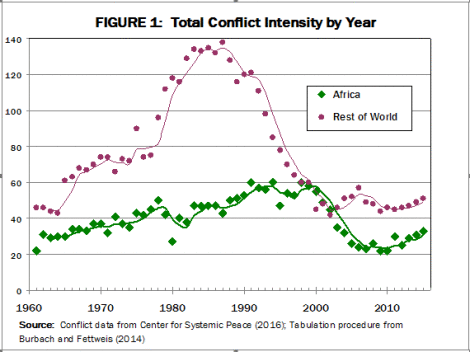
    The trend towards peace in Africa can be seen by using various datasets on armed conflict (for more on data sources, tabulation, and trend analysis, see Burbach and Fettweis 2014). The Center for Systemic Peace (CSP), for example, tracks conflicts from 1946 to the present, scoring each for the intensity of its societal impact. Figure 1 shows the yearly sum of conflict intensity assessed by CSP, for both Africa and the rest of the world. The end of the Cold War brought peace to much of the world, but African conflicts increased in the 1990s. States like Somalia and Sierra Leone collapsed into warlordism, for example. Central Africa was hit by the Rwanda genocide and bloody chaos in Eastern Congo, killing one to five million people.  At least three-fourths of the world’s total war deaths in the late 1990s took place in Africa (Burbach and Fettweis 2014, Figure 4).

    After the year 2000, the tide of war receded. Africa’s total conflict intensity as measured by CSP fell by approximately half. A similar pattern is shown by the Uppsala Conflict Data Project. Using somewhat different definitions, the Uppsala data shows that the number of conflicts in Africa resulting in 1,000 or more “battle deaths” per year declined from an average of 12 in the late 1990s to an average of 3.5 from 2010-2013. Some decades-long wars ended with formal peace accords, as with Angola in 2002; elsewhere, states gradually gained the upper hand on armed disorder. Given the unfortunate rise of warfare in the Middle East, Africa is no longer the most violent region of the world.

    africa-conflict-data

    The decline of warfare in Africa is even more dramatic in terms of individual risks. Africa’s population is growing rapidly, up 150% since 1980. Declining conflict despite a much larger population means the mortality risk from war has fallen substantially. An average of 32 people per 100,000 population were killed per year in the 1980s and 45 per 100,000 in the 1990s. In 2013, though the rate was only 8 per 100,000 (Burbach & Fettweis 2014, Figure 5). World Health Organization data shows an astonishing 95% decline in African conflict deaths from 2000 to 2012. In the 1980s, warfare killed more Africans than vehicle accidents. Today, perhaps three to six times as many Africans die in road crashes than from conflict. Many more Africans are harmed by crime or domestic violence than by warfare. Africa is still afflicted by more conflict than most ofthe world and the suffering of those involved is very real. Nevertheless, a greater proportion of Africans live free of war today than ever in the post-independence period.

    Celebrating African peace may seem premature given the civil war in South Sudan or the ravages of Boko Haram. Conflict has increased since 2011, but the level of armed conflict still remains lower than any time from 1970 – 2000. The most tragic development is the civil war in South Sudan, which the U.N. estimated had killed 50,000 as of spring 2016. Fortunately, South Sudan’s case is nearly unique: a newly created nation, devoid of physical or administrative infrastructure, with ethnically divided, soon-to-be-unemployed armed factions eyeing the lucrative oil revenues awaiting whomever could seize power. As academic panelists noted in 2011 – two years before the civil war –  predictors of conflict were flashing red in South Sudan. Few African countries contain such a combustible mix of problems anymore.

    Accounting for the decline

    Image by UN Photo via Flickr.

    Image by UN Photo via Flickr.

    There are several factors behind the ebbing of conflict in Africa. One important change is the geopolitical environment. During the Cold War, the U.S. and the Soviets armed and funded rival factions in civil wars, allowing bloody wars to fester for decades in countries like Angola, Mozambique, and Ethiopia. Then, 1990s Africa fell into turmoil as superpower-sponsored regimes collapsed. A disinterested world mostly left Africa to its fate, but continued trade in weapons and resources with warlords. In the last decade, however, the U.S., Europe, and China have all become more active in diplomacy, security assistance, and peacekeeping. The US and China are together pressing the South Sudanese factions to stop fighting, rather than choosing sides. The world has become somewhat less willing to sell arms or purchase minerals that directly fuel conflicts, admittedly with a long way to go.

    Africans themselves deserve great credit for ending the wars that plagued their continent.  Economic growth, improvements in governance, and greater space for peaceful political participation have all made state failure and internal conflict less likely. As Paul Collier among others has noted, civil wars tend to create vicious cycles that spread insecurity to whole regions. Many regions of Africa have climbed out of the conflict trap; political, security, and economic improvements are reinforcing each other. The nations of Africa increasingly work together through the institutions of the African Union to head off or resolve conflict, and to deploy peacekeepers to conflict zones. Needs still outpace available resources, but that cooperation is a marked change from 20th century Africa.

    A peaceful future?

    Whether the trend towards peace continues depends foremost on Africa’s leaders, but external actors can encourage positive trends in African security. Most directly, partners can help the AU and its member nations improve peacekeeping and conflict resolution capabilities. Likewise, the world should continue arms embargoes against combatants and regulating trade in valuable resources where exploitation appears to be a key ingredient of protracted conflict. Ongoing encouragement and incentives for democratization and governmental reform are helpful. Western countries should consider, however, that broad efforts like anticorruption programs are probably more helpful than International Criminal Court indictments of individual leaders, which can generate nationalist backlash.

    The world should especially try not to create new ground for conflict. Libya and South Sudan are Africa’s worst conflict zones today. Both were birthed through Western action – the removal by force of the Qaddafi regime, and diplomatically sponsoring South Sudan’s independence from Khartoum. While the moral cases were sound, both countries were left with non-existent governments, antagonistic armed factions, and grossly inadequate provision for disarming, demobilizing, and re-integrating fighters. American and European governments focused more on freeing people from hated regimes than on answering – let alone resourcing – the “what next?” question. Chaos followed, just as many African governments had warned at the time.

    From a humanitarian perspective, advocates should consider whether other challenges in Africa deserve relatively more attention. For example, Fearon and Hoeffler suggest that domestic violence against women and children now imposes larger human costs than warfare, and also that domestic violence can be reduced more cost-effectively than armed conflict. The ballooning toll of vehicle accident deaths in Africa may represent an opportunity for international technical or educational assistance to pay off with many saved lives. Beyond road safety, Africa is rapidly urbanizing.  Western visions of menacing rebels waving AK-47s in the bush privilege the exotic, but most Africans confront more prosaic threats to health and safety. The human security challenges Africans confront are increasingly those of city-dwellers:  crime, sanitation and utilities, safe and reliable transport, etc. Better policing, regularized urban housing, and expansion of infrastructure in megacities like Lagos and Kinshasa ought to be top priorities.

    Conclusion

    Sixteen years ago The Economist magazine suggested Africa was a “hopeless continent”. Lately The Economist has been bullish on Africa, citing the decline in warfare as a key reason for the continent’s improving business prospects. With remarkable speed, in the 21st century African conflict declined and safety improved, a hugely positive change in the welfare of Africans. Africa’s international friends should ensure their priorities respond to contemporary human security challenges, not ghosts of the past – and certainly they should avoid making things worse. Recognition of Africa’s progress itself would be a boon:  the continent’s increasingly out-of-date image as an undifferentiated war-torn anarchy retards investment and engagement from overseas. The tragedies of the moment deserve action, but we should not overlook that there is also much good news out of Africa.

    David T. Burbach is an Associate Professor of National Security Affairs at the Naval War College in Newport, RI.   Dr. Burbach received a Ph.D in Political Science from the Massachusetts Institute of Technology, and has expertise in African security, defense planning, and U.S. foreign policy.   The views expressed in this article are personal and do not represent official positions of the U.S. Navy.

  • Climate conflict: how global warming threatens security and what to do about it

    Climate change has been a key factor in the rise and fall of societies and states from prehistory to the recent fighting in the Sudanese state of Darfur. It drives instability, conflict and collapse, but also expansion and reorganisation. The ways cultures have met the climate challenge provide object lessons for how the modern world can handle the new security threats posed by unprecedented global warming.

    Combining historical precedents with current thinking on state stability, internal conflict and state failure suggests that overcoming cultural, social, political and economic barriers to successful adaptation to a changing climate is the most important factor in avoiding instability in a warming world. The countries which will face increased risk are not necessarily the most fragile, nor those which will suffer the greatest physical effects of climate change.

    The global security threat posed by fragile and failing states is well known. It is in the interest of the world’s more affluent countries to take measures both to reduce the degree of global warming and climate change and to cushion the impact in those parts of the world where climate change will increase that threat. Neither course of action will be cheap, but inaction will be costlier. Providing the right kind of assistance to the people and places it is most needed is one way of reducing the cost, and understanding how and why different societies respond to climate change is one way of making that possible. 


    ‘Dr Mazo authoritatively tackles a much overlooked, yet pivotal dimension of the broader climate change debate – the security implications of evolving climate trends. He makes a strong case, anchored in both contemporary developments and historical analysis, that climate change can serve as a “threat multiplier”, contributing to instability, exacerbating conflicts and complicating foreign-policy decision-making. This book is a must read for foreign-policy professionals.’

    Ambassador Paula J. Dobriansky, former US Under Secretary of State for Global Affairs

    Available here.

  • Sustainable Security

    The French Front National is now one of the most successful political protest forces in Western Europe. The party is preparing to participate in the April 2017 Presidential election where the migrant crisis and the capacity of the government to provide security from terrorist attacks will be pressing issues.

    According to some scholars, such as Cas Mudde, the French Front National (FN) now appears to be one of the most successful populist radical right parties in Western Europe. Since the mid-1980s, the FN has established itself as a permanent force in French politics. Nowadays, the party appears to offer strength in a climate where European security appears weak and vulnerable. Flourishing in a France characterized by strong concerns about the migrant/refuges crisis and recent terrorist attacks by Islamic extremists, the party is currently placed in a European ideological space of extreme right protest, often dominated by racism and xenophobia. The FN supports a concept of “Europe of Nations” and protectionism. These ideas have been encouraged by the recent winning of the “leave” campaign in the UK referendum and the Donald Trump’s rise in the USA. What are the origins of the FN, its current strategies and its role in the contemporary political landscape (at national and supranational level)?

    From Jean-Marie to Marine: a family party

    meeting_1er_mai_2012_front_national_paris_46

    Image credit: Blandine Le Cain/Wikimedia Commons.

    Since Marine Le Pen took over party leadership from her father in 2011, the FN has entered a new stage of its political development, which demonstrates its adaptability and an ability to survive its founding leader: Jean-Marie Le Pen. However, the party has an even longer history in French politics. It was founded in 1972 from a small neo-fascist organization, Ordre Nouveau, as an electoral umbrella for nationalist groups to run in the 1973 legislative elections. The FN remained electorally irrelevant during the first decade of its starting phase. Its turning point was the 1984 European elections where it obtained about 11% of the vote. From the mid-1980s, the party maintained a sort of electoral stability (between 11 and 15% of electoral support). Since 1984, the FN has also fielded candidates in all local and regional elections, winning representation in regional, departmental and municipal councils, as well as in the European Parliament.

    The change of leader in 2011 reinforced the party’s electoral appeal: the FN under Marine Le Pen has enlarged its base of support, reaching new heights in the 2012 Presidential election with about 18% of the vote. The FN also topped the 2014 European election winning a quarter of the national vote and 24 seats, which allowed Marine Le Pen to establish leadership over the pan-European nationalist right. Success at the national level has been corroborated locally. In the 2014 municipal election, the party won 11 municipal councils and 1,544 councillors, outperforming its previous record (1995). The departmental elections of March 2015 showed another surge in FN support at 25% of the vote, with 62 local councillors. In 2015 again (December) the party participated in the regional elections and it obtained a new record. In particular in two regions (Provence-Alpes-Côte d’Azur and Nord-Pas-de-Calais-Picardie) the FN arrived at 40% of the vote during the first round of elections.

    Under Marine Le Pen’s leadership, party change has been embedded in the concept of “de-demonization” (dédiabolisation). As Gilles Ivaldi suggests, de-demonization is primarily characterized by the attempt to detoxify the party’s extremist reputation, while simultaneously preserving its populist radical right potential for voter mobilization. The current FN seeks to improve its credibility through party modernization and professionalization. Whilst the 2011 leadership election represented a first notable step towards greater intra party democracy, there is little evidence of a more substantial move towards a party “normalization”, neither ideologically nor organizationally. Instead, the party has taken a process of “Marinization” (personalization) whereby Marine Le Pen has successfully replaced her father as charismatic leader, both inside and outside the party.

    The 2011 congress represented probably the most important change in the French Front National organizational path, with Marine Le Pen taking over the party. Following Jean-Marie Le Pen’s decision to step down, the party had initiated an internal leadership campaign. During the same campaign against Bruno Gollnisch, Marine Le Pen had indicated that she would turn the party into a professionalized and more effective party organization: “I want to create a renewed, opened and well-functioning party”, she said. In 2011, the FN had experienced its first change of leader since 1972, together with a new executive team and a new logo. The “new” FN has pushed an agenda, which aims primarily to shed its extreme right profile and to achieve agency credibility.

    A “Europe of Nations”

    The FN articulates a strong populist anti-establishment agenda. It opposes European integration, exemplifying the “hard Euro-scepticism” defined by Aleks Szczerbiak and Paul Taggart as “a principled opposition to the EU and European integration”. Its opposition to Europe concerns a wide range of institutional, economic and national identity issues. The FN’s concept of a “Europe of Nations”, argues that institutional cooperation should only take place between sovereign nation-states, opposes the EU as a supranational entity, and criticizes the EU as elitist and bureaucratic. A pledge for a return of competences and powers to the national level has been central to the FN electoral platforms since the early 1990s. The 2014 FN ’s programme featured primarily the promise to shed the Euro which was portrayed as “ a jail” serving the “sole interests of bankers and the wealthy”, and from which the French people “should free themselves”.

    The FN’s distrust of European integration revolves around immigration and issues of national identity, and it is often linked with welfare-chauvinist positions. The FN’s hostility towards the EU is underpinned by the party’s traditional ethno-nationalist policies. As Mudde suggests, the FN’s anti-EU positions are incorporated into a typical populist radical right agenda, which combines nativism, authoritarianism and anti-establishment populism.

    The party is notorious for its politicization of immigration issues. During the 1980s, Jean Marie Le Pen laid out the basis for a potent ethno-nationalist and welfare-chauvinist “master frame”, which later diffused throughout Europe. In 2014, the European campaign by the FN was marked by the continuation of xenophobia and welfare-chauvinism, showing no significant departure from the party’s traditional ethno-nationalist ideology.

    The FN committed to “defending, in all circumstances, France’s values, identity, traditions and way of life” against what would be stigmatized as a “sieve Europe”. The party’s 2014 platform lashed out at the Schengen agreement, campaigning on withdrawal, and claiming that the FN would close France’s borders to “stop uncontrolled immigration and put an end to the free movement of Roma and delinquents across Europe”. In line with its 2012 manifesto, the FN proposedpolicies, which would remove the possibility within French law to regularize illegal migrants. The party’s 2012 presidential platform featured a range of nativist policies, including the FN’s traditional “national preference” scheme, which seeks to give priority to the French people over foreigners in welfare, jobs and housing.

    A product of France’s political system and climate?

    French political parties are characterized by their instability, organizational weakness and fragmentation. As one of the oldest parties in France, FN has shown greater signs of stability over time. Since 1972, it has experienced only one change at the top and it has retained its name. The Parti Socialiste (PS – Socialist Party), currently the most important centre-left party in France, underwent important organizational changes since 1971 as it opened itself to other political forces. Parties of the right exhibit an even greater degree of volatility over time. In 2002, the loose electoral alliances of the 1980s and the 1990s between the Gaullists and the Centre-Right gave way to organizational merger with the creation of the Union pour un Mouvement Populaire (UMP – Union for a Popular Rally), which was an attempt by the centre-right to consolidate its identity.

    In 2007, the new president of the UMP, Nicolas Sarkozy, was elected in the presidential election. In 2011, however, disgruntled liberals and Christian Democrats left the UMP to form an independent party, the Union des démocrates et indépendants (UDI). Following Sarkozy’s defeat in 2012, the UMP entered a period of high ideological, leadership and strategic factionalism. In November 2014, Sarkozy returned to the UMP and won the leadership election with a large internal consensus. He pushed important changes to the party statutes, including a renaming of the party to Les Républicains (The Republicans). Recently, the party reorganized itself around a new right-wing leader, François Fillon, who became the Presidential candidate in view of 2017 appointment and after a victory during an open primary election.

    The same event has generated a new political and social weakness in France, also fuelled by the election of Donald Trump as US president in November 2016. In current context, France is faced with another crucial battle between populist radical right and establishment (right again) forces. The unexpected victory of Fillon in the Republican primary, Socialist President François Hollande’s decision not to run again, may be complicating Le Pen’s efforts to turn her political success into an electoral victory in the two rounds of voting scheduled for April 23 and May 7, 2017. In fact, there are themes, such as Islam, insecurity and immigration, with which the FN is able to rule the debate in general and worry public opinion.

    The FN has been able to aquire a new agenda, a sort of “cultural hegemony”, a “vocabulary” even more used also by other traditional party from the centre-right area. France remains, therefore, pervaded by a strong wave of right-wing extremism. In this changed and menacing context, the FN maintains a high appeal and it is ready to prepare its battle in the 2017 Presidential election and probably it is going to reinforce its campaign and its strategies. In any case, it has become (and  remained) a constant presence in the French political system.

    Maria Elisabetta Lanzone, PhD, is Research Fellow and Teaching Assistant at University of Genoa (Italy). She is expert in comparative populism, Euro-scepticism and migration policies. She is the author, with Gilles Ivaldi, of the book chapter From Jean-Marie to Marine Le Pen: Organizational Change and Adaptation in the French Front National (2016, Palgrave Macmillan). From April 2015 she is also member of the ERMES Laboratory at University of Nice-Sophia Antipolis (France).

  • Sustainable Security

    Authors’ Note: The opinions expressed by the writers are theirs alone and not necessarily those of the United States government or any of its departments.

    As a response to the attacks by violent extremists around the world, policymakers have invested considerable effort into comprehending terrorists’ use of the Internet and initiating counter-measures.

    The internet is undeniably an important factor in understanding the radicalization trajectories of many violent extremists. A senior official at the U.S. Department of Homeland Security recently observed that extremists’ “deft use of Internet propaganda, together with that content’s wide availability, has broadened the population of potentially vulnerable individuals, and shortened the timespan of their recruitment.” Supporting this statement, terrorism expert Magnus Ranstorp lists social media as one of nine factors that may exacerbate causes of an individual’s radicalization, including individual and social factors as well as cultural and ideological motivators.

    Research has also shown that the internet facilitates both early engagement with violent ideologies and opportunities for learning and sharing criminal information. For instance, a study by the University of Maryland’s START terrorism consortium found that “the internet played a primary or contributing role in the radicalization of 86%” in the cases of over 200 U.S.-based foreign fighters. These individuals used the internet to “view extremist materials, research conflicts, groups and attack methods, and participated in online communities of like-minded individuals.” Moreover, results from the same dataset show that the internet “may be speeding up the radicalization timeframe” as compared to radicalization before the advent of the internet. Similar findings from a study of over 200 terrorist offenders in the United Kingdom found that 54% of the perpetrators used the internet to learn about their intended criminal activities and, in 44% of the cases, extremist media (e.g., videos, audio lectures and photographs) were found, viewed, or downloaded by the perpetrators.

    The authors of the UK study, however, recognize that terrorists’ use of the internet “is perhaps unsurprising given the ubiquity of Internet usage in the most benevolent activities across wider society.” Indeed, a good deal of research has examined terrorists’ expansive use of the internet, such as the terrorist organization known as the Islamic State of Iraq and Syria (ISIS) to build a network of ideological conformity through social media platforms like Twitter. A report from the Institute for Strategic Dialogue has shown not only how life under the Islamic State is romanticized through social media postings, but also how important digital connectivity can be to those in the field, describing young women in ISIS controlled territory who resort to “climbing pine trees to gain Internet reception.”

    Countering extremism online

    Image credit: Andres Eldh/Flickr.

    These studies shed light on the particular ways that terrorists use the internet and underscore the importance of law enforcement intervention into online criminal activities. However, an ongoing challenge for researchers and policymakers engaged in preventing and countering violent extremism (CVE) is how to proactively address the role of the internet and social media in the context of violent extremism before criminal activity has occurred. To respond to that challenge, two broad policy approaches have emerged.

    One approach advocates for online content removal and account suspension in order to reduce the supply of non-criminal but potentially extremist content. The European Commission recently instituted content-flagging mechanisms modelled after an initiative by the British government’s Counter Terrorism Internet Referral Unit. Outside of government, technology companies also have taken steps to remove terrorist content. In December 2016, social media companies announced their own cooperative efforts to use hashing techniques to quickly identify and take down extremist images and content that violate terms of service agreements. In their latest annual transparency report, Twitter suspended around 636,000 accounts between August 2015 and December 2016 for promoting extremist content.

    Research studies that have assessed whether content removal and account suspension efforts work to curb the propagation of violent extremist messages suggest promising outcomes. For instance, a report from the George Washington’s Program on Extremism found that “over time, individual users who repeatedly created new accounts after being suspended suffered devastating reductions in their followers.” While ISIS users quickly learn how to overcome account suspensions and restore some followers, the study suggests these actions to reestablish followers have only “limited benefits” once a suspension has occurred.

    Yet, as technology companies like Twitter, Microsoft, and Facebook become more effective at detecting extremist content with tools that recognize unique “fingerprints” of extremist content, terror groups have also become more agile in how they use the internet to facilitate their work. Terrorism researcher Audrey Alexander describes how attempts to limit terrorist content online have pushed extremists away from public platforms and to encrypted tools like WhatsApp, Telegram, and ProtonMail. Indeed, Telegram now “appears to be the top choice among both individual jihadists and official jihadist groups.” The covert nature of these platforms poses significant barriers to researchers and authorities seeking to understand, track, and measure the terrorist threat.

    Another method for combatting online violent extremist content suggests creating counter narratives to refute terrorist claims. The idea is to craft messages that will appeal to vulnerable individuals to persuade them that violence is not the answer.  To explore this approach, the U.S. government has sponsored an initiative along with support from Facebook that known as the Peer to Peer: Challenging Violent Extremism program to engage young people, who may be most vulnerable to violent extremist messages, to create credible counter message for their own peers. Since the program launched in 2015, over 5,000 students have taken part. The 2016 winning team from Rochester Institute of Technology developed an awareness campaign called “Ex-Out Extremism” to “open people’s eyes” to violent extremism and to encourage them to take a stand against it. While initiatives like Peer to Peer typically reach broad audiences, foster educational engagement and increase public awareness, researchers have pointed out that continued work is needed to understand what can inoculate or prevent radical ideologies from taking root in the first place.

    A more targeted approach for reaching at-risk individuals online has been piloted at Jigsaw, Alphabet’s technology incubator focusing on geopolitical challenges, to redirect users from ISIS propaganda to curated YouTube videos that credibly debunk ISIS recruiting themes. Similarly, the Institute for Strategic Dialogue conducted a pilot study to direct individualized online intervention services to those demonstrating affinity to violent extremist groups through their online activities. The results found that intervention messages that reached at-risk individuals were “highly likely” to cause behavior change, either by prompting radicalizing individuals to change their privacy settings or to send direct messages to the intervenors for more engagement.  While these results are based on a very small sample, directed intervention programs may offer options for providing “off ramps” to individuals at critical points.

    The value of partnerships

    Whether intervening online to remove content and suspend accounts or developing credible counter messages or intervention options, effectively addressing violent extremism will require innovative partnerships inside and outside government.  To this end, in 2016 the United States government launched an interagency task force to address countering violent extremism with representation from both security and non-security agencies along with engagement from civil society groups.  While these multidisciplinary partnerships are challenging bureaucratically, they underscore the need for developing networked approaches to emerging security challenges. Similar cooperative agreements might span across national boundaries, not only for the purposes of information sharing between law enforcement officials, but also to include cooperation, such as the recent announcement by the Netherlands and Kenya to build a comprehensive partnership around a range of security related issues including deradicalization efforts.

    Although some have suggested that there is little evidence that terrorism prevention works, there is a small but growing literature providing support for the application of prevention science to the problem of violent extremism. Without question, more attention is needed for rigorous assessment of these programs, especially with regard to evaluating the effectiveness of online campaigns. To fill this gap, the RAND Corporation recently released an evaluation toolkit for countering violent extremism, which includes guidelines for assessing programs’ social media metrics. The London-based Royal United Services Institute has published a guide to CVE program design and evaluation, which provides guidance for articulating relevant impact measures. Ultimately, these resources, coupled with innovative public and private sector partnerships, will contribute to preventing radicalization to violence both online and offline.

    Tackling online radicalization will undoubtedly be a major security priority for policymakers in the future. Following the deadly May 22, 2017 bomb explosion in Manchester, leaders of the G7 convened in Taormina, Italy to reaffirm their efforts to counter terrorism and violent extremism.  In a statement, members underscored several areas for continued engagement, not only through traditional counterterrorism measures like “knowledge-sharing” and cutting off “sources and channels of terrorist financing,” but also through technology sector engagement “to substantially increase their efforts to address terrorist content” and well as civil society engagement to promote “alternative and positive narratives rooted in our common values.” The future war against online extremism may prove to be a long and difficult one, but it is a fight that must be won.   

    Dr. Susan Szmania has served in government and academic positions addressing violent extremism.  She is currently a senior research analyst at the U.S. Department of Homeland Security in the Office for Community Partnerships.  In this capacity, she leads the research and analysis line of effort on the U.S. government’s interagency Countering Violent Extremism Task Force.  Prior to this work, Dr. Szmania was a senior researcher at the University of Maryland’s National Consortium for the Study of Terrorism and Responses to Terrorism, and she served in government positions at U.S. Embassies in Sweden and Spain to implement programs to counter violent extremism. She received her Ph.D. in Communication Studies from the University of Texas at Austin in 2004.

    Matthew Conway has served in various research capacities focusing on conflict and extremism, both independently and with two London-based think-tanks. He is currently a research adviser for the Department of Homeland Security’s Office for Community Partnerships, where he focuses on Countering Violent Extremism research. He received his Master’s in Conflict, Security and Development from King’s College London in 2015 and his Bachelor’s in Political Science and International Studies from the University of Wisconsin-Madison in 2013.

  • Sustainable Security

    Closing Europe’s borders and politicizing the attempt to admit refugees at a time when the growing humanitarian crisis poses mounting human rights challenges to the international community is fundamentally wrongheaded. These approaches only strengthen the hand of Islamic State.

    While violent extremism, terrorism, and civil wars have drawn the most attention, coming to grips with the refugee crisis—emanating mainly from Syria’s civil war, but also more generally from the Middle East and North Africa’s political environment (MENA) in the aftermath of the 2011 Arab uprisings—has never been more essential. The Syrian crisis has propelled a wave of migrants to the neighboring countries of Jordan, Lebanon, Iraq, and Turkey. The Syrian refugee population stands at approximately 4.7 million, of whom 1.7 million live in Lebanon and Jordan and even more in Turkey. It is estimated that Turkey now hosts the world’s largest community of displaced Syrians.

    Defeating the Islamic State in Iraq and Syria (ISIS, also known as ISIL and by its Arabic acronym as Da’esh), while at the same time fulfilling the Responsibility to Protect (R2P) in the Syrian situation, has presented a complex challenge to the international community. The growing threat of ISIS as shown in attacks in Paris (2015) and Brussels (2016), magnified by the increased threat of individual terrorists—the so-called “lone wolves” in San Bernardino, the United States—has stemmed a wave of nationalist, right-wing alarm, reinforcing a general concern about the influx of immigrants and asylum seekers, while underlining the shift from a regional to the international nature of both threat and risk. These security issues have also illustrated the willingness of great powers to support military reactions to ISIS in order to stem the atrocities perpetrated by this group, while putting the departure of the Assad regime on the back burner—at least for now. For all intents and purposes, ISIS poses a much greater threat to Europe than does the current regime in Damascus.

    An Unavoidable Tradeoff

    freedom-house-refugee

    Image by Freedom House via Flickr.

    Confronting and dismantling ISIS need not be achieved by stigmatizing refugees and subjecting them to religious litmus tests. Closing Europe’s porous borders and politicizing the admission of refugees at a time when the growing humanitarian crisis poses mounting human rights challenges to the international community is fundamentally misguided. After all, fortifying European borders, while effective in the short term, strengthens the hands of ISIS and other terrorist groups that portray such policies and practices largely in terms of apocalyptic visions and arcane Islamic prophecies of great battles against Western imperialists.

    Defeating ISIS requires strategic endurance and long-term prudent political decision-making involving internal and external actors in the MENA region. While doing so, it is important to avoid the enemy’s repressive, atavistic, and brutal methods, eschewing certain tactics that could potentially play into ISIS’s hands. It is important to bear in mind that the tactics that terrorist groups like ISIS employ pose mostly political and ideological challenges to the West and that the real fight will be in defeating and destroying the claims and values that these groups assert.  In the end, defeating ISIS requires that its demonic ideology and tactics be confronted and exposed.

    Preventing further refugee crises in the future requires that fighting ISIS be at least temporarily prioritized over the overthrow of the Assad regime.  Seeking a political solution in conjunction with harnessing a multipronged strategy may in fact be among the most effective tools and processes of dealing with current humanitarian crises that the world faces. The possibility of working with the Russians and the Iranians in order to seek a political solution in Syria also raises questions about whether this tradeoff is justified. If the intent is to defeat ISIS, al-Qaeda, and the Levant Conquest Front (formerly known as al-Nusra Front), then this tradeoff is inevitable even as it buttresses the Assad regime in Syria for the foreseeable future. This solution is not problem-free or without significant challenges, however.

    Competing Views

    While the military actions against ISIS are warranted and can be coordinated by both inside and outside actors, the nature of such military missions and their consequences are also subject to further debate and negotiations. The inclusion of Russia and Iran, allies of Assad, in the fight against ISIS raises concerns that their stated goal of curbing ISIS is merely a pretext to prolonging Assad’s rule. Likewise, Turkish participation in air strikes in northern Syria in the war against ISIS has raised the possibility that Ankara will target the Kurds, who have successfully fought against ISIS since the beginning of the conflagration. Turkey’s interest in settling political scores with the Kurds, an interest that it believes is vital to its security, imperils whatever impartiality one might have hoped for in a fight solely against ISIS.

    The massive movement of migrants and refugees to Europe, coupled with the ISIS-led attacks on soft targets in Europe, has created a new urgency among Western leaders to fully confront this new global threat and seriously contemplate the possibility of cooperating with Russia in a coordinated effort. Compromises must at times be made when a multifaceted campaign that includes both countering ISIS and precipitating the removal of the Assad regime is waged. The collapse of the Assad regime would create a significant security void that ISIS and other terrorist groups could easily exploit.

    There is no denying the fact that the Paris, Brussels, and San Bernardino terrorist attacks have heightened the securitization of the refugee threats, as the Islamic State has been using the wave of the migrant influx to infiltrate Europe and North America. The number of terrorists hiding among the refugees is small. ISIS has exploited the flood of refugees to smuggle jihadis into Europe by distributing fake passports in Greek refugee camps to allow its terrorists to travel within Europe. On April 22, 2016, The Washington Post reported that more than three dozen suspected militants who had posed as migrants have been arrested or died while planning or carrying out acts of terrorism.  They included at least seven individuals who were directly linked to the bloody attacks in Paris and Brussels.

    But even a few of these will be highlighted by conservative circles in all Western countries to call for the repatriation or active policing of refugee communities.  Donald Trump Jr.’s notorious analogy between refugees and poisoned Skittles is a case in point. Conservatives rank the issue of terrorism much higher than do liberals in the West, the latter agreeing that one cannot stop all terrorism and that the chances of being caught in a terrorist attack are still quite small. Vigilance and the exclusion of possible threats by governments, however, is prioritized over the compassionate acceptance of refugees.

    The Flaws of the Current Refugee Regime

    The issue remains to be discussed within the core conception of the mandate of the United Nation High Commissioner for Refugees (UNHCR). Remaining at the center of the global refugee regime, UNHCR faces new challenges. Today, for example, most refugees tend to flee from violence and flagrant human rights violations—not necessarily from the threat of persecution, which is a key requirement according to the 1951 Refugee Convention.

    This has resulted in confusion and lack of clarity regarding who qualifies for refugee status and what are the rights to which all refugees are entitled— issues left up entirely to states to interpret. To compound matters further, in the case of Syrian refugee crisis, the neighboring countries of Lebanon, Jordan, and Iraq have never ratified the 1951 Refugee Convention. Now, more than ever, a robust and comprehensive discussion about the future of refugees, whose numbers will only increase with the worsening effects of climate change, is not only timely but necessary, given the tumultuous nature of international politics.

    It is important to bear in mind that refugees can be a destabilizing factor, especially when displaced, alienated, and bitter persons among them are recruited into armed extremist factions. Many studies have shown that the absence of a protective and enabling environment is likely to render more young people vulnerable to racist ideologies and movements and ease the process of their recruitment into the ranks of radical groups like the Islamic State or al-Qaeda. The traditional method of relying on purely humanitarian remedies has proven counterproductive in the face of new influxes of refugees. There is a need for a new thinking that envisions relief and humanitarian aid as fundamentally linked to the granting of work permits to the refugees. To dwell solely on the conventional method of humanitarian aid, and to ignore the importance of wage-earning employment for the refugees, is to wear blinders.

    Shifting Focus from Protection to Empowerment

    The focus of the 1951 refugee protection regime should shift to new ways of dealing with displaced persons that take into account the self-interested reasoning of host countries and the concerns of their citizens regarding competition over jobs. This shift will help to eliminate risks to refugees’ personal security by reducing human smuggling and trafficking by land and sea. Some experts, such as Alexander Betts and Paul Collier, have offered solutions along the line of creating “spaces of opportunity” for the refugees through “special economic zones” that provide jobs, training, and education.

    Helping refugees, I would argue, should begin with technical education and vocational training, coupled with a strategy focused on creating jobs immediately in economic zones from which both host societies and displaced Syrians can benefit. The need to work is inseparable from human security and thus crucial to preserving human dignity. The refugees’ right to legal employment makes good ethical and logical sense. Designing, for example, a vocational skills training program tailored to the needs of women refugees can significantly reduce the incidence of sexual trafficking and abuse. These projects offer a more plausible solution in the long term, not only because they will develop transferable skills that refugees can use in their countries of origin upon return, but also because they create monetary disincentives for refugees to emigrate to Europe in the first place.

    Dr. Mahmood Monshipouri is a professor of international relations at San Francisco State University and he is also a visiting professor at UC-Berkeley, teaching Middle Eastern Politics, and editor, most recently, of Information Politics, Protests, and Human Rights in the Digital Age (New York: Cambridge University Press, 2016).  For more on the perspectives provided here, see Mahmood Monshipouri, Claude Welch Jr., and Khashayar Nikazmrad, “Protecting Human Rights in the Era of Uncertainty: How Not to Lose the War against ISIS,” Journal of Human Rights Online version, July 28, 2016, available at <http://www.tandfonline.com/doi/pdf/10.1080/14754835.2016.1205477>.

  • Sustainable Security

  • Articles EXCLUSIVELY written for sustainablesecurity.org

    To browse a list of all of the articles EXCLUSIVELY written for sustainablesecurity.org – follow this link

  • South Sudan: Enhancing Grassroots Peacebuilding

    South Sudan’s referendum has come and gone. What lies ahead post-independence in terms of peace, development and security is however still to be determined. The 15 years of war left over one million people dead and more than three million displaced. Negotiations led to the Comprehensive Peace Agreement (CPA) in 2005, which included provision for a referendum on independence for the Southerners.  The referendum was held in January, with overwhelming support for succession. But serious challenges face South Sudan as it prepares for independence on 9 July 2011.

    The challenges facing a new nation

    A range of challenges are present themselves with this new nation attempting to stand on its own. Aside from the issues of governance and poor service delivery, the most serious is the seemingly unending internal conflicts. Hence, the government of the new South Sudan should consider:

    • Embracing pluralism by allowing political participation of the citizenry. To do otherwise could pave the way for more conflicts through insurgencies, militia activities, army defections, and latent grievances within the security sector.

    • Post-referendum negotiations between the Sudan People’s Liberation Movement (SPLM) and National Party Congress (NCP) should focus on ensuring a peaceful separation and a constructive North-South relationship based on mutual benefit from the oil resources, averting the ‘resource curse’.

    • South Sudan has to cooperate with its neighbours to overcome security threats by the Lord’s Resistance Army (LRA) and other militia, as well as cross border conflicts. The state of Western Equatoria is particularly suffering under rampaging LRA troops, displacing farmers, and potentially leading to a humanitarian crisis due to heightened food insecurity. Communities will increasingly turn to militia groups for protection if government security is absent.

    • At the national level, the significant role of opposition parties and civil society in the forthcoming transition needs to be acknowledged. There is thus a need for an inclusive constitutional review committee adhering to the agreements of the CPA.

    The gravity of violence needs further deliberate and integrated efforts. The 2010 Human Rights Report: South Sudan noted the abuses and internal conflicts South Sudan faces at independence. Inter-ethnic fighting, post-election militia attacks, cattle rustling, and LRA attacks, all resulted in deaths and displacement in the South since the referendum.

    Coupled with the violence, 2 million Internally Displace Persons (IDPs) and 350,000 refugees have returned to the South since 2005. Given the lessons learnt from the returnees of Liberia, there is a need to find ways of enhancing co-existence between host communities and returnees.

    What role can grassroots peacebuilding play here?

    Enhancing grassroots peacebuilding

    Grassroots peacebuilding encompasses efforts of enhancing localised structures and mechanisms of constructively responding to violence, aiding relief, and conflict transformation. This vital approach is the social fabric that builds durable peace. It is the people at the grassroots who have suffered most from the war, and continue to suffer through displacement, grief, trauma and day-to-day community clashes. Peace is a common good that we must promote and guard.

    March was characterised by community clashes in Mvolo between the Jur and the Dingas in Western Equatoria. Over 60 died and many more internally displaced. With a history of tribal clashes, cattle rustling, and growing insecurity, one would ask: what can be done at a grassroots level to enhance peacebuilding?

    Improving accountability of security forces

    One option for grassroots level work is the improvement of security forces. There are several cases where security forces were blamed for instigating or participating in violence. As illustrated by these incidents, it becomes imperative for a new country to respect the rights and rule of law. It is through the promotion and protection of human rights that peace among the people is enhanced across all sectors and levels.

    When looking at peacebuilding and security reforms in prior post-conflict zones, three lessons are obvious:

    • A lack of governance of the security sector is often a source of conflict and forms a key obstacle to peacebuilding.

    • Security institutions can play an effective, legitimate and democratically accountable role in society.

    • If law-breakers face prosecution and social disapproval, people will be discouraged from engaging in armed violence. This is underlined by the 2011 Word Development Report, with the call for citizen security and justice in order to break the cycle of violence. Indeed, there is need to improve accountability among the security forces and fostering restorative justice in South Sudan so as to prevent and manage a relapse into violence.

    Realise the role of religion

    A second option for grassroots engagement is to work with and through religious communities and structures. In many cases the Church seems to have greater leverage than almost anybody else in brokering peace talks between warring factions. The historical, cultural and traditional embeddedness of the Church has credibility and relevance to the community. It’s extensive network reaches even into the most remote areas. Further, the Church has an integration of social and pastoral work focusing on the psycho-social and spiritual dimension of conflict transformation, although the church is at times blamed for exlusionist tendencies. As an indicator for church influence, around 40% of the population of South Sudan regard themselves Catholics and 30% Anglicans.

    Quiet diplomacy

    A third grassroots option is quiet diplomacy. Influential civil society leaders, among them high profile religious leaders, have the potential of applying preventative diplomacy mechanisms in cooperation with the government.

    This back door approach is suggested because the state is still young. It is further backed up by the cultural background, suggesting that a leader should not be degraded in public. Instead of undermining transparency, this approach acknowledges the huge expectations of a new nation. Normal and open confrontation may be acceptable to the public, but may not bring about the desired democratic state.

    Conclusion and recommendations

    Grassroots peacebuilding has to be enhanced across South Sudan. This can be done through holding the security forces and leaders accountable; realising the essential (commending, condemning, correcting and coalescing) role of the Church, and the application of quiet diplomacy. It is hoped that localised and indigenous peacebuilding efforts can consolidate peace, stability, security and development. Therefore, I would like to make the  following recommendations:

    1. People, parties and civil society to:

      • strengthen women, youth, and community participation in peacebuilding;
      • empower local government structures;
      • invest in education and especially adult literacy;
      • adopt a comprehensive security framework of human security;
      • continue applying corrective and commending public figures through quiet diplomacy.
    2. The government of South Sudan to:

      • build supporting impartial partnerships towards grassroots peacebuilding;
      • enhance trauma healing across all sectors and levels of the country;
      • establish and empower local government structures so as to enhance accountability among county and state executives;
      • deploy security personnel, especially the police, to actively protect the citizenry from community clashes, militia attacks, and the LRA;
      • invest in education in every village;
      • retain and emphasise the rule of law across the country.
    3. The international community:

      • to support grassroots peacebuilding through partnerships;
      • to encourage and facilitate continued dialogue and cooperation between the governments of Sudan and South Sudan.
      • to build impartial supportive partnership with the people of South Sudan and its government, while drawing a clear line between the government and the SPLM.

    Article source: Insight on Conflict

    Image source: United Nations Photo

  • Sustainable Security

    One of the negative aspects of China’s increasing engagement with African states is the spread of small arms and/or light weapons especially in conflict zones and were opposition is violently suppressed. These weapons have undoubtably contributed to the enhancement of closer ties between China and authoritarian regimes and served as an instrument for consolidating its presence in the continent.

    China has developed an extensive presence in Africa through infrastructure such as airports, roads, hospitals,  convention centers,  media investment, agricultural  and health education, among many other  activities that seemingly put China in a good light.  At the same time many of China’s seemingly worthwhile activities by have not consolidated its ties to the African political elite and incumbent regimes as much as its arms sales to authoritarian regimes have.  Its positive contributions in the continent have been offset by the lure of the benefits that are associated with arms sales to African states despite their negative consequences in growing African states.

    Chinese small arms have been implicated in ethnic violence and war crimes in Sudan, South Sudan and the Democratic Republic of Congo (DRC) among others.  They have also been instrumental in the suppression of democratic progress in Zimbabwe, and at the same time expanding its influence and political economic ties with the authoritarian regime of President Robert Mugabe. China’s worldview which puts social and economic rights over individual liberties and political rights is often quick to supply weapons to authoritarian African states because it does not make human rights observance a condition for arms sales to any country. Incumbent African regimes that face severe threats to their survival are therefore quick to turn to China as a source of arms supply in the struggle to preserve their power.

    Apart from the lure of profits for China’s arms sales to Africa, there is also the added benefit of China finding employment opportunities for its skilled Chinese citizens. This contributes to spreading its technical and personnel   influence in the continent. At times, an arms supply relationship also involves establishing an arms factory in a recipient state that requires the expertise of skilled Chinese scientists, engineers, and industrial managers. Such a relationship for China leads to a long term business and security relationship with the African country. This is one reason why China’s influence in Sudan is so strong. However, what happens is that weapons that are sold by China or produced by China in Africa end up fueling and feeding the conflicts in countries such as the DRC, Sudan, South Sudan, and the Central African Republic, among others.  Regime survival or incumbent regime power consolidation efforts fuel arms transfers in South Sudan and Burundi. Chinese arms are often implicated in these conflicts because of China’s aggressive arms sales strategy w is based on the following:

    • A “catch all” customers strategy that has established an arms transfer or military relationship with several large  African states such as Egypt, Nigeria, Ethiopia, Zimbabwe, and South Africa, as well as smaller states like the Republic of Congo, Equatorial Guinea, Eritrea,  Burundi, and Sierra Leone, among others;
    • A favorable  financing strategy especially for African countries that cannot afford to buy sophisticated weapons and  afford to pay the market price for small or light weapons; and
    • China’s use of frequent and aggressive small arms marketing of its and more sophisticated military hardware at annual arms exhibits in various states within the continent. The wide array of Chinese arms enables China to sell weapons to both rich authoritarian African states as well as poorer smaller ones. The Chinese policy of placing no human rights or democracy conditions on arms sales as well its overall policy of non-interference in the politics of African states translates into the availability and affordability of Chinese arms in many African states.

    The bloody footprints of China’s arm sales in Africa

    Image credit: Lance Corporal Jad Sleiman/Wikimedia.

    It is not therefore surprising that arms from China have been implicated in the Ethiopian-Eritrean conflict in which China is known to have supplied arms to both sides in the conflict. It is also well documented that Chinese weapons were used in Sudan’s suppression of rebels in Darfur following a revolt in 2003 which led to a genocide against the region’s people.  It is alleged that the light weapons used in the massacres in eastern DRC were of Chinese origin. There, children as young as 11 years old were given weapons  by warlord Thomas Lubanga, and forced to participate in interethnic killings in the early 2000s. Furthermore, Chinese trained Congolese troops have been implicated on several occasions in ethnic killings of innocent civilians in the eastern DRC.  Similarly, in 2009 Chinese-trained Guinean Commando units were responsible for the killings of about 150 people during a protest against authoritarian and undemocratic rule in the country.

    According to the Stockholm International Peace Research Institute ( SIPRI) report of 2010, China was found to be the foremost exporter of arms to Africa. The Chinese Type 56 which is China’s version of the Russian Kalashnikov (AK47) assault rifle is much easier to use as a light weapon.  The argument could be made that in spite of China’s claim that it does not interfere in the internal affairs of other countries, the fact that it supplies weapons to warring factions within a sovereign nation is itself inherently interventionist by nature. Such interference produces consequences such as gross human rights violations, murder, rapes, tortures, and extra-judicial killings. China’s arms sales to Africa attract negative attention especially because they are made available to states like Sudan and Zimbabwe and the DRC, known for blatant human rights violations in Africa. This often means that China is reaping the profits of selling weapons to both incumbent regimes and rebel groups. The general outcome is the consolidation and expansion of its ties and presence in the continent.

    Looking forward: an unsustainable arrangement

    China’s propensity to spread small arms and light weapons (SALW) among African states will end up undermining whatever positive perception it has generated in the continent as well as taint its goals to support sustainable development and contribute to the national development goals of individual African states.  In particular,  it will cast doubt on its  willingness to support Millenium Development Goals, and other specific  development goals in the continent such as the Program for Infrastructure Development in Africa and similar such programs.

    So far, China’s military to military ties with African states has been a source of frustration for the United Nations.While it China contributes to peacekeeping efforts  in the continent, the United Nations does not know details of its military engagement, or specific  military ties,  with the countries in which its peacekeepers  are deployed such has the DRC, South Sudan, Liberia, Mali, among others. In other words, the expanding military ties with African states, and perhaps the access by rebels to Chinese arms are factors that are likely to undermine UN peacekeeping functions of disarmament of ex-combatants. It is difficult to know whether Chinese arms complement or undermine the efforts to enhance security in fragile African states. It is a question of whether China is willing to ensure that its military ties with countries of concern such as the DRC, Sudan, South Sudan, and Zimbabwe, complement peacekeeping activities there or help to promote peace, stability, democracy and development.

    Human rights organizations have often called attention to the destabilizing role that Chinese arms play in conflict zones in Africa. China so far seems determined to support and forge closer ties with authoritarian regimes in their goals of power consolidation, oppression of the opposition. China on the other hand is preoccupied with spreading its influence, consolidating its ties and deepening its engagement with every African state regardless of whether it is democratic or authoritarian. Accordingly, Chinese SALWs are supplied to both national armies in Africa as well as to rebel groups in the DRC, Chad and Uganda, and now the warring factions in South Sudan.

    China’s supply of arms to both rebels and national armies is often a violation of embargoes as well as a blatant case of economic self-interested behavior. The glimmer of hope in all this is that China has at times bowed to international pressure to cease supplying weapons in areas of gross human rights violations such as was the case with Darfur. But overall China still gives priority to concern over sovereignty and often defers  to incumbent regimes such that human rights  observance and non-proliferation of SALWs  are relegated a secondary role in China’s foreign policy rights towards Africa states.

    Earl Conteh-Morgan is Professor of International Studies in the School of Interdisciplinary Global Studies at the University of South Florida, Tampa, Florida. He is currently working on a book-length manuscript on Sino-African relations from a Political Economy Approach.

  • Global militarisation

    To browse a list of all of the articles EXCLUSIVELY written for sustainablesecurity.org – follow this link

    Read more »

  • Climate Change: Impact on Agriculture and Costs of Adaptation

    This Food Policy Report presents research results that quantify climate-change impacts, assess the consequences for food security and estimate the investments that would offset the negative consequences for human well-being.

    The analysis brings together, for the first time, detailed modeling of crop growth under climate change with insights from an extremely detailed global agriculture model, using two climate scenarios to simulate future climate. The results of the analysis suggest that agriculture and human well-being will be negatively affected by climate change.
     

    See front page article.

  • Marginalisation of the majority world

    “The climate agenda goes well beyond climate,” said Dan Smith, secretary general of International Alert at a recent Wilson Center event. “In the last 60 years, at least 40 percent of all interstate conflicts have had a link to natural resources” and those that do are also twice as likely to relapse in the five years following a peace agreement, said Neil Levine, director of the Office of Conflict Management and Mitigation at USAID.

    Article source: The New Security Beat

    Image source: DfID

    Read more »

  • Sustainable Security

    Countering Militarised Public Security in Latin America: Understanding the trend in Venezuela

    Across Latin America, governments are sending their militaries into the streets to act as de facto police forces in the face of disproportionally high crime and violence rates. This trend has been going on for several years, but has accelerated in 2013. With the move to deploy over 40,000 troops for citizen security in Venezuela, President Nicolás Maduro joined a growing list of leaders throughout the region that have relied on their militaries to carry out police duties. In the first of our two-part discussion ‘Countering Militarisation of Public Security in Latin America’, Sarah Kinosian discusses the conditions that are causing the trend to thrive.

    Read Article →

  • Competition over resources

    In 1985, Oran Young anticipated that the international community was ‘entering the age of the Arctic … in which those concerned with international peace and security will urgently need to know much more about the region and in which policy makers in the Arctic rim states will become increasingly concerned.’ Young’s insights were extremely acute and much international attention is being directed to the geographic ‘North,’ where much resource wealth lies under a rapidly thinning layer of ice.

    Image source: Vishnu V

    Article source: CEJISS

    Read more »

  • Sustainable Security

    Whether the UN Security Council should address climate change is a highly politicized issue. But a more fundamental question has been lost in this debate—what exactly could the Council do about climate change?

    Given growing concerns about the links between climate change, instability and conflict, it is no surprise that the issue has spilled over into the UN Security Council. Since 2007, the Council has conducted two formal and several informal (“Arria-formula”) sessions on the topic. Bringing the climate issue into the Council has been contentious: proponents, including several European member-states, small island developing states, and other vulnerable developing countries, have sought to use the Council’s agenda-setting power and inject a sense of urgency into global climate politics, particularly at moments when global progress on climate action seems stalled.

    Opponents have raised a range of concerns, including longstanding objections to the Council’s composition and procedures; fears of stretching the Council’s mandate beyond recognition, such that anything could be regarded as a security issue; and concerns about negatively impacting the “legitimate” forum for climate discussions, the UN Framework Convention on Climate Change (UNFCCC) and the Paris Agreement. These objections almost blocked a 2011 thematic debate on the issue, leading the Obama administration to rebuke reluctant Council members for “dereliction of duty”. Only informal sessions have been held since then. At the most recent, in May of this year, several member-states urged that the Council revisit the issue in formal session.

    Too often lost in such political maneuvering is a fundamental question: what might the Council actually do on climate, peace and global security? Surveying the record, one finds a range of different ideas that have been floated by academics, advocates, and some individual member-states. These include relatively modest add-ons, such as keeping the Council apprised of how climate change affects current peacekeeping operations or developing better early-warning capabilities. Bolder roles have also been floated: engaging the Council in proactive, preventive diplomacy on emergent challenges such as competition for Arctic resources or water in international river basins, or even creating a climate analogue to the Responsibility to Protect. There have also been calls to inject the Council into complex political challenges for which no obvious institutional home exists within the UN system, such as the existential plight facing several small-island states and the challenge of climate-driven displacement and refugees.

    There are real questions about whether the Council, as currently constituted, can play such roles productively. One basic challenge is how the Council manages information. Conceptually, early warning fits well with current Council efforts around issues such as famine and human rights emergencies. But in practice, past efforts to extend the gaze of early warning into new issue areas, such as conflict-related sexual violence, have met with opposition, narrow framing, and poor follow-through. There are also many practical challenges yet to be resolved, including how to effectively incorporate environmental variables into conflict-assessment tools, or even deciding which variables matter and by what mechanisms they operate. For an early-warning mechanism to have foreseen the role of drought in the Syrian conflict (a causal role about which there remains no consensus among scholars), it would have had to be able to see not just rainfall or run-off data, but also the water-policy choices of the Syrian regime and the impacts of declining rural subsidies on smallholder farmers.

    Challenges facing the Security Council on climate change

    Image credit: The White House/Wikimedia.

    Even the seemingly straightforward exercise of informing the Council about aspects of climate change directly relevant to its ongoing activities around peacekeeping and fragile states has been challenging. The contentious 2011 session yielded a compromise that called on the Secretary-General to use his reporting function to keep the Council apprised about relevant “contextual information” on climate-conflict links. A review my colleagues and I conducted of 446 subsequent Secretary-General reports to the Council (through January 2016) found only 12 references linking climate change to some aspect of conflict or security (with 11 focused on Africa). Most of the content was highly generalized, noting general contextual trends such as urbanization, land tenure conflicts, or farmer-pastoralist tensions that might bear a climate signature. Even the handful of instances of specific reporting lacked the fine-grained subnational and temporal detail necessary for it to be of any operational or decision-making use. Climate-related references were also highly sporadic, with only one in 2012 and none in 2013.

    A second challenge resides in the Council’s largely reactive nature (when it can agree to react at all). Conflict prevention falls squarely within the Council’s mandate, and the high monetary cost of peacekeeping operations creates a strong incentive for prevention. The concept notes circulated by Council chairs for the 2007 and 2011 thematic debates (the UK and Germany, respectively) stressed conflict prevention as a key rationale for conflict engagement on climate. But for interstate preventive diplomacy, such as might be needed in shared river basins, the Secretary-General’s office has generally been a more effective tool than the Council. And on intrastate conflict, the Council has historically been reluctant to take preventive action. Efforts beginning in 2016 to implement a ‘horizon scan’ briefing from the Secretariat, focused on instability and emergent conflict, revealed the great reluctance of many member-states to appear on the Council agenda as ‘fragile’.

    A third problem is the tricky challenge of managing the political division of labor with the UNFCCC. Proponents of Council climate action have used past debates to try to jump-start sluggish climate diplomacy, even as opponents have warned about encroachment on or perturbation of the institutionalized process of global climate negotiations. Initial optimism around the Paris Agreement cooled such polarization, but was blunted by the Trump administration’s recent withdrawal from the accord. The deeper problem is that the Paris process seems to be half-heartedly engaging some of the critical challenges that would most resonate within the Council: blocking space for the Council while failing to really address the issues. On the looming problem of sea-level rise and the existential threat to small-island nations, the Paris Agreement’s provisions on loss and damage explicitly created an opening to address several relevant challenges, including early warning, emergency preparedness, slow-onset events, risk management, and the resilience of communities, livelihoods, and ecosystems (Article 8.4). This may limit political space for the Council on the issue of small-island statelessness, even as the weakness of the UNFCCC process on “liability and compensation” makes it a poor vehicle for serious movement on the problem. A similar dynamic of blunting political momentum through half-hearted response may be shaping up on climate-induced displacement; the UNFCCC’s 21st Conference of the Parties authorized a task force to develop recommendations on how to address the issue, scheduled to make a preliminary report in 2018.

    What can be done?

    Given such challenges, it may be that the relevant question is not “What climate role for the Council?” but rather “How can climate be part of the process of transforming the Council into a more effective body for sustainable security?” A first step in that direction would be to improve the Secretary-General’s reporting function, as agreed to during the 2011 debate. The most useful information for the Council is probably neither localized crisis briefings nor long-range climate-change scenarios, but rather regional-scale, medium-term assessments. Working on those spatial and temporal scales is most likely to yield forward-looking initiatives that can be supported by those member-states that find themselves most directly affected or vulnerable, as in the case of the Integrated Strategy for the Sahel. The strategy stressed building long-term resilience as one of its three pillars, along with inclusive governance and managing cross-border threats. A Security Council briefing in this context, on links among climate trends, migration, and conflict across the region, was well-received for both its specificity and the backing it had from member states in the region.

    A second step would be to challenge countries seeking a seat on the Council to articulate a specific vision of how the Council should move forward on the issue. Several aspirants for an elected seat have raised the issue in recent campaigns, but the question is also pertinent for those countries aspiring to a permanent seat on an expanded, reformed Council—notably, Japan, Germany, Brazil, and India. How, precisely, do they see the climate issue in relation to the Council’s mandate, with particular reference to preventive diplomacy, disaster vulnerability and displacement?

    Finally, while it may seem challenging in the current political moment, a symbolic gesture from the five permanent members (P5) would acknowledge member-states’ multiple roles across the UN system. Done properly, this could help legitimize an active (but not overreaching) Council role as part of a system-wide response. During the 2011 debate, Nigeria noted the P5’s dual role: “Seated around the table are those who could encourage developed countries to implement their commitments to reducing emissions and supporting developing countries with the requisite technological and financial assistance to address climate change effectively.” Imagine the legitimizing value that would have resulted if the US-China climate deal of 2014 had identified conflict prevention as part of its rationale for cutting emissions. Going forward, such commitments could be incorporated into the Nationally Determined Contributions that states offer under the Paris Agreement, and as action on the Sustainable Development Goals.

    The purpose of such measures is to begin to use climate engagements as a vehicle to transform the Council—into a body that is more capable of legitimate action, more proactive in peacebuilding and conflict prevention, and better able to take the long view of risks and responses.

    Ken Conca is a Professor of International Relations at American University in Washington, DC. His most recent book is An Unfinished Foundation: The United Nations and Global Environmental Governance (Oxford University Press). A more detailed version of the arguments here may be found there, and also in Ken Conca, Joe Thwaites, and Goueun Lee, “Climate Change and the UN Security Council: Bully Pulpit or Bull in a China Shop?” Global Environmental Politics 17/2: 1-20. Conca has been a member of the Scientific Steering Committee on Global Environmental Change and Human Security (GECHS) and is a founding member of the UN Environment Programme’s Expert Advisory Group on Conflict and Peacebuilding. He is, with collaborator Geoffrey Dabelko, the 2017 recipient of the Al-Moumin Environmental Peacebuilding Award.

  • Sustainable Security

  • Sustainable Security

    Security Sector Roles in Sexual and Gender-based Violence

    Democratic Republic of Congo’s sexual violence epidemic is not only a weapon of ongoing violent conflict but an expression of entrenched systemic problems. Indeed, sexual and gender-based violence (SGBV) is most commonly perpetrated by the security services in place to protect civilians. In Quartier Panzi in South Kivu province, innovative processes of security sector reform and strengthened police-civilian channels of communication may be providing an opportunity for change, argues World Bank adviser Edward Rackley.

    Read Article →

    The Costs of Security Sector Reform: Questions of Affordability and Purpose

    In considering security sector reform, questions of affordability have often been subordinated to questions of effectiveness and expediency. A recent series of reviews of security expenditures by the World Bank and other actors in Liberia, Mali, Niger and Somalia has highlighted several emerging issues around the (re)construction of security institutions in fragile and conflict-affected states.

    Read Article →

    Countering Militarised Public Security in Latin America: Lessons from Nicaragua

    Facing a myriad of public security challenges that have provoked some of the highest indices of crime and violence in the world, authorities in Central America have followed a variety of different responses, ranging from repressive and reactive policies to grass roots prevention. Of these approaches, the Nicaraguan National Police’s Proactive Community Policing model stands out due to the results it has achieved. In the second of our two-part discussion, ‘Countering Militarisation of Public Security in Latin America’, Matt Budd explores the lessons that Latin American countries can extract from Nicaragua’s unique approach to public security.

    Read Article →

  • New Research Highlights the Role of Climate Change as a Threat Multiplier in Fragile Regions

    The role of climate change in exacerbating conflict situations has been confirmed by various recent studies, as reported by Theresa Polk at New Security Beat. Studies include research into the effects of the short-term weather systems El Niño and La Niña, which have shown to increase the risk of conflict in troubled areas such as Somalia. The first conclusion to draw from these studies is that climate change acts as a threat -multiplier in places that are already affected by issues such as poor governance or ethnic division; conversely, countries and regions that do have effective conflict-prevention mechanisms are generally able to withstand the extra stresses caused by climate change. The second conclusion is that there is no one-size-fits-all policy that can be applied to different communities coping with climate change and conflict risk, thereby showing the need for further context-specific research.


    New Research on Climate and Conflict Links Shows Challenges for the Field

    “We know that there will be more conflicts in the future as a result of climate change than there would have been in a hypothetic world without climate change,” said Marc Levy, deputy director of the Center for International Earth Science Information Network (CIESIN) at Columbia University’s Earth Institute, although existing data and methodologies cannot predict how many additional conflicts there will be, or which causal factors will matter most.

    Levy spoke at a December 19 panel at the Wilson Center on new research on the linkages between climate change and conflict. He was joined by Joseph Hewitt, technical team leader for USAID’s Office of Conflict Management and Mitigation; Joshua Busby, assistant professor at the Lyndon B. Johnson School of Public Affairs, University of Texas at Austin; and Solomon Hsiang, postdoctoral research associate at Princeton University’s Woodrow Wilson School of Public and International Affairs.

    Linking El Niño to Civil Conflict

    Princeton University’s Solomon Hsiang recently co-authored a study published in Nature that used statistical analysis to link observable changes in the global climate to conflict outcomes on the ground. The researchers looked at countries strongly impacted by the El Niño/Southern Oscillation and compared the onset of civil conflict in those countries during El Niño, relative to the La Niña state.

    “[El Niño] is the single dominant pattern of the entire planet’s climate on annual timescales,” said Hsiang. “So what is convenient here from a statistical standpoint is that the climate is going back and forth very rapidly…so there haven’t been major socio-political changes over that time horizon.”

    The study found that conflict risk for a given region doubled during the hotter and drier El Niño state, from an average of around three percent to six percent. “You can make a variety of different assumptions about what kind of statistical model you are using and you generally always get the same estimate,” said Hsiang. “The correlation between the global climate and conflict seems to be very, very robust to a variety of choices…It’s one of the most robust results I have seen in any of the statistical literature.”

    Nevertheless, “our study doesn’t say anything about why El Niño might be linked to conflict,” Hsiang clarified. “We are just showing an association. Climate is not the only thing driving conflict in these countries…it exacerbates an existing problem.”

    Identifying Chronic Vulnerability in Africa

    Working at the University of Texas at Austin, Josh Busby presented the Climate Change and African Political Stability program, a composite index mapping climate security vulnerability in a region with rising strategic significance and low adaptive capacity. The index incorporates not only physical exposure but also demographic, socio-economic, and political indicators.

    “We focus on situations where large numbers of people could be exposed to mass death from climate-related hazards,” said Busby. He identified southern Somalia, South Sudan, and much of the Democratic Republic of the Congo as among the most vulnerable regions, relative to the rest of Africa.

    These areas might not necessarily appear as the most vulnerable from a strictly climatic point of view, Busby said, but the composite analysis brings them into focus. For instance, many factors, including governance and a strong La Niña year, contributed to the famine Somalia experienced this year. Although the precise role of climate change is unclear, from a chronic vulnerability perspective, southern Somalia remains an area of concern, he said.

    Understanding Pre-Existing Conditions in Vulnerable States

    The Office of Conflict Management and Mitigation at USAID has commissioned research looking at the relationship between countries that are conflict affected, countries that are fragile, and countries that are highly vulnerable to climate threats, said Hewitt: “We wanted to better understand which countries are likely not to have the capacity, or likely not to have the ability, to manage the stresses and strains of climate threat.”

    “[Fragile states] are already characterized by many, many different challenges that contribute to causes of conflict, just aside from climate change itself,” Hewitt pointed out. “Any understanding of the relationship between climate change and conflict needs to understand how climate change is in some sense filtered through all of these existing characteristics.”

    On the other hand, many countries identified as highly vulnerable to climate change are not necessarily considered fragile. Despite the predicted changes in climate for these places, they have sources of conflict mitigation and resilience that will likely be able to handle the strains posed by climate change, Hewitt said. “We really want to try and understand what is happening in these countries. How are those countries positioned to confront those stresses, identify coping strategies, and adapt?”

    “Any programming that is done to address the consequences of climate threats needs to be attentive to the connections between the program and any pre-existing characteristics that either mitigate conflict or in some sense make the society more vulnerable to conflict” said Hewitt.

    Projecting Into the Future

    Columbia University’s Marc Levy noted that a strong case for linking climate stress to increased risk of conflict can be made by better explaining the causal chain that leads from environmental change to societal stress. According to the 4th IPCC Assessment, climate change will increase stress on a number of biophysical processes and systems relevant to human societies, such as agriculture, water, ecosystems, and disease. A body of research shows that these natural stresses make societies more vulnerable, consequently increasing their risk of conflict.

    Nevertheless, these conclusions are limited by data, according to Levy. Referencing Hsiang et al.’s study, he noted that “there are very few other things that you could measure in a large-end statistical global time series test than inter-annual variability and civil war.” And, importantly, climate change will alter the conditions that the study focused on. “By focusing on variability we know what happens to societies when you get variations around a mean, but we have almost no basis for figuring out what happens when the mean changes,” he said.

    “I think we need to firm up our knowledge base by looking more explicitly at how these things operate in high-risk countries. And perhaps start thinking about some customized approaches that might be relevant in high conflict risk countries that wouldn’t necessarily be on the radar outside of those countries,” Levy concluded.


    Article Source: New Security Beat

    Image Source:CMagdalin


  • Sustainable Security

    RC_long_logo_small_4webThis article is part of the Remote Control Warfare series, a collaboration with Remote Control, a project of the Network for Social Change hosted by Oxford Research Group.

    The use of security forces to protect merchant vessels from piracy has led to a rise in ‘floating armouries’: vessels that are used for weapons storage, often moored in international waters. This growing trend raises a number of concerns over security, oversight and transparency. 

    From 2005 onwards, cargo ships traversing the seas off the coast of Somalia into the Gulf of Aden have become targets of maritime piracy.  One of the responses has been to station armed guards on the ships, or on support vessels travelling with the ships to protect them. On commercial ships these guards have generally been provided by Private Maritime Security Companies (PMSCs) with weapons owned by the PMSCs themselves or leased from governments or other PMSCs in the region.

    PMSCs need to have storage for the weapons when not in use. One option is to store them in land-based armouries, the other is to store them in ‘floating armouries’. A new report by the Omega Research Foundation commissioned by the Remote Control project examines the issue of floating armouries and offers recommendations for how they could be regulated.

    What are floating armouries and why are they used?

    Floating armouries are ships that store weapons, ammunition and other equipment such as night vision goggles and body armour for use by PMSCs engaged in vessel protection. They also provide other logistics support including accommodation, food and medical supplies storage. They are typically commercially owned vessels, and are often anchored in international waters. These vessels are not purpose built, but ships that have been converted and retrofitted.

    Due to the tightening of state regulation over the use of land based armouries, restrictions on weapons in some territorial waters, as well as the fees levied at PMSCs to move weapons through ports, PMSCs have increasingly turned towards floating armouries.

    What are the issues?

    Whilst PMSCs have dramatically reduced piracy off the coast of Somalia, the Omega Research Foundation’s report sheds light on an underexplored issue: the lack of regulation, oversight and security of floating armouries. It is not known how many floating armouries there are in operation – due to the lack of information on these vessels it is hard to verify their numbers. In 2012 a UN report detailed 18 floating armouries; other reports put the number at between 12 and 20 (See an industry newsletter and a Guardian article quoting the EU Naval Force). In September 2014 the UK Government published a list of floating armouries that UK PMSCs were licensed to use, stipulating 31 armouries. As this number only represents floating armouries licensed for use by UK companies, there may well be other armouries in operation.

    In 2012 the UN Monitoring Group on Somalia and Eritrea highlighted concerns over the safety and security of floating armouries, citing the lack of national and international regulations. The Group stated:

    This new and highly profitable business for PMSCs is uncontrolled and almost entirely unregulated, posing additional legal and security challenges for all parties involved.

    Two years on there is still no international regulation and only limited national regulation. As the floating armouries are often moored in international waters, they operate in a ‘legal grey area’ with, in some cases, the only regulation coming from the states that register the vessels (the flag states). There are at least 3 states (Djibouti, Mongolia, and St Kitts and Grenadine) that give explicit approval for vessels to operate as floating armouries. Other states do have some regulation regarding the carrying of weapons on board ships but it mainly relates to PMSCs rather than floating armouries specifically.

    Some of the vessels operating as floating armouries are flagged to countries that are on the Paris MoU or Tokyo MoU ‘black lists’. These black lists are derived from the Port State Control authority’s inspection of ships for compliance with international conventions and international law. Port State Control publishes an annual list evaluating the performance of flag states and assigning each a white, grey or black classification. The Omega Research Foundation has raised concerns that some floating armouries are flagged to states where there are serious concerns over the regulation of ships that fly under their flags.

    There are also concerns over the construction and physical security standards of the floating armouries. None of the vessels currently used as floating armouries have been purpose built for that function. Existing vessels have been adapted, which means they may not have acceptable storage facilities for arms and ammunition. As a minimum, floating armouries should have an armoury contained within the structure of the ship and should have a secure entrance. Arms and ammunition should be stored separately, and should be kept in a weatherproof, ventilated and shelved environment.

    What are the solutions?

    Whilst states can introduce legislation to regulate floating armouries operating within their jurisdiction, the most effective regulation needs to be at an international level. The International Maritime Organisation (IMO) as well as international trade bodies, such as the Security Association for the Maritime Industry (SAMI), should review current regulation and implement the necessary changes.

    As a first step there should be an international in-depth study into the number of floating armouries currently in operation and the establishment of a central registry that contains information on the vessels used as floating armouries and the companies that operate them. The IMO or another international body should also review any existing national regulations and examples of best practice. Subsequent work should focus on establishing an international regulatory framework for floating armouries and an effective monitoring and compliance mechanism.

    The Omega Research Foundation (@Omega_RF) is an independent UK-based research organisation dedicated to providing rigorous, objective, evidence-based research on the manufacture, trade in, and use of, military, security and police (MSP) technologies. Their report, ‘Floating Armouries: Implications and Risks’ is available here.

    The Remote Control project is a project of the Network for Social Change hosted by Oxford Research Group that looks at the current developments in military technology and the re-thinking of military approaches to future threats.

    Featured image: Offshore tug, the same kind of vessel used for floating armouries. Source: Flickr | Luc Van Braekel

  • A New Strategy for the US: From the Control Paradigm to Sustainable Security

    The United States needs a new national security narrative, agreed a diverse panel of high-level discussants last week during a new Wilson Center initiative, “The National Conversation at the Woodrow Wilson Center.” Hosted by new Wilson Center President and CEO, Jane Harman, and moderated by The New York Times’ Thomas Friedman, the inaugural event was based on a white paper by two active military officers writing under the pseudonym “Mr. Y” (echoing George Kennan’s “X” article). In “A National Strategic Narrative,” Captain Wayne Porter (USN) and Colonel Mark Mykleby (USMC) argue that the United States needs to move away from an outmoded 20th century model of containment, deterrence, and control towards a “strategy of sustainability.” 

    Anne-Marie Slaughter of Princeton University, who wrote the white paper’s preface, summarized it for the panel, which included Brent Scowcroft, national security adviser to President Ford and President H.W. Bush; Representative Keith Ellison (D-Minn.); Steve Clemons, founder of the American Strategy Program at the New America Foundation; and Robert Kagan, senior fellow for foreign policy at the Brookings Institution.

    Framing a 21st Century Vision

    We can no longer expect to control events, but we can influence them, Slaughter said. “In an interconnected world, the United States should be the strongest competitor and the greatest source of credible influence – the nation that is most able to influence what happens in the international sphere – while standing for security, prosperity, and justice at home and abroad.”

    “My generation has had our whole foreign policy world defined as national security,” said Slaughter, “but ‘national security’ only entered the national lexicon in the late 1940s; it was a way of combining defense and foreign affairs, in the context of a post-World War II rising Soviet Union.”

    As opposed to a strategy document, their intention, write Porter and Mykleby, was to create a narrative through which to frame U.S. national policy decisions and discussions well into this century.

    “America emerged from the Twentieth Century as the most powerful nation on earth,” the “Mr. Y” authors write. “But we failed to recognize that dominance, like fossil fuel, is not a sustainable source of energy.”

    It is time for America to re-focus our national interests and principles through a long lens on the global environment of tomorrow. It is time to move beyond a strategy of containment to a strategy of sustainment (sustainability); from an emphasis on power and control to an emphasis on strength and influence; from a defensive posture of exclusion, to a proactive posture of engagement. We must recognize that security means more than defense, and sustaining security requires adaptation and evolution, the leverage of converging interests and interdependencies. 

    Prosperity and Security a Matter of Sustainability

    The “Mr. Y” paper is similar in some respects to other strategic documents that have promoted a more holistic understanding of security, such as the State Department’s Quadrennial Diplomacy and Development Review, which was partially authored by Slaughter during her time in State’s Policy Planning Office. But there’s a markedly heavy focus on economics and moving beyond the “national security” framework in Porter and Mykleby’s white paper. They outline three “sustainable” investment priorities:

    1) Human capital: refocus on education, health, and social infrastructure;
    2) Sustainable security: use a more holistic, whole-of-government approach to security; essentially, expand the roles of civilian agencies and promote stability as much as ensuring defense; and,
    3) Natural resources: invest in long-range, sustainable management of natural resources, in the context of expanding global demand (via population growth and consumption).

    “These issues have come in and out of the security debates since the end of the Cold War, but they have not been incorporated well into a single national security narrative,” Geoff Dabelko, director of the Wilson Center’s Environmental Change and Security Program, told The New Security Beat. “This piece is a positive step toward achieving a coherent and inclusive national security narrative for the United States.”

    To provide a “blueprint” for this transition, Porter and Mykleby call for the drafting of a “National Prosperity and Security Act” to replace the national security framework laid by the National Security Act of 1947 (NSA 47) and followed by subsequent NSAs.

    A New Geostrategic Model?

    The panel unanimously praised the white paper’s intentions, if not its exact method of analysis and proposed solutions. All agreed that globalization and technology have helped create a more interconnected and complex world than current foreign policy and national security institutions are designed to deal with. Scowcroft called the 20th century “the epitome of the nation-state system” and said he expects an erosion of nation-state power, especially in light of integrated challenges like climate change and global health.

    Kagan disagreed, saying he’s less convinced that the nation-state is fading away. “If anything, I would say since the 1990s, the nation-state has made a kind of comeback,” he said, adding that the paper lacks “a description of how the world works, in the sense of ‘do we still believe in a core realist point that power interaction among nation states is still important?’” In that sense, he said, “I’m not at all convinced we’ve left either the 20th century or the 19th century, in terms of some fundamental issues having to do with power.”

    “I think there are three things that really are new,” said Slaughter. “The first [is the] super-empowered individual…the ability of individuals to do things that only states could.” We saw that with 9/11, with individuals attacking a nation, and we’re seeing that with communications as well, she said. “I can tell you, Twitter and the State Department’s reporting system, they’re pretty comparable and Twitter’s probably ahead, in terms of how much information you can get.”

    Second, there is a “whole other dimension of power that simply did not exist before and that is how connected you are,” Slaughter said. “The person who is the most connected has the most power, because they’re the person who can mobilize, like Wael Ghonim in Egypt.”

    Third, there are a greater number of responsible stakeholders. “What President Obama keeps telling other nations is ‘you want to be a great power? It’s not enough to have a big economy and a big army and a big territory, you have to take responsibility for enforcing the norms of a global order,’” Slaughter said. Qatar’s willingness to participate in the international community’s intervention in Libya, she said, was in part an example of a country responding to that challenge and stepping up into a role it had not previously played.

    These new dimensions to power and security don’t entirely replace the old model but do make it more complex. “It’s on top of what was,” Slaughter said, and “we have to adapt to it.”


     This article originally appeared on The New Security Beat. 

  • Sustainable Security

    Introduction

    The international community is currently underperforming when it comes to integrating the environment into matters of peace and security. Climate change and contemporary armed conflicts are forcing a re-evaluation of this at times complex relationship but in general, the environment remains under-prioritised – as evidenced by its absence from Goal 16 of the Sustainable Development Goals (SDGs). But could the process towards the SDGs as a whole finally encourage greater consideration of the environment throughout the conflict cycle – as both a question of state security, and human security?

    Goal 16 of the SDGs seeks to promote peaceful and inclusive societies for sustainable development, provide access to justice for all and build effective, accountable and inclusive institutions at all levels. Like many other investigations before and since, a 2011 study by the World Bank clearly showed that conflict and insecurity hamper sustainable development. It would, therefore, have been unusual for peace and security not to be included in the SDGs. Russia nevertheless objected to their inclusion on the grounds that it would introduce an “artificial politicization” and that “…peace-building, rule of law and human rights have their own well-established intergovernmental processes”. For their part, NGOs were adamant that the SDGs, like peace itself, required the attainment and assurance of fundamental human rights. They would receive a major endorsement when Ban Ki-moon’s High-Level Panel of Eminent Persons made “peace and effective, open and accountable institutions for all” one of their five key objectives for the SDGs.

    Whither the environment?

    SDG16_environmental_960

    The environment may be absent from SDG 16 but the path towards the SDGs should encourage governments and civil society to more fully consider the role that the environment plays throughout the conflict cycle. Image by Doug Weir.

    Interpreted loosely, the targets comprising SDG 16 could relate reasonably well to some of the environmental dimensions of armed conflicts. However, the performance indicators currently being developed by a UN committee will introduce a level of specificity that could preclude this. A proposal that governments must record all conflict-related deaths is welcome, but what of ill health or lost livelihoods caused by conflict pollution or wartime environmental degradation? Similarly, the environment is absent from any indicator for the promotion of the rule of law and access to justice – for example, on land rights or resource management. For natural resources in conflict settings, the only directly relevant draft indicator is the requirement on governments to improve the recording of illicit financial flows.

    On participatory rights, which are crucial elements of environmental human rights, the indicators simply require States to record the diversity of individuals in public institutions, rather than empowering communities to participate in environmental decision-making. Meanwhile, the goal of ensuring access to information – be it environmental or otherwise, will only be tested by measuring the rates of detention and arbitrary killings of media representatives and human rights defenders. Of environmental rights defenders, there is no mention.

    Does this matter?

    Naturally, some may argue that the environment is dealt with by the other SDGs, such as those dealing with terrestrial and marine ecosystems, chemicals or health. Yet here again, few of the proposed indicators under these SDGs relate specifically to armed conflict. But it is the environment’s absence from SDG 16 which is perhaps most symptomatic of the low priority afforded to the environment in matters of peace and security. This is a troubling oversight as UNEP has found that at least 40 per cent of all violent conflicts in the last 60 years have been linked to natural resources, resources that are set to be further degraded by climate change and increasingly intense natural disasters. During the development of the SDGs, this led UNEP to argue that the sound stewardship of “…resources, including access to information, inclusive decision-making, equitable benefit sharing, and rule of law are essential to mitigate these risks and help create resilient and peaceful societies.”

    Is there a reason for the environment’s apparent exclusion from SDG 16? Reviewing the recommendations from many of the leading human rights and development NGOs that advocated for the inclusion of a strong SDG on peace and security, it’s clear that its environmental dimensions were low on their agendas; whereas for the environmental NGOs, attention was largely focused elsewhere – on marine life, forests or conservation. This siloing was unfortunate because current crises continue to highlight the importance of integrating the environment more fully into our thinking about the causes and consequences of conflicts.

    Lessons from Syria on the environment and security

    The Syrian crisis is a clear demonstration of why we must better integrate the environment into peace and security policy-making and practice. When researchers argued that climate change and an ensuing drought had played a role in creating the instability that led to the conflict in the run up to the Paris COP21 climate talks last year, the world’s media took note. For some, Syria was merely the latest stage in a process to securitise climate change, and in so doing help create a compelling state-centric narrative for global action. This was a process initiated by military think-tanks and which has now seen climate change defined as a “threat multiplier” – rather than a direct cause of conflict in and of itself. Meanwhile those opposed to the securitisation of climate change argue that this framing risks overwhelming humanitarian priorities such as adaptation, mitigation, resilience and justice for affected communities.

    The attempt to link climate change with the Syrian conflict, as earlier with the conflict in Darfur, elicited a backlash from some climate scientists, particularly when public figures like Al Gore and Prince Charles promoted the idea. Opponents argued that the studies were speculative, that the data were incomplete and that the political context of the urgency behind the Paris deal was skewing interpretations. The scientific jury remains out, with some arguing that the link between climate and conflict is clear, others that it is yet to be conclusively proven based on the historical record. Studies have shown that the region has suffered a drought more intense than could be expected by natural variation alone but the data linking this to the outbreak of the conflict are less clear. Beyond the specifics of the Syrian conflict, it is inescapable that climate change is happening and that the effects that are predicted have the potential to negatively influence the socio-political conditions in affected countries. Therefore in all likelihood, climate change will interfere with the objectives set out in SDG 16.

    Human displacement and migration allow the consequences of environmental problems associated with conflicts, climatic change and variability to be transmitted locally and regionally. This can translate into environmental consequences for neighbouring countries, as well as political instability for governments far removed conflict-affected areas. This is a pattern of connectivity that seems likely to become ever more apparent as climate change intensifies; as UNEP’s Disasters and Conflict Coordinator Oli Brown recently observed: “When you look to the root causes of migration, more often than not environmental change or mismanagement is in there somewhere.”

    For Jordan and Lebanon, rapid urbanisation, fragile and resource-scarce ecosystems and huge refugee populations are combining to create environmental risks that threaten stability. As its population has surged in the wake of the Syrian conflict, Jordan has seen rapid increases in illegal timber collection, overgrazing and wildlife poaching. Levels of air pollution from vehicle and industrial emissions have risen and its waste management sector has been stretched by growing levels of hazardous waste. The government has made tackling these issues a priority so as to minimise threats to public health and environmental quality and defuse community grievances.

    Within Syria, the precise extent of the damage to the resources upon which the civilian population depends for life and livelihoods is yet to be fully assessed, although early indications show that the environmental degradation caused by the conflict has been significant. When coupled with the pollution caused by the widespread destruction of urban and industrial areas, the collapse of environmental management and services and the future health and economic inequalities this will create, it seems inevitable that environmental quality and access to resources will strongly influence Syria’s chances of recovery and its eventual transition into a peaceful and inclusive society.

    The jury may still be out on the precise role that climate change played in Syria but it seems impossible to exclude it as a risk factor for future conflicts. Climate aside, it’s clear that displacement and the direct environmental damage caused by the conflict within Syria will have repercussions for the goals and spirit of SDG 16. These are not problems unique to the Syrian conflict and serve to underscore the importance of the environmental dimensions not only of peace and security but also of sustainable development itself.

    Sustainable development: not just a set of targets

    That the proposed SDG 16 indicators risk failing to specifically address many of the environmental dimensions of armed conflicts and insecurity, be they on resource management, migration, human rights or environmental degradation, is unfortunate. All the more so because for many countries it will be conflicts that invariably present the greatest challenge to them achieving the SDGs.

    But the true value of the SDGs is unlikely to be found in their rigid targets or indicators. Their greatest strength could instead be as a framework through which to understand and communicate the interconnectedness of all these themes. The path towards the SDGs should therefore encourage governments and civil society to more fully consider the role that the environment plays throughout the conflict cycle – from trigger to victim – and how the consequences of environmental change care little for national borders.

    In this respect, while the SDG indicators may lack the precision necessary to fully articulate the environmental dimensions of peace and security, as a process the SDGs should serve to encourage the long-overdue mainstreaming of the environment in this field. However, because of the low prioritisation afforded to the environment across many sectors, but particularly in peace and security, there will inevitably be a temptation to present the environment as part of a traditional state-centric security threat, rather than a question of human security. While this could help increase visibility and engagement in the short-term, as with the securitisation of climate change, it could also risk ignoring the needs of the communities and individuals who bear the brunt of the environmental causes and consequences of conflicts.

    Doug Weir manages the Toxic Remnants of War Project, part of a global coalition of NGOs advocating for a greater standard of environmental and civilian protection before, during and after armed conflict. The project is on Twitter: @detoxconflict

  • Sustainable Security

    The Islamic State’s loss of the territory does not mean that has been defeated. Rather, it presents several new challenges to those trying to contain the threat of the Islamic State.

    After months of a sustained, international military campaign against the organization, the Islamic State is now in retreat, relinquishing towns, territories and populations once under its control across Iraq and Syria. At its height, the organization was estimated to control or influence a territorial space between 12,000 to 35,000 square miles, areas approximating the size of Belgium or Jordan, respectively.

    Though the crumbling of a self-proclaimed caliphate represents a victory in many ways to many different actors—the Assad Regime, the Iraqi government, the Russian government and the United States—IS’ significant loss of the territory and populations does not mean that the Islamic State has been defeated. Instead, the loss of territorial control presents several new challenges to those seeking to contain the IS threat.

    The importance of territory in conflict

    Today, as in previous civil wars, control of territory has fundamentally shaped the nature of conflict. Not only is territorial control a preliminary objective and launch pad for many rebel groups globally and historically, it also influences insurgent behavior in several significant ways. From shaping how rebels deploy violence, the targets of said violence, whether rebels provide some sorts of services or develop governing institutions, and the beneficiaries of these services, territorial control, or the lack thereof, is a profound shaper of conflict dynamics. As the Islamic State shifts from being in control of significant swathes of land and peoples, to a landless network of raiders, the organization’s behavior seems increasingly likely to change, and in some ways, has changed already.

    In a recent paper published in the Journal of Politics, my co-author, Yu-Ming Liou, and I argue that the reason for this is that territorial control in and of itself is a military resource. Beyond simply influencing the politics and people in a region or town, the control of territory means the ability to defend and hold a place from counterinsurgent attack. The absence of the state is critical for rebels. With a space for themselves, free of enemy interference, insurgents can train and move around freely. They can begin unhindered propaganda campaigns that may have local or global reach. They can initiate contacts with supportive foreigners or foreign governments abroad. They can stash equipment and materiel for later use. They can recoup and recover in relative safety after a raid or ambush. Territorial control on its own serves to boost the military strength of an insurgent organization.

    But territorial control is not simply about the acquisition of space: it frequently includes the acquisition of people, under control of the rebel group, but not a part of the insurgency. The relationship between rebels and civilians living within the territory rebels control are inherently intertwined, and as Mao famously quipped, civilians are the sea in which the insurgent fish should swim. Where territory is itself a military resource, civilians can also provide intelligence and information, medicine, technical expertise, weapons or financial aid, compliance, and importantly, recruits.

    The resources civilians offer, however, are not always so easily won. Rebels may use coercion or violence to get what they wish from civilians, generating resentment and shrinking the pool of potential recruits and resources providers. On the other hand, insurgents can incentivize cooperation by limiting violence and predation of civilians, as well as providing goods or services, quasi-state institutions, education, health care, security and justice. When rebels control territory and civilians, they move from being roving bandits to stationary bandits, incentivized to provide some form of governance.

    Thus, when rebels capture territory and control civilians, it generally affects their behavior in two key ways: rebel predation of civilians, and rebel governance to civilians. Strong rebels and rebels that control territory are less likely to rely on indiscriminate violence. They also tend to avoid terrorism. Similarly, given that most rebels want to eventually rule over the civilians they control as a legitimate sovereign, many insurgent groups are more likely to provide social services and develop governing institutions once they capture territory and populations. In fact, according to an original dataset on rebel education and health care provision, about one-third of all insurgencies provide some form of governance.

    Among rebel groups that control territory, however, this figure almost doubles. Though not all rebel groups want to rule over all civilians living in the territory they capture (for instance, IS engaged in mass killing and genocide against the Yazidis, and allegedly offered Christians a chance to pay taxes or flee), for those civilians who rebels view as being future citizens of the state its creating or leading, the foundations of governance are frequently established in the roots of war. As an example, those who lived within IS territory claimed they were living in a “golden era,” better than the governance that had preceded the Islamic State’s control. These services ranged from running utilities and hospitals, to building schools and developing a curriculum that comports with the Islamic State’s ideological precepts.

    The Islamic State and territory

    Image credit: Dying Regime/Flickr.

    Over the past several months, the Islamic State has consistently lost territory across both Iraq and Syria. Facing incursions from the Iraqi military as well as the Syrian government and its allies, the Islamic State’s grasp on space and domination over people has diminished. As a result of this change, several IS behaviors may also begin to shift, and the lack of territory does not correspond to a lack of threat.

    The governance IS provides will likely dissipate. It is challenging to provide governance without some form of territorial control, and with the Islamic State on the run from military forces bearing down, IS will increasingly face challenges to providing services within the remaining spaces it controls. Though the lack of services for civilians may not seem particularly consequential, clean water and electricity are essential for healthful and hygienic living and the practice of more advanced medical treatment, like surgeries.

    The rise of the Islamic State and its initial popularity was also tied to the lack of sufficient goods and services—a lack of governance by the Iraqi government. Without the Islamic State’s organization and provision of goods, people’s needs might not only go underserved, triggering a humanitarian crisis, but the governance vacuum could be filled by equally ruthless and dangerous actors, and terrorism expert Bruce Hoffman has suggested that a blow to the Islamic State could be a boon to Al-Qaeda operatives in the region. Foreign governments and domestic actors ought to be acutely aware of making the day-to-day living of civilians as normal as possible, as quickly as possible.

    Second, civilians may increasingly find themselves as the targets of violence, rather than state military or security forces. The underground, clandestine nature frequently associated with a lack of territorial control makes IS movements harder and harder to track, and has been linked to terrorist violence. As an example, the Islamic State, which does not territorial control in Europe, typically relies on attacks on civilian targets by affiliates as a means of attack there. Just last week, the Islamic State killed over a dozen people in Barcelona by using a car to mow down a busy street of pedestrians (a style of attack replicated by white supremacist terrorists in the United States).

    On the other hand, in Syria and Iraq, the Islamic State has been able to rely on conventional or guerrilla tactics to achieve its goals. Consequently, the lack of territorial control and potential increase in the use of terrorism by the Islamic State, civilians may increasingly find themselves in the crossfire of IS attacks. Already, Though the Islamic State endeavors to survive and endure, and can do so by moving its operations online and underground despite territorial losses, it nevertheless keeps the image of the caliphate alive by repurposing videos and media that “depict the ­Islamist state it sought to establish as an idyllic realm destined to be restored.”

    The Islamic State might also create or be given some form of Just like controlling territory in the country a rebel group seeks to one day rule, a sanctuary or foreign base is also a safe space that confers military benefits to the insurgency. However, when rebels have foreign sanctuary, they are removed from the civilians they might some day hope to govern, and incentives to moderate their behavior declines. Ultimately, then, when rebels control territory separated from those they wish to govern, it has all the benefits of acquiring territory, without any of the costs (or benefits) of also acquiring civilians. In our paper, we find that when civilians have access to a sanctuary in a foreign territory, they are more likely to engage in violence against civilians, killing over twice as many civilians than the average rebel group.

    Conclusion

    In sum, as IS transitions from controlling territory to a more clandestine network, civilians’ lives and livelihoods remain in the crosshairs. Weak rebel organizations and rebel organizations that lack territorial control are more likely to engage in terrorism and indiscriminate violence.

    Civilians could lose access to critical goods and infrastructure services, thereby putting them at risk for a humanitarian crisis. Unbound by territorial space, IS could prioritize deadly terrorist attacks outside the realm of Syria and Iraq, focusing instead on Europe and North America, in addition to the Middle East and North Africa. Military forces may have wrested the Islamic State from its self-proclaimed caliphate, but the battle may be far from over.

    Megan A. Stewart, Ph.D., is an Assistant Professor of Transnational and International Security at American University’s School of International Service. Her research lies at the nexus of two distinct areas: civil war processes and state formation. Megan is currently completing her book manuscript, Governing for Revolution, which explains variation in rebel governance and incorporates both quantitative and qualitative methods, including the creation and analysis of an original dataset, elite interviews held in Lebanon, and archival research and fieldwork conducted in East Timor, Australia and the United Kingdom. In 2016, her paper “Civil War as State-Building” received honorable mention for the Best Paper Award by APSA Conflict Processes Section and is forthcoming at International Organization. Her research has been published at Conflict Management and Peace Science and the Journal of Politics, and has also been featured in the Washington Post, Political Violence at a Glance, and the Project on Middle East Political Science (POMEPS).

  • Sustainable Security

    by Isabelle Geuskens, Executive Director of Women Peacemakers Program

    Almost 15 years after the first resolution to address women, peace and security, the agenda’s implementation is increasingly subverted by the militarised security paradigm. Implementing UNSCR 1325 has been interpreted as being about fitting women into the current peace and security paradigm and system; rather than about assessing and redefining peace and security through a gender lens. As a result, the opportunity to create a new recipe for peace and security, based on taking women’s perspectives into account, is being lost.

    North Darfur Committee on Women session on the UN Security Council Resolution 1325 on women, peace and security in Dar El Salaam, Darfur Source: UNAMID (Flickr)

    North Darfur Committee on Women session on the UN Security Council Resolution 1325 on women, peace and security in Dar El Salaam, Darfur, 2011 Source: UNAMID (Flickr)

    Next year we will be celebrating the 15th anniversary of United Nations Security Council Resolution (UNSCR) 1325, the first resolution of seven addressing Women, Peace & Security. In 2000, UNSCR provided the world with a groundbreaking message – providing an important recognition of the crucial role that women have to play in processes of conflict prevention, resolution and peacebuilding, as well as the specific impact of war on women’s and girls’ lives.

    The years following its adoption have borne witness to an increase in the amount of interest in the Resolution, as well as in the number of activities dedicated to “1325”, both at civil society and governmental level. However, almost 15 years into actual implementation of UNSCR 1325, we are still facing many challenges. Women’s participation in peace negotiations and peace agreements has remained low. Though some progress has been made in the adoption of UNSCR 1325 National Action Plans (NAPs) and in terms of legal and judicial reforms in some countries; implementation of these policies is often not enforced. Conflict related sexual violence as a deliberate weapon of war still occurs on a large scale and with impunity

    Peace and security from a holistic gender perspective

    Analyzing and addressing these challenges requires us to go back to the bigger picture. Over the years, the women’s peace movement has observed a growing, and worrying, trend. To a large extent, implementing UNSCR 1325 seems to be interpreted as being about fitting women into the current peace and security paradigm and system; rather than about assessing and redefining peace and security through a gender lens. In other words, “Just Add Women and Stir” has become the maxim as the way to move forward, instead of coming up with a new recipe for peace and security altogether, based on taking women’s perspectives into account.

    Such a new recipe would not only impact the lives of women, it would also provide important alternatives for men. The dominant peace and security paradigm is heavily militarized, normalizing the use of armed force and violence as a means to address conflict. This process of militarization incorporates specific gender dynamics, among others pushing men to engage in armed and violent action to solve conflict. Redefining this peace & security paradigm from a holistic gender perspective not only brings in women’s perspectives of what makes up real human security, it also addresses the normalization of violence in patriarchal society and prioritizes conflict prevention as well as nonviolent conflict resolution.

    Militarization of Women, Peace & Security

    Member of a female engagement team, Ghazni province, Afghanistan. Source: US Department of Defense

    Member of a US Marine Female Engagement Team, Ghazni province, Afghanistan. Source: US Department of Defense

    UNSCR 1325 is increasingly being used as a tool to support women’s recruitment into militarized institutions and environments. Though some actors in the women’s movement view the increase of women’s participation in the armed forces as a sign of women’s empowerment and emancipation, others see it as a sign of the increased militarization of society. It is not the question whether women are capable of taking up arms and engaging in military action; for many of us, the discussion is about whether the militarization of women’s lives is beneficial for women and society in general.

    Often, the call to increase women’s participation in militarized institutions is backed up by essentialist arguments. One of the arguments given is that “adding women” will somehow challenge its hyper-masculine culture and contribute to both a more humane and a more women-friendly environment. The assumption at work here is that women are naturally less violent than men, and hence might have a soothing effect on the inside and the outside. However, using violence against the enemy is part and parcel of every militarist system. Some of the women combatants WPP has spoken to over the years – whether active within state armies or guerrilla movements – indicated that in order to be taken seriously as a woman fighter, they often presented an even tougher front towards the enemy. They made it clear: a woman in the armed forces is, first and foremost, a fighter. Within any military system – state or non-state – unity is key, and many women in armed forces most certainly do not want to be viewed as special category, because they are working hard to be taken seriously in their role of fighters.

    It is also often argued that women’s inclusion will benefit the military mission, as their presence provides access to previously untapped sources of intelligence: women in the community. However, referring to local women in such a manner can be dangerous, as in many situations of conflict, anyone (and in particular women’s groups, whose women’s rights activism might already challenge existing traditional notions around gender) seen interacting closely with (foreign) armed forces is at risk of being labelled a traitor or enemy agent.

    A major concern for us is that the above lines of argumentation completely instrumentalize women’s lives and experiences. The arguments also fail to challenge the – patriarchal – status quo by any means: conflict continues to be framed and solved by armed intervention, hence promoting the use of violence to overcome and dominate the enemy “other”.

    Missing an opportunity for change

    With the 15th anniversary of UNSCR 1325 around the corner, there are some big questions to be asked. Is the world becoming a safer place if UNSCR 1325 implementation merely focuses on integrating the female half of the population in upholding and promoting militarization? If the focus is narrowed to embedding women firmly within existing systems, are we not missing out on an opportunity for real change? Should UNSCR 1325 not also be about stretching the current peace and security paradigms, about addressing the gendered way that humanity frames and addresses conflict itself, and about investing in disarmament, conflict prevention, human security and alternative conflict resolution mechanisms? As UNSCR 1325 is about gender and peacebuilding, should we not also explore and address men’s gendered experiences of violence and war? Is it not time to  lay bare the connections between war and hyper-masculinity, and thereby show the importance of investing in alternative masculinities to address violent conflict at its roots?

    Many women peace activists – some of whom laid the ground work for UNSCR 1325 via the Beijing Declaration and Platform for Action and their continued mobilizing during the late 90s – have presented us with powerful feminist perspectives on peace and security that challenge current patriarchal paradigms. Their peace work is inextricably linked to calls for disarmament; investment in nonviolent conflict resolution and the prevention of policies of aggression; the need to divert excessive military expenditures to social development, and the promotion of women’s leadership in order to advance a culture of peace.

    Now is the time for their claims to be taken serious: violent intervention is not bringing about the desired impact. In their publication “Gender, Conflict and Peace” (2013), Dyan Mazurana and Keith Proctor state: “Contrary to popular belief, the academic literature increasingly argues that a strategy of non-violence is more effective than violence in achieving policy goals. According to data analyzed by Stephan and Chenoweth, between 1900 to 2006 non-violent campaigns were successful in achieving their policy goals 53 percent of the time, whereas violent campaigns only had a success rate of 26 percent.

    Nonviolence provides an important alternative to our current thinking about peace and security. Often also referred to as “people power” or “civil courage”, it recognizes that conflict is a fact of life, and can even provide an important opportunity for positive change. The challenge lies in how to frame and address conflict. Instead of the current “Power Over” security model – which is rooted in the use and legitimacy of armed violence to overcome and eliminate the opponent – nonviolence operates on the principle of “Power With”: empowering the people with the idea that peace and security ultimately has to come from the people, which implies that injustice can be successfully addressed when people organize themselves into a nonviolent collective.

    For decades now, women peace activists have presented us with feminist analysis and viable alternatives to secure peace for all, challenging the current patriarchal security and peace paradigm. Despite their efforts, their claims and peace work tend to still be largely overlooked– even after 15 years of USNCR 1325. If we truly want to engender peace, we need to broaden and diversify UNSCR 1325 implementation. For only by going back to the bigger picture and applying a holistic gender analysis to peace and security, can we become successful in securing peace and security for all.

    Isabelle Geuskens serves as Executive Director of  Women’s Peacemakers Program, a Dutch NGO that works for the nonviolent resolution of conflict, and the inclusion of women’s voice and leadership in nonviolent conflict resolution processes. From 2002-12, she acted as program Manager of WPP at the International Fellowship of Reconciliation (IFOR). Under her leadership, WPP started pioneering a program on engaging men for gender sensitive peacebuilding. Prior to taking up this position, Isabelle was active in peacebuilding initiatives in Belfast and in Srebrenica, where she worked for the Working Group Netherlands-Srebrenica. Isabelle holds a Master of Arts from the University of Maastricht.

    Featured Image: Female soldier at a shooting range during IDF training, southern Israel  Source: Wikipedia

  • climate change

    Food security will remain out of reach for many people, especially women and children, in the Lao People’s Democratic Republic, or Laos, if the country continues to emphasize commodities and resources development at the expense of the environment and livelihoods while ignoring global trends for food and energy. Read more »

  • Marginalisation of the majority world

    For some years, the Oxford Research Group (ORG) has been analysing the likely underlying drivers of global insecurity over the coming years, and ways to develop sustainable responses to these threats. This analysis has focused on four trends that are expected to foster substantial global and regional instability, and large-scale loss of life, of a magnitude unmatched by other potential threats. These are climate change, competition over resources, marginalisation of the ‘majority world’ and global militarisation.

    Read the full article here.

    Author: Hannah Brock

    Image source: WorldIslandInfo.com

    Read more »

  • Defense Department Reports Project Mixed Impressions of Climate Threats

    The 2010 Joint Operating Environment report, recently released by the U.S. Joint Forces Command, rightly recognizes climate change as one of 10 trends “most likely to impact the Joint Force.” The JOE is a periodic planning document created by USJFCOM, the military command responsible for developing ideas to better integrate and coordinate the work of our nation’s individual armed services. The report does not have the stature of the Defense Department’s Quadrennial Defense Review, but it does serve as “an intellectual foundation” for future force development. It is therefore heartening to see the report draw attention to this serious and understudied national security concern. Yet in this case the old aphorism isn’t quite true: well begun isn’t nearly half done.

    Including climate security issues is important, but the new report does not reflect the Defense Department’s own progress in mapping out the national security consequences of climate change since the last JOE was released in 2008. This is serious cause for concern for an issue as potentially wide-ranging as climate security that will push our military beyond traditional operations and familiars notions of national security, and DOD should have a consistent strategy to move forward in this 21st century operating environment.

    The Defense Department’s Quadrennial Defense Review acknowledged for the first time this year that climate change is an “accelerant of instability.” This essentially means that planning for climate security challenges requires understanding and anticipating a wide spectrum of the second- and third-order effects of climate change. For example, a climate event will likely not cause conflict in itself, but it might worsen food shortages, drive people to migrate internally or internationally, and consequently exacerbate existing conflicts or political instability. This idea is already accepted wisdom in the United Kingdom. As Rear Admiral Neil Morisetti, the U.K.’s climate and energy security envoy noted in a recent op-ed with U.S. Deputy Assistant Secretary of Defense Amanda Dory, “climate change will amplify the impact of some of the world’s most difficult and common challenges.”

    Yet the 2010 JOE climate section appears to be just an elaboration of the ideas outlined in the 2008 report—in some cases whole sentences were transferred verbatim. The 2010 report recognizes climate change as a threat because of “global warming and its potential to cause natural disasters and other harmful phenomena such as rising sea levels.” And it notes several potential consequences of the changing climate, including resource competition in new areas as arctic ice recedes, pressure on coastal populations as saltwater threatens fresh water supplies, and the potential for natural disasters to overwhelm already weak states. But it overlooks the essential recognition of climate change as an accelerant of instability, or threat multiplier.

    This designation is important because it would demand than the JOE offer a broader vision for how climate change will interact with a wide variety of security trends, as well as examine how climate-induced challenges may influence and build on each other. This missing perspective is particularly evident in the case of two issues, pandemic disease and migration.

    The Center for Naval Analyses called in 2007 for the next QDR to “examine the capabilities of the U.S. military to respond to the consequences of climate change, in particular, preparedness for natural disasters from extreme weather events, pandemic disease events, and other related missions.” And the New York Academy of Sciences last month held a symposium to examine “emerging infectious diseases in response to climate change.” Yet the JOE report misses this key causal connection. Unlike the QDR, it addresses infectious diseases and pandemics entirely in isolation of its discussion of climate security challenges.

    The JOE report also seems to miss the depth of the connection between migration and climate change. It acknowledges that coastal populations are growing quickly and that “local population pressures will increase as people move away from inundated areas and settle farther up-country,” but the section on climate change misses the essence of why these movements should influence the way we structure our armed forces.

    The demographics section gets the idea right: migrations, particularly those in already troubled areas, not only cause population pressures, but can “disrupt patterns of culture, politics, and economics and in most cases carry with them the potential of further dislocations and troubles.” Some estimates predict that the world will see 200 million climate migrants by 2050 in places like Northwest Africa, Bangladesh and India, and China—areas that the Center for American Progress will explore in a series of upcoming reports on climate security issues. But the rest of the report misses the extent of this connection.

    It will be increasingly important as the Pentagon continues its work on climate security issues for reports such as the QDR and JOE to consistently reflect the latest thinking on the issue within the Defense Department. Such consistency and clear messaging are particularly important because DOD cannot and should not handle climate security policy alone. The State Department and the U.S. Agency for International Development will have leading roles to play in managing and mitigating the effects of climate change, and DOD should speak with one voice in this vital interagency conversation. Our armed forces will be better prepared to deal with the security implications of climate change in the future if they can institutionalize meaningful, clearly defined cooperation with interagency partners now.

  • Climate change and conflict: lessons from community conservancies in northern Kenya

    The devastating drought that affected large areas of Kenya in 2009 and the upsurge in inter-community violence in the north of the country highlighted an apparent connection between climate change and conflict. However, the evidence-base for this connection is limited and it is therefore imperative to analyse how these factors interact in reality rather than to make assumptions.

    This report is based on the findings of research carried out in two community wildlife conservancies in northern Kenya in 2009. It illustrates how climate change is affecting the distribution and prevalence of natural resources in Kenya but makes clear that this is not the only factor contributing to resource scarcity.

    It emphasises that competition for natural resources is a key driver of conflict, but also that it interacts with a range of other factors, and that violence is not inevitable. The research finds that local governance mechanisms, especially natural resource management, are crucial in determining whether competition over scarce resources will turn into violent conflict.

    Based on the research findings, the report makes a series of practical policy recommendations targeted at relevant Kenyan Government Ministries and other stakeholders. The recommendations focus on conflict-sensitising Kenya’s climate change response strategy, as well as related policies concerned with natural resource management, peacebuilding and security.


    The full report is available here.

  • South Sudan: Conflict is ‘fact of life’

    In a radio interview for the BBC, Dr Sara Pantuliano of the Overseas Development Institute highlights a tribal conflict in Jonglei State that has grown particularly violent. The conflict between the Murle and Luo-Nuer groups has traditionally centred on cattle-raiding (cattle being a vital element of the region’s economy for centuries), but recently it has taken on the character of a ‘military assault’ along ethnic lines. Dr Pantuliano attributes this change to both the sheer number of weapons flooding the region, and to the anonymity and consequent remoteness of modern warfare. Compounding these factors is the diminished status of chiefs and elders and the effectiveness of the traditional checks and balances that they enforce, compromised as they have been by the protracted civil wars of the past.

    This case is symptomatic of the general lack of security in South Sudan, which is overwhelming the small UN security presence put in place after independence last summer. It is therefore extremely important that the causes of insecurity are targeted because the symptoms are already causing serious damage in this young country.


    BBC Radio4 Today Programme, 03 January 2012

    Tens of thousands of South Sudanese people are fleeing from their homes, after inter-ethnic clashes around the town of Pibor.

    The United Nations is warning villagers to run for their lives ahead of advancing fighters from a rival tribe.

    Parthrsary Rajendran, head of mission for Medecins Sans Frontieres in South Sudan, speaks on the phone from the capital Juba.

    Dr Sara Pantuliano, Sudan analyst at the Overseas Development Institute, says that this is part of a “long-standing conflict” in the region.

    Conflict is a “fact of life” between these two social groups, she adds, but the cattle wars have now become more like “military assaults” as the authority of the elders and chiefs has diminished as a result of the “massive proliferation” of weapons in the region.

    To hear the interview, click here


    Article Source: BBC

    Image Source: Oxfam International

  • What is Sustainable Security?

    Current approaches to national and international security are dominated by the ‘control paradigm’: an approach based on the premise that insecurity can be controlled through military force or balance of power politics and containment, thus maintaining the status quo. The most obvious recent example of this approach has been the so-called ‘war on terror’, which essentially aims to ‘keep the lid’ on terrorism and insecurity, without addressing the root causes. Oxford Research Group (ORG) argues that such approaches to security are deeply flawed and are distracting the world’s politicians from developing realistic and sustainable solutions to the new threats facing the world in the 21st century.

    An alternative approach is needed: that of ‘sustainable security’. The central premise of sustainable security is that we cannot successfully control all the consequences of insecurity, but must work to resolve the causes. In other words, ‘fighting the symptoms’ will not work, we must instead ‘cure the disease’. Such a framework must be based on an integrated analysis of security threats and a preventative approach to responses.

    Sustainable security focuses on the interconnected, long-term drivers of insecurity, including:

    • Climate change: Loss of infrastructure, resource scarcity and the mass displacement of peoples, leading to civil unrest, intercommunal violence and international instability.  
    • Competition over resources: Competition for increasingly scarce resources – including food, water and energy – especially from unstable parts of the world.
    • Marginalisation of the majority world: Increasing socio-economic divisions and the political, economic and cultural marginalisation of the vast majority of the world’s population.
    • Global militarisation: The increased use of military force as a security measure and the further spread of military technologies (including CBRN weapons).

    Sustainable security makes a distinction between these trends and other security threats, which might instead be considered symptoms of the underlying causes and tend to be more localised and immediate (for example terrorism or organised crime). It promotes a comprehensive, systemic approach, taking into account the interaction of different trends which are generally analysed in isolation by others. It also places particular attention on how the current behaviour of international actors and western governments is contributing to, rather than reducing, insecurity.

    Sustainable security goes beyond analysis of threats to the development of a framework for new security policies. It takes global justice and equity as the key requirements of any sustainable response, together with progress towards reform of the global systems of trade, aid and debt relief; a rapid move away from carbon-based economies; bold, visible and substantial steps towards nuclear disarmament (and the control of biological and chemical weapons); and a shift in defence spending to focus on the non-military elements of security. This takes into account the underlying structural problems in national and international systems, and the institutional changes that are needed to develop and implement effective solutions.
     
    By aiming to cooperatively resolve the root causes of threats using the most effective means available, sustainable security is inherently preventative in that it addresses the likely causes of conflict and instability well before the ill-effects are felt.

    The sustainable security framework is being developed and promoted by Oxford Research Group. Please read the About page for more information.

  • Sustainable Security

    Many researchers have focused on how the institutions of the nation-state can help build peace. Though useful, this focus can often ignore how institutions older than those of the nation-state can contribute to peacebuilding processes.

    Can the introduction of “right” institutions facilitate peace in fragile states? Conflict researchers grappling with this question have mostly focused on the institutions of the nation-state. From this perspective, states can exit the conflict trap by introducing fair elections, capable national bureaucracies, independent judiciaries and constitutional protections against misrule. However, this state-centric perspective ignores the reality that national political institutions are far from the “only game in town” in many of the world’s most conflict prone states. Recent research suggests that institutions older than those of the nation-state can contribute to peace.

    African pre-colonial institutions

    ashanti_yam_ceremony_1817

    Image via Public Domain.

    A powerful example of how non-national political institutions contribute to peacemaking is found in the case of pre-colonial “customary” institutions in Africa.  As students of African history should know, post-colonial national institutions were layered on top of a pre-existing mosaic of kingdoms and state-like entitities, many of which have roots to the pre-colonial era.

    Consider the Ashanti Kingdom in Ghana. This political structure existed prior to colonialism, endured numerous conflicts with British colonizers, and was eventually recognized as a subnational political entity with special prerogatives. Today, after decolonization, several Ashanti institutions remain, such as the King, the customary court system and the council of elders. These institutions of the Ashanti Kingdom have served as an important platform for bargaining with the Ghanaian state, as well as in dispute resolution between conflicting parties in Ashantiland.  A similar pattern is found in the Buganda Kingdom in Uganda, where Buganda pre-colonial institutions have been incorporated into the constitution and serve as the main focal point for interactions between the Buganda ethnic group and the government.

    While some have pointed to customary institutions in Africa as a source of ethnic tension and conflict, this view is not correct. Recent research suggests that customary institutions play important roles as arbiters of conflict in state peripheries where central governments are weak. In a recent article in the Journal of Peace Research, I argue and demonstrate that this is an instance of a more general relationship. In Africa, where customary institutions are plentiful and many states have low capacity, strong pre-colonial institutions can serve as tools for peaceful bargaining and thus conflict reduction.

    To evaluate this claim, I collected data on the pre-colonial institutional affiliation of over 243 politically relevant ethnic groups as listed in the Ethnic Power Relations database. The data was collected from the ethnographic atlas, a collection of comparative ethnographic data on over 800 ethnic groups. Combining these data sources enabled a comparison of the degree to which contemporary ethnic groups inherited centralized pre-colonial political institutions such as kingdoms, chieftaincies and empires.

    Within this sample of ethnic groups, I investigated whether groups that were excluded from political power – which a decade of research suggests are the most conflict-prone ethnic groups – were less likely to experience armed conflict if they had inherited strong pre-colonial institutions. The results clearly show that ethnic groups who are excluded from power, but inherit pre-colonial institutions, are less likely to be involved in civil conflict in the period between 1945-2010. This is consistent with the claim that these groups can rely on their pre-colonial institutions to bargain with governments, avoiding armed conflict.

    Reasons for the success

    Why are ethnic groups with inherited political structures more adept at avoiding conflict? I argue that strong centralized customary institutions improve their capacity to engage in non-violent bargaining that avoids costly conflict. When groups have centralized customary institutions they can make their promises to respect agreements more credible by enshrining them in centralized political authorities, such as the Ashanti King (in Ghana). When agreements are guaranteed by a customary institution, such as a king or a traditional legislature, this raises the cost of violating the agreement, since reneging will have reputation costs for the customary institutions themselves, and since customary authorities can sanction violators. Furthermore, having strong centralized authority in customary institutions minimizes the risk of  “spoilers” to an agreement, i.e. factions of the given ethnic group that will not abide by the will of group leaders.

    For these reasons,  groups with decentralized customary institutions face greater constraints on their bargaining credibility since no preeminent authority can be used to guarantee that agreements will be respected. This is exemplified in the roles of centralized customary authorities in striking non-violent bargains with central governments in Africa. In Uganda, the institutions of the Buganda kingdom, such as the traditional authority of the King himself and the traditional Buganda legislature, have been relied on in deals made with the Ugandan regime. In Ghana, the Ashanti Kingdom has been pivotal in brokering with the Ghanean state, and has used its centralized customary court system to ratify land-rights acts and to adjudicate land-disputes in Ashantiland. In South Africa, Zulu authorities have used their customary institutions, such as the office of the Zulu king, to extract concessions from the South African government, regarding their role as traditional rulers in Kwazulu province.

    Conclusion

    This research on pre-colonial institutions has implications for how we approach the link between political institutions and peacebuilding in fragile states. First, it prompts the recognition that political institutions other than those related to national governments are vital to ensuring civil peace at the local level. Instead of seeing national institutions as the most vital to peace, we should see them as one category of a rich institutional mosaic. Crucially, in states where national institutions fail to penetrate the periphery, customary political institutions will be more central to building peace and good governance.  Second, it shows that traditional or “customary” institutions in Africa should not be seen as obsolete remnants of a forgotten era, but as vital parts of Africa’s institutional mosaic when it comes to building peace. Instead of inducing conflict and fueling ethnic antagonisms, these institutions play vital roles in containing conflict. Their local presence and importance to peace should be recognized by policymakers and scholars alike.

    Tore Wig is a post-doctoral fellow at the Department of Political Science at the University of Oslo.  He is currently affiliated with the project Disentangling the Economic Effects of Political Institutions (DEEPI), which seeks to study the historical (and contemporary) causal links between aspects of democratic institutions, economic growth and inequality.

  • Sustainable Security

    by Amira Armenta

    Colombia 2011 article smallIn Colombia there are many regions where poverty and the absence, or weak presence, of the state has facilitated the emergence of violence by armed groups. Among these are the Afro-Colombian communities of the Curvaradó and Jiguamiandó in the Urabá region

    The Urabá is located in the Northwest of Colombia, near the border with Panama. It is a region of great biodiversity, rich in minerals, oil, water, and timber, amongst other natural resources. Urabá is also one of the regions with the highest poverty rates, and lowest rates of schooling in the country. The region is inhabited by many indigenous peoples and Afro-Colombians, who are the traditional owners of hundreds of thousands of hectares of land. Collective ownership of these territories is supported by Colombian Law 70 of 1993.

    With the rise of drug trafficking in the country in the 80s, the region became a point of export of illegal narcotic drugs. At the same time, the illegal import of weapons soared to meet the growing demand of Colombian armed groups. Various increasingly powerful criminal groups (known as ‘paramilitaries’) began to invest money earned from their illegal activities in profitable lawful sectors such as the agribusiness – palm oil, bananas and cattle. In a few years Urabá went from being a marginal and sparsely populated region to a place where settlers converged, and multinational corporations and armed groups of all stripes were vying for control of territory and a stake in the business.

    In this context, poor rural communities such as bold”>Curvaradó and Jiguamiandó were sucked into the violence unleashed between the different armed groups. As the collective ownership of land was an obstacle to the economic interests of the new sectors (farmers and landowners whose funds often had an illicit origin), these groups used threats and harassment to banish the native people and appropriate their land. This violence and banishment was possible given the state of marginalization of the population, totally unprotected by the central government. Large palm oil plantations installed since then in the area have been financed largely with the laundered drug money. They use land violently obtained by the forced displacement.

    Since the 1990s, the Curvaradó and Jiguamiandó communities have specifically been the target of violence and subsequent displacement. They have lost their few belongings and have helplessly seen the powerful economic groups systematically seize their land.

    The Colombian government has recently begun a process of returning land to the inhabitants of the river basins of Curvaradó and Jiguamiandó and reparation for victims of violence. The move is encouraging, but it might not be enough to solve the problems. The history of violence can repeat itself any moment, as long as the causes that led to the banishment and violence are not addressed and those responsible are not punished. Standards of justice must apply, not just to those still operating outside the law, but also to those who now operate legally but whose past is murky.

    Whilst the Colombian government fails to fully develop social development programs (including education, health and infrastructure) and sustainable economic development policies to assist marginalised communities, the people of Curvaradó and Jiguamiandó will remain poor, uneducated, vulnerable, and at risk of lose their territories once again.

    Amira Armenta is a Researcher with the Drugs & Democracy Programme of the Transnational Institute (TNI), with a particular focus on Colombia.

    Image source: Yuliam Gutierrez

    Some Useful References

    Murder in Curvaradó: http://www.cipcol.org/?p=682  Bajo Atrato

    UNHCR on the situation of Colombian Afro Descendants: http://www.acnur.org/t3/fileadmin/scripts/doc.php?file=t3/fileadmin/Documentos/RefugiadosAmericas/Colombia/EN/Colombia_Situation_-_2011_International_Year_of_Afrodescendants

    Alternative Developments, Economic Interests and Paramilitaries in Uraba : http://www.tni.org/sites/www.tni.org/files/download/brief27fin.pdf

    El caso de Jiguamiandó y Curvaradó: http://www.lasillavacia.com/historia-invitado/22660/yamile-salinas-abdala/el-caso-de-jiguamiando-y-curvarado-estrategia-criminal

    Coca y violencia en el Chocó BiogeográficoL: http://www.tni.org/es/archives/archives_armenta_cocachoco

    Comisión Intereclesial de Justicia y Paz – Jiguamiandó y Curvaradó: http://justiciaypazcolombia.com/-Consejo-comunitario-de-Jiguamiando-

    Las tierra de Curvaradó de nuevo invadidas – Verdad Abierta : http://www.verdadabierta.com/paraeconomia/tierras/2944-las-tierras-de-curvarado-de-nuevo-invadidas

    Bajo Atrato se resiste a la violencia y a la pobreza: http://www.elcolombiano.com/BancoConocimiento/B/bajo_atrato_se_resiste_a_la_violencia_y_a_la_pobreza/bajo_atrato_se_resiste_a_la_violencia_y_a_la_pobreza.asp

  • Monitoring disaster displacement in the context of climate change

    Climate change is already increasing the frequency and  intensity of natural hazards, and the numbers of natural disasters reported and people affected are rising. Although it is clear that natural disasters are one of the principal causes of forced displacement, data on disaster-related displacement has not been consistently collected and analysed. The lack of reliable baseline data on disaster-related forced displacement has prevented adequate evaluation of the scale of the phenomenon and the patterns of displacement. It also makes it difficult to extrapolate potential human mobility based on existing climate change models or scenarios, or to develop realistic assessments to be taken into account in climate
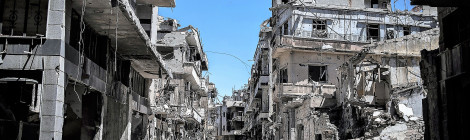

    change adaptation policy formation.

    This study looks at natural disasters and forced displacement in the context of climate change. It has two aims: firstly, to provide an estimate of forced displacement related to disasters in 2008, specifically climate-related disasters; and secondly, to propose a methodology that could be applied to monitor disaster-related displacement on an ongoing basis. The study uses existing data sets on the impacts of natural disasters in 2008, crossreferences various sources, and individually investigates a number of events to estimate the numbers of persons displaced by disasters in 2008.

    The findings show that at least 36 million people were displaced by sudden-onset natural disasters in 2008. Of those, over 20 million were displaced by sudden-onset climate-related disasters. As a reference, the total population of people living in forced displacement due to conflict, including IDPs and refugees, was 42 million in 2008, with 4.6 million having been newly internally displaced during the year. It is likely that many more are displaced due to the other climate change-related drivers, including slow-onset disasters, such as drought and sea level rise; however the study does not present an estimate of their number.

    The methodology proposed in this study could be applied with relatively limited additional resources to monitor disaster-related displacement on an ongoing basis. Monitoring of disaster-related displacement could be significantly enhanced through additional steps to collect data on the duration of displacement, returns, local integration and relocation and the needs of displaced populations.

    The full report can be downloaded here.

  • Sustainable Security

  • The US Navy in a Warming Arctic

    A new report by the U.S. Naval Forces Naval Studies Board about the implications of climate change for the US Navy finds that “many changes are already under way in regions around the world, such as in the Arctic, and call for action by U.S. naval leadership in response.”

    The report and its findings and recommendations are organized around six discussion areas—all presented within the context of a changing climate: 

    1. Disputes of boundaries and exclusive economic zones as a result of new maritime transits and competition of new resources;

    2. Strains on naval capabilities—given continuing first responder missions, and the opening of new international and territorial waters;

    3. Vulnerabilities to naval coastal installations due to sea-level rise and increased storm surges;

    4. Demands for establishing greater U.S., allied, and/or international maritime partnerships;

    5. Impacts on the technical underpinnings that enable, in part, naval force capabilities, particularly those that operate and train in the Arctic; and

    6. Investments for additional research and development that have implications for future naval operations and capabilities and might not be met by other groups pursuing climate-related research.

    One of the most interesting findings of the report is that “The ability of U.S. naval forces to carry out their missions would be assisted if the United States were to ratify UNCLOS.” According to the report:

    The committee has studied the implications of the failure of the United States to ratify the 1982 United Nations Convention on the Law of the Sea (UNCLOS) from the standpoint of potential impacts on national security in the context of a changing climate. As climate change affords increased access to the Arctic, it is envisioned that there will be new opportunities for natural resource exploration and recovery, as well as increased ship traffic of all kinds, and with that a need for broadened naval partnership and cooperation, and a framework for settling potential disputes and conflicts.

    The report is available from the National Academies Press website.

  • Sustainable Security

    The War in Syria: Responding to Stalemate

    The Syrian War is now in its fourth year and the indications are that the regime will survive and consolidate its position in 2014. This is radically different from early last year when many analysts thought it was under serious pressure, and it should be recalled that in mid-2011, a few months into the war, the prevailing view was that the regime would not last to the end of that year. The costs have been huge, with around 140,000 killed, twice that number injured and more than a third of the population displace, millions of them refugees in other countries. Here, Paul Rogers seeks to put this appalling conflict in a longer term regional context as an aid to looking at possible policy options in attempting to bring the war to an end.

    Read Article →

    International Dimensions of the Ukraine Crisis: Syria and Iran

    The Russian annexation of Crimea may be in direct contravention of international agreements but is popular in Russia and almost certain to hold. Given tensions within Ukrainian society and its weak transitional government, there remains some risk of further intervention in eastern Ukraine and possibly the Trans-Dniester break-away region of Moldova. Even if there is no further escalation in the crisis, the deterioration in EU/Russian and US/Russian relations is of great concern, not least in relation to two aspects of Middle East security – the Syrian civil war and the Iran nuclear negotiations.

    Read Article →

    Responding to Climate Disruption – Developing the Agenda

    Recent examples of short-term climate disruption have done much to bring the overall issue of climate change up the political agenda. In responding to what will be one of the key challenges of the next decades – well beyond the 15-year lifetime of the post-2015 global development goals currently under discussion – much of the attention has been focused on the need to adapt to those elements of climate change that are already irreversible and also to the need to decarbonise existing high carbon-emitting economies. What needs much greater attention is the fundamental need to ensure that low-carbon emitters in the Global South are enabled to combine effective human development with responding to the challenges of climate change.

    Read Article →

    What next for Iran? Foreign Policy after a Nuclear Agreement

    If Iran and the P5+1 succeed in negotiating a robust agreement on the nuclear issue, then Iran will be less preoccupied with rebalancing its relationship with antagonistic western powers and its role in the Middle East and the wider region has scope for developing in many new directions. This briefing looks ahead to a post-agreement environment and assesses where Iran might chose to concentrate its resources. A key question is whether it will work to build better links with the US and selected European states or whether it will be more interested in the BRIC and other states, not least Turkey. Its choice will be influenced strongly by domestic politics and the urgent need for a more stable region.

    Read Article →

  • Sustainable Security

    As activists around the world participate in a Global Day of Action against criminalisation of drug use, evidence from the multi-billion dollar War on Drugs in Colombia suggests that militarized suppression of production and supply has displaced millions of people as well as the problem, not least to Mexico. The wrong lessons are being exported to Central America and beyond, but a groundswell of expert and popular opinion internationally is calling for alternative approaches to regulating the use and trade in drugs.

    The arrest of the Mexican drug kingpin Joaquin ‘El Chapo’ Guzman on 22 February was cheered by US and Mexican officials as the most important success against narco-trafficking since the killing of Pablo Escobar two decades earlier. Designated in 2013 by the Chicago Crime Commission as the ‘public enemy number one’ and featured among the ‘most powerful’ by Forbes, he was the leader of the Sinaloa Federation. This is considered the most powerful drug trafficking group worldwide, responsible for around 25% of the cocaine that enters the US market and enjoying connections in various continents.

    UH-60 Black Hawk fotografiádo después del desfile militar del 15 de septiembre de 2009 en la ciudad de méxico

    Mexican UH-60 Black Hawk lands in the Zocalo, Mexico City’s main square, 15 September 2009. (Source: Wikipedia)

    If the ‘War on Drugs’ logic is followed, the event should mark the beginning of the end of drug-related violence in Mexico. But the lessons from the elimination of Pablo Escobar and the defeat of the Medellín (and later Cali) cartels in Colombia suggest otherwise. Whether El Chapo continues to run operations from jail, full leadership is assumed by the remaining commander, or the group breaks into smaller factions, the drug business is likely to survive.

    What could be reinforced is the trend to fragmentation already in place, which does not necessarily means less violence, at least in the short and medium term, and could give birth to a decentralized and networked drug business. In this sense, Mexico could well be now where Colombia was 15-20 years ago.

    Colombia’s success narrative

    Despite their different insertion into the global political economy of drugs, both countries are remarkable examples of militarized approaches to the drug war promoted by the US in Latin America (and beyond). The focus is almost entirely on the supply side: criminalization, eradication and aggressive enforcement with the aim to put a halt to the global supply of illegal drugs. The burden is mostly assumed by countries of production and transit that are evaluated on an annual basis against compliance with those prescriptions.

    The terms of the debate about this issue have until recently been limited and based on partial evidence in at least two aspects. Success is measured by the figures of crops eradication, detentions and seizures of drugs, not by net impact on the trade (drug availability and market prices). And the consequences in violence, violations of human rights, marginalization, corruption and institutional failure, have been exclusively attributed to illegal drugs and organized crime and not to the war on drugs itself. Fortunately, those terms are changing and a range of new voices, including at highest political levels, are joining a necessary and urgent discussion.

    Colombia has undertaken an amazing journey in this regard. Once criminalized in the international arena through its identification with the drug trade, in recent years it has been promoted as the brightest example of success in the drug war. The narrative of success is based on two main elements: the defeat of the big cartels in the 1990s and Plan Colombia in the 2000s.

    However, the story has critical under-reported angles. What followed the demise of Medellin and Cali was not elimination of the drug trade but the decentralization and fragmentation of the market into around 300 smaller, flatter and networked groups. The Revolutionary Armed Forces of Colombia (FARC) – and, to a lesser extent, National Liberation Army (ELN) insurgents and United Self-Defense Forces of Colombia (AUC) paramilitaries – furthered their involvement in the drug business and provided the armed ‘muscle’ in order to finance their nation-wide expansions.

    Moreover, the biggest cocaine profits shifted from Colombia to Mexico, contributing to the financial and armed power of its drug trafficking groups as the smaller rings and armed actors in Colombia lacked the power, contacts and/or will to control international logistics and operations, not to mention distribution in the US. The vacuum was filled by the Mexican cartels that established a direct buying presence in Colombia (and later Peru), logistic bases in the Caribbean and Central America for transportation, and distribution networks in the US market.

    Plan Colombia

    The largest counter-drugs programme ever launched, Plan Colombia was funded by the US with more than $7 billion to conduct massive aerial spraying of illicit crops and provide equipment and training to the Colombian armed forces.

    The focus of Plan Colombia was counter-insurgency against the FARC, particularly after the US Congress unblocked in 2002 the use of counter-drug funds for counter-terrorism. The group was weakened by increased state military power and mobility, and is currently involved in peace talks with the government. But it retains 8,000 combatants and has increasingly relied on urban militias. More importantly, despite the propaganda, the FARC was never the only (nor main) group involved in drug trafficking.

    The AUC paramilitaries had a mixed criminal-political character from their beginnings. Born out of an array of self-defence groups and narco-trafficking interests, these two ‘souls’ coexisted for years but the drug trade eventually prevailed. The demobilization of more than 31,000 AUC combatants in 2006 was immediately followed by the emergence of 30 new criminal groups that drew membership from former AUC members and mid-level commanders and sought (and eventually won) control of cultivation and trade in areas and routes formerly under paramilitary control.

    With an estimated initial membership of 4,000 members, these new criminal groups later expanded throughout the territory and are now present in 17 out of 32 departments. Those groups have never been a unified project but an array of decentralized criminal networks. Infighting and shifting alliances are the norm among them and with sectors of the FARC and the ELN also involved in drug trafficking. According to the Colombian police, they were responsible for half the total murders committed in 2010.

    Uncounted costs

    The Colombian success in the war on drugs has been partial at best and come at a high price. Taking the accumulated figures of the US International Narcotics Control Strategy Report, around 2 million hectares have been fumigated to eradicate crops since 2000. Massive herbicide spraying destroyed coca, but also livelihoods and protected natural areas, and impacted food security, health and the environment. The complex marginalization problems of rural communities that resort to coca as a livelihood strategy were addressed through securitization and criminalization (coca farmers have often been identified with the FARC). The result, for many, was forced displacement and further vulnerability. Cultivation expanded to new areas and departments, and fragmented as a result.

    The levels of violence have decreased slightly nowadays, but the homicide rate stayed at 32 for 100,000 in 2013, well above Mexico in its worst year of violence (2011, with 24 for 100,000). Also in 2013, between 140,000 and 219,000 persons (depending on the sources) were forcibly displaced in Colombia. Those figures are lower than in the past but nonetheless immense and add to a total of 6 million people forcibly displaced since 1985. The specialized agency Insight Crime interprets the current high incidence of this phenomenon in the Pacific regions and intra-urban settings as an indicator of displacement by criminal –not political- violence.

    Mexico’s War on Drugs

    Regardless of the real situation on the ground, those policies (and apparently, the high levels of popular support enjoyed by then Colombian president Alvaro Uribe) inspired President Felipe Calderón to launch an all-out war against drugs in Mexico in 2007. Around 100,000 soldiers and thousands of marines were deployed to fight the cartels in an effort to overcome the problems of corruption and ineffectiveness of the police forces, a policy later backed by the US under the Merida Initiative. The strategy got results, with relevant high and mid-level commanders of drug trafficking groups captured or killed, and seizures of illegal drugs soaring amidst the crackdown.

    Mexican Special Forces with Barrett M82 sniper rifles.

    Mexican Special Forces with Barrett M82 sniper rifles. (Source: Wikipedia)

    But the destabilization of the drug market triggered an escalation of violence. Violent competition for power erupted within the groups and coalitions as leaders were eliminated, coupled with fierce battles for territorial control among groups. The response against the state scaled up with the cartels creating militarized wings and using sophisticated military weaponry and tactics to fight the military and the police. The process of fragmentation and decentralization accelerated and the six big cartels of 2006 have split into around 15 today, coupled with a diversification of transnational criminal activities and soaring incidences of kidnapping and extortion. The Sinaloa Federation and the Zetas remain the most powerful cartels but have also suffered splits and setbacks.

    More than 60,000 people have died and 26,000 ‘disappeared’ in just six years. The formerly respected military have been accused of grave human rights violations including extrajudicial killings and forced disappearances. More than 4,000 complaints for human rights violations by military personnel were filed in 2006-2010 This was more than the total figure for the previous 15 years.

    Mexico has come under close scrutiny by the Inter-American Court on Human Rights and other international institutions. On June 12, the UN Special Rapporteur on extrajudicial, summary or arbitrary executions warned about unacceptable levels of violations to the right to life and impunity. Although recognizing some positive steps by the government of Enrique Peña Nieto, he warned that “a heavy-handed military approach is unlikely to improve the situation” and what is needed is “systematic, holistic and comprehensive strengthening of the rule of law”.

    As in Colombia, the Mexican victims of violence face further victimization as the government and sectors of the media dismiss them as criminals. Families and civil society groups claiming for justice may become targeted themselves. Unabated violence and institutional failure are the factors behind the emergence of armed self-defence groups, first in Michoacán and Guerrero and currently in around 10 states, as civilians take up arms to face lawlessness and fight the cartels (and sometimes corrupt authorities). This adds a new layer of armed actors whose evolution may not be easily put under control.

    Challenging the Colombian success narrative

    In Colombia, and later in Mexico, the militarized drug wars have proved ineffective in halting the drug trade but their impact is hugely negative on security and human rights, development and governance. While marginalization feeds the illegal economy, the securitized responses criminalize communities and add abuses and institutional failure to the problem of exclusion. The focus on the military also delays the hugely needed efforts to establish functioning justice systems and effective rule of law. Meanwhile, the drug business learns and adapts, moving from strict hierarchies to networked configurations.

    Despite those evidences, growing international debates about drug policies and a shifting internal public opinion, the US continues to promote a securitized approach to drugs that is most evident now in Central America. The use of Colombia as a symbol of success for Mexico and others, and as an actual ‘proxy’ to provide support in counter-narcotics and counter-insurgency to third parties including West Africa, should raise some basic questions about the premises, effectiveness and potential consequences of those policies.

    This month, the West African Commission on Drugs – an expert panel convened by Kofi Annan and chaired by former Nigerian president Olusegun Obasanjo – has called for decriminalization of drug use and to “avoid militarisation of drug policy and related counter-trafficking measures, of the kind that some Latin American countries have applied at great cost without reducing supply.”

    This potentially brings West Africa into line with the Organisation of American States, which in a report of May 2013 proposed “alternative legal and regulatory regimes” for tackling drugs, starting with cannabis”. Uruguay has already decriminalized cannabis and Colombia’s President Juan Manuel Santos, re-elected this month, has at times advocated drug policy reform. Enrique Peña Nieto has recently called on the US to start an open debate and a revision of ‘failed’ hemispheric policies whose outcome has been the rise of drug production and consumption.

    There are growing calls internationally to open a global debate over drug use and the policies needed to address it, including addressing demand in consumer countries. No less a figure than Sir William Patey, British Ambassador to Afghanistan from 2010 to 2012, has called for legalization of the heroin trade as the war on drugs in Afghanistan fails to address the complex problems at the roots of opium cultivation. Dozens of high profile British individuals and organisations, including the Prison Governors Association, have also called for decriminalization of drug use.

    The debate seems to be reaching a tipping point as the numbers and diversity of the sceptical and critical voices grow worldwide. Now it is the turn of policy makers to listen and act.

    Mabel González Bustelo is a journalist, researcher and international consultant specialized in international peace and security, with a focus on non-state actors in world politics, organized violence, conflict and peacebuilding. You can follow her at her blog The Making of War and Peace, her webpage, and Twitter (@MabelBustelo).

  • Global militarisation

    Executive Director of the Sustainable Security and Peacebuilding Initiative at the Center for American Progress, John Norris discusses the need to consider options carefully to avoid militarising the West’s response to the crisis in Libya. He writes that blowing up a runway or imposing a no-fly zone are not silver bullets. And one would hope that after the experience of both Afghanistan and Iraq—and earlier interventions such as Kosovo and Bosnia—we understand that war is a dangerous, uncertain business.

    Image source: Quigibo. 

    Read more »

  • Sustainable Security

    Following the 1998 peace agreement, Northern Ireland has been promoted as a model for peacemaking. Human rights discourse played a role as a cause and cure of the conflict.

    Since the civil rights movement of the 1960s, the Northern Irish conflict has captivated imaginations far beyond the island. Following the 1998 peace agreement, the region has been internationally promoted as a model for peace-making. Politicians from the region have shared wisdom of the Northern Ireland peace process in far-flung countries in conflict, including the Philippines, Sri Lanka, Iraq, and Afghanistan. Some of the lessons exported from Northern Ireland’s peace process are general prescriptions, such as the necessity of engaging with enemies or the need for multi-party talks to include even the smallest parties. Broader lessons promoted about Northern Ireland’s peace process are claims about the role of human rights in conflict resolution. During the peace process, a popular history emerged with rights—political, economic, and human— occupying a central role as a cause and cure of the conflict.

    Human Rights as Political Narrative

    The broad outlines of this narrative are: after partition in 1921, the new state in Northern Ireland systematically denied civil and economic rights to Catholics and maintained Protestant dominance. In the late 1960s, when peaceful civil rights demands were met with both loyalist and state violence and state reforms failed, the republican movement was forced into armed struggle. During the conflict, the British state engaged in human rights violations, further compromising the legitimacy of UK governance. In the late 1990s, republicans, unionists, and the British state settled the conflict by agreeing to new political institutions that ensured equal rights for all.

    However, human rights lessons from Northern Ireland’s peace process are not quite as tidy as this narrative suggests. My longstanding ethnographic and historical research in the region suggests caution about the comforting certainties of this causal account. In the 1960s, grassroots advocates protested that nationalists’ civil rights were systematically undermined since partition, and throughout the conflict, “first generation” rights to speech and association, or freedom from torture, were violated and remain deeply contentious. At the same time, human rights were absorbed into the conflict, and became another arena for ethnopolitical contest. In the Good Friday Agreement (GFA), an explicit commitment to human rights was envisioned for the new political arrangements. Yet as the agreement was implemented, rights politics have often been vehicles for the claims of nationalists and unionists, rather than universal human subjects.

    Ethnopolitics and Human Rights

    Time_for_Peace

    “Time for Peace” mural, Whiterock Road, Belfast. Image available under the GNU Free Documentation License via Wikimedia Commons.

    Since the GFA, the tendency to argue ethnopolitical conflicts in terms of human rights has intensified, to the detriment of both wronged parties and broader understandings of human rights. A compelling example of how human rights were an incomplete solution to the conflict emerged early in the post-GFA era, in 2001, when a dispute in Ardoyne, north Belfast, resulted in shocking, violent loyalist protests at the Holy Cross Primary school (a Catholic girls’school). In June 2001, loyalists from the Glenbryn estate began picketing Holy Cross Primary School in nationalist Ardoyne, north Belfast. The school entrance was located just on the Glenbryn side of a famous “peace line.” Police in riot gear were deployed to protect small girls as they walked to school past lines of enraged adults. The dispute continued for four months, with violent conflicts during the summer break and a resumption of the pickets when the new term began in the autumn. Riots spread throughout north Belfast that autumn and winter, along with attacks on children travelling to other schools.

    Families of the distressed children eventually backed an unsuccessful challenge of police conduct under the Police (Northern Ireland) Act 2000, and under Articles 3, 8, 13, and 14 of the European Convention. That case, P.F. and E.F. v. the United Kingdom (Application no. 28326/09), was eventually ruled inadmissible by the European Court of Human Rights. Its long legal journey ended in 2010, when the European declared that, horrific as the protests were, there was no evidence of European convention breach.

    The dispute and legal proceedings very nearly derailed the new Human Rights Commission formed under the GFA.  In 2002-3, six members resigned or withdrew from the commission, citing multiple reasons related to the commission’s lack of authority and resources, its approach to drafting a Bill of Rights, and, most notably, its approach to handling the Holy Cross protests. Although the commission as a whole voted not to become involved, its casework committee committed the commission to supporting the families’ lawsuit. Individual commissioners took contradictory public positions and became increasingly divided. Meanwhile, the commission was perceived as part of an ethnopolitical conflict rather than as public advocates for either the protection of vulnerable people or fundamental rights.

    The Holy Cross protest was not resolved by human rights institutions or advocacy; some might argue that it has never been resolved. The situation revealed several problematic dimensions of treating human rights as a cure for conflict. One difficulty is that human rights laws concern the conduct of state actors. Paramilitary organizations, neighborhood associations, and transnational corporations do not sign human rights treaties.

    Human Rights in the Good Friday Agreement

    Another issue making it difficult for human rights law or advocacy to provide a resolution to conflict was how the GFA itself situates human rights principles in relation to power-sharing as a means to manage conflict. One innovation of the GFA is that it makes human rights central to the settlement, with the entirety of section 6 devoted to “Rights, Safeguards and Equality of Opportunity.” However, the GFA is more strongly oriented by political scientist Arend Lijphart’s consociational model. This model prescribes the management of conflict through power sharing among parties defined in ethnic or communal terms. Thus, the GFA situates human rights within a broader logic that privileges collective political rights. This conceptual maneuver mirrors the way political rhetoric and everyday life absorb human rights claims into regional ethnopolitics, rather than creating a transformative alternative to ethnopolitics.

    In the Holy Cross conflict, protagonists framed the dispute in terms of collective rights and alleged that these rights were being differentially allocated by the state. Families of the girls argued that the protests subjected them to inhuman and degrading treatment—violations of their human rights. Furthermore, they said, police did not use force to stop the protests because the girls were Catholic, but they would have ended any such protest by nationalists. Loyalists claimed that free assembly was an unconditional right, irrespective of sectarian content or whether violence might be a consequence.

    Unfortunately, the kinds of conflicts and challenges for human rights politics raised in the Holy Cross conflict are neither unusual nor uncommon in Northern Ireland. For example, in Donaldson v. the United Kingdom (Application no. 56975/09) the European Court of Human Rights refused to hear the complaint of a republican prisoner that his human rights were violated when the prison service did not allow him to wear a lily (a symbol of the republican struggle for a unified Ireland) outside his cell. Disputes over rights to display emblems may appear frivolous outside the region, but they are part of a broader process, in which human rights laws and institutions have been insufficient to resolve the disputes that emerge from Northern Ireland’s longstanding political conflict.

    Enduring Lessons and the Everyday Life of Rights

    In my 2014 monograph, I explore at length how rights politics have often functioned war by other means over time, rather than providing a comprehensive resolution to conflict. I conclude that advocacy such as the lesbian, gay, bisexual, and transgender (LGBT) equality movement have been more transformative in human rights terms than attempts to balance ethnopolitical rights. This cautionary point about how human rights politics have been received, reinterpreted, and transformed in the Northern Ireland context is not intended to dismiss the peace process’ significant achievements, including the profound diminution of political violence, paramilitary demobilizations, and decommissioning.

    Nevertheless, the successes of the process also require recognition that throughout the fitful implementation of the GFA, political polarization intensified, past violence and political symbols have been repeatedly contested, and riots surrounding parades and symbolic matters like flags have become dangerous and costly recurrent events, intimating, for some, a return to conflict. Violence casts a long shadow across the present peace; prosecutions and re-investigations of past murders and atrocities continue, recent killings like the murder of Kevin McQuigan last summer destabilize power-sharing institutions, and ministers continue to warn of resurgent paramilitary activity – such as a recent upsurge in bomb attacks.

    Understanding the role of human rights in everyday politics in both the past and present is necessary for making nuanced claims for human rights advocacy and law in conflict resolution. Northern Ireland’s tremendous reduction in violence must not be dismissed, but it is important to recognize that the settlement also sustains a form of ethnopolitics that is not always congruent with the goals of human rights advocacy. As the politics of the conflict continue to structure the settlement, it is fair to ask how transformative human rights politics have been. Such an approach can make us conscious of perilous conditions that constrain the present fragile peace, and highlight achievements that are durable and transferrable for the future.

    Dr. Jennifer Curtis is Honorary Fellow in Social Anthropology at the University of Edinburgh. She is the author of Human Rights As War By Other Means:  Peace Politics in Northern Ireland, published by the University of Pennsylvania Press. Her work focuses on how grassroots social movements appropriate and alter rights advocacy and law. She has conducted long-term ethnographic research in Belfast, Northern Ireland and in the United States.  She is currently completing an ethnographic monograph on race, sexuality, and civil rights in red state America, based on fieldwork in Missouri. The book explores the local and national significance of #BlackLivesMatter, movements for LGBT equality, and anti-equality movements, within the broader historical context of racialized violence, slavery, and inequality in the American South.

  • Global militarisation

    In a paper exclusively written for sustainablesecurity.org, Serena Joseph-Harris (former High Commissioner for Trinidad and Tobago) focuses on competition over natural resources, the role of maritime routes in the Caribbean, and the importance of multilateral approaches to finding sustainable solutions in the Caribbean.

    Image source: Len@Loblolly

    Read more »

  • Sustainable Security

    The environment has often taken a backseat in discussions about conflict, but an increasing amount of evidence suggests that environmental and wildlife conservation could and should be very useful to post-conflict recovery work.

    The notion that the environment can play a useful role in peacebuilding has been around for a number of decades. The environmental peacebuilding theory emerged after research found that even while countries were engaged in armed conflict they were cooperating over water management. The theory was that water management could establish cooperation and lay a platform for wider peacebuilding initiatives. Peace Parks follow the same principles to use transboundary biodiversity conservation to support peacebuilding. While both are appealing projects, their failure to translate from environmental cooperation into wider scale peacebuilding processes suggest they are of only limited use for peacebuilding and post-war recovery.

    While the above processes have been of limited effectiveness, the shared geography of many areas of armed conflict and biodiversity hotspots suggests that conservation could and should be useful to post-conflict recovery.

    Guerrillas and Gorillas

    Research has found that 80% of modern armed conflicts occurred in biodiversity hotspots, and 90% within countries containing biodiversity hotspots. The use of ‘conflict timber’ and the illegal wildlife trade to finance conflict, and the presence of many armed groups in and around protected areas, creates clear links between conflict and the environment. Conflict also often leads to widespread environmental damage, and the post-conflict period can cause even more damage as short term human needs lead to ungoverned and unsustainable exploitation of the environment. This destroys key ecosystem services, opens opportunities for banditry and corruption, and increases the risk of natural disasters.

    Addressing these threats to security and protecting the environment in the aftermath of conflict is therefore vital to ensure a resilient recovery process. This creates an opportunity for conservation to support the post-conflict recovery effort by simultaneously addressing threats to security and protecting the environment to support economic development. Current approaches to do this are limited, but potential exists for much more work to be carried out. I have therefore proposed the umbrella term of ‘Ecological Development’ to create a framework of methods to actively use conservation as a tool for post-conflict recovery.

    Environmental Peacekeepers

    Virunga_National_Park_Gorilla

    Mountain Gorilla in Virunga National Park, in the Democratic Republic of the Congo. Image via Wikimedia.

    Some work has already been undertaken in this area, such as the proposal to create a ‘green helmets’ UN force, with a mandate for environmental protection. Whether funding for such a force could be obtained, and a mandate agreed upon, is doubtful; even if it was, it is unlikely to be an effective unit. Current UN peacekeeping missions have regularly failed in their roles to protect civilians, so are unlikely to be able to effectively extend their mandate to environmental protection. Peacekeepers have also been caught with illegal fauna and flora. While the UN Peacekeeping operations now have an environment department to reduce the footprint of missions and educate soldiers about the environment, their role in environmental protection is now, and will likely be for the foreseeable future, minimal.

    Using a country’s army to support conservation work has also been trialled, but with limited impact; for example, in the Democratic Republic of Congo the army became involved in poaching ivory. Both this and the proposed green helmets UN force also take a combative approach to conservation, seeking to fight poachers and armed groups in protected areas rather than addressing the underlying causes of poaching and deforestation. A different approach is required.

    Instead, I have proposed the conversion of rebel groups en masse into a ‘Yellow Berets’ force under UN, or other neutral, control; their role would be to support existing wildlife rangers to protect the environment and start to engage in ecosystem regeneration and sustainable exploitation projects. Such a scheme would form a significant contribution to post-conflict recovery in several ways: it would employ ex-combatants, reducing the risk of a relapse into conflict; it would protect critical ecosystems, species and carbon sinks vital for human populations (and arguably worth protecting in their own right); and it would support efforts to develop sustainable natural resource extraction businesses to bring in revenue and create jobs to support post-conflict recovery. Crucially, this process seeks to address security threats with dollars not bullets; engaging rebel groups as paid eco-guards rather than engaging them in battle.

    The DRC provides an example of the necessity and benefits of such a programme. Work is already underway to ensure Virunga National Park brings multiple economic benefits to surrounding populations, including the development of hydropower electricity generation. Security threats remain a major concern in the park, however, and there are too few rangers to address these threats. The ecological development method would offer financial incentives to rebel groups to join the yellow berets unit. This would simultaneously increase the number of conservation personnel and decrease the security threat, opening the way for an expansion of development projects around the park. It would also enable the restoration of forest areas – which could be financed by carbon offset schemes – and the further development of a tourist industry centred not only on gorillas but multiple other attractions in the region. Such a process would not be without challenges: securing the long-term finance required to pay wages; coping with disruptive private interests intent on perpetuating insecurity; and avoiding conflict between Congolese army soldiers and police who receive their wages intermittently or not at all.

    Nevertheless the project holds promise, even in such a difficult operating environment as the DRC. It could also be used in other parts of the world where rebel groups operate in protected areas, as a means to bring an end to conflict and deal with ex-combatants efficiently and at scale.

    Conservation for Development

    The Yellow Beret process would require a large amount of finance to pay the wages of several hundred or even thousand eco-guards that would form it. While donor finance could be mobilised for such a process – combining conservation, security, humanitarian and carbon finance – this would be difficult both to obtain initially and also, critically, to sustain over the long term. Protected areas must therefore become sites of revenue and job creation in order to finance such an initiative.

    The work being undertaken in Virunga, described earlier, is an example of this, but more is required. Projects that support the livelihoods of local communities and also bigger schemes that can generate greater revenues and create jobs on a large scale need to be trialled and refined. Examples of community projects are livestock and micro-finance schemes to provide sources of protein and finance to start small enterprises. These projects alleviate communities’ dependence on protected area natural resources by providing sustainable sources of sustenance and protein, and improving the perception of conservation.

    At the same time, larger schemes are required that seek to create products for sale into international markets; this may be ‘green gold’ projects seeking to make gold mining both sustainable and ethical; sustainable timber exploitation and processing for sale; or the creation of ‘wildlife-friendly’ businesses that could create a range of products from tea to clothing, and help to grow the certification scheme into something akin to the size of the Fairtrade and Rainforest Alliance schemes. The benefit of such schemes is two fold: firstly, they are profit making, so would not be reliant on hard-to-access donor funding; secondly, they would generate jobs and revenue around protected areas that could be taxed and support the yellow beret and other conservation initiatives.

    Traditionally, tourism has been the main, and in many cases sole, commercial method used for conservation to support development. This narrow focus on tourism leads to a lack of innovation and a dependence on an unreliable industry. Particularly in regions of armed conflict, tourism can at best play a small role in development programmes; too few people are willing to visit a dangerous area to make it a viable business model. The other methods described above are therefore necessary.

    Justifying Conservation

    Time and time again I have heard that ‘a hungry man is an angry man’. Indeed, groups of unemployed young men are particularly dangerous. To transition from conflict to a successful post-conflict recovery, peace must be more attractive than conflict; there must be good opportunities for secure, paid employment for actors in conflict. Conservation can and must play a role in providing those opportunities.

    In short, for the environment – and protected areas in particular – to play a useful role in post-conflict recovery, they must be demonstrably beneficial to people. Most crucially, they must be able to help improve security and generate revenue from conservation quickly and to a value in excess of alternative uses such as agriculture. Protected areas must therefore become sites of revenue and job creation in the post-conflict period. This will help to improve security and support post conflict economic recovery while protecting key environmental assets and species; at the same time it would lay a platform for longer term commercial investment in eco-man friendly industries once security has been assured.

    Richard Milburn is Research Co-ordinator and PhD candidate at the Marjan Centre for the Study of Conflict and Conservation, within King’s College London’s Department of War Studies. His research examines the security threats associated with biodiversity loss as well as the opportunities to utilise conservation as a core component of post-war recovery, particularly in the Democratic Republic of Congo. He is also the UK representative of the Pole Pole Foundation, a Congolese conservation charity based in Bukavu.

  • Human Security and Marginalisation: A case of Pastoralists in the Mandera triangle

    This paper seeks to bring out the relevance of human security in pastoral areas of Mandera triangle and the relationships and contradictions that exist between it and national security. The “Mandera Triangle” encompasses a tri-border region of Ethiopia, Somalia, and Kenya that exemplifies, in a microcosm, both a complex and a chronic humanitarian crisis that transcends national boundaries. The resident Somali pastoral population is highly vulnerable to periodic droughts and floods; high levels of poverty; long-term disruption to the traditional systems of livelihood; ongoing inter-clan conflicts and border tensions between states. Human security can be said to have two main aspects. It means, first, safety from such chronic threats as hunger, disease and repression. And second, it means protection from sudden and hurtful disruptions in the patterns of daily life – whether in homes, in jobs or in communities.

    Violence in the Mandera triangle is often viewed narrowly as a symptom of inter-tribal conflict over cattle and other common property resources. This line of thinking is questionable given that an important issue in understanding insecurity among pastoralist groups is their distant and often oppositional relationship to the state. As with other peripheral groups, pastoralists in the region have suffered systematic marginalization by central authorities and have a history of rejecting the authority of the state, which they view as threatening to their distinct nomadic way of life. Pastoralist violence must therefore be situated, in terms of these forces of mutual opposition and exclusion as well as the struggle for control of resources. Ultimately, pastoralists do not partake in the nation’s so-called ‘public goods’. They are often denied government services and since formal legal and police services are usually nonexistent in pastoralist communities, the state seldom plays a role in guaranteeing their security. When they do become an object of state interest and intervention, it often involves forced settlement and other coercive efforts which only strengthens their resolve to remain apart.

    Until rather recently there was a pronounced “blame the victim” approach in discussions about the pastoralists. The searing images from the famines of the 1970s and 1980s, much of it from the Sahel, reinforced the notion that the pastoralist was largely responsible for these immense difficulties. This understanding spurred much inappropriate development that is only now beginning to be fully understood and reassessed. The human security dimensions of the pastoralist plight are now more clearly understood as being attributable to a combination of population growth, immigration, conflict and specific government policies. Yet if we are to move beyond blaming the pastoralists, neither will simply victimising them suffice.

    An adequate conceptualization of human security for Mandera triangle states and other states in Africa should ‘link human security with human development’. Economic development will have to be at the top of the institutional agenda, since development and security are ‘two sides of the same coin’. Non-state actors do not have the power to bring about large-scale development or to resolve the new security threats alone, without any state assistance. In the final analysis, studies of internationalized pastoral conflicts in Mandera triangle suggest that interest in these conflicts is justified on a number of practical grounds which have been summarized by Peter Wanyande as follows:

    “First is that the conflicts are very costly to the governments and the peoples of the region as a whole and the individual countries in which they occur. The costs are in terms of loss of human life and property and the destruction of public infrastructure. Hundreds of thousands of people have been killed in many of the countries in which the conflicts occur. Many others have also suffered and continue to suffer untold psychological trauma associated with conflicts. Second, these conflicts drain the scarce resources available to the affected countries. Once conflicts occur, scarce resources are inevitably diverted to the purchase of military equipment at the expense of socio-economic development. This is not to mention the fact that the conflicts disrupt normal economic activities such as agriculture and trade. Third, the conflicts and violence they generate in any one country creates insecurity and related problems far beyond the countries in which they originate. Conflicts in the region have also caused diplomatic tensions between neighbouring countries in the region. Fifth, most of these conflicts have resulted in large numbers of refugees and displaced persons.”

    This implies that states in the region must invest a substantial effort in trying to understand, and abandon the current relative indifference to, the complex interconnections between regional political instability, poverty and lawlessness.

    Image source: TURKAIRO

    Abdul Ebrahim Haro is an employee of Practical Action Eastern Africa (an international NGO) in the Reducing Vulnerability Programme, and is the Area Coordinator for Somali Cluster Region in the tri-border areas of Kenya-Ethiopia-Somalia. Abdul Haro has a masters in International conflicts management and is a consultant in Pastoralism and security matters in pastoral areas.

  • Sustainable Security

    Deforestation: REDD-y for peace or fuelling conflict?

    REDD forestry efforts don’t pay enough attention to their influence on local conflict dynamics. For REDD+ to be an effective mechanism to curb deforestation and strengthen peace opportunities, it has to pay more attention to pre-existing land and forest conflicts linked to tenure, take into account the interests of the local communities and be more sensitive to the local context

    Read Article →

    The Global Land Rush: Catalyst for Resource-Driven Conflict?

    Michael Kugelman of the Woodrow Wilson International Center, argues that the factors that first sparked many of the land acquisitions during the global food crisis of 2007-08 — population growth, high food prices, unpredictable commodities markets, water shortages, and above all a plummeting supply of arable land — remain firmly in place today. He writes that land-lusting nations and investors are driven by immediate needs, and they have neither the incentive nor the obligation to slow down and adjust their investments in response to the wishes of distant international bureaucrats. This, he argues, has serious consequences for global security.

    Read Article →