 By Oxford Research Group’s Sustainable Security Programme Manager Ben Zala
Attach PDF:
By Oxford Research Group’s Sustainable Security Programme Manager Ben Zala
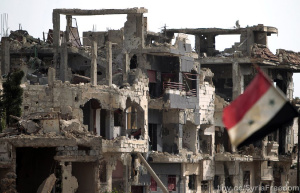
The recent announcement that the so-called Geneva II conference would finally convene on 22 January 2014 is overdue but good news. What are the chances of it bringing peace? With an interim deal signed on Iran’s nuclear programme, Richard Reeve discusses what chance the great powers, Middle Eastern diplomats and the mediators of Geneva have as they turn their attention to ending the war in Syria.
In the UK, the Conservative-Liberal Democrat coalition government continues to pursue the renewal of Britain’s Trident nuclear weapon system amidst criticism of the opacity of the procurement process and concerns over the substantial and increasing costs of the project. Adding fuel to public anger over widespread government cuts, the Defence Secretary Liam Fox’s long overdue announcement in May 2011 that the Initial Gate for the project had been approved was accompanied by the revelation that when inflation is taken into account the price tag for just the new submarines (excluding missiles, warheads and running costs) is likely to be £25 billion, as opposed to the £11-14 billion announced in 2006. With the defence budget already curtailed by the October 2010 Comprehensive Spending Review (CSR) and under strain on account of a projected deficit of £36 billion over the next 10 years, these latest figures have prompted further concerns that Trident is being replaced at the expense of conventional military capabilities. Moreover as the Ministry of Defence (MoD) is now locked in yet another battle with the Treasury pressing questions are being asked about the costs, benefits, priority and opportunity costs of Trident replacement as compared with other areas of government expenditure. On 3 August, the Defence Select Committee – a cross-party committee of MPs -criticised the government over its “rushed” and “badly done” Strategic Defence and Security Review (SDSR). Responding, Jim Murphy, the UK’s Shadow Defence Secretary said “events have exposed the mismatch between policy ambition and the resources provided by ministers”.
Originally scheduled for September 2009 the Initial Gate announcement, which gave the green light for the next stages of procurement to be undertaken (up to 15% of the budget), had been postponed numerous times whilst decisions were made regarding design, particularly over which type of nuclear reactor to use in the new submarines. The Defence Secretary’s Initial Gate statement in the Commons revealed that the new PWR3 reactor would be used, which will increase costs further. The decision to install the PWR3 instead of the currently used PWR2 reactor in the new subs was based on the results of a safety assessment which was accidentally made public by the MoD when anunredacted version of the report was posted on the internet. This led to criticisms of the MoD as well as of Parliamentary Under Secretary of State for Defence Equipment, Support and Technology, Peter Luff, who contradicted the report in Parliament. Anxieties over safety were amplified when an MoD report was published that assessed that government funding cuts are likely to jeopardise the safety of the UK’s nuclear weapons. Likewise, an official inquiry into the August 2010 fire at Aldermaston Atomic Weapons Establishment (AWE) contained strong criticism of the private management consortium (AWE plc, comprising US arms dealer Lockheed Martin, SERCO and Jacobs Engineering) that runs this publicly-funded nuclear weapons plant, particularly with regard to fire prevention and response. The report led the government’s Health and Safety Executive to investigate whether to take legal action against the AWE Management group. Nonetheless, despite a catalogue of problems associated with private sector management of AWE and other UK nuclear sites, in May the Scottish Herald revealed that the nuclear warhead storage base at Coulport is to be sold off to a consortium of private companies also led by, Lockheed Martin.
The statement on the Initial Gate was accompanied by the publication of areport describing work on the Trident renewal programme to date, the decisions taken at Initial Gate and around £3 billion of work scheduled to take place in advance of the Main Gate. Dr Fox also identified spending on long lead items that would cost a further £500 million. Alongside the announcement came the news that, in line with the Coalition Agreement under which it was agreed that the Liberal Democrats could continue to make the case for alternatives, an18-month study to review the “costs, feasibility and credibility of alternative systems and postures” would be undertaken. The study will be conducted by the Cabinet Office and overseen by Armed Forces Minister and Liberal Democrat Nick Harvey who is more open to exploring alternatives to Tridentthan his senior colleague, Conservative Defence Minister Liam Fox, who hasmade it clear that he is absolutely opposed to change. By way of compromise, the study will consider only nuclear weapons options for replacing the role assigned to Trident in the UK’s nuclear deterrence posture, with no consideration of non-nuclear options for deterrence and security. In Scotland meanwhile, following the May 2011 elections which gave the Scottish National Party (SNP) a strong working majority in the Scottish Parliament, a resolution is to be tabled calling for the removal of UK nuclear weapons from Scottish territory. If successful, such a resolution could have far-reaching implications for the storage of nuclear warheads at Coulport and the deployment of Trident, currently homeported at the MoD’s naval base at Faslane.
In spite of his unswerving commitment to replacing Trident, Liam Fox was keen to stress the UK’s disarmament credentials on the occasion of the ‘P5 follow-on meeting to the 2010 NPT Review Conference’, using the opportunity to confirm that part of the warhead reduction announced by the UK’s most recent Strategic Defence and Security Review (SDSR) has been completed. Not long afterwards, former UK Foreign Secretary Margaret Beckett reignited the debate over the policy of Continuous-at-sea-deterrence (CASD) when she raised the possibility of “not necessarily needing four boats”.
Article source: The Acronym Institute
Image source: UK Parliament
 Delicious
 Digg
Digg StumbleUpon
 Reddit
This article was originally published on openSecurity’s monthly Sustainable Security column on 15 August 2014. Every month, a rotating network of experts from Oxford Research Group’s Sustainable Security programme explore pertinent issues of global and regional insecurity.
Control of water, including navigation rights, resource extraction and the exploitation of shared watercourses is at the heart of today’s geopolitical tensions in Asia. China’s recent actions in the South China Sea and Himalayas have given rise to further—and at times violent—conflict over the region’s natural resources. So will water insecurity lead to greater partnership in Asia? Or will it lead to a revival of China’s traditional sense of regional dominance and undercut efforts to build a rules-based approach to growing resource conflicts?
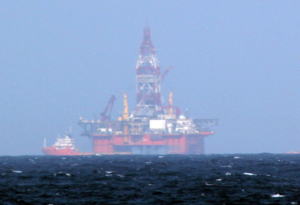
China National Petroleum Corporation’s Haiyang Shiyou-981 oil rig is situated close to the Paracel Islands, which Vietnam claims fall inside its exclusive economic zone. Source: East Asia Forum
On 15 July, a month earlier than scheduled, the China National Petroleum Corporation (CNPC) announced that it was removing its Haiyang Shiyou-981 oil rig—40 storeys high and worth an estimated $1 billion—from waters close to the Paracel Islands which Vietnam claims fall inside its exclusive economic zone.
There were four possible explanations. The first was the one the CNPC offered: the rig had completed its work early. The second was the approach of Typhoon Rammasun, signalling an early start to the region’s storm season. A third was that the US-China Strategic Dialogue the previous week had put pressure on China to lower the temperature in the South China Sea and China had taken the opportunity to demonstrate that it was a responsible international player.
The fourth interpretation was that the rig had accomplished its purpose—not prospecting for hydrocarbons but promoting a steady advance of Chinese claims on the South China Sea through a series of assertive steps, none so provocative as to bring in outside players. With each little step, this story goes, China is building its case for singular rights to navigation and resource extraction there.
The other players on the regional chessboard—the Philippines, Vietnam, Brunei, Taiwan, Indonesia and Malaysia—have grown increasingly agitated. With the memory of violent clashes between Vietnam and China over the Paracel Islands in 1974 and 1988, the installation of the oil rig in May provoked outbreaks of violence in Vietnam against Chinese citizens and businesses. Vietnamese fishing boats and Chinese ships harassed each other throughout the drilling.
It is a dangerous ploy, but China calculates that the dangers are containable. If ethnic Chinese or Chinese citizens suffer harm in the backlash, the host country is to blame. If two ships collide in the course of the hazardous games of “chicken” that have become routine in this contest, Chinese citizens can be mobilised to shout their indignation against the “aggressor”.
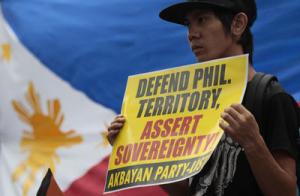
A Fililipino protester holds a slogan beside a Philippine flag during a rally outside the Chinese Consulate in suburban Makati, south of Manila, Philippines on Tuesday June 11, 2013. Source: East Asia Forum
The waters to which China lays claim are divided under the United Nations Convention on the Law of the Sea (UNCLOS) into exclusive economic zones for Brunei, Indonesia, Malaysia and Taiwan, each of which argues it has been adversely affected by China’s oil rig and claims of sovereignty. The zones, running 200 nautical miles into the South China Sea, allow these states special rights of exploration and exploitation of marine resources in specific areas.
The sea is a major shipping route and fishing area, accounting for around one-tenth of the global fish catch and believed to have substantial untapped natural resources. Notably, China’s claims (outlined in a map in 1947) overlap a large portion of these zones. Malaysia also lays claim to a small number of islands in the Spratlys archipelago. With such a concentration of multifaceted and overlapping claims, China’s oil-rig foray heightened tensions and raised fears.
In an attempt to settle its resource conflict with China peacefully , the Philippines has filed a case before the UN Permanent Court of Arbitration in The Hague on its own exclusive economic zone. However, even if, , as Manila expects, the court rules in its favour, China will ignore this—preferring to use its superior weight in bilateral negotiations rather than submit to third-party or multilateral processes where it is the rules that count. Diplomatic efforts by the Philippines to co-ordinate other claimants to take a common position vis-à-vis China have so far met little success.
China’s behaviour has made its smaller neighbours, including Vietnam, reach out to the US for reassurance. But what can it really offer?
For the US, the fading Pacific power, the disputes in the South and East China Sea pose a particular dilemma. In the East China Sea, China and Japan have overlapping territorial claims, including to the Diaoyu/Senkaku Islands which Japan controls and does not recognise as contested. The US has maintained neutrality on the islands but has a treaty commitment to defend Japan as the quid pro quo for its post-war pacifism.
China might be uncertain about the depth of US enthusiasm for that commitment today but limits its provocation, nevertheless, to such moves as the declaration in November 2013, without consultation, of an “air defence identification zone” which covers territory claimed by its neighbours. International flights are now required to report their identity and flight plans to China when crossing the zone, at risk of “defensive emergency measures”.
The strengths and limitations of the US position were clear in May, at the Shangri-La Dialogue in Singapore, the region’s annual multilateral “track two” security summit, where the US retains the power to mobilise a chorus of allies to uphold rules and laws and to criticise China’s behaviour. A series of speakers, including the Japanese prime minister, Shinzo Abe, and the US defence secretary, Chuck Hagel, condemned the use of muscle to enforce claims to the China seas, calling instead for freedom of navigation and overflight and a system based on international rules.
General Wang Guanzhong, leader of the Chinese delegation, accused the US and Japan of ganging up on China. He was not sufficiently moved to answer pertinent questions on the rules of engagement for Chinese patrol vessels in the East China Sea, but he did make it clear that China saw no place for the US in 21st-century Asia.
China is by far the largest trading partner of all the ASEAN members, which are caught in the small-neighbour dilemma, somewhere between the fear that China will come to rule their lives and consume their resources and the fear of giving offence to the region’s most important economic power. For them, the game is to try to stay on good terms with both sides.
The dilemma is also evident among a different set of China’s neighbours—those that depend on the rivers that rise in the mountains and on the high plateau of Tibet. China’s largest downstream neighbour is, of course, India. India-China relations are bedevilled by unsettled borders-status rivalries, the subject of relatively recent skirmishes, but their most intractable potential conflict is over the shared resource of the Himalayan watershed.
In its eagerness to promote new Asian alliances, Beijing dispatched the foreign minister, Wang Yi, to Delhi in June, to reach out early to the administration of the newly-elected Narendra Modi. Wang presented himself as the personal envoy of China’s president, Xi Jinping, and startled the Indian press by claiming that the two countries were ready to settle their long-running border dispute. The announcement was however short on detail—and, since the Indian state of Arunachal Pradesh is claimed by China while China’s Aksai Chin is claimed by India, details matter.
There has been no further hint of an imminent deal but India, like all of China’s downstream neighbours, is more concerned by the impact Chinese activities are having on the quality and quantity of water that crosses its borders than the exact position of the borders themselves. The Himalayan cryosphere contains the largest store of fresh water outside the two polar regions and is a significant influence on the region’s climate, including its monsoons. As in the polar regions, rising temperatures are affecting the glaciers and snow fields that give birth to Asia’s rivers and future impacts on monsoons, though hard to predict, are highly likely.
In the shorter term, China’s expansion of development westward is affecting the Qinghai Tibet plateau and everything that flows from it. Increased mineral extraction in Tibet and a renewed frenzy of big-hydro construction on trans-boundary rivers are changing Asia’s water flows for ever. There is increasing awareness of the risk of the downstream disasters that could result from building mega-dams in one of the world’s most active earthquake zones.
There are no trans-boundary agreements between China and any lower riparian country on the shared use of Asia’s great rivers, even though 1.6 billion people depend on them and China is building dams on all their head waters. For India, dams and threatened water diversions on the Brahmaputra are a particular concern. For the countries of the Mekong, China’s dam-building upstream poses a series of potential dangers. Meanwhile, India and others are running to catch up in the dam race, fearful of allowing de facto rights to be created unchallenged.
There has been no source-to-sink assessment of the impact on river ecosystems of any single dam—let alone of the massive cascades planned or under construction—and there are no mechanisms for resolving disputes. China has refused to enter into discussions with lower riparian countries, beyond agreeing to share limited water-flow data with India.
But, as in the South China Sea, limited bilateral discussions are not enough to ensure that the ecosystems of the watershed are protected and the legitimate interests of all those whose livelihoods depend on the rivers are recognised. From the high Himalaya to the teeming deltas, life will be affected.
If ever there was a case for clear rules and co-operation, it can be found in the South China Sea and the Himalayan watershed. Both raise the essential question of whether the region’s resource conflicts will be settled by arbitration and law or by force. China’s challenge to US influence is also a challenge to an international order that values arbitration as a way of defending the weak against abuse by the strong.
Isabel Hilton is the editor of chinadialogue.net, and Advisor to Oxford Research Group’s Sustainable Security Programme. She is a journalist, broadcaster, writer and commentator
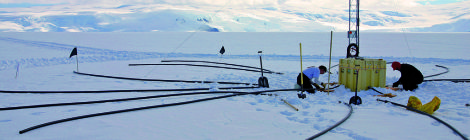
Despite not yet entering into force, the 1996 Comprehensive Test Ban Treaty has succeeded in almost eliminating nuclear weapons testing and in establishing a robust international monitoring and verification system. A breakthrough in its ratification by the few hold-out states could have important positive repercussions for the Nuclear Non-Proliferation Treaty or nuclear disarmament in the Middle East.
The recent walkout by Egyptian negotiators at UN talks have demonstrated that, like a building with rotten foundations, the nuclear non-proliferation regime is far less stable than many believe it to be. Egypt’s actions make clear that anything less than a regime specifically geared towards addressing the reasons why some states seek nuclear weapons is a regime existing on borrowed time.

The Bay of Bengal is uniquely vulnerable to a changing climate because of a combination of rising sea levels, changing weather patterns, and uncertain transboundary river flows. These problems combine with already existing social problems like religious strife, poverty, political uncertainty, high population density, and rapid urbanization to create a very dangerous cocktail of already security threats. Andrew Holland argues that foresight about its impacts can help the region’s leaders work together to solve a problem that knows no boundaries.
Author’s Note: This contribution is a shorter version of the article “Assessment of Transboundary River Basins for Potential Hydro-political Tensions” by De Stefano et al. 2017.
The impacts of new dams and diversions are felt across borders, and the development of new water infrastructure can increase political tensions in transboundary river basins. International water treaties and river basin organizations serve as a framework to potentially deescalate hydro-political tensions across borders.
The availability of freshwater in the right quantity and quality at the right times for dependent systems is required for human security, environmental security, and economic growth. As populations and economies have grown, water has become scarcer and more variable in certain locations, leading to concerns over how water may lead to conflict. Though violent conflicts over water occur more often at the local level, disputes over water are also possible at the international level, particularly as impacts of water use spill across international borders.
Dams and other water infrastructure help manage water variability—providing water in times of drought and dampening the effects of floods. With these benefits come ecological impacts as large-scale water infrastructure effects the hydrologic function of the basin in which they are built. This includes altering the timing and/or magnitude of flows, altering aquatic migratory patterns, and preventing sediments from moving downstream. Thus, the construction of large-scale water infrastructure such as dams and water diversions can become significant sources of tension between countries sharing a river basin.
The significance of new dams and water diversions is increasing across the world as many countries have begun construction on large infrastructure projects in internationally shared river basins. This is evident in places such as the Nile Basin, where the Ethiopian government’s construction of the Grand Ethiopian Renaissance Dam has been occurring without an agreement with downstream Egypt, and the news of its construction has been met with violent protests and strong rhetoric from Egyptian politicians. Water diversions are not the only factor potentially creating tension between countries over shared waters. Other factors including high population growth, urbanization, increasing water pollution, over-abstraction of groundwater, climate change and water-related disasters can contribute to tensions.
Building institutional capacity (treaties and river basin organizations) is a crucial factor in decreasing the likelihood of conflict over shared waters – particularly if the agreements contain mechanisms that reduce uncertainty and increase flexibility in water management. Past research suggests that a basin will be more resilient to conflict if a basin has international mechanisms able to manage effects of rapid or extreme physical or institutional change. However, the mere presence of institutions does not necessarily indicate that a basin is resilient, nor does it indicate that water-related conflict will be absent.
Countries can exploit treaties since they are not easily enforceable. Treaties can also be structured in a way that exploits (or worsens) already-existing inequities between countries. Treaties can not only solidify power imbalances, but can also lock out public participation or even become a source of conflict themselves. This can lead to a lack of participating by some countries.
Previous studies in analyzing potential future conflict in river basins at a global scale have identified basins at future risk through predictive and forecasting methods, treaty analysis, and climate change. Our recent study aims to contribute to those types of analyses through examining multiple issues – stressors on political relationships due to the development of dams and water diversions, how treaties/river basin organizations can mitigate these stresses, and external socio-environmental factors that could exacerbate these tensions in the near future. We integrate these multi-faceted data to map the risk of potential tensions regarding water and politics in transboundary basins across the globe.
We found several basins to be vulnerable to tensions over water, particularly in Southeast Asia, South Asia, Central America, the northern part of the South American continent, the southern Balkans as well as different parts of Africa (Table 1). New dams and diversions is ongoing or planned in at least 57 basins worldwide. The new dams are highly concentrated in very few geographic areas, including regions in Nepal, Brazil, and India. Most international river basins were found to have a moderate risk of tensions over water (see Figure 1). Twenty-two basins were classified as having a very high risk, and 14 basins were classified as having a high risk of tensions. Many basins of higher risk are concentrated in Sub-Saharan Africa and in Central and Southeast Asia. These basins at higher risk are experiencing a combination of factors lending them vulnerable to conflict, including high rates of dam development, limited, weak, or nonexistent treaty coverage, high water variability, and low gross national income per capita.
The indicator-based analysis (Figure 1) uses a combination of environmental, political, and economic metrics, including high or increased climate-driven water variability, presence of armed conflicts, and low gross national income per capita, to identify vulnerability and resilience to tensions brought forth by water resources development in international watersheds at a global scale. The development of new dams and water diversions is very unevenly distributed.
Certain basins will be much more impacted than others. Most of the new water infrastructure is in upstream portions of river basins, with many dams being built in emerging or developing economies that require increased hydropower and water regulation to sustain their economic development. Many of these areas still lack well-developed instruments and institutions that would contribute towards transboundary cooperation.
The ability to understand when (and where) these variables combine to potentially create conflict is critical to managing and transforming future conflict in transboundary basins. Understanding where conflict might occur can contribute towards guiding policy interventions, focusing capacity-building efforts where needed, and actualizing worldwide initiatives of integrated water resources management. This includes achieving the United Nations’ Sustainable Development Goal Target 6.5 (“By 2030, implement integrated water resources management at all levels, including through transboundary cooperation as appropriate.”).
Jacob D. Petersen-Perlman is a Research Analyst at the University of Arizona Water Resources Research Center. His research areas of interest include transboundary water conflict and cooperation, water security, and water governance.
Lucia De Stefano is Deputy Director of the Water Observatory of the Botín Foundation and Associate Professor at Complutense University of Madrid (Spain). Her main fields of interest are multilevel water planning, drought management, groundwater governance, transboundary waters, and the assessment of good governance attributes from different disciplinary perspectives.
Eric Sproles is a hydrologist at the Centro de Estudios Avanzados en Zonas Áridas in La Serena, Chile and a Courtesy faculty member at Oregon State University. His research areas of interest include climate change impacts on hydrology, particularly on mountain snowpack and streamflow, and remote sensing of terrestrial water storage.
Aaron T. Wolf is a professor of geography in the College of Earth, Ocean, and Atmospheric Sciences at Oregon State University and directs the Program in Water Conflict Management and Transformation, through which he has offered workshops, facilitations, and mediation in basins throughout the world. His research focuses on issues relating transboundary water resources to political conflict and cooperation.
Water managers in the Indus Basin will have to overcome a host of overlapping socio-economic, environmental, and policy pressures as they strive to fulfill their society’s future water needs. The Indus sustains some 200 million people and nourishes the breadbaskets of both India and Pakistan, countries where the agricultural sector provides almost a fifth of national GDP and employs roughly half the labor force. But demands on the river have risen to the point that it no longer reaches the sea year round. Nearly 90 percent of the Indus’s resources are already allocated to supply the subcontinent’s growing populations and expanding economies, with little to no capacity to spare.
Even as they increasingly exploit the Indus, India and Pakistan also are draining their underground aquifers. Water tables have plummeted throughout the region as overdrafts exceed rates of recharge. Satellite data indicate the Indus Basin lost 10 billion cubic meters of groundwater annually between 2002 and 2008, a yearly depletion equivalent to half the available water storage in all the reservoirs of Pakistan.[1]
Consequently, numerous studies foresee increasing water scarcity there. The consulting firm McKinsey and the International Finance Corporation project supply deficits will top 50 percent on the Indian side of the Indus Basin by 2030. The situation is equally alarming across the border. The World Bank figures Pakistan already has hit the limit of its available resources, yet will require 30 percent more water by 2025 to meet rising agricultural, domestic, and industrial needs.
Climate change will exert additional, chronic pressures on freshwater supplies in the region. The Indus headwaters rise in the Himalayan range where snow and glacial melt contribute some 45-60 percent of the river’s annual flow. In recent decades, glaciers worldwide have retreated as global average temperatures have warmed. Initially, greater glacier melting will boost river runoff, increasing the danger of seasonal flooding. As de-glaciation continues, however, melt water flows will subsequently wane, diminishing downstream supplies. According to one study, receding glaciers could pare water supply in the upper Indus more than eight percent by 2065. Reverberating through irrigation demands and crop yields, this drop could ultimately reduce the number of people that basin resources could feed by 23 to 30 million.[2]
Left unaddressed, such strains could sow increasing competition over dwindling water supplies, potentially fueling destabilizing international tensions. Water has been a consistent flash point between India and Pakistan since their partition. The international boundary that set the two nations apart also set them at odds over water. As the downstream neighbor, Pakistan feared Indian withdrawals or diversions could deprive it of its water supply, throttling its agriculture and undermining its food security. Up-river, India worried that according all flows to Pakistan would curtail possibilities for developing the Indus for its own benefit.
Since 1960, the river has been governed by the Indus Waters Treaty (IWT). The IWT physically divided the Indus, allocating use of the three western tributaries that feed the main river entirely to Pakistan and the three eastern tributaries to India, while also controlling the type and features of projects that India can establish on its portion of the Indus. The IWT has stood through three wars and countless clashes. But the accord has no provisions for how the parties should respond to variations in water flow that climate change could engender. Nor does it address water pollution, though deteriorating quality cuts into available quantities as sources become too degraded for many uses. And while consumers across the basin rely on groundwater to supplement or substitute for surface water, there is no agreement for sharing supply or even sharing data on shared groundwater resources. Finally, though the Indus in fact begins in China and receives 10 percent of its discharge from Afghanistan’s Kabul River, the ITW includes neither of these other two riparians.
Indeed, the IWT may now hinder India and Pakistan’s abilities to face emerging realities. Both countries, for instance, lack adequate water storage capacity – a serious vulnerability as climate change threatens to disrupt future water availability. Both also suffer significant power shortages. New dam construction could potentially furnish them with reservoirs to buffer prospective shortfalls, flood control against the projected rise in extreme monsoon events, and hydropower to reduce their carbon emissions. Developing such projects, though, would heighten the need for enhanced cooperation as the ends of irrigation, electricity generation, flood protection, and ecosystem maintenance do not necessarily coincide. Multiple works on the same river cannot be effectively managed in isolation; the operations of those upstream also affect those downstream. But the IWT restricts the types of dams, and caps the amount of storage India can install on its tributaries, thereby limiting the type and amount of benefits – flood protection, hydropower – that more coordinated management of the river could offer.
In the wake of continuing controversies, voices in both countries have suggested revisiting the IWT terms – or even scrapping the accord and starting over. Ultimately, some mutually agreed alterations to the IWT might improve the scope for effective international cooperation and integrated resource management across the basin. Presently, though, moves to renegotiate the IWT would almost certainly prove more contentious than current confidence levels between the parties could bear. Before seeking to revise or reconstruct the accord, India and Pakistan could make better use of collaborative mechanisms it already offers. Article VII requires the countries to share hydrological data, but neither India nor Pakistan publish information on the Indus’s flows, making it that much more difficult for public interest groups, academic analysts, local stakeholders, or even decision-makers in other policy departments in either country to constructively participate or contribute to policy formation. Similarly, Article VII expressly envisages the two states could undertake cooperative engineering works, a possibility they have never pursued.
Under the IWT, “East is East and West is West.” Contra the poem of Rudyard Kipling, however, the ‘twain must meet if they are to effectively manage their shared water resources.
[1] V.M. Tiwari, J. Wahr, and S. Swenson, “Dwindling groundwater resources in northern India, from satellite gravity observations,” Geophysical Research Letters 36, L18401 (2009).
[2] Walter W. Immerzeel, Ludovicus P.H. van Beek, and Marc P.F. Bierkens, “Climate Change Will Affect the Asian Water Towers,” Science 328, no.5984 (2010).
This article originally appeared on Stimson Center’s website.
Delicious Digg StumbleUpon Reddit
Acclaimed military historian Dr. Mark Moyar discusses the history and current use of US special operations forces, America’s most elite soldiers.
This interview was originally conducted for the Remote Control project.
Q. Your book Oppose Any Foe was recently published. The book examines the history of U.S. special operations forces. What are the origins of America’s special operations forces and why were they created?
Most of America’s special operations forces trace their roots to World War II. The Army Rangers were created in 1942 as a means of collaborating with the British Commandos, at a time when the Commandos were a central element of Winston Churchill’s raiding strategy. The Rangers were disbanded after World War II and again after the Korean War, but they were reincarnated in the 1970s and have been a part of the US Army ever since. President Franklin Roosevelt created the US Marine Corps Raiders in 1942 because his son, who was enamored with commando-type forces, convinced him to form Marine special operations forces despite objections from the head of the Marine Corps. Marine special operations forces were dissolved in 1944, not to be reconstituted until 2006, and eventually the new organization took on the Raider name.
The US Navy fielded Frogmen in WWII as a means of clearing channels for amphibious landings, and retained some of the units after the war. In 1961, some of the Frogmen were converted into members of Sea, Air, Land Teams (SEALs). The Office of Strategic Services, the primary US intelligence agency during World War II, created special operations forces such as the Jedburghs and Operational Groups, which in the 1950s became the model for the US Army Special Forces.
Q. In the early years, how strategically effective were US special operations forces?
During both World War II and the Korean War, the United States formed special operations forces for the purpose of raids on enemy “soft spots.” In both cases, the Americans soon discovered that opportunities for such missions were few and far between. Given the need for regular infantry in these wars of grinding attrition, the special operations units were routinely employed in conventional infantry missions. For the purposes of stealth and speed, these units carried less heavy equipment than other line units, which proved to be a major handicap in conventional combat.
The heavy losses sustained in battle led to the dissolution of most special operations units prior to the ends of both World War II and the Korean War. The special units of the Office of Strategic Services were somewhat more effective in their role of supporting resistance movements behind enemy lines, but for the most part they had little impact on the tide of battle, and they too were disbanded after the war. The US Navy Frogmen were a notable exception to the general trend, as their performance in clearing obstacles prior to amphibious landings was deemed so successful that they were retained after war’s end.
Q. In your book, you describe how the future of special operations forces at the end of the 1950s looked bleak, but that the Vietnam War seemed to mark a turning point. What roles were US special operations forces used for during the Vietnam campaign and how did this experience effect their organisational structure and future use?
President John F. Kennedy was more interested in special operations forces than any other US President, before or since. He enlarged the Army Special Forces and created new units in order to counter insurgencies in Vietnam and other third-world countries. The largest Special Forces program, the Civilian Irregular Defense Groups (CIDGs), performed both guerrilla and counterguerrilla missions, as they shifted from defending their villages to attacking infiltrating North Vietnamese Army units.
In addition, the Special Forces attempted to insert intelligence collectors and saboteurs into North Vietnam, but most of the people they sent were compromised or killed. Special operations units also carried out reconnaissance missions in Laos and Cambodia, advised paramilitary forces, and conducted raids. After the war, conventional forces and special operations forces blamed each other for failures in Vietnam, based largely on inaccurate perceptions of the war, and those accusations would remain a source of friction for decades to come. Because conventional officers had greater clout, the special operations forces suffered the greater loss in resources after the war.
Q. In the post-Vietnam era, there was a rise in hostage taking by Islamic terrorists which created the need for soldiers who could take out terrorists quickly and effectively without harm coming to hostages. How did this demand change U.S. special operations forces?
In the post-Vietnam era, as in other post-conflict eras, special operations forces sought new missions to keep them occupied and demonstrate their worth. An upsurge in hostage taking by Islamic terrorists in the early 1970s led to the reconstitution of the US Army Rangers in 1974 and the formation of Delta Force in 1977 and SEAL Team Six in 1980. The Delta Force mission to rescue US hostages in Tehran in April 1980 failed spectacularly, but it led to a series of reforms with far-reaching implications for special operations forces.
In the aftermath of the abortive raid, the US government formed the Joint Special Operations Command to alleviate the command problems that arose during the operation, as well as the 160th Special Operations Aviation Battalion to prevent recurrence of aviation mishaps. The Iran calamity also gave impetus to the reforms of 1986, which included creation of Special Operations Command, appointment of an Assistant Secretary of Defense for Special Operations, and authorization of a separate funding line for special operations forces. The inception of Delta Force and SEAL Team Six gave special operations forces permanent raiding capabilities, which would be used for different ends in the early twenty-first century.
Q. Moving into the twenty-first century, the post-9/11 era has seen a significant increase in the use and numbers of US special operations forces. During the Afghanistan campaign, U.S. special operations forces played an important role in the overthrow of the Taliban. How much did the Afghanistan experience and its perceived successes influence the strategic thinking behind the U.S. military campaigns which would follow?
The Northern Alliance militias defeated the much larger Taliban armed forces in 2001 thanks to US Special Forces advisers, whose chief task was the guiding of precision munitions onto Taliban targets. It was the first time that American SOF played a role that could be characterized as strategically decisive, and thus encouraged the view that SOF were a strategic instrument. That view in turn fueled decisions to enlarge SOF and employ them in isolation from conventional forces. Efforts to rely primarily or solely on SOF, however, did not yield the anticipated successes.
The use of SOF to support local actors failed twice in Afghanistan shortly after the fall of the Taliban- at Tora Bora at the end of 2001 and in Operation Anaconda in early 2002. SOF would also come up short when the Obama administration charged them with the task of building an army of Syrian rebels. Both George W. Bush and Barack Obama attempted to achieve strategic success through SOF surgical strike operations against the leaders of insurgent and terrorist organizations, but the elimination of large numbers of leaders failed to destroy these organizations.
Q. What were some of the reasons for these failures you mention?
SOF did not achieve their objectives at Tora Bora because their Afghan partners were not as competent or reliable as the Northern Alliance had been. The Afghan militiamen at Tora Bora failed to pursue Bin Laden aggressively, ensuring that he would escape. In Operation Anaconda, the Afghan partners panicked at the first setback and abandoned the battlefield. In the case of Syria, American special operators were unable to recruit substantial numbers of rebels because the White House put unrealistic constraints on recruitment and because most of the moderate rebels had been wiped out by the time the United States was prepared to back them.
The many tactical achievements of surgical strike operations did not produce strategic success because the enemy was able to replace lost personnel with competent individuals, in part as the result of popular dissatisfaction with the surgical strikes.
Q. As you previously mentioned, US special operations forces have expanded much since 9/11. Do you think the US is over-reliant on special operations forces and, if so, why has the US become so dependent on them?
After 9/11, the Bush administration built up special operations forces for “manhunting” operations against extremist leaders, in the hope that extremist organizations could be destroyed through decapitation. Those organizations proved capable of withstanding the precision strikes, which led the United States to the use of special operations forces against lower levels of insurgent groups. Whereas the Bush administration sought to employ the special operators in concert with conventional forces in Iraq and Afghanistan, the Obama administration began seeking ways to use them as low-cost substitutes for large conventional forces.
The Obama administration also decided to send more special operations forces into failed and failing states such as Somalia, Yemen, and Iraq to support friendly governments or insurgents. There is now general recognition in the US SOF community that the operators have more work than they can handle with their existing manpower base, and hence some of their work must be shifted to other military forces or civilian agencies.
Since 9/11, the demands for SOF have exceeded the supply, which explains why the stresses on the forces have become unsustainable. Rectifying the problem will require reducing the deployment pace of special operations forces, which means that some tasks will either have to be performed by other forces, or not performed at all. US conventional forces have the capacity to perform some of those tasks, so the best solution is to shift duties to the conventional forces.
Q. How much transparency and accountability has there been regarding the use of special operations forces in the US?
From their inception, US special operations forces have functioned under conditions of greater secrecy than other military forces. The primary reason has been the need to conceal their activities from the enemy–the more that was known about them, the better the enemy could combat them. Secrecy, though, has also shielded special operations forces from the scrutiny of the American public, media, and Congress
Lack of transparency has at times made it more difficult to hold special operations forces accountable. Congress, which for decades held special operations forces in high esteem, turned against Special Operations Command in the latter part of the Obama administration as a result of the command’s unwillingness to share information with Congress. Ultimately, Congress used its authority over funding to compel greater transparency.
Q. One of the many interesting things about your book is that it highlights how important certain presidents were in deciding the types of roles that special operations forces were used for. Thus far, has the use of special operations forces under Trump differed from their use under Obama?
It is too early to tell how the use of special operations forces will differ under the Trump administration. The Defense Department is still fleshing out strategy, and has yet to fill key positions. Given the heavy involvement of special operations forces in a multitude of pressing tasks, a certain amount of continuity is inevitable.
About the interviewee
Mark Moyar is director of the Project on Military and Diplomatic History at CSIS. The author of six books and dozens of articles, he has worked in and out of government on national security affairs, international development, foreign aid, and capacity building. Dr. Moyar’s newest book is Oppose Any Foe: The Rise of America’s Special Operations Forces (Basic Books, 2017), the first comprehensive history of U.S. special operations forces. He is currently writing the sequel to his book Triumph Forsaken: The Vietnam War, 1954-1965. Moyar has served as a professor at the US Marine Corps University and a senior fellow at the Joint Special Operations University and has advised the senior leadership of several US military commands. He holds a BA summa cum laude from Harvard and a PhD from Cambridge.
Climate change is high on both domestic and international political agendas as countries face up to the huge environmental challenges the world now faces. Whilst this attention is welcome, less energy is being focused on the inevitable impact climate change will have on security issues.
The well-documented physical effects of climate change will have knock-on socio-economic impacts, such as loss of infrastructure, resource scarcity and the mass displacement of peoples. These in turn could produce serious security consequences that will present new challenges to governments trying to maintain stability. Indeed, the United Kingdom Ministry of Defence’s report ‘Global Strategic Trends – Out to 2040’ highlights climate change as a “ring road issue” – a “driver that is so pervasive in nature and influence that it will affect the life of everyone on the planet over the next 30 years”. When the increased instability of this humanitarian challenge (such as food insecurity) is combined with persistent socio-economic divisions, the potential for social unrest and political instability is considerable. As well as generating new conflicts, climate change acts as a threat multiplier – exacerbating existing tensions and divisions – especially in already fragile situations.
The ‘securitisation’ of climate change – treating the issue as a matter of local, national or global security – need not mean an automatic ‘militarisation’ of the issue – the adoption of military responses based on the threat or use of force to a changing climate. Such an overly pessimistic view ignores the potential we still have for tempering the most dramatic effects of climate change, and may decrease the chances of us embracing a more preventative approach, promoting a low-carbon transition.

Environmental changes in the Arctic are making the region more accessible which many believe will lead to competition and conflict over its resources. But is this really the case? The […]

In the Arctic, Indigenous peoples are increasingly seeing their own survival as threatened by environmental change. In this respect, the small Inuit community of Clyde River, Nunavut in Canada represents an […]

The Anthropocene denotes the current geological age, in which human activity has had a significant impact on climate and the environment. The pressing issue of this epoch is whether the […]

Carefully planned interventions in the water sector can be an integral part to all stages of a successful post-conflict process, from the end of conflict, through recovery and rebuilding, to […]

Climate change and human migration are often presented as threats to national and international security. But what is the actual link between these phenomena and conflict? Author’s Note: This commentary […]

Droughts can potentially help escalate conflicts, but empirical evidence from the Sahel suggests that the root causes of land disputes are more historical and political than climate driven. The climate-conflict […]
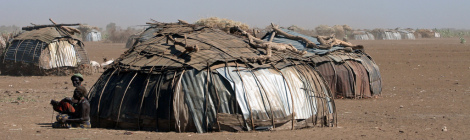
Violence between nomads and sedentary populations has become widespread across the globe and there is an urgent need to address the root causes of this escalation of violence. Conflicts between […]

The environment has often taken a backseat in discussions about conflict, but an increasing amount of evidence suggests that environmental and wildlife conservation could and should be very useful to […]

Introduction The international community is currently underperforming when it comes to integrating the environment into matters of peace and security. Climate change and contemporary armed conflicts are forcing a re-evaluation […]

In 2008, media outlets declared that a new Cold War was unfolding in the Arctic. This story was centred on a small, titanium Russian flag, fixed to the seabed below […]

Like its neighbours in the northern triangle (El Salvador, Honduras and Guatemala), Belize has a high murder rate that is closely connected to the strong presence of gangs. But the character of gang activity in Belize is quite different from its Central American neighbours. Belize has pioneered some innovative solutions to the problem it is facing. But it will need to overcome the challenges of internal resistance and an acute lack of resources in order to address the political, economic and social issues that marginalise Belize’s large youth population.

Facing a myriad of public security challenges that have provoked some of the highest indices of crime and violence in the world, authorities in Central America have followed a variety of different responses, ranging from repressive and reactive policies to grass roots prevention. Of these approaches, the Nicaraguan National Police’s Proactive Community Policing model stands out due to the results it has achieved. In the second of our two-part discussion, ‘Countering Militarisation of Public Security in Latin America’, Matt Budd explores the lessons that Latin American countries can extract from Nicaragua’s unique approach to public security.
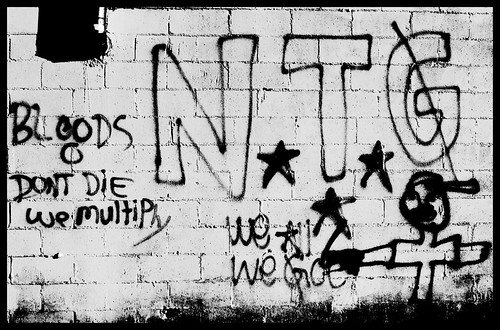 ‘The sheer scale and chaotic construction of the favelas, which became home to hundreds of thousands of migrants, made them the ideal milieu for drug gangs to hide from the police and set up initially paternalistic, de-facto governments, albeit without any concrete political aims.’
This report explores the human insecurity issues that stem from rapid urbanisation, poverty, cultures of violence and ineffective governance.
Source: IRIN News
Image source: Tony the misfit
Delicious Digg StumbleUpon RedditThe UN climate change negotiations in Durban began under a cloud of low expectations, which have been partly dispelled by the last-minute agreement to extend the legally-binding Kyoto Protocol on greenhouse gas emissions. And while Canada, a major emitter, has pulled out of the Protocol, a new environmental divide has emerged that contrasts with the traditional paradigm of developed versus developing countries: the new faultline pits the United States, Canada, China and India, who oppose legal limits for a variety of economic reasons, against the European Union, African, Latin American and island states who favour binding measures – often for reasons of national survival.
The following article from the Director of the International Institute for Environment and Development contrasts the dynamics that have driven both the climate talks in Durban and the debate on European financial regulation that ended with a British veto. While market forces guide the decision-making process in the world of finance, progressive decisions on the world climate have little to recommend them beyond moral appeal. While welcoming the achievements of the Durban talks, she stresses that governments are unwilling to take the steps necessary to curb carbon emissions that they are currently implementing in the name of austerity – but if we address the two problems together, then there is potential for optimism.
Camilla Toulmin | 13 December 2011
The media has been telling a tale of two crises: they are complex, interconnected and have much in common. The common threads include richer countries living beyond their means and racking up high levels of financial and ecological debt over several decades leading to an economic and financial crisis. In Europe, we are due for a substantial adjustment in living standards, to get back into balance. Analysts reckon that in the UK, families will only regain their 2002 incomes by 2016 – and that’s if all goes to plan.
On the finance side, it’s the “markets” which provide the heat that forces politicians to act. Bond buyers will only continue to purchase what the government offers if they feel confident in their commitment to public debt reduction and re-structuring of the economy to generate growth and productivity. These actions are often divisive; Prime Minister David Cameron’s decision to veto a new EU treaty has led to fears that the UK will become isolated if we don’t fully engage with Europe.
If it’s the markets that force us onto the financial straight and narrow, there seems no such force at work to push international leaders to take prompt and effective action on climate change. Unlike the fear and respect of governments for brokers and credit rating agencies, there is no baleful higher power that forces a common approach to safeguarding the planet’s future. The climate vulnerable have no power to press for change, save the moral argument.
But, despite the earlier despondency about potential outcomes from the UN Climate change negotiations, there is some room for optimism. The crucial outcome from Durban is an extension of the Kyoto Protocol. Although only the European Union and a few countries will commit to it, and the time frame for the second commitment period has yet to be decided, it’s extension re-establishes the “principle that climate change should be tackled through a framework of international law.” The agreement also:
* refers to the current emissions gap – the gap between commitments made and commitments needed to meet the 2 degrees Celcius target;
* starts a process for a post 2020 climate treaty which will require emerging economies, such as China, to commit to targets as well;
* establishes a Green Fund which could provide the financial and technical support necessary for the poorest countries to adapt to the effects of climate change, if properly financed.
The threat of bankruptcy has so focused the minds of politicians in Europe, that Greece and Italy have put in place technocratic governments to carry out the difficult and unpopular economic measures that most people recognise need to be taken, but for which no-one has the political courage to take responsibility. Would we be willing to do the same to get real cuts in greenhouse gases?
On both climate and finance, we need a credible plan for the next 10-20 years that people can buy into. This needs to be clearer about the shape of the economy we want. Crisis can be a spur to generate major structural change, as was seen in many countries like Argentina and Brazil in the 1990s. Greening the economy could provide a new narrative for growth. London could use its primacy as a global financial centre to generate the finance for new investments and green infrastructure. Many companies are cash-rich. A firm commitment to a long-term credible plan to shift to a low carbon economy could generate sustainable growth, and create much-needed jobs.
Camilla Toulmin is the Director of IIED.
Article Source: International Institute for Environment and Development
Image Source: European Parliament
Delicious Digg StumbleUpon RedditThe world is witnessing unprecedented forced displacement due to conflict, persecution, and human rights violations. The conflict in Syria has been a major source of this displacement, producing over 7.6 million internally displaced persons and over 4.8 million refugees. The escalation of armed conflict in Iraq since 2014 has also contributed to a dire humanitarian and displacement crisis, and recent data indicate that Iraq is one of the three main origin countries—along with Syria and Afghanistan—for asylum seekers and migrants arriving in Europe. The conflicts in Syria and Iraq have been characterized by mass atrocity crimes including war crimes, crimes against humanity, and possible acts of genocide. As the death tolls and casualties associated with attempts to flee these conflicts continue to rise, the failure of the international community to adequately protect civilian populations targeted by violence underscores concerns regarding the international norm of Responsibility to Protect (R2P). Over ten years after its acceptance by all member states at the United Nations World Summit, the framework for collectively responding to mass atrocities when states have manifestly failed to protect their populations remains weakened by critiques of selective use and by its conflation with coercive humanitarian intervention in the aftermath of its application in Libya. R2P’s association with controversial coercive measures threatens to undermine its legitimacy and overlooks important non-coercive opportunities for implementing the human protection principles that are at its core. In particular, in the wake of mass atrocity situations, facilitating access to asylum and other forms of protection for refugees and displaced persons represents an essential step towards fulfilling R2P.
Linking the Responsibility to Protect and Refugee Protection
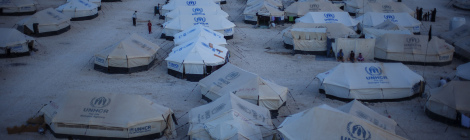
Za’atari refugee camp, Jordan. Image by DFID via Flickr.
There are strong foundations for emphasizing R2P as refugee protection. First, the international norm is intended to apply to mass atrocity situations where there is evidence of war crimes, crimes against humanity, ethnic cleansing, or genocide. The refugee crises associated with World War II, the Vietnam War, the Rwandan genocide, and the Balkans conflicts of the 1990s underscore the connection between mass displacement and mass atrocity crimes. International indifference or opposition to collective refugee burden-sharing in these cases frequently resulted in further victimization. In his study of mass killings, Benjamin Valentino argues that greater international response to refugees could have helped reduce the death toll of many of the 20th century’s worst genocides.
An emphasis on R2P as refugee protection also bolsters the non-coercive and non-violent aspects of the human protection norm at a time when significant criticism surrounding the third pillar of the framework regarding forceful intervention threatens to erode its legitimacy and global consensus. Humanitarian interventions raise concerns about selectivity and often pose significant risks with regard to civilian harm. These risks are compounded by the power asymmetries and realpolitik dynamics that typically characterize coercive interventions. Further associations of R2P with forceful interventions will understandably trigger greater contestations of the norm and undermine the potential for its evolution into meaningful legal obligations. As an alternative to the use of force, states can respond to mass atrocity situations with mechanisms of refugee protection like facilitating access to asylum, granting temporary protection, and upholding the principle of non-refoulement, thus addressing R2P’s call for collective international response in a timely and decisive manner to protect civilian populations and prevent further victimization.
Allocating Responsibility for Refugees
While there are robust foundations for connecting the human protection norm to mass displacement and refugee response, the implementation of R2P as refugee protection faces significant impediments both in Europe and the United States. One major obstacle is refugee burden-sharing. The 1951 Refugee Convention and its 1967 Protocol do not specify how, in the face of major refugee crises, states should equitably allocate legal, financial, or physical responsibilities for protection. While states are obligated by the principle of non-refoulement not to contribute to refugees’ harm by returning them to their place of persecution, international law grants states the right to retain control over their sovereign borders. As such, states are not compelled to grant asylum. A related problem is that the existing refugee protection regime relies on post-World War II assumptions that forced displacement is a temporary phenomenon and refugees will be able to return to their country of origin following the resolution of the conflict. Despite data indicating that displacement has become increasingly prolonged, the repatriation of refugees to their home countries remains more heavily promoted than their resettlement or local integration in host countries.
To date, neighboring states in the Middle East have absorbed the vast majority of refugees fleeing atrocities in Syria and Iraq. This disproportionate burden on states in the region is in line with global trends in the distribution of refugees. Because proximity to place of origin has been a key determinant of distribution, developing countries that can least afford to host refugees have assumed the overwhelming responsibility for them. This inequality in refugee burden-sharing emerges not only due to geographical proximity, but also reflects the increased ability of developed countries to prevent refugees from arriving on their territories. In the ongoing crisis, inequitable burden-sharing is also apparent on a regional level within the European Union (EU), as southern European states have continued to bear the primary responsibility for screening and processing asylum claims. While other EU members have partially shared the burden by committing financial resources to assist Greece and Italy and by hosting some refugees through relocation frameworks, as of November 2015 only three states—Germany, Austria, and Sweden—fulfilled their committed quotas for relocating refugees. Debates over refugee burden-sharing in Europe have underscored tensions between EU principles and individual member states’ willingness to implement norms of equity in refugee protection.
While discussions of refugee burden-sharing have largely focused on capability—that is, states’ relative capacities to assist refugees based on factors like economic development, population, and territorial size—the criteria that ought to govern the allocation of refugee responsibility remain ambiguous. The EU plan for distributing asylum seekers approved in September of 2015 utilized economic strength, population, unemployment, and the number of asylum applications approved in the last five years as criteria; however, this resettlement plan has faced opposition from central and eastern European states, and Poland announced that it would not participate. Complicating the task of determining how refugee protection responsibilities should be allocated is the notion that a country’s culpability in the creation of the displacement might also shape its obligations to respond.
The Securitization of Refugees
Even if consensus can be reached at the international level regarding principles of equitable refugee burden-sharing, policymakers can increasingly expect resistance from their domestic publics rooted in logics that link refugees to fears of terrorism and perceptions of foreigners as threatening. The implementation of R2P as refugee protection thus faces significant hurdles related to the securitization of asylum seekers—particularly those from Muslim-majority countries—as threats to both national security and cultural values in the United States and Europe. Increased fears of terrorist infiltration via refugee flows have produced calls to round up Syrian refugees and resulted in the U.S. House of Representatives passing H.R. 4038, the American Security Against Foreign Enemies (SAFE) Act. Opposition to refugees at the domestic level has also manifested in arson attacks against refugee shelters in Germany and violence against refugees in France. As refugees are increasingly conflated with migrants, and the current crisis emanates largely from the Middle East, perceptions of asylum seekers have become linked to broader debates about immigration and Islam. In this context, domestic political forces in Europe and the US have framed the refugee crisis in ways that undermine the potential for R2P to be successfully reoriented as refugee protection.
Navigating these obstacles requires grappling with representations of refugees in social and political discourse, as well as articulating how refugee burden-sharing can serve states’ national interests. Organized and predictable responses for allocating refugee responsibilities could, for example, support greater international stability and reinforce principles of cooperative security. In an increasingly interdependent global environment, fulfilling R2P through refugee protection could arguably compliment counterterrorism policies and contribute to an international protective infrastructure that facilitates better coping with transnational threats and humanitarian emergencies.
Alise Coen is currently Assistant Professor of Political Science at the University of Wisconsin-Sheboygan, USA. Her article, ‘R2P, Global Governance, and the Syrian Refugee Crisis’ was recently published in the International Journal of Human Rights. She is on Twitter at @alise_coen
Author’s note: This contribution is partly based on an article published by Weeraratne and Recker in 2016 and provides an updated assessment of the security threat posed by the ADF in the Ugandan/Congolese borderland.
The Allied Democratic Forces—a militant Islamist group in the Ugandan-Congolese borderland—have been depicted as a serious threat to regional security with links to transnational Jihadist groups. But how accurate is this story and what threat does this group actually pose?
The Allied Democratic Forces (ADF), commonly perceived as a “militant Islamist group,” is a violent non-state movement operating in the Ugandan-Congolese borderland. The group has increasingly been in the spotlight and stands accused of carrying out numerous attacks since late 2014, mostly in and around the city of Beni in the northeastern province of North Kivu in the Democratic Republic of Congo (DRC). According to data from the Global Terrorism Database, the ADF carried out 80 separate attacks against civilians and government/military targets from October 2014 to December 2015, resulting in a cumulative total of 507 fatalities. Similarly, Human Rights Watch and a report published by the UN Group of Experts on the DRC estimate well over 600 fatalities in attacks attributed to the group over the last two years.
The Ugandan regime and their Congolese counterparts have been quick to highlight the growing security menace presented by the ADF and often portray the group as a militant Jihadist movement with a litany of ties to transnational Jihadist groups like Al-Qaeda, Al-Shabaab and Boko Haram. However, many analysts caution that the deteriorating security situation in Beni is not entirely due to the ADF and present mounting evidence of complicity of several other actors in the violence. Furthermore, the dogged portrayal of the ADF as a predominantly Islamist militant group with ties to transnational terrorists is a simplistic and overly opportunistic narrative that overplays the role of religion and mischaracterizes the varied objectives of the many disparate elements that increasingly constitute the ADF.
Origins and evolution of the ADF
The ideological roots of the ADF grew in the 1980s in central Uganda as a response to the Museveni government’s perceived discrimination towards its Muslim population. The precursor to the ADF was the Ugandan Mujahidin Freedom Fighters, an armed group instituted by The Islamic Salaf Foundation and composed mainly of members of the puritanical Tabliq sect. A controversial decision by the Ugandan Supreme Court in 1992 to rule in favor of a rival Muslim group further radicalized the Tabliq movement. They retaliated violently, fled to western Uganda and engaged the Ugandan military in sustained fighting. After a series of defeats, the Tabliq retreated to the DRC, from where they established the ADF in 1996, under the leadership of Jamil Mukulu.
Despite its central Ugandan origins, the ADF’s principal theatre of operations has long been the Rwenzori mountainous region straddling western Uganda and the eastern DRC. This choice of location as a base was influenced by the region’s celebrated history of contentious mobilization, weak central government control on either side of the border, similar cross-cultural traits and ample opportunities for collusion with numerous other militant groups embroiled in the larger Congolese war. One such group was the National Liberation Movement for Uganda (NALU), which fled to the DRC following military defeat by the Ugandan army. In 1996, NALU formed an association with the ADF in the city of Beni. Several common denominators united the two groups; distrust of the Museveni regime, their presence on Congolese soil and external support provided by the Sudanese and Congolese governments. The ADF-NALU partnership carried out numerous attacks in the 1990s; conservative estimates indicate that over 1,000 people were killed and over 100,000 displaced from 1996-2001. Prominent targets included police stations, administrative buildings and schools.
The Ugandan military deployed troops across the border in eastern Congo in 1998 to combat the ADF threat. Multiple leaders were killed or captured and the movement was largely destabilized by 2002. The rebels retreated deeper into the DRC and the departure of the Ugandan troops in 2003 allowed the ADF-NALU alliance to regroup through vigorous recruitment. The next few years were punctuated by intermittent attacks by the ADF and military offensives launched by the Ugandan army, Congolese army and the UN Mission in the DRC. In 2007, the ADF lost its NALU component as the latter surrendered and acquiesced to a political settlement with the Ugandan government.
Recent escalation in violence
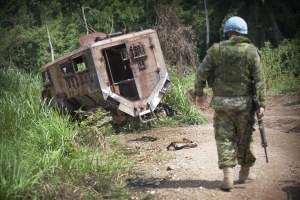
UN vehicle ambushed by the Allied Democratic Forces (ADF). Image credit: UN Photo/Flickr.
After a period of relative dormancy from 2007 to 2013 that was interspersed with occasional bouts of violence, there has been a significant resurgence in ADF activity over the last two years. A series of devastating attacks on civilians in the eastern Congo since October 2014 has left over 600 dead, tens of thousands displaced and many of the attacks have been marked by high levels of brutality. Survivors and witnesses have spoken of kidnappings, rape, torture, abduction of children and rampant destruction of property. Furthermore, the ADF was accused of killing Muslim clergy members in Uganda in early 2015. Also contributing to the escalation in violence has been Operation Sukola I, launched against the ADF by the Congolese army and the UN Stabilization Mission in the DRC (MONUSCO), in January 2014. Continued military operations have seen the ADF suffer several battlefield defeats and the militants have been forced to flee into the forest. It is reported that the ADF fragmented into smaller groups to improve their chances of avoiding detection from the advancing Congolese forces. Many senior commanders are still missing; however, after a protracted search, ADF’s leader, Mukulu, was arrested by the Tanzanian police in Dares Salaam in April 2015 and later extradited to Uganda where he was convicted on charges of treason.
There is little doubt that the ADF has been responsible for at least some of the attacks in and around Beni. While the ADF did carry out intermittent acts of violence against civilians, the arrangement between the ADF and the local community, at least until 2013, was one of “cooperative (if oftentimes) reluctant coexistence.” In general, the ADF respected the “traditional hierarchy of the host communities” and in 2011, was estimated to command “the popular support of nearly half of the population of Beni territory.” The increasing focus on civilian targets since 2014 may partly be due to the fact that as the military offensive against the ADF intensified, the group carried out numerous reprisal attacks on civilian informants alleged to have collaborated with the UN and Congolese forces. As one scholar noted, “people are being punished and killed when they don’t want to collaborate” with the ADF.
While the Ugandan and Congolese governments have portrayed the ADF as the primary culprit (for a variety of instrumental motivations), it is increasingly apparent that other actors have been involved in the massacres in North Kivu, including members of the Congolese armed forces, other rebel groups and communal militia. Moreover, as the ADF fragmented into smaller units, the absence of a centralized chain of command resulted in different groups pursuing diverse agendas. Some ADF factions, accused of violence, formed ties with local militia and outside elements who were then also involved in some of the killings. Indeed, interviews with survivors and witnesses suggest that many attackers spoke languages not normally used in this part of the Congo. Further, the breadth and the scope of violence as well as the nature of weapons used are suggestive of the involvement of multiple armed actors. The UN Group also concluded that some Congolese army officers played an overt and covert role in support of certain incidents of violence. While the precise underlying triggers for the violence are not clear, there is evidence that localized conflicts over land and power struggles over leadership contributed to at least some of the attacks. The dominant narrative of blaming the ADF is widely entrenched and largely unquestioned and has hampered efforts to dig deeper into the causes of the violence.
The “Islamist” character of the ADF
The ADF are commonly depicted as an Islamist terrorist organization with a complex array of ties to regional jihadist groups. Consequently, it is seen to pose an existential security threat to the region. The Ugandan government in particular has aggressively peddled this misleading narrative. It is true that ADF’s inception can be traced to a core group of puritanical Muslims from the Salaf Tabliq movement. ADF’s erstwhile leader, Jamil Mukulu, is a strong adherent of Salafi Islam and has indicated his desire to overthrow the government of Uganda and establish an Islamist state based on Sharia law. The ADF has distributed incendiary tape recordings of Mukulu that urge followers to wage a holy Jihad, carried out forcible conversions of non-Muslims, conducted Islamic instruction in training camps and meted punishments in accordance with Islamic law.
However, Scorgie-Porter argues forcefully that an exclusive focus on the religious aspect provides a limited account of the group’s motives and neglects other important strands to the development of the ADF. Some suggest that the group was mainly driven by a political agenda of removing the Museveni regime and used its Islamic identity instrumentally. A former ADF militant contended that “the agenda of the ADF was purely political…the ADF adapted the grievances of Islam in order to appeal to these people. Islam was a ticket, so the leaders disguised their political motives in religion.” Titeca and Vlassenroot resist reducing the role of Islam to instrumental usage, but suggest that the religious reference co-existed with other agendas such as regime change. They describe the ADF as a “rebellion without cause,” and contend that the movement’s agendas have changed over time. For instance, during recent peace talks, the principal ADF demands revolved around socioeconomic issues such as reintegration of demobilized soldiers rather than effecting regime change or Islamic governance.
ADF is often described as a multi-layered entity comprising several different elements with varying agendas. While the Tabliq network served a vital role in recruitment and was largely responsible for securing funds from Islamic charities and foreign countries during the group’s formative stages, ADF is considerably less reliant on the Tabliq now. Recruitment in the ADF has also been heavily contingent on non-religious factors such as the exploitation of deep-seated perceptions of marginalization, poverty and the lack of alternative opportunity in the Rwenzori borderland. ADF’s economic embeddedness in the local community provides the group with its primary avenues of funding and material support at present and the group’s financial contributions from Islamic sources have considerably dwindled over time. Due to the group’s tendency to seize resources from local populations, some have gone as far as to describe the group as little more than “bandits”.
Conclusion
The Ugandan government has consistently attempted to link the ADF to global Jihadi groups and, in turn, depict the group as a serious threat to regional security. Some sources do suggest that elements of Al-Qaeda had sporadic ties with the ADF in the 1990s and provided some financial assistance. Reportedly, Osama bin Laden even met Mukulu while they were both in Sudan in the early 1990s. Similarly, there has been occasional correspondence with Al-Shabaab operatives. However, such ties have been infrequent and there is little concrete evidence that regional Jihadists have any meaningful ties with the ADF. Indeed, Weeraratne and Recker argue that ideological incongruence, lack of salience to the local community and the fear of attracting more attention from counter-terrorism operatives reduce the likelihood of the ADF forming significant connections with transnational Islamists. Moreover, given that less than 10% of the population is Muslim in ADF’s chief operating environment in eastern Congo (a region that has shown very few signs of radicalization), it is unclear how foreign Jihadists would benefit from a union with the ADF.
Museveni’s regime has a vested interest in embellishing real or perceived links between the ADF and foreign Jihadists. First, it allows the regime to deflect attention from its authoritarian tendencies and project itself as a key ally in the US led war on terror; in turn, making it easier to attract American military and diplomatic assistance. Second, exaggerating links also justifies the maintenance of high levels of military spending and gives the government a convenient alibi to continue raids on the eastern DRC where it has a range of interests.
In summation, the portrayal of the ADF as a mainly Jihadist group is incomplete at best and deceptive at worst. It is clear that the ADF is not a monolithic organization with a dominant preference for executing a puritanical Islamist agenda. The group has moved away from its earlier stated ambition of overthrowing the Museveni regime and replacing it with Islamist governance. The present day ADF constitutes a motely array of disparate interests, many of which are linked to economic and local political issues. To be clear, this is not to say that the ADF does not pose a security threat. As discussed earlier, the group was responsible for several of the attacks over the last two years. However, at least for the foreseeable future, ADF’s threat is likely to be confined to the rural areas in Beni. Hence, the group is unlikely to pose an existential security threat to either the Ugandan government or their Congolese counterparts.
Suranjan Weeraratne is a faculty member in the Department of Political Science, Southern Illinois University Edwardsville. His research focuses on various aspects of terrorism, including examining linkages between transnational militant groups and studying patterns of terrorist funding.
In peacekeeping missions, peacekeepers live seperated and segregated from the local communities which they are mandated to protect. This wide gulf between the everyday lives of peacekeepers and locals has consequences for peace interventions’ effectiveness and outcomes.
A truism of international peace interventions is that peacekeepers – and international peacebuilding personnel writ large – live in the same place as local residents, but do not live in the same world. The peacekeeping world is air-conditioned, clean, and well-guarded; it consists of decent housing, generous pay, access to vehicles, domestic help, and, usually, a robust (if limited) social life that revolves around expensive restaurants, hotels, bars, and clubs. In other words, peacekeepers live, work, and socialize in what I call ‘blue helmet havens’, distinct from the spaces most locals inhabit. They are spatially, economically, culturally, and in many cases linguistically separated or segregated from the majority of the local population of the ‘peace-kept’ city. As a Goma-based source put it, peacekeepers are ‘living in Congo’ but not ‘living Congo’.
The security and safety of peacekeeping personnel and property is the dominant justification for the ‘bubble’ in which peacekeepers live. Notably, this separation is enacted not only by barriers, bunkers, and security guards, but also by various peacekeeping rules, regulations, and norms that mitigate – if not actively discourage – informal or social contact between peacekeepers and locals.
Thus, peacekeepers’ off-duty movements are circumscribed by the security perimeter zone that is established by the mission’s internal security service, which delineates where peacekeepers can live, shop, and socialize and, in capitals and other urban areas, excludes vast swathes of the host cities. Even within the zone, peacekeepers are advised never to move on foot. They are required to live in gated and guarded compounds; are given black-lists of proscribed social venues; and, besides being prohibited from buying sex while in the mission area, are also strongly discouraged from having any intimate or sexual relationships with locals. These formal rules and regulations are reinforced by informal norms and mission cultures, which are heavily oriented towards keeping the peacekeeping bubble intact and exclusive. Cumulatively, the extremely risk-averse approach that missions take towards peacekeepers’ interactions in and with their surroundings means that the contact between peacekeepers and locals is both sparse and essentially transactional. There exists a wide gulf between the everyday lives of peacekeepers and locals, and very few means to bridge it.
Peacekeeping-as-enterprise in the peacekeeping ‘bubble’
Image by UN Photo via Flickr.
But why is this important? Research shows that the gap in proximity and understanding between the international and the local matters for peace interventions’ effectiveness and outcomes. For example, in her book Peaceland, Séverine Autesserre argues that the shared everyday habits, practices, and narratives of international interveners simultaneously enable international peacebuilders to work in challenging environments, and degrade the effectiveness of peacebuilding interventions. In other words, she asserts a direct link between the peacebuilding bubble and peacebuilding outcomes.
My own research also deals with the distorting effects of the peacekeeping bubble. Using the analytical lens of the peacekeeping economy – which encompasses the services, establishments, and activities needed to allow peacekeeping and peacekeepers to function, and which to a large extent frames and contains the peacekeeping bubble – I have argued that in areas with robust peacekeeping economies, peacekeeping appears to locals more as an enterprise than protection or development. Where peacekeeping economies flourish, they are as visible and tangible to local citizens as anything else done by peacekeeping missions – maybe even more so. It is thus unsurprising that, when people look around them and see money flowing and where it flows, they conclude that, heroic narratives aside, peacekeeping is not that different after all: it is all about the money. This in turn fosters cynicism and resentment among local citizens towards the peacekeeping mission, from which it is plausible to draw a connection to subpar results. On the peacekeepers’ side, meanwhile, what is striking is the extent to which their arms-length relation to the local reveals a sense of vulnerability – a perception of themselves as potential victims of exploitation, crime, or violence, thus upending the normal framing of peacekeepers as powerful, dominant protectors. On both sides, the strict separation between the peacekeepers and the local encourages, if not fosters, a lack of understanding and trust.
Taken together, then, this paints a picture of peacekeeping and peacekeepers as purposefully disconnected from the local everyday, apart from the microeconomic transactions contained by, and constitutive of, the peacekeeping economy. When it comes to how peacekeeping really works, the peacekeeping bubble is as relevant and significant as the peacekeeping mandate. Problems associated with this bubble’s existence include local suspicion of missions’ activities and motives; and a dearth of knowledge of, and empathy towards, locals from peacekeepers – each of which could be reasonably conjectured to inhibit the effectiveness and transformative potential of peacekeeping.
Security, estrangement, and stasis in peacekeeping transformation
An obvious implication of this contention is that international peace interventions will work better and more empathetically if the prevailing separation and segregation is lessened, such that the international and local ‘everydays’ are more enmeshed and aligned. But how would this work? Is it even possible?
There are modest proposals that missions could immediately initiate in order to promote an environment of mutual trust and more substantive formal and informal contact between peacekeepers and locals, which could eventually make peacekeeping environments safer for both peacekeepers and locals alike. For example, to mitigate the negative effects of the peacekeeping economy on the local economy and labour market, missions could:
The most significant obstacle to peacekeeping transformation lies in the area of security. The tendency in peacekeeping missions to take greater and greater precautions to obviate danger and avoid risk is not without reason: persuading member states to contribute troops and money to peacekeeping is significantly more challenging if the UN is perceived to be reckless, and recruiting civilian peacekeepers also becomes more difficult. But ‘security’ in peacekeeping increasingly seems to mean the elimination of risk – whether stemming from armed groups, organized or ordinary criminals, fraudsters and scam artists, or everyday activities like driving, eating out, having sex, or walking down the street. According to such a standard, peacekeeping missions will never be fully secure. Nor, for that matter, will anything else. Peacekeeping institutions (headquarters and missions) and peacekeepers surely recognize this reality, yet there is little evident willingness at any level to push back against ever-escalating security demands and regulations.
In this heavily securitised and risk-averse environment, where protection of peacekeepers is (and always has been) mandated equal to protection of civilians, separation is the path of least resistance. This implies that fundamental transformation in how peacekeeping missions situate themselves to local people and communities is unlikely. Missions’ estrangement and alienation from the local community and the local ‘everyday’ is a feature, not a bug; and thus that whatever losses may ensue – of legitimacy or effectiveness – is a price that the peacekeeping apparatus is willing to pay.
Kathleen Jennings is a senior researcher at the Fafo Research Foundation in Oslo. Her work focuses on UN peacekeeping, gender, and political economy in sub-Saharan Africa. Jennings recently defended her PhD thesis on gendered peacekeeping economies in Liberia and the DR Congo. She has previously worked at the Norwegian Peacebuilding Resource Centre and the Council on Foreign Relations.
Executive Director of the Sustainable Security and Peacebuilding Initiative at the Center for American Progress, John Norris discusses the need to consider options carefully to avoid militarising the West’s response to the crisis in Libya. He writes that blowing up a runway or imposing a no-fly zone are not silver bullets. And one would hope that after the experience of both Afghanistan and Iraq—and earlier interventions such as Kosovo and Bosnia—we understand that war is a dangerous, uncertain business.
Image source: Quigibo.
Dangerous pressures are pushing international warfare in the direction of the absolute, imperiling the future of mankind. Undoubtedly, the foremost of these pressures is the emergence, use, retention, and proliferation of nuclear weapons, as well as the development of biological and chemical weapons of mass destruction.
Since Hiroshima and Nagasaki there have been several close calls involving heightened dangers of nuclear war, especially during the 45 years of Cold War rivalry. None of these was more frightening than the Cuban Missile Crisis of 1962, when it took Soviet willingness to reverse their decision to deploy missiles in Cuba to avert a slide into catastrophic nuclear war.
To entrust such weaponry to the vagaries of political leadership and the whims of governmental institutions seems like a Mount Everest of human folly. Yet there is little outcry against nuclear weapons today, despite the collapse of the deterrence rationale that seemed to make reliance on the weaponry somewhat plausible during the decades of confrontation between the Soviet Union and the United States. Even under Cold War conditions, deterrence was seen by peace activists as a form of geopolitical insanity widely known by the descriptive acronym “MAD”, short for “Mutually Assured Destruction”.
Underneath the tendency of powerful governments to develop whatever weapons and tactics technology can provide are the fragmented political identities of a world divided into sovereign political actors. The inhabitants of these states of greatly varying size, capabilities, vulnerabilities, cultural and political traditions have long been indoctrinated to approve blindly of the actions of their own state. The idolatrous eyes of nationalism treat the extermination of an enemy as an acceptable goal if necessary for national security, and even desirable, if it is seen as furthering national ambitions.
Beyond this, defending the security of one’s own state is viewed as an unconditional prerogative, vindicating even a suicidal reliance on nuclear weaponry. The ideology of nationalism, nurturing the values of unquestioning patriotism and militarism in the modern West, have led to an orientation that can be described as secular fundamentalism, embodying imperial worldviews, however dysfunctional, given the risks and limits associated with continuing to seek desired political ends by relying on military superiority. The crime of treason reinforces these absolutist claims of the secular state by disallowing citizens of democratic states any right to claim conscience, law, and belief in support of their deviant behaviour.
‘Militarist frustration’ since WWII
Any objective study of international history will show that the militarily superior side has rarely prevailed in an armed conflict since the end of World War II unless it has also been able to command moral and legal legitimacy. The political failure of the colonial powers despite their military dominance provide many bloody illustrations of this recent trend toward militarist frustration, starting in the middle of the 20th century.
Because of entrenched bureaucratic and economic interests (the “military-industrial-media complex”), the evidence of the decline of hard-power geopolitics has been ignored. As a result, dysfunctional military solutions for conflicts continue to be relied upon in the West, especially by the United States, and costly and futile recourses to war are repeated over and over without lessons of restraint being learned. Experience, which might provide a rational limit on militarism, has been neglected; instead, old habits persist.
Another check on the excesses of warfare is supposedly provided by the inhibiting role of conscience, the ethical component of the human sensibility, that is supposed to be a hallmark of citizenship in liberal democracies. This sentiment was vividly expressed in a Bertolt Brecht poem, “A German War Primer”:
General, your bomber is powerful
It smashes down forests and crushes a hundred men
But it has one defect:
It needs a driver.
A driver is both a human cost, and maybe a brake on excess, as Brecht suggests a few lines later:
General, man is very useful
He can fly and he can kill
But he has one defect:
He can think.
Of course, military training and discipline are dedicated to overcoming this defect, especially when complemented with nationalist ideologies. International humanitarian law has vainly been trying to impose limits on combat behaviour in wars, but almost always yields in practice to considerations of “military necessity”.
The Nuremberg Trials decided that “superior orders” were no excuse if war crimes were committed, a breakthrough in establishing responsibility for adhering to law in relation to war, but flawed by its character as “victors’ justice”. Although beset by double standards, this Nuremberg tradition of imposing individual accountability for political and military leaders has persisted, and has recently been revived through the establishment of the International Criminal Court in 2002.
In the nuclear age, this process of dehumanising the military machine went further because the stakes were so high. I recall visiting the headquarters of the Strategic Air Command (SAC) at the height of the Cold War. SAC was responsible for the missile force that then targeted many cities in the Soviet Union. What struck me at the time was the seeming technocratic sensibility exhibited by those entrusted with operating the computers that would fire the missiles.
This amoral posture contrasted with the ideological zeal of the commanding generals who would give the orders to annihilate millions of civilians at distant locations. I was told at the time that the lower-ranked technical personnel had been tested to ensure that moral scruples would not interfere with their readiness to follow orders.
I found this mix of politically and morally driven commanders and amoral subordinates a most disturbing mix at the time, and still do, although I have not been invited back to SAC to see whether similar conditions now prevail. I suspect that they do, considering the differing requirements of the two roles. This view seems confirmed by the enthusiasm expressed for carrying on the “war on terror” in the aftermath of the 9/11 attacks. Although my remarks here are confined to the United States, I would suppose they apply to other major governmental bureaucracies dealing with national security and war/peace issues.
Use of drones dehumanises war
Now, new technological innovations in warfare are underlining these concerns. American reliance on drone attacks in Afghanistan (and elsewhere) removes the human altogether from the war theater, except in the geographically remote roles of programmer and strategic planner. And even then, reliance on algorithms for targeting removes any shred of personal responsibility. When mistakes are made, and innocent civilians are killed, it is treated as an unfortunate anomaly.
The tragic event is deprived of its human quality by being labeled “collateral damage”, and a formal apology is usually made. But nevertheless, the practice goes on: the US is investing heavily in more and better drones for future wars. Eliminating the presence of human soldiers from the battlefield is a chilling development: historically, the fact that war put soldiers’ lives at risk forced citizens to think about whether a war was morally right, or worth fighting. The anti-war sentiments of American soldiers in Vietnam exerted a powerful influence that helped over time finally to bring the war to an end.
Ultimately, what is at stake is the human spirit, which at the moment is being squeezed to near-death by technological momentum, corporate greed, militarism, and secular fundamentalism. The ultra-sophistication of the new weaponry and the accompanying military tactics create a new divide in the military sphere, giving rise to an era of virtually “casualty-free” and one-sided wars where the devastation and victimisation are shifted almost totally to the technologically inferior side. Examples include The Gulf War of 1991, the Kosovo War of 1999, and the Gaza Attacks of 2008-09. In the background, however, is the persisting threat of a use of nuclear weapons either by a state or an extremist non-state actor that could in a flash change this ratio of comparative vulnerability.
This web of historical forces continues to entrap major political actors in the world, and dims hopes for a sustainable future, even without taking into account the growing threat of climate change. Scenarios of future cyber warfare are also part of this evolving capacity to destroy distant societies without any human interaction. The cumulative effect of these developments threatens to make irrelevant the moral compass that alone provides acceptable guidance for a sustainable political future. Because international institutions remain too weak to provide global governance, reason and prudence remain the best hope to guide human destiny.
Richard Falk is Albert G. Milbank Professor Emeritus of International Law at Princeton University and Research Professor in Global and International Studies at the University of California, Santa Barbara. He has authored and edited numerous publications spanning a period of five decades, most recently editing the volume International Law and the Third World: Reshaping Justice (Routledge, 2008) and Achieving Human Rights (Routledge 2009).
He is Chair of the Board, Nuclear Age Peace Foundation and Director, Global Climate Change Project, UCSB. He is currently serving the fourth year of a six year term as a United Nations Special Rapporteur on human rights in the Occupied Palestinian Territories.
This article originally appeared on Al Jazeera’s English website.
 Delicious
 Digg
Digg StumbleUpon
 Reddit
The announcement of fresh counter-terrorism powers in the UK follows assertions that returning foreign fighters present a substantial new threat to national security. But these powers may be counter-productive in the long term, risking a legacy of injustice that will only exacerbate the political tensions of the War on Terror.
Following the vote to renew the Trident nuclear programme, a former nuclear-armed submarine commander discusses why the UK needs to seriously rethink its attitude to nuclear weapons.
Editor’s Note: Commander Forsyth’s explanation as to why he has changed his view on the deterrence value of the now and future Trident weapon system was originally written for family members. It has been edited by the ORG with the full involvement and agreement of Commander Forsyth to be suitable for wider publication. Of particular interest is his alternative proposal for a smaller, ‘for but not with’ and more versatile submarine platform as a stepping stone to reducing the level of ready use weapons whilst preserving the ability to resurrect full CSD posture if required.
In 1972 I became Executive Officer of HMS Repulse, one of the four Polaris A3 missile-carrying submarines based on the Clyde. Based on this experience I can say, without any sentiment or exaggeration, that the use of nuclear weapons during the Cold War would have threatened the existence of humanity.
I believed that Mutually Assured Destruction (MAD) was at the centre of the UK’s deterrence policy, meaning that if the Soviets fired at us then we (as well as the USA and, latterly, France) would respond in such measure as to immediately annihilate several major cities in the Soviet Union.
The consequential radiation effects of any nuclear detonation would largely complete the destruction and this would almost certainly have caused a ‘nuclear winter’.
MAD and the Cold War

Commander Forsyth on HMS Sceptre.
The policy of MAD would, we were told, only have been used in retaliation to a Soviet nuclear first strike with missiles en route to Europe or the USA. We were constantly assured that under no circumstances would we fire our Polaris missiles first even if tanks were rolling across the German plain, unless the Soviets had already fired nuclear weapons at us.
As Paul Rogers notes, the UK’s other tactical nuclear weapons could have been used against such a Soviet offensive. Yet at the time we thought that this would not necessarily start a strategic exchange. Perhaps naively, we tended to consider Polaris in isolation from the tactical battlefield and on a whole different level.
The UK’s retaliatory only policy (assuring a second strike was possible) let us sleep easily at night during the years that we took 16 Polaris missiles to sea. As Nick Ritchie explains, each of these missiles carried two warheads with an estimated yield of 40kt. Thus, with 16 missiles per boat, just one patrolling submarine could have fired 32 40kt warheads, which would have given a potential explosive yield of 1.28 megatons—hence why we called what would happen if they were used Armageddon.
Understanding the power of the bomb
The US had many more submarines, aircraft and land-based missile silos. Our contribution was a gesture of togetherness against a common enemy whose declared policy was assumed to be ‘world domination by any means’.
Periscope pic of torpedo tracks approaching the target.
In comparison, the atomic bomb that physically destroyed the Japanese city of Hiroshima in WWII and killed 100,000 people in the process had just a 15 kiloton yield. So when Prime Minister Theresa May stated in parliament last July that she was prepared to press the button and kill 100,000 people, we should recognise that the number of deaths she was referring to was significantly less than that which Polaris missiles were capable of inflicting—never mind the massive collateral structural and radiation casualties which would result.
Each Trident warhead has a yield of up to 100 kilotons, which, in terms of destructive power, is equivalent to six or seven Hiroshimas. The UK presently deploys 40 nuclear warheads and not more than eight missiles on its four submarines, meaning that the destructive power on board just one of these submarines, if used at the same time against a densely populated country, would kill considerably more than 100,000 people.
Justifying nuclear use
The ownership of this sort of power begs the question: what threat might justify the use of such destructive force? We also need to be clear under what circumstances and at what scale the Prime Minister might authorise a nuclear strike because she could be taking us all with her.
Two government statements are relevant to this discussion:
Keeping the option open of using nuclear weapons first against an adversary who you judge is threatening your ‘vital interests’ with non-nuclear force is quite different from MAD. This is what makes me question the whole basis of what we may or may not do with Trident. Formerly we would not have fired Polaris missiles until British cities had been totally destroyed by a megalomaniacal action by the Soviets. It would have been a futile gesture by us but the threat of doing so was considered to be a deterrent. Now it is ultimately a matter of the Prime Minister’s judgement as to whether we embark on a nuclear war. This raises the prospect of deliberately causing Armageddon as opposed to a reaction to one already started.
In which case, I would argue that we have the right seriously (a) to question whether the Government should have that power and (b) if so, to constrain the circumstances in which such power can be used. As Nick Ritchie points out, the UK ‘does not dispute that international humanitarian law applies to the use of nuclear weapons and has incorporated the notion of “extreme circumstances of self-defence” into its declaratory nuclear policy statements’. Yet will all future Prime Ministers follow such guidelines in practice?
The need to ask these questions, and decide if building a new generation of nuclear weapons is justified and will ‘keep us safe’, is particularly important given that no military case has been made for Trident’s use by its supporters—other than the vague statement that we don’t know what the future holds.
Reference to the prospective use of nuclear weapons is nearly always qualified by adding that they are a weapon of ‘last resort’. As part of the Prime Minister’s decision making process she has therefore, at the very least, to be satisfied that all other alternative avenues have been exhausted, starting with the political and economic ones, escalating up through the increasing use of conventional military power.
Rethinking what military capabilities the UK needs

Image of Trident missile via Wikimedia.
When I was at sea in the 1960s and 1970s the UK invested in both the Polaris force and significant conventional armed military forces in all three services. The country was able to send a Task Force as far afield as the Falklands and, more importantly, the armed forces were strong and large enough to withstand the quite considerable attrition—particularly in the Navy—in fighting a full-on war.
The services have gradually been whittled down to a level in which such a Task Force could not be assembled. By its own admission the Navy does not have enough ships and submarines to meet peacetime commitments—never mind war. The six Type 45 destroyers designed to protect the UK’s two new carriers were victims of over-design and under-funding (albeit costing £1billion each) such that they are now in harbour with major operational limitations which will take some years to be rectified.
Meanwhile, the next generation of frigates have been delayed. When they do come they will have outdated equipment and there will still not be enough of them to give anti-submarine warfare protection to the carriers—unless they forego other roles of which there are many. The Army and Air Force also have their own tales of woe—soldiers die for lack of body armour and the correct vehicles because the military budget has to cope with the costs of Trident.
Why is this? To some extent you can blame senior officers for lack of management ability and vision when challenged by the need to meet major commitments with a constantly reducing budget. They should perhaps have been stronger and said we are not well placed to play the role assigned in the Iraq war, be peace keepers afterwards and also embark on a new war in Afghanistan. The ‘can do’ spirit has been counter-productive.
However, the other budgetary factor is that the cost of building four Successor submarines alone is now set to cost at least £31 billion. You can buy quite a lot of aircraft carriers, frigates and hunter killer submarines for that.
The consequential reality is that we have very little conventional capability before the use of Trident becomes our last resort—a very dangerous situation for world peace. So who are we likely to need to use our last resort against having said that rogue states and dirty bombers are not likely targets? The answer is no one at the moment. Yes, Russia is acting aggressively, waving their nuclear weapons stick, but Russia has no grand plan for world domination. I must therefore conclude that the Royal Navy is being exploited to operate a political status symbol with no military value at the cost of other important capabilities.
There is no threat to the UK that justifies our nuclear force
During the Cold War the UK’s nuclear-armed submarines were at 15 minutes notice to fire. Since 1994 however, following an agreement with Russia, the UK’s nuclear weapons have been de-targeted—although this situation could be quickly reversed. The Trident submarines are lurking on standby ‘just in case’, so there is time to target and arm them if the situation escalates. Saying North Korea is a threat to the UK is not credible. Pyongyang may become a threat to US interests, but even that is unlikely and the US is more than capable of responding.
Some may argue that now is not the time to lay down our nuclear arms because it might further destabilise our position in Europe and be seen as a further ‘weakness’ post-Brexit. But what does this mean? That the Russians will see an opportunity and seize it? I believe they know, despite the Prime Minister’s words, that we would not fire our nuclear weapons except in retaliation to a major nuclear first strike by them—which they are unlikely to launch. But I also believe it is possible that Putin could take advantage of our regular Force’s weakness, for example, through giving covert military support and overt political support to ‘popular’ pro-Moscow uprisings in Russia’s near abroad. The calculation here would be that NATO would likely find it difficult to find an effective response to such manoeuvres.
As for a developing intercontinental threat from elsewhere in the future, if it’s not on the drawing board now (and it’s not) then we have time to consider our options. Designing a submarine today to go to sea in 17 years’ time to counter a future undefined notional threat is really fighting yesterday’s war with yesterday’s technology. By making that decision now it becomes harder to change our posture as more and more money is poured into the Successor programme.
Is there an alternative? Yes there is. If, despite all the above, the UK decides it needs to have a nuclear weapon system for ‘insurance’ reasons then a submarine platform is probably the best vehicle to carry it because it is considerably less vulnerable (I would not use the word invulnerable now) to counter-detection than cruise missiles, aircraft or land based weapon platforms. However, the problem with the current and future Trident submarines is that they are a single purpose platform, very big—consequentially comparatively slow—and really only have a self-defence capability. They contribute nothing to peacetime surveillance or war-fighting capability in any other area than firing strategic missiles and cost the earth.
We have already reduced the number of missiles per boat so why not make a further reduction to say four per boat and fit a missile section into existing Astute class hunter-killer submarine hulls?[1] This option could save money, enable a dual role and, by building five, two or even three of them could be at sea at any time in either role and be a useful enhancement to the UK’s broader submarine needs.
Furthermore, if the Government wished to demonstrate its willingness to comply with the Nuclear Non-proliferation Treaty, then missiles and warheads could be placed in ready-use store. This is justifiable on the basis that there is no threat today that requires the cost of having a submarine at sea at all times employed solely on what is known as Continuous at Sea Deterrence (CASD). Apart from anything else, the maintenance of the ‘invisibility’ of the SSBN on patrol requires additional support from ships, submarines and maritime aircraft taken off other more real time operations. Should it ever begin to become necessary, a CASD posture could, of course, be re-introduced very quickly as a clear signal of the UK’s determination to deter and as a further step up the nuclear ladder.
Conclusion
I believe that it is highly unlikely that the UK will ever come under nuclear attack from an enemy remotely susceptible to a threat of nuclear retaliation. I also don’t think first strike nuclear attack should ever be an option for the UK—we should not duck saying that. But if, as some may argue, that now is not the time to scrap the nuclear option because there is a remote chance we need to retain a nuclear weapons capability, then there is an option which cuts the cost significantly, allows for the restoration of our three Services to something resembling useful and still maintains the nuclear deterrent as a capability to be deployed if events ever require. Yet, of course, even this option would not prevent the government of an independent Scotland from forcing the relocation of Trident south of the border at a massive extra cost.
[1] Trident submarines have 16 missile tubes and the Successor class is due to have 12. Each missile is capable of carrying 12 warheads. The 2010 Strategic Defence and Security Review, unilaterally downgraded the outload per submarine to a maximum of 8 missiles and 40 warheads. There are, therefore, redundant missile tubes in existing and planned submarines. Only 4 missiles are needed to carry 40 warheads.
Commander Forsyth joined the submarine service in 1961 (aged 22). He subsequently served in conventional and nuclear powered submarines until 1980. During his career he commanded HMS Alliance (diesel powered), was Executive Officer (2nd in command) of HMS Repulse (Starboard Crew) a nuclear powered, Polaris missile firing submarine, Commanding Officer (Teacher) of the Submarine Command Course (aka ‘Perisher’) and Commanded HMS Sceptre a nuclear powered Hunter Killer submarine deployed on Cold War patrols. He created the website www.whytrident.uk with the aim of providing the wider world with answers to the obvious questions not easily obtainable elsewhere.
A fractious mix of violence and politics is unsettling the relationship between east African neighbours and putting more pressure on Somalis living in Kenya writes Daniel Branch for openDemocracy. The Somali militia group known as al-Shabaab is often viewed as the source of the problem. But the roots of the turmoil go deep in Kenya’s own history.
Image source: Internews Network.
A complex interplay of discrimination, global poverty, inequality and deepening socio-economic divisions, together make for key elements of global insecurity. While overall global wealth has increased, the benefits of this economic growth have not been equally shared. The rich-poor divide is actually growing, with a very heavy concentration of growth in relatively few parts of the world, and poverty getting much worse in many other regions. The ‘majority world’ of Asia, Africa and Latin America feel the strongest effects of marginalisation as a result of global elites, concentrated in North America and Europe, striving to maintain political, cultural, economic and military global dominance. This is not necessarily a matter of addressing a gap between rich and poor countries but the gaps between elites and non-elites, both within and across national boundaries.
This connection between marginalisation and insecurity is increasingly recognised by security policymakers. The U.S. National Intelligence Council’s Global Trends: 2025 predicts that in the years ahead, “increasing interconnectedness will enable individuals to coalesce around common causes across national boundaries, creating new cohorts of the angry, downtrodden, and disenfranchised.” Similarly, the Chief of the UK Defence Staff, General Sir David Richards has described the Naxalite insurgency that has spread across India as a conflict with a “sense of hopelessness and economic envy at its core.” The effects are no longer merely local, Richards warns that “these are powerful instincts that today can be inflamed and communicated to other similarly dispossessed groups across the world at the touch of a button.”
One of the many consequences of the great improvements made in recent years in terms of increasing access to information technologies in the Global South is that while the great majority of the world’s people are on the economic and political margins, their self-knowledge of this marginalisation is steadily increasing. With these improvements, often comes resentment and anger as well as an enhanced capacity for organised action. Anti-elite sentiments can be a powerful driver of radicalisation and militarisation, and the longer the majority world is excluded from the benefits of global economic prosperity and marginalised from mainstream ‘international society’, the greater the threat to global security.
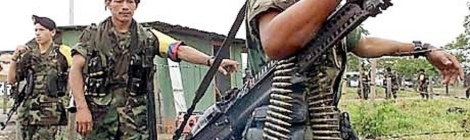
After four years of peace negotiations, the 52-year-long civil war between the Colombian government and the left wing guerrilla FARC-EP recently came to an end. What will happen now to […]

Since the attacks of 9/11, the banner of national security has led to intense monitoring of the politics of Muslim and Arab Americans. Young people from these communities have come […]

Despite being strictly prohibited in international humanitarian law, child soldiering remains a serious global problem. How effective has the international community’s response to this phenomenon been? Constituting one of the most […]

Research from social media accounts suggests that Western women who travel to join Deash do so for largely the same reasons as male recruits – the ideological pull of extremist […]
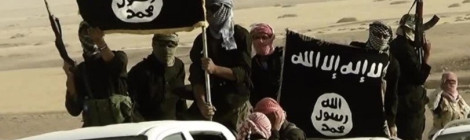
Former combatants can play a powerful role in preventing violence, as the case of former combatants in Northern Ireland shows. Former Islamic State fighters could have a role to play […]

Western states are growing increasingly reliant on private military and security companies. Fully understanding the privatization of security and its effects on sustainable security requires the inclusion of a critical gender lens. Introduction In […]
Sustainable security and peacebuilding remain elusive in northern Uganda. But gender-relational peacebuilding offers a potential avenue to strengthen post-conflict peacebuilding efforts. Sustainable peacebuilding in post-conflict northern Uganda is intricately interwoven […]
Another year has confronted us with yet another tragedy in another European Capital – Madrid in 2004, London in 2007, Paris last year – and, most recently, Brussels. The litany […]

Introduction The acknowledgement of gender issues through the Women, Peace and Security (WPS) agenda marked a watershed moment for women’s rights. Despite this, the Responsibility to Protect (R2P) framework remains […]

Scarred in recent years by questionable involvements in the likes of Afghanistan and Iraq – and by the casualties they wrought – risk-averse Western governments have begun to look to […]
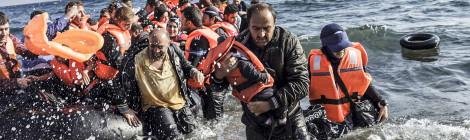
Closing Europe’s borders and politicizing the attempt to admit refugees at a time when the growing humanitarian crisis poses mounting human rights challenges to the international community is fundamentally wrongheaded. […]

US drug policy has become increasingly privatised in recent years as the US government contracts private military and security companies (PMSCs) to provide intelligence, logistical support and training to state security forces in drug-producing and –transit states. As the cases of Colombia and Mexico illustrate, this privatisation strategy is having a damaging impact on these already fragile environments.
Summary
The issue of state fragility and the presence of radical religious movements in Yemen have occasioned misperceptions and confusions in recent debates about the country. This report argues that the language of “failed states” arises nearly exclusively in relation to countries deemed threatening to US security interests. Moreover, this language obscures rather than reveals how regime incentives to build state institutions can be incompatible with regime interests in survival. The result is that a seemingly neutral analytical category misrepresents local realities even while it is used as a warrant for policy initiatives that are likely to be counterproductive.
The full report is available here.
Delicious Digg StumbleUpon Reddit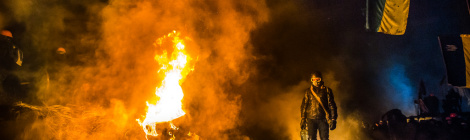
One year after violent conflict began, information is now emerging on the specific environmental impact of war in Ukraine’s highly industrialised Donbas region. Although obtaining accurate data is difficult, indications are that the conflict has resulted in a number of civilian health risks, and potentially long-term damage to its environment. In order to mitigate these long-term risks, international and domestic agencies will have to find ways to coordinate their efforts on documenting, assessing and addressing the damage.
It should come as no surprise that David Cameron and the campaign for the UK to remain in the EU have argued that Britain’s continued membership of the EU will benefit the UK’s security. Britain’s EU membership has always had a security side to it. Membership has never been entirely about trade or jobs. And whatever the result of the referendum, the security relationship with the EU will remain vital for the UK.
Those campaigning for the UK to leave the EU do not dispute that relations with the EU, along with European security in general, are not of central concern for the UK. For them, however, not only does the EU make the UK and Europe less safe (for example by allowing free movement of criminals and terrorists), but putting international relations ahead of domestic politics, especially economic and democratic needs, weakens Europe’s nation states and their ability to combat the full range of problems facing them.
The UK government itself is clear that traditional security threats to the UK do not figure as highly as they once did, although they have certainly not disappeared. As successive national security strategies and strategic security and defence reviews have made clear, security challenges to the UK range from nuclear war to environmental disasters, with many not recognising the borders of nation states. While British governments are often reticent to admit to the EU playing a positive role in security cooperation, or admit that the UK has led in such cooperation, there is no denying that tacking these security challenges has been an important part in UK-EU relations.
From the start, European integration has had a security side to it, whether this be about managing the reintegration into Europe of West Germany and later a united Germany, or integrating former Eastern European Communist or Southern European Fascist states into a liberal European mainstream. The EU itself has not been sufficient to keep the peace. The argument by some Eurosceptics that it has been NATO that has kept the peace in Europe is as selective a reading of history as any pro-European that claims it has all been down to the EU. Nevertheless, for successive British governments, especially at the height of Britain’s retreat from empire in the 1960s, Britain’s declining ability to shape the world and the security challenges it posed meant membership of the European Economic Community and later EU was a necessary step for both British, European and transatlantic security cooperation.
Today, Cameron and others in the Remain campaign trumpet Britain’s ability to use the EU to boost Britain’s still substantial but reduced economic and military capabilities to give it the full range of tools and opportunities to face the full range of security challenges. Whether in facing a newly assertive Russia, dealing with Iran or tacking climate change, the UK’s EU membership has been cited as crucial to allowing the UK to shape its security. This is not to argue that EU cooperation is without its problems. Finding consensus amongst 28 states is never easy, even when you have the institutions and familiarity that EU membership offers.

Image by Djevdet via Flickr.
The referendum poses the question of what options the UK has beyond working through or with the EU. Talk of the UK rebuilding the Commonwealth is often oblivious to how strategically marginal that organisation can appear to most of its members. Britain’s NATO membership will remain important to it and Europe. NATO, however, is not the whole story when it comes to European security and the UK should not bet on the alliance being as solid as it was once. Close bilateral relations with the likes of the USA or France will remain, not least in the military fields. But this should not blind us to how the US and European states will continue to cooperate through a range of EU-US forums and that this could leave Britain outside the EU as something of an awkward in-betweener in the transatlantic relationship.
The US in particular is aware of the wider implications of a Brexit for Europe’s geopolitics. As Condoleezza Rice, former Bush Administration Secretary of State and National Security Advisor, told Chatham House: ‘It is a very different Europe if it is a continental one’. Accusations that the UK is a US ‘Trojan Horse’, sent to weaken EU cooperation from within, display an ignorance of how the USA – a European power since 1945 – has had a hand in European integration and security from the very start and doesn’t wholly depend on the UK for relations with the rest of the EU.
Britain’s departure from the EU could change the Union in any number of ways, with far-reaching geopolitical implications that will shape Europe’s security. That some Leave campaigners such as Michael Gove have spoken of Britain setting an example that could lead other states to follow gives a hint to the wider geopolitical changes to Europe some Eurosceptics hope a Brexit will bring about.
Such disintegration or radical reconfiguration of the EU has not been set out or anlaysed in any document or strategy. As such this half-baked approach risks a dangerous case of strategic overreach by the UK. Any changes to Europe would rely less on Britain’s willingness to offer the ways and means of managing such changes and more on encouraging a collapse of the EU. Losing control of such a development should not be overlooked. An uncontrolled collapse of the Eurozone, for example, would inflict significant costs on the UK, Europe, the USA and the wider world economy. As HM the Queen warned in June 2015 during a state visit to Germany, Europe’s division is in nobody’s interests.
It is possible that a Brexit will cause the opposite reaction, with an EU rid of ‘an awkward partner’ going forward by unifying further. One of Britain’s longest standing international aims has been to prevent any single power dominating Europe. The EU would be a benign power compared to previous attempts, but such an outcome warrants careful consideration by the UK. Whatever the outcome, the EU’s status quo is unsustainable. The question for those concerned with Europe’s security is whether changes – whether triggered by Brexit of not – can happen in a stable, cooperative way or bring about a collapse into nationalism and parochialism.
The best hope for UK and EU security is that whatever the result of the referendum both sides seek ways of cooperating, if only to rebuild trust. The initiative here will rest with the UK whose recent approach to the EU in the eyes of many elsewhere in Europe has been an unwanted distraction from the many other challenges facing the EU. A UK in search of cooperation with its European neighbours will find it can offer little to help with the problems in the Eurozone or Schengen. Instead, whether in or out of the EU, it will find itself playing its only trump card: security and defence cooperation.
Whether in facing a resurgent Russia – and therefore the continued relevance of hard power in European and international relations – or the more nuanced but potentially far more catastrophic global environmental challenges, the UK and EU could find common ways forward that help both sides realise their mutual interdependence. The UK and the rest of the EU must appreciate that instability or division in Europe limits their options to shape security in the wider world.
Last, but not least, we should not overlook that if the first priority of any state is its own survival then alarm bells should be ringing about how the referendum could lead to the end or weakening of the UK itself. The vote could throw into doubt the place in the Union of Scotland and Northern Ireland, both bringing with them a host of traditional security concerns whether they be terrorist related or the future of the UK’s nuclear weapons. Tensions within England should not be overlooked. Immigration and economic changes have made London the UK’s undiscovered country, much to the chagrin of some elsewhere in England and Britain who feel a Europeanised and globalised capital city has left them behind. Arguments over identity, immigration, radicalisation, race, equality and standards of living rumble beneath the surface of the EU referendum. A reminder, if any were needed, of how sustaining the UK’s own stability and security will be no easy challenge after the 23 June.
Dr Tim Oliver is the Dahrendorf Fellow for Europe–North American relations at the London School of Economics and Political Science. He is also a non-resident fellow at the Center for Transatlantic Relations of the Johns Hopkins University Paul H. Nitze School of Advanced International Studies, Washington DC. He has worked in the House of Lords, the European Parliament, the German Institute for International and Security Affairs (SWP), RAND Corporation, and taught at the Royal Military Academy Sandhurst, the London School of Economics and University College London.
The strategic nuclear-arms treaty agreed between the United States and Russia on 26 March 2010 entails substantial and welcome cuts in the two countries’ nuclear arsenals, and leaves the way open for further reductions before Barack Obama’s first term in office is tested in the presidential election of November 2012. This bilateral deal is a healthy prelude to the quinquennial review conference of the nuclear non-proliferation treaty (NPT) in New York on 3-28 May 2010, of its nature a much broader intergovernmental endeavour (see “The nuclear-weapons moment”, 5 March 2010).
These two arms-related events reflect an important part of the way the present world-system operates: that is, via cooperation, competition and negotiation between states. These forms of interaction appear so powerful and ever-present that they can appear almost to define the political world as it exists and is “managed”. Yet stand back, look more widely and deeply, and other realities – even more fundamental and more potent – can come into view.
A future of growth
The perspective on nuclear-arms diplomacy outlined in the first paragraph exemplifies a worldview that has become the norm among most international-relations specialists; it can be found in relation to many other issues and case-studies. This identifies states and governments as the key global actors, and thus the essential explanatory variable for making sense of the contemporary world. The core argument that tends to follow is that an enormous global reassembly of state-centred wealth and power is occurring: China, India and Brazil are among those countries making a great leap forward while those in the north Atlantic are entering an era of retreat.
In this view, the world’s destiny is being and will be shaped by the interaction of states which depend on continuous economic growth for their survival and ability to secure consent. Globalisation is a fact; transnational corporations may wield great power; citizen groups may occasionally exert influence – but the root of world politics remains a globalised state-system, and this will endure.
Many analysts warm to this theme by examining the changing status of the European Union and the United States within the context of an evolving “multipolar” world. They see the EU as a huge economic entity which has however become unwieldy and over-extended, thus limiting its potential for security cooperation. The resort to Nato as guarantor of security for many European states follows, but the alliance too faces serious problems (not least in Afghanistan). The conclusion is that Europe’s pre-eminence – if not its prosperity – is a thing of the past; the continent is going to be overtaken by players now arriving into the global arena.
The United States, according to the same diagnosis, remains a superpower; but its experience of the 2000s – the wars in Afghanistan and Iraq, the enormous burden of debt, and the failure to match the dynamism of key Asian economies – presages its eventual decline. The “new American century” may have looked feasible a decade ago, but it cannot be sustained by fighting $3-trillion wars amid the financial sector’s implosion (see “The costs of America’s long war”, 8 March 2007).
The logic of this approach is to foresee in the 2010-40 period the relative decline of the north Atlantic community and the even further rise of Asia (and a few large states elsewhere). This will entail a degree of adjustment by the older powers, but the guarantee of economic growth will assuage the pain. The realities of inter-state domination and ever-further economic expansion, albeit with variable elements, will remain over the next three decades the only game in town.
A world of difference
There is however another way of looking at the world that is both radically different yet equally – and arguably more – grounded in underlying realities and trends. It holds that the implantation of the neo-liberal market model from the late 1970s onwards has nurtured the growth of a trans-global elite of around 1.5 billion people, and that this minority has been able successfully to entrench its wealth and power so as to leave the rest of humanity far behind. Most of this elite is concentrated in the countries of the north Atlantic (living amidst its own impoverished minorities), but with the spread of the economic model has come to include perhaps 300 million people in India and China and 100 million across Latin America (see Losing Control: Global Security in the 21st Century, Pluto Press, 3rd edition, 2010).
This “minority-world” elite has in little more than a generation secured an unparalleled ownership of the fruits of the world’s labour and resources: it commands around 85% of global income and an even greater share of household wealth. At the other end of the scale is a marginalised majority of 5 billion people, at least a billion of whom are malnourished (a figure that has doubled since 1975); around 830 million people live in slums, mostly on the edges of the world’s megacities; and 3 billion survive on the equivalent of less than $2 per day (see Göran Therborn, “The killing-fields of inequality”, 6 April 2009).
It is significant, however, that huge numbers among the excluded “majority-world” are more educated and literate than in the 1970s, and thus far more conscious of their own marginalisation. The “revolution of rising expectations” beloved of market analysts in the 1960s-1970s is being replaced by a “revolution of frustrated expectations”. This liable to erupt break in high urban-crime rates that justify gated communities, but also in radical and insurgent movements such as the Zapatistas in Mexico and the Naxalites in India (see “India’s 21st-century war”, 5 November 2009).
This divided world is now facing the added issue of environmental constraints, especially resource conflict and climate change. These potential “limits to growth” were first discussed in 1972 in the book of that name, whose analysis was at the time widely scorned by economists (amongst others) for its supposed “doomwatch” approach. It is worth noting, then, that the team at MIT (Dennis L Meadows, Donella H Meadows, Jørgen Randers, and William W. Behrens III) actually predicted that the major problems would arise from around 2015 onwards; forty-eight years on, Limits to Growth appears uncomfortably close to target (see “Wanted: a new global paradigm”, 8 November 2007)
Those limits will affect everyone but will hit hardest the 75%-80% of the world’s population excluded from the fruits of wealth and enduring endemic human insecurity. The reactions among them will vary from the desperate to the violent; in turn, much security thinking among elites across the world will focus on how to maintain the status quo – and how best to cooperate in doing so (see “After war, security”, 10 December 2009).
A choice of futures
This overall elite response can be characterised as “keeping the lid on things” – or “liddism”. The strategy is both pervasive and accumulative, involving an intense effort to develop new tactics and technologies that can avert problems and suppress them should they arise (see “A tale of two paradigms”, 28 June 2009).
This is currently one of the defence-industry’s biggest growth-areas. A telling example is the “alternative weapons summit” to be held in Washington on 24-26 May 2010. The event, with a price-tag of $1,999 for industry representatives and $999 for military (the latter asked to come in uniform) has much to offer to current or potential “liddites”. Its presentations include:
Perhaps most revealing of all is Managing Crowds in the Middle East. This session, led by a principal scientist from Applied Research Associates, has crystal-clear intentions:
“While assumptions can be made about the behaviour of Westerners in response to law enforcement actions, we cannot say it is the same for non-Western cultures. Tactics used for crowd control in the U.S. can be interpreted and responded to much differently in diverse cultures.”
The spreading tools of the trade are “non-lethal”, “less-than-lethal” and “I-can’t-believe-it’s-not-lethal” weapons, not least because these help replace the mess of killing with more clinical means of control. The fundamental purpose, however, is the same as in overtly brutal repression: to maintain control, if in a way that is more acceptable to the protected, massaged and (it is hoped) more contented classes (see Global Security and the War on Terror: Elite Power and the Illusion of Control, Routledge, 2007).
The first decade of the 21st century has been dominated by wars that have killed or injured close to half a million people, wars that arose after determined paramilitaries used parcel-knives to exploit the weaknesses of the world’s most advanced state. That incident might in principle have been a lesson in the impossibility of preserving the status quo – and that, as a consequence, “liddism” will not work. That indeed was the conclusion when the first edition of Losing Control was written and published in 2000, not long before 9/11. What has happened since has reinforced the argument. The search for a different, sustainable future is more urgent than ever.
 Delicious
 Digg
Digg StumbleUpon
 Reddit
The United Nations Mission in Liberia (UNMIL) has significantly decreased its presence in the country in 2016. The departure of much of the peacekeeping force has left the country with several security issues that it is struggling to resolve during its transition.
2016, an important year for Liberia, a country that has seen a steady consolidation of peace since 2003. 2016 is the year when the United Nations Mission in Liberia (UNMIL) formally left, barring a minuscule presence. This is also a time when Liberia’s security sector would be left without a big brother stationed to ward off any potential threats to security. This transition to national responsibility for security will test some key assumptions about security sector reform (SSR). First, what is the effectiveness of SSR as a policy of international development? Second, what is the utility of SSR as a tool for external influence?
Liberia’s political and economic transition
Image by UN Photo via Flickr.
UNMIL’s exit comes at a time of anticipated political contest in the upcoming elections of 2017. Given the potential for politically motivated armed mobilization of security actors in a system that is rooted in patronage and loyalty to the ruling party and elites, one could expect some election centric violence. As a run up to this uncertainty, in 2014, the ruling Unity Party fared poorly in the Senate elections, receiving only 10 % of votes. Large scale corruption, deep-rooted cronyism, and mishandling of the 2014-2015 Ebola outbreak that claimed nearly 5000 lives have turned voters against the ruling regime. It is also a time when critics of the political elite and its policies are increasingly being targeted and threatened. Arrests and politically motivated killings have created an uneasy atmosphere of fear and suspicion.
Given this context, the prospect of a post-Ellen Sirleaf Liberia is unsettling because of the limited leadership options and a potential polarisation of domestic politics. The opposition remains divided with few serious contenders. Prince Johnson, from Nimba County, a warlord who led the Independent National Patriotic Front of Liberia (INPFL) group, and Benoni Urey, a close business associate of Charles Taylor, present less than ideal choices. Other more positive options include George Weah, a renowned international soccer star turned politician. He was recently appointed a Peace Ambassador by the President and is also the chairman of the National Reconciliation Committee. He is widely popular with the youth, who make up an overwhelming majority of the voting bloc. He might be a candidate to watch out for.
On the economic front, Liberia has long standing problems with chronic poverty, high prevalence of informal or vulnerable forms of work and poor physical infrastructure. The Liberian economy’s decade-long dependence on international aid and primary commodity exports has presented weak growth indicators. A weak currency, high inflation and a null growth in 2015, according to the IMF, are worrying statistics. According to estimates, the prices of rubber and iron, two main export commodities have fallen more than 80 % since their peak in 2011. Widespread work layoffs, labour unrest and government instigated austerity measures due to lower revenues and drop in international donor funding have created a less than ideal economic environment for reform.
What about security?
A post-UNMIL security environment presents some gaps that have still to be plugged despite every effort to undertake a responsible draw-down in Liberia. The core issues of transparency, accountability, efficiency, respect for human rights, and civilian oversight will be tested in an environment where the different security agencies continue to struggle for lack of sufficient trained staff and resources.
The Armed Forces of Liberia has witnessed a high attrition rate, and its 2000 strong force remains a token army that is for the most part confined to the barracks. In August 2014, an army scuffle with civilians in West Point, resulted in civilian injuries and some reported deaths that enhance lack of trust towards the national army.
The Liberian National Police, and different immigration, border and intelligence agencies that had been the target of SSR efforts led by UNMIL and donors, remains poorly resourced. A mere 5000 strong force to secure a 4.4 million strong population results in low levels of police presence outside the capital region.
Despite efforts to decentralize the security apparatus through Justice and Security Hubs, across the country, the slow response of LNP to local problems such as the mining riots in 2014, present evidence that gaps remain. There have also been allegations of police corruption in recent investigations by Human Rights Watch.
In reality the transition from a regime centered security sector to a people-centered one is far from complete. It is likely that the security apparatus will be used by the government to intimidate opposition politicians and instigate localized violence as this has been the legacy of the past.
Finally, an ‘unintegrated’ ex-combatant element lingers in the background of externally supported statebuilding. The UNDPled disarmament, demobilization, reintegration and rehabilitation (DDRR) programme in Liberia (2004-2009), did not absorb fighters from the different non-state groups involved in the civil war into the new security sector.
Considerable civilian infiltration in the DDR programme, also meant that ex-combatant continues to live and work within their wartime social networks. Efforts by UNMIL to break command and control chains had limited impact due to neo-patrimonial nature of Liberian society and politics.
Reflections on the SSR
There has been much criticism of the SSR in Liberia. It is accused of causing:
Core problems with physical infrastructure, weak capacity of the human resources, corruption and elite control make the prospect of delivering ‘people centered security’ challenging. The security transition plan of the UNMIL requires nearly 38 million USD to complete the process of handover to national agencies. So far the national government has disbursed only 10 million USD, towards this effort.
Earlier mistakes committed by international advisers on SSR, such as requiring all police officers to re-apply to be vetted for their eligibility as LNP officers has left lingering gaps. As a result, senior officers became patrol officers even though they had many years of experience.
Such a demotion brought serious moral problems to the police. Other policy decisions such as retiring senior officers, and those found ineligible on human rights or qualifications related criteria has created dissatisfied pockets within the security sector.
Citizen security currently remains a low priority as security efforts are geared towards replacing UNMIL duties in the area of VIP protection, aerial surveillance for border patrol and management, maritime and prison security, and bomb disposal.
National adaptation
Given this reality of a less than complete reform process, it will be worthwhile to observe how national models of adaptation fare compared to international or UNMIL led models such as the Justice and Security Hub (JSH) structure.
This model of decentralisation, attempts to build five ‘hubs’ or centres where formal security and justice providers will be stationed in key provincial locations.
To date only the Gbarnga hub is operational; while the government has committed US$1 million over 2014–16, in addition to the funds provided by the Peacebuilding Fund, to support the construction of the Harper and Zwedru hubs.
This model of decentralization and access remains difficult to operationalize because of constraints related to finance, infrastructure and capacity (human and material). Further, the JSH concept did not address the issue of civilian oversight of security and justice institutions or the issue of legitimacy.
In reality, most Liberians continue to trust and turn to local informal security and justice providers. National level adaptation includes setting up of the County Security Councils (CSC) structure. It is part of national peacebuilding efforts to ensure decentralization and access. The CSCs incorporate the paramount, clan and town chiefs, providing much-needed civilian input into security policy making at the sub-national level.
President Sirleaf, the current elected Chair of the Economic Community Of West African State (ECOWAS), has also attempted to beef up the role of the Peace and Security Council apparatus to boost regional security linkages with Côte d’Ivoire, which shares borders with LIberia and has witnessed illicit cross-border farming in the Western front.
In sum, Liberia will need to continue capacity building in a post-UNMIL environment. President Sirleaf’s efforts to gain technical assistance from Israel to train Liberian security forces is one example of this strategy. As such the true test of adaptation will come in the post 2017 election period when a remaining UN presence of nearly 2000 military and civilian staff will finally exit.
In essence the effectiveness of SSR as policy tool remains questionable. Do the peace dividends returned from an enormous time-bound and often poorly targeted investment of resources and technical capacity building create a capable security apparatus? The answer in the case of Liberia remains far from positive.
Sukanya Podder is a Senior Lecturer in the Defence Studies Department, King’s College, London.
Mineral resources have played a crucial role in fuelling protracted armed conflict in the east of the Democratic Republic of the Congo (DRC). This Policy Paper examines the the prospects for and interactions between various trade- and security-related initiatives that are aimed at demilitarizing the supply chains of key minerals. It also describes the changing context in which such initiatives operate. Finally, it offers policy recommendations for how the Congolese Government and international actors can coordinate and strengthen their responses in order to break resource–conflict links in eastern DRC.
Read the report here: SIPRI
Image source: Tim Pearce, Los Gatos
Delicious Digg StumbleUpon RedditOn 17 May the World Future Council released its latest report entitled Climate Change, Nuclear Risks and Nuclear Disarmament: From Security Threats to Sustainable Peace. It is the outcome of groundbreaking research by Prof. Dr. Jürgen Scheffran of the University of Hamburg.
The report examines the linkages between nuclear and climate risks, noting that these two clear threats may interfere with each other in a mutually re-enforcing way. It also acknowledges that finding solutions to one problem area could lead to solutions in the other: “Preventing the dangers of climate change and nuclear war requires an integrated set of strategies that address the causes as well as the impacts on the natural and social environment.” Prof. Dr. Scheffran offers an approach to move away from these security threats to building sustainable peace.
The study brings to light the multidimensional interplay between climate change, nuclear risks and nuclear disarmament, and its critical implications for the strategic security environment. In addition, it explores prospects and openings to tackle these key challenges, stressing the role played by institutions to “strengthen common ecological and human security, build and reinforce conflict-resolution mechanisms and low-carbon energy alternatives, and create sustainable lifecycles that respect the capabilities of the living world.”
Read the full report here.
Image source: GreenDominee
Delicious Digg StumbleUpon RedditIn spite of early signs of progress, 2016 saw damaging levels of wartime environmental damage. Will 2017 be any different?
Marking the UN’s international day on conflict and the environment in November, the Special Rapporteur tasked with reviewing and developing the law protecting the environment before, during and after conflict argued that 2016 was “…set to be a milestone in global efforts to protect the environment in connection with armed conflict.” But it has also been a year where such efforts have seemed more vital and urgent than ever. This blog takes a look back at conflict and the environment in 2016, at the progress made and considers what should come next.
Fires from burning oil facilities are one of the most visible forms of wartime environmental damage; 2016 began in flames, and it will end in flames. Back in January, facilities in Libya’s oil crescent were being targeted by Islamic State. The smoke plumes from the huge blazes at the storage sites at As Sidr and Ras Lanuf were visible from space, the attacks – branded an economic and environmental disaster by local emergency staff – were intended to help further destabilise the fragile interim government.
The year will close with another environmental disaster caused by oil, this time in northern Iraq where oil well fires, again started by Islamic State, have burned for months and with no end in sight. As of November, data from UNOSAT showed that 29 fires were burning near Qayyarah, and two oil slicks were travelling down a tributary of the Tigris.
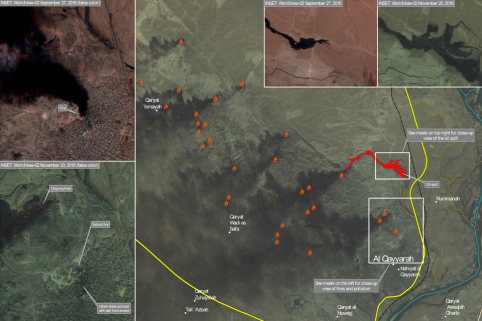
Map illustrating satellite-detected fires and oil spills between September and November at and around Al Qayyarah, approximately 60km south of Mosul, Iraq. Credit: UNOSAT/UNITAR
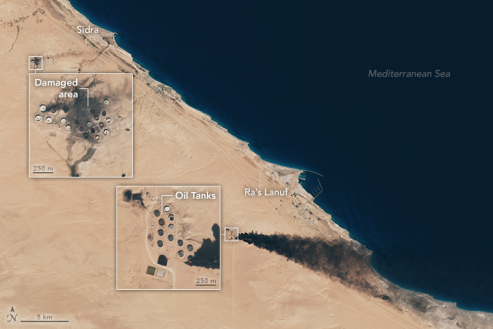
Satellite photos of fires at oil production and storage facilities near Sidra, Libya. Image credit: NASA
25 years on from the last time
The fires in Libya, Iraq and also in Syria – where facilities have been targeted by all sides of the conflict – have served as a perverse marker of the 25th anniversary of the 1991 Gulf War. A reminder, were it needed, that while our understanding of the environmental causes and consequences of conflicts has grown, our formal systems of protection and response appear as weak today as they were 25 years ago.
But as 2016 began, there were modest signs of progress. States at the preparatory meetings for the second UN Environment Assembly (UNEA-2) were considering three draft resolutions on conflict and the environment: on the environmental consequences of human displacement from the Syrian conflict; on the need to assess Gaza’s environment; and on the protection of the environment in all areas affected by armed conflict.
After months of mergers, disagreements and redrafts, the last of these, sponsored by Ukraine, was passed by consensus in May. Co-sponsored by a number of conflict-affected and Western States, in some ways it too marked an anniversary, that of the weak UN General Assembly resolution passed in response to the environmental disaster of the Gulf War in 1992. The UNEA-2 resolution is a significant step forward in many ways. Its scope, which includes the humanitarian consequences of environmental degradation, natural resources, displacement, protected areas, human rights, post-conflict assessments and assistance, is a world away from that passed in 1992. Both were products of their time, reflecting the concerns of States and civil society, but also the international community’s knowledge and understanding of the issues at hand.
Untangling conflict and the environment
The often complex linkages between conflict, peace, environment and health were visible throughout 2016. For Colombia and its peace agreement, it meant costing up the financial benefits of peace – the health and environmental savings that could accrue if the deal were to pass. But peace seemed likely to also herald new challenges for Colombia’s environment, biodiversity and human rights, from an anticipated expansion of the extractive industries, from accelerated deforestation and conflict over rural land rights.
In Syria, the health of children and communities is being harmed by pollution from makeshift oil refining. This coping strategy has flourished thanks in part to a chain of events initiated by policies intended to destroy and degrade the country’s oil production and refining capacity, some of which had fallen into the hands of Islamic State. Satellite images have also captured the wholesale collapse of Syria’s agricultural system as a result of displacement and insecurity. The latter completing the closely related story of growing environmental pressures in Syria’s neighbours due to the influx of people fleeing the conflict, a conflict that has now caused local, national and transboundary impacts on the environment.
Effective policy-making requires that we work to fully understand the causal linkages between conflict and insecurity, and environmental degradation and its impact on human health and ecosystems. While it may be tempting to present simplistic narratives – such as those proposed in relation to Syria and climate change – this year has shown just how important it is to comprehensively document and interrogate the evidence. One powerful example of this has been a new study on conservation in conflict zones, which identified institutional collapse as the single greatest threat to wildlife.
Legal initiatives contribute to a sense of momentum
The complexity and scope of conflict and the environment was also apparent in a major legal development this year. The third report from the UN’s International Law Commission’s (ILC) ongoing study into the protection of the environment in relation to armed conflicts primarily dealt with the law applicable after conflicts. The report’s draft principles cover everything from military bases, to peace operations, peace agreements, the rights of indigenous peoples and toxic remnants of war; with still more topics proposed for study by governments. The principles that the ILC is formulating are merging humanitarian, environmental and human rights law in an effort to clarify the disparate norms and practices that could provide a legal framework for enhanced protection.
Elsewhere, the chief prosecutor of the International Criminal Court announced a new focus on the prosecution of individuals involved in the illegal exploitation of natural resources, deliberate environmental destruction, and land grabbing. All problems associated with armed conflicts and a potentially useful contribution if the court follows through on the decision. Meanwhile the 33rd session of the UN Human Rights Council heard from its Special Rapporteur on the management and disposal of hazardous wastes, on the impact of toxic remnants of war on health and the environment. He recommended that States improve monitoring of such threats and ensure that remediation and assistance takes place.
These parallel legal and political pathways are providing a long-overdue framework for debate and State engagement on conflict and the environment. The renewed energy around the topic was clear on November 6th this year – the UN’s international day on conflict and the environment. The level of interest this year was a world away from previous years, with compelling statements calling for progress from the UN Secretary General, the heads of UNEP and UNOCHA, governments, experts and civil society.
Where next for conflict and the environment?

Photo of Sirda oil fires. Image credit: NASA/Flickr
The question of “where next?” is currently being considered by a number of parties. Whatever the outcome, it remains the case that civil society will have an important role to play in working with international organisations and progressive States to encourage further progress. The momentum to date is the result of seven years of work and the conditions for advancing protection for the environment and civilians in relation to conflict come around rarely.
When this same question was posed to governments in 1992 in the wake of the Kuwaiti oil fires, the response mirrored the situation today: “Some States felt that the existing rules were sufficient and what was needed was ensuring better compliance with them. However, most of the States represented thought it also necessary to clarify and interpret the scope of some of those rules, and even to develop other aspects of the law relating to the protection of the environment in times of armed conflict.”
But it cannot just be a question of law and compliance. Like that other cross-cutting issue gender, what seems to be required is effective environmental mainstreaming throughout the conflict cycle. Good work has and is being done with regard to peacebuilding and humanitarian response but more is needed. There are also strong arguments in favour of a more robust system of environmental response in the wake of conflicts. And of course more visibility and stigmatisation for the practices that can cause serious harm to the environment and human health. Vague objectives for now maybe, but they perhaps demonstrate one possible direction of travel. Civil society can continue to contribute through research and advocacy, in untangling and communicating complexity, and by engaging at key moments, but achieving substantive progress will require greater capacity and coordination than we have at present.
Work on conflict and the environment in 2017 should aim to signpost the direction of travel, and make more use of the parallel processes currently in play. If they can be identified and agreed, a clearer destination and mode of transport will allow a greater number of States and civil society to engage, something that will be vital if we are to make use of the momentum that has been created this year.
Doug Weir manages the Toxic Remnants of War Project. The project is on Twitter: @detoxconflict
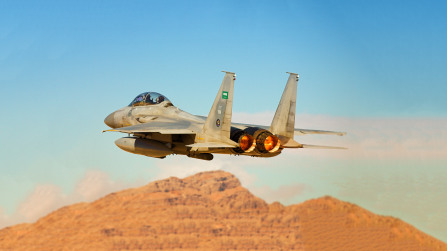
In order to persuade its allies in Israel and Gulf Arab states to support the Iran nuclear deal, the United States is relying on inducements of weaponry sales; this regional militarisation is destabilising the wider Middle East region.
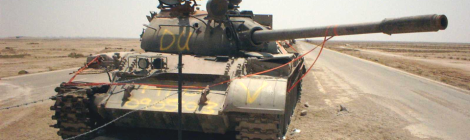
Is the US backpedalling on its use of depleted uranium (DU) rounds? There are indications that the use of these highly toxic munitions could increasingly be a political liability for the US, with countries affected by DU, like Iraq, other UN Member States, and populations in contaminated areas all expressing concerns over its use and impact. But stigmatisation, although important, is not enough on its own – in order to make sustained progress on accountability and in reducing civilian harm, a broader framework that addresses all toxic remnants of war is needed.

While the world’s attention has been focused on the US-led military interventions in Iraq and Syria a quieter build-up of military assets has been ongoing along the newer, western front of the War on Terror as the security crises in Libya and northeast Nigeria escalate and the conflict in northern Mali proves to be far from over. In the face of revolutionary change in Burkina Faso, the efforts of outsiders to enforce an authoritarian and exclusionary status quo across the Sahel-Sahara look increasingly fragile and misdirected.

Barack Obama’s new strategy against the Islamic State commits the United States to further long-term conflict. It involves a great forgetting of the recent war in Iraq.
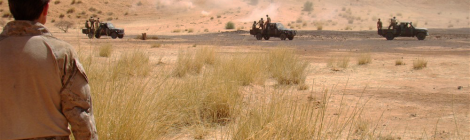
Despite the crumbling façade of its interventions in Iraq and Afghanistan, the US is preparing for a new century of ‘light footprint’ warfare, using Africa as its laboratory.
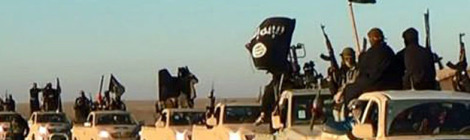
An unlikely alliance of four states – Iran, Syria, the United States and Russia – is coalescing to oppose the ISIS advance in Iraq. Is military intervention in Iraq imminent?

As activists around the world participate in a Global Day of Action against criminalisation of drug use, evidence from the multi-billion dollar War on Drugs in Colombia suggests that militarized suppression of production and supply has displaced millions of people as well as the problem, not least to Mexico. The wrong lessons are being exported to Central America and beyond, but a groundswell of expert and popular opinion internationally is calling for alternative approaches to regulating the use and trade in drugs.

Following the abduction of over 200 school girls from Chibok in northern Nigeria, clarion calls on social media for action in Africa have once again become an excuse to flex military muscle, as the rhetoric of ‘humanitarian’ interventions is increasingly outfitted with the tactics of the war on terror.
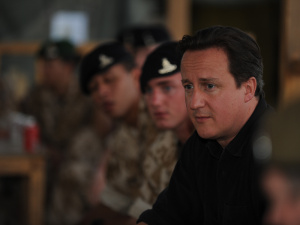
After 100 years of continuous war, can Britain learn the limits of military action to respond to shifting realities of insecurity? Continued investment in force projection and lack of commitment to genuine reflection on today’s security challenges suggests it’s not yet ready to let go of its militarist mindset.
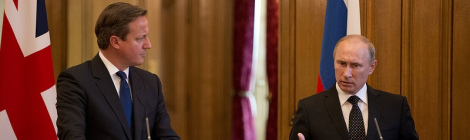
The defeat of the UK government’s parliamentary motion on support in principle for military action against the Syrian regime means that Britain will play no part in any direct attack on Syria. What then are its options for resolving the Syrian conflict, protecting civilians and punishing those responsible for war crimes there? This article assesses what the UK can do in terms of pushing for a negotiated peace settlement and to hold accountable those responsible for using chemical weapons and any other war crimes committed during this century’s worst humanitarian crisis.
 Why START is only a beginning on the long road to nuclear disarmament
Andrew Futter
The ‘New START’ Treaty signed by Barack Obama and Dmitry Medvedev in Prague on 8th April 2010 is an important first step in the renewed drive for nuclear disarmament, but its overall contribution towards the goal of a world free from nuclear weapons should not be overstated. In many respects the treaty merely codifies the current status quo, and is arguably more about symbolism than it is about substance, and in this respect much of the hard work in reducing and potentially eliminating the vast stockpiles of nuclear weapons held by nations across the globe is still to be done. Perhaps most importantly, before any meaningful multilateral talks and possible agreements on abolition can seriously begin, the US and Russia will need to go much further in reducing their nuclear ordinance. Moreover, it will only be after US and Russian weapons stockpiles have been reduced to numbers in the low hundreds that the push for more widespread reductions, and possibly abolition, can seriously and credibly begin. As such, and while many are aware of the problems of going from only a few nuclear weapons to zero, this article argues that many of the toughest problems are likely to come in the first phase of the disarmament process, a phase that will involve reducing US and Russian nuclear stockpiles down to numbers more in line with that of other nuclear weapons states.
The New START treaty is certainty important in a number of political, diplomatic and strategic ways. First, it commits both the US and Russia to reduce their deployed strategic warheads to 1550 and deployed delivery vehicles to 700 within seven years – representing a 65% reduction from the numbers contained in the original 1991 START treaty negotiation signed by George HW Bush and Mikhail Gorbachev, and a 30% cut in numbers from the Moscow Treaty negotiated by former President’s George W Bush and Vladimir Putin in 2002. Of equal importance is the fact that the treaty ensures the continued verification of both nations nuclear stockpiles (that had expired with the first START treaty in December 2009), which in turn allows for transparency in measuring both governments compliance with the new agreement as well as ensuring the security of each nation’s nuclear sites. This is particularly important in Russia. On top of this and perhaps in many ways the most important part of the agreement is its political symbolism and significance, and more broadly its importance for US-Russian strategic dialogue, international cooperation and a predictable relationship. Politically, the treaty cements previous work by the Obama administration to ‘reset relations’ with Russia and from the administration’s perspective, should help enlist Russian support with other US foreign policy objectives. Diplomatically it establishes a link between the two sides from which to push on and attempt to negotiate further arms control agreements. For Russia it is also an important chance to be involved in international policy at the highest levels as the country tries to mitigate its declining strategic world role.
Militarily however, the treaty really changes very little. It is likely that regardless of the new agreement the US would have made further (possibly unilateral) reductions in its nuclear weapons stockpile – and indeed may continue to do so even if the Senate does not ratify the treaty in the coming months. Moreover, it is likely that the US – through NATO – may choose to withdraw its tactical nuclear weapons from Europe, and possibly from other regions across the globe – especially in areas where ballistic missile defences are beginning to play a larger role in strategic deterrence. On the Russian side the treaty essentially codifies the current state of the Russian nuclear arsenal, which after years of underfunding and neglect is now essentially in a state of disrepair. It is therefore likely that despite the vast stockpiles of nuclear related material still in Russia, only a percentage of this nuclear ordinance is actually serviceable and usable. When economic pressures in both countries – but particularly Russia – are added to this, much suggests that a renewed drive to service or embark on a large-scale plan to build new nuclear weapons by either nation is highly unlikely.
However, and whilst the provisions contained in START are important, and indeed mark a notable diplomatic achievement, far deeper cuts in US and Russian nuclear stockpiles will need to be made before any serious multilateral nuclear reductions can be contemplated. However, because both strategic and political pressures will make further significant reductions in US and Russian stockpiles far harder to agree, it is arguably in this pre-nuclear abolition stage that most of the short-term problems with the disarmament agenda reside. Fundamentally, without significant further US and Russian reductions – perhaps reducing warhead numbers to the low hundreds – it will be very difficult to multilateralise the push for disarmament and consequently begin making meaningful strides towards possible nuclear abolition. Making things more completed is the fact that nothing in the recent START agreement prevents the modernization and testing of US or Russian warheads or delivery vehicles, or provides any official constraints on ballistic missiles defences. Additionally the treaty does not include any reductions of the several thousand tactical nuclear weapons still deployed by both the US and Russia. Moreover, and although President Obama has suggested that negotiating a tactical nuclear weapons treaty with Russia is a key priority, and despite rumours that US tactical weapons may be removed from Europe, continued and indeed increasing Russian reliance on these types of weapons will make the pursuit of such an agreement an arduous task. What is more, because dismantling and destroying nuclear weapons takes a long time, and because both countries already have huge stocks of weapons awaiting destruction, the number of operationally inactive US and Russian stockpiled warheads will remain in the high thousands for many years to come.
The first big hurdle to further reductions is going to be the increasing political and strategic reliance by Russia its nuclear weapons complex. Politically Russian leaders feel that the countries substantial nuclear weapons ordinance is one of the few things that allows it to retain ‘great power status’ and thus enables it to pursue a role at the forefront of global politics, whilst militarily, Russian nuclear weapons are gaining increased importance because of the declining size, capability and professionalism of Russian conventional forces. As such, nuclear weapons are becoming more, not less, important components of Russian security thinking, and this suggests that further Russian agreements on nuclear reductions will be far harder than has been the case with START. The second big hurdle will be overcoming the political and bureaucratic pressures in the US, where one of the biggest problems facing any administration will be how to gain acquiescence from hawkish members of Congress and the Joint Chiefs of Staff about where the cuts should be made, and how low stockpiles can go before the concept of a three part nuclear deterrence posture becomes unfeasible. What is more, the continued spread of nuclear weapons and their proliferation and acquisition by so-called ‘rogue states’, added to Russian intransigence and general disinclination to disarm beyond a certain point, is also likely to make it far harder politically for any US President to push ahead with unilateral nuclear disarmament measures. Strong criticism from many conservatives in Congress concerned about America’s ability to protect itself are equally likely to make reductions in nuclear weapons capabilities politically challenging, especially if – as in the current case – they are pursued by a Democrat President. More broadly the rising price of energy is likely to see both nations expand their domestic civilian nuclear infrastructures, further entrenching a reliance on nuclear power, and providing both with a substantial ‘virtual’ weaponization capability.
Lastly, there is the issue of the offense-defence balance that has surrounded the nuclear arms race almost from its inception, and which since George W Bush’s abrogation of the Anti Ballistic Missile Treaty in 2002, has become an even more important component of international stability. Under the Bush administration, and now under Obama, the US ballistic missile defence programme has grown substantially and seems well on its way to becoming a ‘normalised’ component of security policy. Moreover, and although questions remain over the technology being deployed, and regardless of the fact that the stated goal of the system is protection against a limited rogue state attack or accidental missile launch from an established nuclear power, and not in defeating a strategic strike by Russia, the expansion of the system has caused concern in Moscow. Indeed, missile defence – particularly in Europe – was one of the main stumbling blocks that prevented the START agreement from being concluded far sooner. Consequently, strategic logic suggests that the more the US and Russia reduce their nuclear arsenals the more important, and potentially destabilising, missile defences may become, thus creating something of a ‘disarmament paradox’. Both nations, but particularly Russia (and subsequently China) will want to ensure they maintain a credible nuclear deterrent that can overcome any US (or NATO) missile defence system. Moreover, the opposition to US missile defence plans remains a key way to garner domestic support and score rhetorical points for Russian leaders.
The New START agreement is an important first step on the road to nuclear disarmament but its actual relevance and importance in the larger quest for nuclear abolition should not be overstated. This is because the US and Russia will need to go far further than the agreements reached in the current treaty before they can credibly begin calling on other smaller nuclear powers to eliminate their own nuclear stockpiles. Although there will be pressures making further disarmament difficult in the United States, particularly for a Democrat President, it will be in Russia that the greatest stumbling blocks to this process will be found. Growing Russian reliance on nuclear weapons, not just for security but also for political and diplomatic reasons, will make further substantial reductions in the Russia nuclear arsenal very difficult to achieve. Moreover, such Russian intransigence, coupled with a potential growth in the number of states – many of them unstable or hostile – seeking to acquire nuclear weapons will make any unilateral disarmament moves by the US equally difficult to achieve. Consequently, and while much attention is paid to the latter stages of the problem of how nuclear weapons can finally be abolished or how to deal with securing fissile material, we may in fact need to concentrate far more on the significant problems of US-Russian nuclear reductions that must necessarily precede this.
Andrew Futter is a PhD candidate in the Department of Political Science and International Studies at the University of Birmingham.
Image source: PhillipC<!–[endif]–>
Delicious Digg StumbleUpon Reddit
Implementation of the interim deal with Iran, which freezes the country’s nuclear enrichment in exchange for limited sanctions relief, began in January. As a result, we are witnessing a substantial shift in diplomatic relations between Iran and its regional neighbours – some positive, some not. This deal marks a significant step for the international non-proliferation regime, but will it achieve the trust and confidence-building goals intended? As the US and Iran face increasing domestic pushback on the terms of the agreement, questions remain on the interim deal’s impact on relations in the region and abroad, and the effect these relations may have on the prospects of coming to a full comprehensive follow-up agreement between Iran and the P5+1 countries.

2014 is a time for looking backwards and forwards. While the dynamics of the war on terror are still very much in play, the withdrawal from Afghanistan and the re-escalation of violence in Iraq and Libya present an opportune context for sincere reflections on the disastrous consequences of war without borders. Such inquiry needs to look forward too, to the implications of the current administration’s ‘war-lite’ and the unstoppable proliferation of remote control technologies.

If Iran and the P5+1 succeed in negotiating a robust agreement on the nuclear issue, then Iran will be less preoccupied with rebalancing its relationship with antagonistic western powers and its role in the Middle East and the wider region has scope for developing in many new directions. This briefing looks ahead to a post-agreement environment and assesses where Iran might chose to concentrate its resources. A key question is whether it will work to build better links with the US and selected European states or whether it will be more interested in the BRIC and other states, not least Turkey. Its choice will be influenced strongly by domestic politics and the urgent need for a more stable region.
Remote Warfare series intro – read other articles in the series.

This article is part of the Remote Control Warfare series, a collaboration with Remote Control, a project of the Network for Social Change hosted by Oxford Research Group.
Editor’s note: Remote Warfare and the War on Drugs mini-series: This series of articles explores how remote warfare is being used in the war on drugs. To date, much of the debate on remote warfare has focused on its use in the war on terror. However, the use of drones, private military and security companies (PMSCs), special forces and mass surveillance are all emerging trends found in the US’s other long standing war, the War on Drugs. The articles in this series seek to explore these methods in more depth, looking at what impact and long term consequences they may have on the theatre in which they’re being used.
US drug policy has become increasingly privatised in recent years as the US government contracts private military and security companies (PMSCs) to provide intelligence, logistical support and training to state security forces in drug-producing and –transit states. As the cases of Colombia and Mexico illustrate, this privatisation strategy is having a damaging impact on these already fragile environments.
Since the mid-1970s, the US government has invested billions of dollars in anti-drug assistance programmes. The main objective is to reduce the flow of Latin American-sourced illicit drugs to the US. At the beginning of this so-called War on Drugs, the US treated the fight against drugs as a police problem, providing equipment and supplies to civilian law enforcement for counter-narcotic efforts. Since the 1980s, however, US drug policy has been militarised and, more recently, privatised: the US government provides military-grade equipment and training to police forces and contracts private military and security companies (PMSCs) to provide intelligence, logistical support, and training to state security forces in drug-producing and -transit states, such as Colombia and Mexico.
The privatisation of the War on Drugs has had a significant impact in countries where it is waged, adding further complexity to these already complicated environments. As states often fail to properly control PMSCs’ activities, this tends to increase the risk of human rights violations and impunity in contexts where the application of the rule of law is already uneven. The use of PMSCs in the War on Drugs often weakens the rule of law and so is counterproductive. The cases of Colombia, where the use of PMSCs takes place largely under the guise of Plan Colombia, and Mexico, where PMSCs have been used since the implementation of the Merida Initiative, illustrate these issues well.
Colombia: Human rights violations and impunity
Colombia is experiencing an armed conflict where the Colombian government fights against several armed groups, such as Fuerzas Armadas Revolucionarias de Colombia—Ejército del Pueblo (FARC, Revolutionary Armed Forces of Colombia) and Ejército de Liberación Nacional (ELN, National Liberation Army) that are well-organized and heavily linked with drug trafficking. Since the 1960s, the US has collaborated militarily with Colombia in the fight against those armed groups, as well as drug traffickers. In 2000, Colombia and the US agreed on a new plan of cooperation called Plan Colombia: Plan for Peace, Prosperity, and the Strengthening of the State (usually referred to as Plan Colombia).

Image of Mexican Drug War-themed street art. Picture entitled: The Mexican Dead by Suslan Soosay via Flickr
Although Colombia and the US had long cooperated in fighting drug trafficking, Plan Colombia represented a shift. Since its implementation, the US State and Defense Departments have contracted PMSCs to carry out activities related to US military and police aid to Colombia. For example, the 2007 Reports to Congress On Certain Counternarcotics Activities in Colombia–partly reproduced here–mention that Telford Aviation provided logistical support for reconnaissance airplanes and ITT and ARINC were responsible for operating radar stations. Furthermore, in 2006, Chenega Federal Systems was in charge of maintaining an intelligence database, and Oakley Networks was responsible for Internet surveillance. Other sources reported that Military Professional Resources Incorporated (MPRI) helped restructure the Colombian armed forces to aid their fight against drugs; Northrop Grumman, under its contract, flew over the Colombian jungle with aircraft equipped with infrared cameras in order to track illegal activities related to drugs or guerrilla movements; and DynCorp has been in charge of the fumigation of coca plants since 2000.
The concern about human rights violations by PMSCs is particularly acute in Colombia because all US personnel, including PMSC employees, working in Colombia through Plan Colombia have been granted immunity from Colombian jurisdiction by bilateral treaty with the US.
The lack of control and supervision has been observed on many occasions, including by US authorities. A report on contracting oversight by the United States Senate Committee on Homeland Security and Governmental Affairs concluded that the “State Department, which has awarded over $1 billion in counternarcotics contracts in Latin America to one company, DynCorp, has conducted sporadic oversight of that company.”
There have been numerous allegations of human rights violations at the hands of PMSCs operating under Plan Colombia, but, so far, none of these violations have been brought to justice. For example, in 2004, a pornographic movie went public that included US contractors from the Colombian base Tolemaida sexually abusing minors. No investigation took place and no one was ever punished. DynCorp’s activities, particularly the fumigation of coca plants, have also caused concern. In 2008, Ecuador filed suit against Colombia at the International Court of Justice, arguing “Colombia has violated its obligations under international law by causing or allowing the deposit on the territory of Ecuador of toxic herbicides that have caused damage to human health, property and the environment.” In August 2013, the governments of Colombia and Ecuador announced an agreement ending the dispute, with Colombia paying reparations for the damage caused.
Mexico: Increasing violence and a lack of state control
The drug-related violence in Mexico that has captured so many headlines in recent years is not new to the country. Although drug traffickers have operated in Mexico for more than half a century, serious violence related to drug activity started around the 1990s, when the drug market became more lucrative and the centralized power of the Mexican government started to slip. Mexico is now a major supplier of all kind of illegal drugs—heroin, methamphetamine, marijuana, and cocaine—to the US drug market: the drug market between US and Mexico is estimated by US government reports as ranging between US $18 and 39 billion in profits annually.
In 2007, following President Calderón’s lead to crack down on the drug cartels, the US and Mexico cemented a plan to cooperate in fighting drug trafficking and increasing security in the region. This plan, called the Merida Initiative: Expanding the US/Mexico Partnership (hereinafter the Merida Initiative), established full cooperation between the two countries, with the US providing an anti-crime and counter-drug assistance package to Mexico that included training and equipping Mexican forces. The provision of Merida Initiative assistance to Mexico has included contracting PMSCs to train local forces.
As in Colombia, the human rights situation in Mexico is complicated. Militarizing the War on Drugs in Mexico has been severely criticized due to the resulting human rights abuses. For instance, Human Rights Watch (HRW) reported in 2011 “credible evidence of torture in more than 170 cases across the five states surveyed” and documented “39 ‘disappearances’ where evidence strongly suggests the participation of security forces.” HRW concluded that “rather than strengthening public security in Mexico, Calderón’s [and now Peña Nieto’s] ‘war’, has exacerbated a climate of violence, lawlessness, and fear in many parts of the country.”
In this scenario, the activities of PMSCs, which are hired by the US, raise additional concerns about the respect of human rights. In fact, contractors have been accused of training Mexican police in torture techniques. As is the case in Colombia, the use of PMSCs by the US government to perform security tasks in another country tends to adversely affect human rights, when the purpose should be the contrary.
A worrying (and growing) strategy
The privatization of the “war on drugs” is one more element endangering human rights in an already complex environment. Privatization is often resorted to as a strategy when the use of public resources is seen as risky. Indeed, in both Colombia and Mexico, public forces have been involved in massive human rights violations. Given their past history of human rights violations in Colombia and Mexico, the unrestrained use of PMSCs is not the best strategy for improving security and upholding the rule of law. Unfortunately, the trend of privatizing the War on Drugs is not diminishing: following the Plan Colombia and Merida Initiative, the US government implemented the Central American Regional Security Initiative (CARSI) to fight against drugs in Central America, and PMSCs are a key actor in its execution.
Antoine Perret is visiting research fellow at Columbia Law School. He holds an LLM and a PhD in Law from the European University Institute (Florence), an MA in International Affairs from the Universidad Externado de Colombia (Bogotá) in collaboration with Sciences Po (Paris) and Columbia University (New York), and a Licence in International Relations from the Graduate Institute of International and Development Studies (Geneva). He was a lecturer and researcher at Universidad Externado de Colombia (Bogotá) and research fellow at the Center for Latin American and Latino Studies at American University (Washington, DC). Through his work on PMSCs he has collaborated with the Geneva Center for Democratic Control of Armed Forces (DCAF), the UN Working Group on Mercenaries, and the UN Regional Centre for Peace, Disarmament and Development (UNLIREC).
 The approach to the United Nations climate-change summit in Copenhagen on 7-18 December 2009 is mired in controversy as blocs of states vie with each other to determine the real agenda. The multiple interests involved range from elite trading-networks and powerful oil-producers to small-island states in the global south. The underlying reality is a deep-seated inequality in bargaining-power in which the United States and leading European Union member-states can assemble delegations of a hundred or more specialist advisers, whereas the poorest states may have two or three diplomats with no special help. The stark injustice is reinforced by the fact that the climate dynamics of the world’s environment put the majority world most at risk.
The beginning of progress in redressing current dangers and unfairness is accurate information and sound analysis. There have great advances here since the significance of atmospheric carbon- accumulation was registered in the mid-1970s, around the time of the original study of The Limits to Growth. At that time, most analyses predicted that climate change would have its dominant impact on the temperate latitudes of north and south. In part this was because very long-term natural changes in climate (across millions of years) appeared to have had little impact on the tropics and sub-tropics. When the British land-mass was covered in ice and snow around 11,000 years ago, for example, the climate of sub-Saharan Africa was not greatly different to what it is today. The conclusion reached was that the regions likely to experience the largest climate- change impacts were also among the world’s richest – and thus would be best able to adjust.
The next generation saw improvements in climate-change modelling that by the early 1990s had overturned this thinking. There was now a recognition that the tropical and sub-tropical land- masses would indeed be greatly affected, though less by a process of warming than by major changes in world rainfall-distribution; the expectation being that more of the world’s rain would fall over the oceans and the northern and southern polar regions, and far less over the tropics and sub-tropics (see David Rind, “Drying out the tropics”, New Scientist, 6 May 1995). This “drying-out” of the tropics would – if not prevented by radical cuts in carbon-emissions – drastically reduce crop-yields. With two-thirds of the world’s people dependent on local food- production, the consequences could be disastrous.
The sinking road
Some current analysis on climate change also predicts increasing variations in rainfall distribution, part of a damaging global asymmetry in temperature-related trends. A study by Britain’s Met Office made public on 28 September 2009 assesses several recent climate-change models in terms of the consequences of a 4ºC overall rise in temperature (using 1980 as the baseline of comparison). This may seem alarmist; but since average temperatures in 1980-2009 have already risen around 0.7ºC, and since there is a very long time-delay between cutting carbon-emissions and containing climate change, the approach is actually realistic. The projection is quite properly indicative of the world as it could look in 2055, unless there are radical cuts in carbon-emissions that go a very long way beyond current plans (see Shanta Barley, “A World 4ºC Warmer”, New Scientist, 3 October 2009).
The asymmetry of impact predicted by this recent modelling is very significant. Many parts of the world will warm relatively slowly; much of the southern ocean will become only marginally warmer; most other oceans (the Arctic excepted) will warm by 2-3ºC compared with 2009 levels. Some continental land-masses will experience a slightly below-average rise; in this category will be the southern part of south America, parts of southern India, and southeast Asia and Australia. Even so, these regions still face temperature increases of 3ºC or more, leading to dangerous shifts in climate, while the ocean-warming will intensify tropical storms and lift sea-levels.
This is serious enough, but the modelling should cause even greater concern in relation to the projected impact on other land-masses and the Arctic. Much of Amazonia, and central and north America, is expected to warm by around 10ºC on average on current trends; as will southern Africa, central and eastern Europe, much of the middle east, and central and north Asia right through to the Pacific. The temperature increases across the Arctic could even exceed 12ºC, leading to wholesale melting of the Greenland and Canadian Arctic island icecaps and major increases in sea-levels across the world. These are potentially catastrophic changes.
It is possible that further modelling will lead to some modification of these results, and there is no pretence that climate-change predictions made at a single point in time are immutable. But the work that has been done suggests with reasonable certainty that the continuation of present trends will carry two major consequences.
The first is that the impact of climate change will be highly variable across the world. Its effect on land-masses will be massive, on the oceans (apart from the Arctic) slightly less so. The most worrying in ecological terms among all the expected outcomes would be the destruction of the Amazonian rainforest, a process that would accelerate the existing impacts of human activity.
The second is that many of the poorest regions of the world, those least able to cope with climate change, will suffer the most (see Camilla Toulmin, Climate Change in Africa [Zed Books, 2009]). The severity of the effects can be gauged if it is recalled that the world’s tropical and sub-tropical land-masses are home to a majority of the world’s people and produce almost all of their food.
The saving pressure
What are the implications of this analysis for the Copenhagen summit? It is important to emphasise the context of the meeting, namely that it is part of a process rather than an isolated event. This in turn means that not everything depends on its outcome alone – but the larger picture is such that the process does need to be accelerated in 2010-12 in order to prevent catastrophic impacts by 2040-50. The radical action required includes a reduction in carbon- emissions by industrialised and industrialising states amounting to 40% by 2020 and 80% by 2030.
This may seem from the perspective of the present – including the widespread low expectations of the Copenhagen meeting – impossibly idealistic. But there are also many hopeful indicators, both at grassroots and government levels. The emergence of a new generation of determined and organised climate-change activists in a number of western countries, prepared to take non-violent direct action is one such; the embrace by some politicians of the need for bold action, after the “lost decade” of George W Bush, is another. The developments in China are especially interesting; the official Chinese stance may foreground demands that western states curb their emissions while allowing China’s economy to catch up, but on the ground there are signs of an embrace of wind-power, photovoltaics and solar-thermal systems, as well as efforts at least to curb the increase in carbon-emissions.
But for large-scale and comprehensive progress to occur, nothing less than a reworking of the structures of the global economy that addresses the issues of socio-economic divisions and environmental constraints is needed. Here too there are positive signals, such as the support by British prime minister Gordon Brown (at the G20 finance ministers’ meeting in Scotland on 7 November 2009) for a Tobin-like tax on financial transactions. This, from the leader of one of the world’s larger economies, represents a near-astonishing breakthrough whose impact among financial analysts is just beginning to be felt (see Saskia Sassen, “A global financial detox”, 3 September 2009).
Beyond this, the economic shift of the coming generation must be grounded in a serious analysis of the essentials of the new green economy. The work being done by the London-based New Economics Foundation (NEF) – for example, in its new “great transition” project – is just one welcome indicator. Much more research is needed, but even the initial analysis by the NEF is enough to show that “blue-sky” thinking can also be deeply practical.
Copenhagen may not achieve much, but this itself may not be fatal; for in terms of preventing the extremes of climate change, what happens elsewhere may well turn out to be more vital. The work of independent think-tanks (such as Sustainablesecurity.org) and dedicated activists could, in combination, become a singularly powerful force; the response of enlightened political leaderships could prove invaluable. But these agencies will need an infusion of more energy and broad-based support to enable the pressure for fundamental change to reach a tipping-point.
Delicious Digg StumbleUpon Reddit The World Development 2010 climate Change Report published in September outlines how a 2 degree centigrade rise in global temperature would likely cost Africa 4% of GDP whilst the impact on India would be %5 of GDP. Developing countries are already disproportionately impacted by climate change with 80% of the worlds population located in the developing world.
As the report states:
“Solving the climate problem requires a transformation of the world’s energy systems in the coming decades. Research and Development investments on the order of US$100 – $700 billion annually will be needed—a major increase from the modest $13 billion a year of public funds and $40 billion to $60 billion a year of private funds currently invested.
Developing countries, particularly the poorest and most exposed, will need assistance in adapting to the changing climate. Climate finance must be greatly expanded, since current funding levels fall far short of foreseeable needs. Climate Investment Funds (CIFs), managed by the World Bank and implemented jointly with regional developing banks, offer one opportunity for leveraging support from advanced countries, since these funds can buy-down the costs of low-carbon technologies in developing countries.”
The report is published at an important juncture as world leaders begin positioning themselves in the run-up to negotiations at Copenhagen.
The full report can be downloaded here.
Delicious Digg StumbleUpon RedditThe Nigerian militant group Boko Haram has become one of the most potent examples of the ways in which underlying structural inequalities can drive political violence. The brutal attacks on 25 December last year are only the latest in a number of violent events linked to the group and fighting has continued over the last two months. Writing for Consultancy Africa Intelligence, Ronan Farrell discusses the emergence of Boko Haram against a backdrop of economic growth in Nigeria (on the back of high oil and gas prices) but extreme inequality.
Farrell focuses particularly on the concentration of profits in the south of the country at the expense of the north and the effect of an overly militarised response to the popular protests against inequality and corruption. This he says gave rise to a set of conditions, characterised by repression and marginalisation, out of which Boko Haram have emerged and grown.
The analysis notes that “Although religious identity and extremist beliefs are often cited as the main factors contributing to inter-communal violence in Nigeria, many of these clashes are in reality more rooted in political and economic tensions. Longstanding battles for control over political power, as well as economic rivalries between various ethnic groups often underline this violence.”
Importantly, there is increasing pressure in the United States to add the organisation to the US list of foreign terrorist organisations. Yet as Farrell argues, “Whilst doing so would give the Nigerian Government access to significant resources and funding, the military actions which might follow are unlikely to deal with the underlying reasons for the growth of the movement, including the high level of support it undoubtedly has amongst northern Nigerians given the economic disparities and perceived social injustices in the north.”
The full article can be accessed here.
Image source: pjotter05.
Delicious Digg StumbleUpon Reddit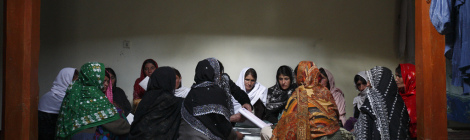
In an important year for the Women, Peace and Security agenda, women’s civil society organising is increasingly being impacted by global and national counter-terrorism regimes.

Almost 15 years after the first resolution to address women, peace and security, the agenda’s implementation is increasingly subverted by the militarised security paradigm. Implementing UNSCR 1325 has been interpreted as being about fitting women into the current peace and security paradigm and system; rather than about assessing and redefining peace and security through a gender lens. As a result, the opportunity to create a new recipe for peace and security, based on taking women’s perspectives into account, is being lost.
A version of this article was originally published on openSecurity’s monthly Sustainable Security column on 18 November 2014. Every month, a rotating network of experts from Oxford Research Group’s Sustainable Security programme explore pertinent issues of global and regional insecurity.
This article is part of the Remote Control Warfare series, a collaboration with Remote Control, a project of the Network for Social Change hosted by Oxford Research Group.
While the world’s attention has been focused on the US-led military interventions in Iraq and Syria a quieter build-up of military assets has been ongoing along the newer, western front of the War on Terror as the security crises in Libya and northeast Nigeria escalate and the conflict in northern Mali proves to be far from over. In the face of revolutionary change in Burkina Faso, the efforts of outsiders to enforce an authoritarian and exclusionary status quo across the Sahel-Sahara look increasingly fragile and misdirected.
In early August, coinciding with the restructuring of French military operations in the Sahel and the US-Africa Leaders Summit, Oxford Research Group and the Remote Control Project published a comprehensive assessment of counter-terrorist operations targeting jihadist groups in the Sahel-Sahara region of north-west Africa. That report found extensive and growing evidence of combat, intelligence, surveillance and reconnaissance (ISR), training and equipment, abduction and rendition programmes on this new frontier. While France and the US were easily the most active foreign actors, the UK, Canada, the Netherlands and several other NATO states were also found to be increasingly involved in special forces and ISR operations.
The launch coincided with the onset of air attacks on Islamic State targets, initially by the US in northern Iraq and latterly by a broad coalition of Western and Arab states in Iraq and Syria. In a context of worsening security crises in Libya, Nigeria and northern Mali and Niger since, US and UK ISR activity is increasing, French deployments in Mali have been reinforced, a new configuration of Arab states has provided impetus for foreign intervention in Libya’s civil war and a “black spring” backlash is emerging against the west’s authoritarian allies in the region.
Libya is at the core of the security crisis in the Sahel-Sahara. Since the NATO-led military intervention which overthrew the Qaddafi regime in 2011, Libya has become a security and political vacuum and a major exporter of weapons and insecurity in the region. This has included the return home to the Sahel of hundreds of combatants formerly given refuge or employment by the Libyan state.
Libya’s civil war reignited in May with the launch of “Operation Dignity” by secular forces from eastern Cyrenaica, seeking to wrest control of Benghazi and Tripoli, the two main cities, from Islamist militia. This has been largely a failure. Most diplomatic missions evacuated Libya in late July and Tripoli and its burnt-out international airport fell to militia from Misrata (Libya’s third city) and allied Islamist groups on 23 August. Benghazi has fallen increasingly into the hands of Salafist groups and the nearby city of Derna is run as an Islamic emirate by Ansar al-Shari’a. Much of the rest of Libya is dominated by local tribal leaders or armed factions, beyond any state control.
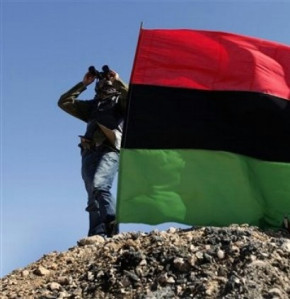
Anti-Gaddafi rebel looks to the sky in the oil town of Ras Lanouf, eastern Libya, March 6, 2011. Source: cropped version of BRQ Network image (via Flickr)
Indeed, there are now two rival, elected Libyan governments. The one recognised internationally meets in a Tobruk hotel. It controls little beyond this Egyptian border outpost and its electoral mandate was recently invalidated by the Tripoli-based Supreme Court. The revived General National Council in Tripoli governs the capital and north-west and is dominated by an affiliate of the Muslim Brotherhood and other Islamist factions.
Libya has thus become a new frontline in the proxy war between the international proponents and opponents of the brotherhood. Qatar and the United Arab Emirates (UAE) were the two main Arab sponsors of the anti-Qaddafi rebellion and contributed to the air attacks on Qaddafi’s forces. They now find themselves backing different sides in Libya. On 17 and 23 August, days after the Tobruk parliament called for foreign military intervention, Emirati aircraft based in and refuelled from Egypt launched unclaimed attacks on pro-Islamist militia around Tripoli airport.
Despite official denials, it appears that air attacks on Salafist groups in Benghazi in mid-October were launched by Egyptian aircraft. Egypt and the UAE accuse Qatar, the primary sponsor of the brotherhood in Egypt, and Sudan, long ruled by a military affiliate of the brotherhood, of funnelling arms to the various Libyan Islamist militias.
While the US has condemned all post-2011 foreign intervention in Libya, it is likely that it was aware of the movement of UAE aircraft to Egypt, given that fighters presumably left from Al-Dhafra air base in Abu Dhabi, which is shared by US and French squadrons. Emirati refuelling aircraft are based at Al-Minhad in Dubai, where the UK Royal Air Force (RAF) has an expeditionary wing. These aircraft presumably were cleared by Saudi Arabia (another great opponent of the brotherhood) to overfly its territory. The aircraft and weapons used were supplied by the US and/or France.
France stands apart among Western allies in its advocacy of, and preparedness for, renewed military intervention in Libya. Since the fall of Tripoli, its defence minister, Jean-Yves Le Drian, has several times advocated a UN mandate for intervention against Islamist groups in Libya and hinted that France may need to act unilaterally sooner or later. Whereas Egypt is most concerned about Salafist groups in Derna and Benghazi, France is focused on al-Qaida affiliates in south-west Libya. Already this year it has opened bases near the Niger-Libya and Chad-Libya borders and revived ISR operations from its air base at Faya-Largeau in northern Chad.
France cares about southern Libya primarily because of its security commitments to Mali, Burkina Faso, Chad and Niger, the latter hosting multi-billion-euro French investments in uranium production. Since France reorganised its forces in the Sahel from the Mali-focused Opération Serval to the pan-Sahel deployments of Opération Barkhane in mid-2014, security in northern Mali has worsened significantly. This relates partly to the decline in French troop numbers there but also to the reorganisation of regional jihadist groups and the deterioration in relations between the Malian state and local armed separatists. Twenty UN peacekeepers from the Multidimensional Integrated Stabilisation Mission in Mali (MINUSMA) have been killed in at least five jihadist attacks in the north of the country since September. In response, France has had to reinforce its deployments in Kidal district, pulling in troops and equipment from its base in Côte d’Ivoire.
On 9 October, French forces under Barkhane mounted their first publicly acknowledged offensive action outside of Mali, attacking a convoy supposedly transporting militants and weapons from Libya through Niger towards the country. Militants apparently moving from north-eastern Mali attacked Nigerien security forces in Ouallam three weeks later, freeing dozens of Islamist prisoners and attacking a refugee camp. Citing increased activity, the huge Algerian military is also reported to have moved thousands of troops to its borders with Niger and Mali since last month.
The US has also sought to extend its own ISR deployment in Niger, announcing in early September that it would be moving its two MQ-9 Reaper unmanned aerial vehicles from Niamey airport, where they have been deployed since early 2013, to Agadez, the main town in the desert north. As with French redeployments in 2014, the objective appears to be to bring more of southern Libya into range of ISR assets.
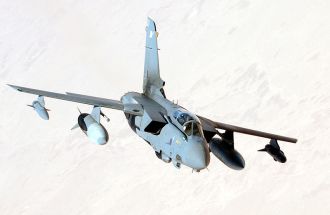
RAF Panavia Tornado GR4 fighter over Iraq during a combat mission in support of Operation “Iraqi Freedom”, on 16 August 2004. Source: SSgt. Lee O. Tucker – Official U.S. Air Force Photo no. DF-SD-07-05791 (via Wikipedia)
Perhaps least analysed of recent military deployments to west Africa have been those associated ostensibly with humanitarian, rather than security, crises. In late August, following Boko Haram’s seizure of territory and declaration of its own caliphate in northern Nigeria, the RAF deployed a number (three is reported) of Tornado GR4 aircraft from the UK to the French air base in N’Djamena, Chad. This base is also used by US drones.
Unusually, the Ministry of Defence issued almost no comment on this and refuses to disclose how many aircraft were involved, where they operated from or exactly when and why they were deployed. Officially, they were on an ISR mission in support of attempts to locate the more than 200 girls abducted by Boko Haram from a boarding school in Chibok in north-eastern Nigeria in April. All aircraft had officially returned to the UK by 15 October. While the Tornado GR4 is often deployed as a reconnaissance aircraft, it is dual use and its primary role—for example, in Iraq—is as a medium-range strike aircraft.
Also very little reported was the US Marine Corps’ establishment during September of three new “co-operative security locations” in Senegal, Ghana and Gabon, along the west African coast. These are to be bases permanently prepared and supplied, but not necessarily manned, to support US interventions under the Obama administration’s “New Normal” doctrine, which facilitates defence or evacuation of US interests and citizens under (terrorist) attack in any country. While marines and their V-22 Osprey aircraft may continue to be based in Spain, Italy and Djibouti, these new west African bases are specifically launch pads for future US military interventions. US military contractors have been stockpiling aviation fuel at these and many other African airports for several years.
Interestingly, the Senegal facility has been specifically referred to as an “interim staging base”—the usual terminology for a Special Purpose Marine Air-Ground Task Force base—in the context of the US military’s humanitarian mission to control the Ebola epidemic in Liberia. As with previous Obama-era deployments against the Lord’s Resistance Army in and around Uganda and in support of the Chibok abductees, the escalation of a US military presence appears to have been achieved under the cover of humanitarian imperatives and initiatives.
All this matters because if there is one thing that we should have learned since 2001 it is that Western military interventions to oppose terrorism on foreign soil do not work: they tend to destroy the “host” country while amplifying the threat to the “far enemy”. And proxy wars between the Arab states so lavishly armed by the US, France, the UK and Russia tend to end in something worse than tears. Neither the “war on terror” nor the “Arab spring” (counter-)revolution has yet run its course.

“The Army: National Shame” caption held by protester in Mali against the 2012 coup. Source: Wikipedia
The political crisis in Burkina Faso, in which the authoritarian president of 27 years, Blaise Compaoré, was overthrown in a popular uprising turned military coup on 31 October, provides ample warning of the toxic relationships Western states are forging in the Sahel-Sahara in the name of counter-terrorism. As in Mali in 2012, the coup leader in Burkina was an ambitious, US-trained officer. French and US special-operations forces will probably retain their semi-secret bases but their political masters have again been embarrassed by their own role as props to the hated old regime.
Protesters in Burkina Faso—a remarkably civil, peaceful, articulate and internationalist society that belies the Sahel’s reputation for isolation—have talked up the precedent of their revolution for a “black spring” that would sweep away the Western-armed and educated tyrants whose misrule blights the south of the Sahara. They have chosen a very different path to the eschatological nihilism of Boko Haram but their hunger for change is similarly derived from generations of stultifying and systematic marginalisation under a corrupt, militarised and foreign-sponsored elite.
Like Tunisia before it, Burkina Faso may be the clear-sighted vanguard that has the self-belief and self-discipline to manage a successful transition from autocracy. It is hard to hold such hope for the supposedly firmer pillars of western Sahel strategy, Chad and Mauritania, which have known almost nothing but rule by armed clans. Nor for Algeria—where the “printemps noir” epithet was coined during a forgotten 2001 Berber uprising—the last of whose mid-century revolutionary leaders yo-yos, paralysed and dying, between Algiers and French clinics.
Sahara bores are wont to remind outsiders that the great desert is a crossroads, not a cul-de-sac, composed far more of enduring rock than shifting sands. The opposite can perhaps be said of the region’s militaries. Viewed within fragile states, military institutions may look rock-strong but they are built on sand and bound to fickle alliances. As in Burkina, it is society that is the bedrock with the power and permanence to anchor a sustainable strategy for peace and stability.
Trying to contain a revolution in the Sahel-Sahara is not a long-term option but channelling it may be. Change is coming, one way or another.
Richard Reeve is the Director of Oxford Research Group’s Sustainable Security programme. He has researched African peace and security issues since 2000, including work with ECOWAS, the AU and the Arab League.
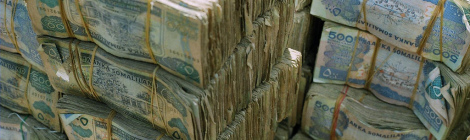
In considering security sector reform, questions of affordability have often been subordinated to questions of effectiveness and expediency. A recent series of reviews of security expenditures by the World Bank and other actors in Liberia, Mali, Niger and Somalia has highlighted several emerging issues around the (re)construction of security institutions in fragile and conflict-affected states.
 The doubters of global warming are emboldened by their new ability – as in the “climategate” affair – to put climate researchers on the defensive. But the experience of comparable assaults on the discipline of peace studies in the 1980s suggests that hostile scrutiny can have longer-term benefits for the target.
The articles in this series try to throw light on recent or current developments in international security. Just occasionally an element of personal experience creeps in. This is one of those.
The last weeks of 2009 were difficult for the public face of scientific research into global warming. The failure of the climate-change conference in Copenhagen, the identification of minor flaws in the International Panel on Climate Change (IPCC’s) published documentation, and the exposure of email exchanges centred on the Climatic Research Unit (CRU) at England’s University of East Anglia – all raised doubts about those charged with presenting scientific evidence about climate change and renewing efforts to address the phenomenon. In the case of the email affair – given an extra conspiratorial frisson by being called “climategate” – the careful selection of damaging details by an evidently well-resourced group made it possible to erect a narrative of deception that found an uncritical welcome among climate “sceptics” and “deniers”.
Soon after the furore, Associated Press tasked a team to examine 1,073 emails from the CRU material in order to provide an independent view of what had happened. The result showed no evidence that climate change was faked (see “’ClimateGate’ Doesn’t Show Global Warming Was Faked, AP Reports”, Huffington Post, 12 December 2009); but amid a deluge of negative comment this attracted little attention, and the impression persists that the whole case for human-induced climate change has been severely hit.
For many of the researchers involved, the period of late 2009-early 2010 has been traumatic; they may have had to contend with controversy over the years, but this is something outside their experience.
The intensity of the coverage, and the zealotry of many sceptics in pressing their case, stem in part from changing global circumstances. There has long been deep opposition to any international move towards a low-carbon economy, from reasons both ideological (free-market true-believers) and commercial (the more retrograde transnational corporations, especially fossil-fuel companies). There was no great risk of such a move as long as George W Bush was in the White House; but the election of Barack Obama and the prospect of Copenhagen agreeing a successor to the Kyoto protocol made 2009 potentially a dangerous year. In this context, “climategate” has been a gift.
The lesson of my own experience in the 1980s suggests that the longer-term impact might be rather different from what the architects of this affair intend. I got into working in the field of international security from teaching environmental science and resource-conflict at Huddersfield Polytechnic, west Yorkshire, in the early 1970s (and recently came across some of my thirty-five-year-old lecture notes dealing with rising atmospheric CO² levels!). I moved to Bradford’s department of peace studies at the end of the decade, just as the cold war was entering a particularly tense period; from around 1980 onwards, several of us there saw the need for independent research and writing on nuclear issues.
An early outcome (with co-authors Malcolm Dando and Peter van den Dungen) was a book about the risks and consequences of nuclear war: As Lambs to the Slaughter: The Facts About Nuclear War (1981). It struck a chord; 25,000 copies were sold in a few weeks, and that year around 500,000 people purchased an accompanying leaflet published by the environment group Ecoropa.
As Lambs... was part of a wider body of writings, much of it for an academic rather a general readership. This was the case with A Guide to Nuclear Weapons (1981) which ran to several editions and led eventually to a reference work: The Directory of Nuclear, Biological and Chemical Arms and Disarmament 1990. The core purpose of this writing was to be as accurate as possible; this meant (for example) always analysing Soviet as well as western systems and postures, and having a particular focus on the actual consequences of a nuclear war.
What strikes me in retrospect – and when thinking about the problems that climate scientists now face – is how widely varied were the reactions to our work. Military officers, for example, were actually very interested in it and very ready to engage in intensive debates. I was first invited to lecture at the Royal Air Force staff college in 1982 and have continued frequently to lecture at defence colleges to the present day. Senior civil servants in Britain’s ministry of defence were also willing to discuss our work.
The reaction on the political right – then very much in the ascendancy during Margaret Thatcher’s long premiership (1979-1990) – was very different; it was bitter and sustained opposition to what we were doing. In the Thatcherite view of the world, peace studies was “appeasement studies”, indulgent to official enemies and undermining of the nation’s moral fibre. Many articles and pamphlets were written about the Bradford department’s dangerous and subversive nature; one noble member of the House of Lords (the upper chamber of Britain’s parliament) even described us as a “rest home for urban guerrillas”. Some critics preferred a more personal touch: I was called “Dr Death”, and we regularly got abusive mail (which, on one or two occasions, went as far as death-threats).
It was known that Margaret Thatcher wished “something to be done” about peace studies; but this was politically difficult, since universities still retained considerably more independence (a situation that subsequent governments have done much to redress) than now. But the University Grants Committee (UGC) came under pressure to investigate us and to its credit agreed to do so only if Bradford’s vice-chancellor allowed it; he too was prepared to say yes, but – also to his credit – only if the peace-studies staff gave their consent. We certainly would! What followed was the equivalent of today’s “subject review”. It was thorough and exacting, and the UGC made public its verdict – that the department was maintaining high standards.
That outcome lifted the pressure off peace studies for the rest of the 1980s. With the end of the cold war by the end of the decade, much of the other work our staff and research students already did – on peacekeeping, environmental conflict, and mediation, among other issues – came to the fore; this created the foundation for an expansion of our work in the 1990s.
How does this relate to “climategate”? A key factor is that we were exposed to intensive criticism and persistent scrutiny of our work virtually from day one, and this in direct consequence made us hugely aware of the need for very high levels of accuracy and impeccable referencing of sources. Access to a wide range of military and defence journals, and a huge amount of information in the public domain, meant that this was actually not so difficult; but under so much external pressure we learned to be very cautious in our analysis at a time when exaggeration on the issues we addressed was common enough.Many of us now think that the experience made us better academics. If almost everything you write is going to be exposed to detailed examination by relentless and often politically-motivated critics, then you have to set unusually exacting standards for your work. The likely – and beneficial – implication is that climate researchers who have gone through their own test-by-fire will in future take even greater care over published assessments and analyses.
In many ways we were luckier than today’s climate researchers: for there was an intense focus on our peace-studies work from the very beginning – whereas critics of climate science are able to retrieve work published a decade and more ago, when the issue was far less controversial, in order to pinpoint a minor laxity and use it to great effect to damn the whole enterprise.
The overall effect of the setbacks to climate-science’s public face may amount to the loss of a year in the transition to a low-carbon future, but the good work being done in this area offers many grounds for optimism. The New Economic Foundation’s The Great Transition project, and Tim Jackson’s book Prosperity Without Growth: Economics for a Finite Planet (Earthscan 2009) are but two examples. Alongside the evidence that continues to emerge about the accelerating impact of climate change, the flow of impressive research and compelling argument based on even more rigorous standards will ensure that the refusenik stance will in future become harder to make.
In the end, peace studies was made stronger by those who sought to expose it. In a similar way, the travails of climate researchers may well end up reinforcing the integrity of the science and the necessity of the low-carbon transition.
 Delicious
 Digg
Digg StumbleUpon
 Reddit
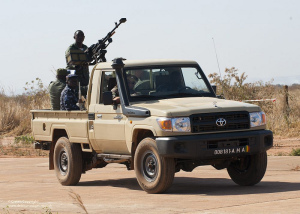 (This piece was originally published by Channel 4 News on Tuesday 22 January 2013, and is the second of two parts by Ben Zala and Anna Alissa Hitzemann)
Not unlike the United States in both Afghanistan and Iraq, the French government has begun the intervention with talk of short timelines and minimal troops on the ground before quickly changing its tune, write Anna Alissa Hitzemann and Ben Zala for the Oxford Research Group.
The initial deployment of 800 French troops may end up numbering more than 2,500 and President François Hollande has stated France’s mission is to ensure that “when we end our intervention, Mali is safe, has legitimate authorities, an electoral process and there are no more terrorists threatening its territory”. This does not seem to tally with the earlier statement by the French Foreign Minister that the current level of French involvement in the country would last for “a matter of weeks”.
The latest reports are that the Islamist fighters have been preparing for this intervention by carving a network of caves and tunnels into cliff faces to house bases and supplies of fuel and ammunition. This, combined with the concerns about the roles of both the Malian security forces and a number of potential contributors to the ECOWA force in relation to the abuse of civilian populations (and the likely blowback effect of such actions), mean that stability in Mali will be almost impossible achieve with military force alone.
It is also far from clear whether the African states that are set to join the intervention will be able commit forces for a drawn-out insurgency. After Chad, the second biggest promised contributor of troops is Nigeria, which has pledged a contingent of 900.
Yet the Nigerian government itself is fighting its own Islamist-inspired insurgency with the Boko Haram group in the country’s north. Despite a relative decline in Boko Haram attacks in recent months and even the potential for Saudi-backed peace talks between the rebels and the government, fighting could easily intensify once more, in which case Nigeria is unlikely to remain involved in Mali in any significant way.
Without taking serious action to address the sense of marginalisation and disenfranchisement of those who were willing to join one of the rebel groups… there are few reasons to think the current intervention will produce a durable peace in Mali.
Not only have France and its allies underestimated the difficulty of fighting the northern rebels among civilian populations in which bombing from above is of little use, there appears to be no sign of a plan as to how the factors underlying the uprising (including the original Tuareg rebellion) can be addressed.
Without taking serious action to address the sense of marginalisation and disenfranchisement of those who were willing to join one of the rebel groups — Tuareg, Islamist or otherwise — there are few reasons to think the current intervention will produce a durable peace in Mali.
While military force is considered the only option, feelings of resentment amongst elements of the population of northern Mali are likely to increase. Not only this, it will provide ample encouragement to other anti-Western paramilitary groups across North and Sub-Saharan Africa, the Middle East, and Central, South and Southeast Asia.
The central lesson of the western interventions and small-scale military operations (including Pakistan, Yemen, Somalia and elsewhere) of the post 9-11 era, has been that reacting to the symptoms of insecurity once they are deeply manifested, and few options other than military force remain, is a fundamentally flawed strategy for global security. This means that France and others are likely to now be involved in an ongoing conflict in Mali for some time.
Not only do the (so far conspicuously absent) plans for a post-conflict stabilisation process need to be settled between France and its coalition partners now, a serious commitment to assisting the Malian government to going much further in addressing the marginalisation of the north will be crucial.
Until the focus shifts from military control to working towards solving the root causes of the conflict, no viable sustainable security will be found for Mali.
Anna Alissa Hitzemann is a Peaceworker with Quaker Peace and Social Witness. She currently works with Oxford Research Group as a Project Officer for the Sustainable Security Programme, with a focus on our ‘Marginalisation of the Majority World’ project.
Ben Zala is a Lecturer in International Politics at the University of Leicester.
Image source: Malian Airfield Protection Vehicle and Crew at Bamako, Mali. Source: UK Ministry of Defence.
 To browse a list of all of the articles EXCLUSIVELY written for sustainablesecurity.org – follow this link
Climate Change and its variability is a phenomenon that cannot be pushed aside because of its potentail consequences and global scale. Its impacts have been suggested at different times by researchers to have favorable and unfavorable implications in different parts of the world.
Sub-Saharan Africa is home to about 635.2 million people (cited in Oduaran & Nenty, 2008), and is always in the world’s news, being the hot zone of the African continent that has been noted for its volatility and instability. Some of its countries are in protracted conflict. Climate change has been implicated by many literatures to multiply these tensions.
Natural resources are supposed to be the economic backbone of Sub-Saharan African countries. Some of these natural resources are also expected to be vulnerable to climate change. Experiments have suggested that conflict can be driven by natural resource degradation, scarcity and by competitive control of areas where resources are abundant (Myers 2004). Several researchers and authors have corroborated this position, with particular emphasis on water resources. Water is a natural resource of immense importance for every facet of life. Therefore, its potential distortion by climate change may interfere with human security, which has been proposed to be connected to water security.
This conflict tendency of the imminent effects of climate change in the world was also supported by the statement made by United Nations Secretary General, Ban ki Moon in March 1, 2007, when he said:
“The majority of the United Nations’ work still focuses on preventing and ending conflict, but the danger posed by war to all of humanity and to our planet is at least matched by the climate crisis and global warming… [the effects of climate change are] likely to become a major driver of war and conflict.”
This statement shows why climate change should be given utmost research and policy consideration in every facets of our society.
This paper identifies poverty as a threat in Sub-Saharan Africa countries that will be exacerbated by water scarcity, analyzes the conflict implications of the supposed effects of climate change on water security in Sub-Saharan Africa, and advocates for sustainable water management as an ameliorative and mitigation approach to water security in Sub-Saharan Africa.
Poverty, Water Security and Climate Change in Sub-Sahara Africa
Many countries and its people in Sub-Saharan Africa are regarded as poor. These poverty levels are in variations. Poverty is a threat that affects every facets of human society, including water security. Poverty and conflict are sometimes linked together by researchers, conflict having been seen as both a cause and a consequence of poverty (Brown and Crawford, 2009). At the same time, human dignity and development have at most times been hindered in Sub-Saharan Africa by continued conflict.
The World Bank (2010) Poverty Data gives the statistical data of the Sub-Saharan Africa poverty headcount ratio in 2005 as $1.25 a day (PPP): 50.9%, and $2 a day (PPP): 72.9%. This data attetsts to the extraordiary level of poverty being witnessed in the region. The conflict atmosphere in some of the nations in the Sub-Sahara Africa has visible socio-economic implications on sustainable development and invariably exacerbates the impoverishment of the people.
Laplante (2009) surmised that there is existing empirical evidence clearly demonstrating a positive correlation between poverty (or economic development) and the impacts of climate change. Several researchers have also interlinked poverty to climate change vulnerability and adaptation (Mckee and Suhriki, 2005 cited in Confalonieri, 2005, Watson et. al., 1997 cited in O’Brien and Leicheko 2002, AFP, 2007). This poverty and climate change nexus may have implications for water security, thereby instigating stress on the people.
As I have argued in previous papers, “Water is practically an issue tied with the existence of life because of its importance in nearly every area of development including sustaining life on the planet earth” (Akiyode, 2010). Water security is important to environmental sustainability and paramount to the sustenance of societal peace. Therefore, the goal of human society and challenges of the world’s poor countries including Sub-Saharan Africa must be to achieve water security (Grey and Sadoff 2007).
Read the rest of the article at peace and conflict monitor
Image source: Abdurrahman Warsameh for the International Relations and Security Network
Delicious Digg StumbleUpon RedditThe dramatic recent escalation of rhetoric and military posturing on the Korean peninsula has reawakened suggestions that the United States could use relatively low-yield nuclear weapons in a limited or tactical operation to neutralise North Korea. Indeed, both the idea of nuclear ‘first strike’ and their ‘flexible’ usage on and off the ‘battlefield’ are deeply rooted in historic and current NATO and UK doctrine on nuclear weapons. Given the extraordinarily militarised nature of the inter-Korean border and, increasingly, that between NATO and Russia, the potentially cataclysmic nature of any nuclear exchange must be urgently recalled and avoided at all costs.
One of the most common misunderstandings about nuclear weapons in general and Britain’s nuclear weapons in particular is that nuclear strategy is solely about deterring an opponent from attacking you by threatening that opponent with all-out destruction in response. Given the growing risk of a nuclear confrontation over North Korea it is appropriate to point out that this has never been the case. Ever since the start of the nuclear age nuclear weapons have been seen as useable weapons and appropriate in certain circumstances for fighting limited nuclear wars.
As a member of NATO Britain retains the option of using nuclear weapons first and has the means to do so. This briefing is intended to serve as a reminder of this. It will do so by concentrating specifically on British policy, both within NATO and out-of-area, but this applies just as much to the other seven full nuclear powers and, no doubt, to North Korea as well. It applies very much to the United States in particular and its current president, Donal J Trump, who has made it clear that the United States will not allow North Korea to develop the ability to target the continental United States with nuclear weapons.
When Hiroshima and Nagasaki were destroyed in August 1945 these weapons were seen in air force circles as direct descendants of the mass bombing of cities with conventional weapons using a thousand bombers or more. The raids on Hamburg and Dresden and especially the firestorm raid on Tokyo each killed tens of thousands of people so the perception after Hiroshima and Nagasaki was that the primary difference between conventional and nuclear weapons was one of cities being destroyed by one atom bomb from a single plane rather than five thousand tons of high explosive bombs from many planes. Indeed the US Army Air Corps and the nuclear weapon industry had already set in motion the industrial structures to destroy two Japanese cities every month until surrender.
By 1948 the United States had an arsenal of fifty atom bombs and was already starting to develop the far more powerful thermonuclear weapon or H-bomb. Britain came on the scene rather later. While it first tested a nuclear weapon in 1952, it was not until the late 1950s and early 1960s that it could start deploying its Valiant, Vulcan and Victor strategic bombers in large numbers. These, too, were seen in the context of the British involvement in the area bombing of German cities, but Britain was also an early adherent of the idea of fighting limited nuclear wars, an issue that was seen as particularly relevant in the Middle East and Eastern and South Eastern Asia.
Thus there were nuclear-capable Canberra bombers and nuclear weapons deployed to RAF Akrotiri in Cyprus from 1961 to 1969 to support the Central Treaty Organisation (CENTO), the South West Asian equivalent of NATO. These were replaced by Vulcans until 1975. From the mid-1960s there were regular detachments of V-bombers to RAF Tengah in Singapore and the Royal Navy had nuclear-capable Scimitar and Buccaneer strike aircraft on aircraft carriers such as Eagle, Ark Royal, Centaur and Victorious over a 16-year period from 1962 to 1978.
From the early days of the deployment of nuclear weapons by states such as the Soviet Union, the United States and Britain there is ample evidence that both military and political leaders accepted the possibility of limited nuclear war. It was expressed in Britain, for example, by the then Minister of Defence, Harold Macmillan, speaking in the House of Commons in 1955:
“…the power of interdiction upon invading columns by nuclear weapons gives a new aspect altogether to strategy, both in the Middle East and the Far East. It affords a breathing space, an interval, a short but perhaps vital opportunity for the assembly, during the battle for air supremacy, of larger conventional forces than can normally be stationed in those areas.” (Hansard, volume 568, column 2182, 2 March 1955).
As one of the founder members of NATO, and the second to develop nuclear weapons, Britain was involved in NATO nuclear planning from the very early years of the mid-1950s. In those early years and until the late 1960s, NATO nuclear policy was codified in document MC14/2 known as the “tripwire” policy which planned a massive nuclear response to the initiation of war by the Soviet bloc.
While the United States maintained massively greater nuclear forces, and a wide variety of weapon types, Britain also had a significant arsenal which eventually developed to include an array of strategic and tactical systems. These included the Polaris submarine-launched ballistic missiles, free-fall bombs of variable power and anti-submarine nuclear depth bombs as well as nuclear-capable 155mm and 203mm artillery and Lance short-range nuclear missiles, the last three utilising US nuclear warheads under a dual control system. Thus, for several decades, all three branches of the British Armed Forces focused their operational planning around use of forward-deployed tactical nuclear weapons.
By the latter part of the 1960s the Soviet Union had developed its own array of tactical systems and NATO responded by modifying “tripwire” and developing “flexible response”. This was encoded in MC14/3 of 16 January 1968 and envisaged the limited use of mostly low-yield warheads early in a conflict against Warsaw Pact troops and their immediate logistic support in the belief that they might be “stopped in their tracks”. If that failed, a more general nuclear response might ensue.
Britain was very much part of this move, its nuclear forces were normally committed to NATO and UK personnel played significant roles within the NATO Nuclear Planning Group. This move away from deterrence through massive assured destruction was rarely publicised by the British government, one exception being an exposition of the policy offered to the House of Commons Select Committee on Foreign Affairs two decades after the transition to flexible response:
“The fundamental objective of maintaining the capability for selective sub-strategic use of theatre nuclear weapons is political – to demonstrate in advance that NATO has the capability and will to use nuclear weapons in a deliberate, politically-controlled way with the objective of inducing the aggressor to terminate the aggression and withdraw. The role of TNF [Theatre Nuclear Forces] is not to compensate for any imbalance in conventional forces. The achievement of conventional parity could have very positive consequences for the Alliance’s strategy of deterrence. But it would not, of itself, obviate the need for theatre nuclear forces.” (Third Report of the House of Commons Select Committee on Foreign Affairs 1987-88, p.35, para. 6.)
What was very little understood at the time in the public domain was that NATO’s flexible response approach was not just the preparedness to use nuclear weapons first in response to a conventional military attack from the Soviet bloc but to do so at an early stage in such a conflict. This was made clear by SACEUR (the Supreme Allied Commander, Europe), General Bernard Rogers, in an interview published in early 1986:
“Before you lose the cohesiveness of the alliance – that is, before you are subject to (conventional Soviet military) penetration on a fairly broad scale – you will request, not you may, but you will request the use of nuclear weapons”. (International Defence Review, February 1986)
NATO’s flexible response policy remains broadly in place to the present day and nuclear planning allows for many different targeting options. This also applies to the United States where such options are constantly updated to allow for changing political situations. In an interesting reflection on relative economic and political strength, Russia also sees nuclear weapons as intrinsically of greater relevance given the low capabilities of its conventional military forces compared with those of the Warsaw Pact at the height of the Cold War.
Since the end of the Second World War the United Kingdom has been one of the most active countries to be involved in overseas wars. The majority of these were wars of the late colonial period, but many others have been more broadly based, from Korea through to former Yugoslavia as well as the more recent and intensive post-9/11 conflicts across the Middle East and North Africa. Throughout all this period the UK has maintained its wide-ranging tactical and strategic nuclear options, even though the size of the arsenals is smaller than thirty years ago.
Two of the most controversial conflicts, the Falklands/Malvinas War of 1982 and the first Gulf War of 1991 have both had a nuclear connection. After Argentina occupied the Falkland Islands in early 1982 the UK government under Margaret Thatcher despatched a substantial naval task force and six days after it left Britain The Observer reported that
“It is almost certainly carrying tactical nuclear naval weapons – atomic depth charges carried by Sea King helicopters and free-fall bombs carried by Harrier jump jets – as part of NATO equipment.” (11 April 1982)
Later reports indicated that many of the weapons from the smaller warships were transferred en route to an auxiliary supply ship, the RFA Resource which proceeded to the South Atlantic with the rest of the fleet but was deployed away from the most intense areas of action during the subsequent war. It is not clear whether this also applied to the nuclear weapons that may have been deployed on the two aircraft carriers, HMS Invincible and Hermes and there were also multiple if unconfirmed reports that the Thatcher government was prepared to deploy a Polaris missile submarine to the mid-Atlantic to bring it within range of Argentina. (Paul Rogers, “Sub-Strategic Trident: A Slow Burning Fuse”, London Defence Papers 34, Brasseys, 1996)
Nine years after that war the UK government committed substantial forces to a US-led multinational military coalition to evict the Iraqi forces that had invaded and occupied Kuwait in August 1990. At the time there was considerable concern that Iraq had a useable arsenal of chemical weapons and a clear indication of UK willingness to use nuclear weapons in response came in an interview with a senior army office attached to the 7th Armoured Brigade which was leaving for the Gulf. He confirmed that an Iraqi chemical attack on UK forces would be met with a tactical nuclear response. (Observer, 30 September 1990).
During the 1990s, after the end of the Cold War, the UK government, under the leadership of the Conservative Prime Minister John Major, scaled down Britain’s nuclear arsenals in a series of unilateral moves, ceasing to deploy dual-control US nuclear artillery and missiles and withdrawing the WE.177 tactical nuclear bombs and depth bombs between 1992 and 1998. US-owned B61 tactical nuclear bombs continued to be deployed at RAF Lakenheath for another decade and still are based in Belgium, Germany, Italy, Netherlands and Turkey under enduring nuclear sharing arrangements with those host countries.
In order to preserve a British “sub-strategic” capability, a low-yield variant of the standard high-yield Trident thermonuclear warhead has since been deployed, although terms such as “tactical Trident” or “Sub-Strategic Trident” are no longer used in government publications. Neither is there any specific reference in official publications to the UK maintaining a policy of potential first-use of nuclear weapons.
Instead a generic description of the UK nuclear posture appears in successive defence white papers, the 2015 statement being an example:
Only the Prime Minister can authorise the launch of nuclear weapons, which ensures
that political control is maintained at all times. We would use our nuclear weapons only in extreme circumstances of self-defence, including the defence of our NATO Allies. While our resolve and capability to do so if necessary is beyond doubt, we will remain deliberately ambiguous about precisely when, how and at what scale we would contemplate their use, in order not to simplify the calculations of any potential aggressor. (National Security Strategy and Strategic Defence and Security Review 2015, para 4.68, page 34, November 2015)
It should be borne in mind that, while British ambiguity on nuclear first use is echoed by its NATO allies in Washington and Paris, as well as its assumed adversary in Moscow, there is nothing intrinsic about such a posture. China has consistently maintained a policy of no first use and normally stores its warheads separately from its delivery systems to prevent any accidental or malicious usage. India and Pakistan are also formally committed to no first use.
This brief summary of elements of the UK nuclear posture is intended as a reminder that such a posture is far more complex than simply providing a last-ditch deterrence against nuclear attack. Moreover, this applies very much for the United States which has a far wider array of nuclear weapon types and has been at the forefront of NATO nuclear planning, including the first use posture.
Should a conflict arise between the United States and North Korea it is by no means certain that Britain would be involved, given public attitudes within the UK, although a joint RAF/US Air Force/Korean Air Force exercise was held in South Korea late last year for the first time in several decades. Even so, at a time of heightened tensions over North Korea’s nuclear ambitions the concern should be that a crisis could escalate to the use of nuclear weapons, especially with an unpredictable incumbent in the White House.
Given Britain’s propensity for considering the idea of out-of-area nuclear first use and limited nuclear war, one would hope that there is also a full understanding of the considerable dangers of such a posture. If so, what should follow is a determination to do everything possible to advise President Trump against even considering this option in the case of North Korea.
Image credit: Neil Hinchley.
About the Author
Paul Rogers is Global Security Consultant to Oxford Research Group and Professor of Peace Studies at the University of Bradford. His ‘Monthly Global Security Briefings’ are available from our website. His new book Irregular War: ISIS and the New Threats from the Margins will be published by I B Tauris in June 2016. These briefings are circulated free of charge for non-profit use, but please consider making a donation to ORG, if you are able to do so.
In recent years, the Mexican government has been struggling to deal with a dramatic rise in crime and violence, with state responses largely failing to effectively resolve these problems. But there are some grounds for optimism.
Over the course of too many years of elevated crime and violence, the Mexican government has been visibly struggling to identify the best possible course to improve public security and a more effective administration of justice. This article examines the magnitude of Mexico’s still ongoing security crisis, as well as the measures that the Mexican government has employed to try to resolve it. Drawing from an ample body of academic and policy research, there are some clear indications of what has not worked, as well as some bright spots for Mexico moving forward.
The State of Play in Mexico
For the past decade, the Justice in Mexico program based at the University of San Diego has studied the proliferation of crime and violence in Mexico, the country that has seen the greatest increase in homicides among all Latin American countries. Notably, following a marked decline in violent crime from the mid-1990s to the mid-2000s, Mexico experienced a dramatic increase in homicides during the five year period from 2007 to 2011, when homicide rates rose threefold nationally, from 8.1 to 24 per 100,000 inhabitants, according to official homicide statistics. (Based on the author’s own elaboration from Mexico’s national statistical clearinghouse, the National Institute of Statistics, Geography, and Information; see here also). The net result during that period alone was a total of nearly 100,000 homicides, and the subsequent four years through 2015 added roughly 90,000 more. Many of these homicides—an estimated 30-40%—bear characteristics frequently associated with the country’s powerful drug cartels and other organized crime groups: use of high caliber weapons, mutilation and dismemberment, execution style killings, publicly displayed bodies, and chilling messages and threats authored by the perpetrators.
While casual observers might assume that Mexico’s violence was widespread and pervasive throughout the country, the phenomenon was highly concentrated in certain regions and localities, primarily in the northern border region and in the country’s Pacific coastal states. In 2007, a Mexican city with more than 100 homicides could easily make it onto the country’s “top ten” list for total homicides; in fact, that same year, only Tijuana—the quintessential Mexican border city—reported more than 200 homicides (206 to be exact). Yet, just two years later, no city among the top ten most violent cities in Mexico had fewer than 200 homicides, and the top five had at least 400 homicides (as illustrated in Figure 1). Indeed, by 2010, arguably the peak of the violence, there were 18 Mexican cities with more than 200 homicides: now Mexico had many “Tijuanas.” Indeed, some of Mexico’s most violent cities—such as Acapulco, Ciudad Juárez, and Nuevo Laredo—saw rates more than triple the national homicide rate.
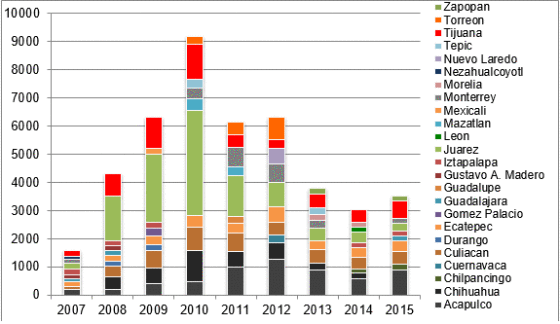
Figure 1: Number of Homicides in Mexico’s Top Ten Most Violent Municipalities by Year. Source INEGI.
In a country unaccustomed to the civil wars and brutal dictatorships that plagued other parts of Latin America in the 20th century, such an explosion of violence was unexpected and previously unfathomable. The Mexican government’s apparent inability to resolve the problem triggered an international debate on the problems and limits of the Mexican state. A 2008 worst-case assessment by the U.S. Joint Forces Command named Mexico as one of two countries—along with Pakistan—that could suffer a sudden collapse into a “failed state.” Specifically, the report asserted, “In terms of worst-case scenarios for the Joint Force and indeed the world, two large and important states bear consideration for a rapid and sudden collapse: Pakistan and Mexico…”. Pronouncements by U.S. officials—including Secretary of State Hillary Clinton in 2010—asserted that Mexico’s woes were comparable to Colombia’s long-standing problems of domestic insurgency, or even on par with a civil war. Others sensationalized Mexico’s recent violence as a new hybrid threat of “criminal insurgency” or suggested that the power and infiltration of such groups had turned Mexico into a “narcostate” overrun by violence, corruption, and “narco- terrorism.”
The merits of such assertions were quite debatable then and have proved false with time, as they tended to exaggerate and misconstrue Mexico’s current security situation. The methods and organizational forms of Mexican organized crime groups are arguably terrifying and sometimes truly mimic those of terrorists and insurgents. Yet, Mexico’s organized crime groups have shown no ambition to govern or supplant the state. They have no record or evident intention of disrupting the state’s capacity to deliver basic services. Moreover, the Mexican state maintains substantial democratic legitimacy, and has successfully deterred would-be insurgents in recent decades. Lastly, by the various measures used by the Fund for Peace to compile the Fragile States Index (formerly known as the Failed State Index), the health of the Mexican state ranks about average for Latin American countries, and its capacity is far greater than in war-torn countries like Afghanistan, Central African Republic, Iraq, Somalia, Syria, or Yemen.
The Mexican State Response

Image by Presidencia de la República Mexicana via Flickr.
There is no doubt that Mexico’s recent security crisis presented—and continues to present—a major challenge for the Mexican state, and raises serious questions about its limits and failings. It is true that, like any other individuals who violate the law, the goal of organized crime groups is to minimize the state’s ability to detect, prevent, and/or punish their illicit activities. Yet, unlike other criminal actors, organized crime groups—and particularly drug trafficking organizations—in Mexico have demonstrated a remarkable capacity to secure protection from the state to support and sustain their criminal activities, with corrupt officials on their payrolls at all levels of government. Also, to varying degrees, such groups have at least temporarily attained a stronger presence and degree of control than the government in some limited geographic areas. Moreover, in some places, organized crime groups have capitalized on anti-government sentiments to achieve a degree of popularity or even legitimacy that seriously undermines state capacity. What, then are the sources of Mexico’s recent violence, and why have state responses failed to resolve the problem in a timely manner?
The rise of Mexico’s most powerful organized crime groups—commonly referred to as drug trafficking organizations, or “cartels”—came amid a severe economic crisis in the 1980s. While other industries faltered, illicit drug production and trafficking enjoyed a major boom and substantial impunity, thanks in part to the complicity of government and law enforcement personnel. By the late 1990s, growing problems of crime and violence contributed to a crisis of “public insecurity,” characterized also by a feeling of widespread fear and frustration on the part of the general public due to the inability of the Mexican government to maintain order. Following a major political transition in 2000—the ouster of the PRI, Mexico’s long-time ruling party, from the presidency—the administration of Vicente Fox (2000-06) disrupted the leadership of two of the country’s four main organized crime groups.
This tactic of arresting, extraditing, or otherwise eliminating the top leaders of major criminal organizations has been commonly referred to as the “kingpin” strategy. Fox’s successor, President Felipe Calderón (2006-12), deployed the kingpin strategy vigorously. Calderón and other proponents of the kingpin strategy argued that taking out the top leadership would help to disrupt their operations and convert a national security threat into a more localized public security problem. In some cases, at least, the government succeeded in reducing the functional capacity of some of the country’s major criminal organizations, but the unintended result was the creation of internal power vacuums and incentives for regionally based drug trafficking organizations to clash over turf and expand into rival territories. The subsequent conflicts within and among these groups were responsible for tens of thousands of organized crime-style killings that made up nearly the entire increase in homicides noted above, especially in major drug trafficking production and transit zones.
In December 2012, a new president, Enrique Peña Nieto, took office and restored the PRI to power. His government continued to deploy the kingpin strategy, arresting high-ranking members of the Zeta and Sinaloa cartels. Remarkably, these arrests did not produce the same kind of violent aftershock that occurred under previous administrations, perhaps because of a new equilibrium among organized crime groups (there were few large cartels left standing) or perhaps more effective accommodation strategies (such as negotiations with the leaders next in line to take control of criminal operations). Whatever the reason, during 2013 and 2014, Peña Nieto’s first two full years in office, levels of homicide actually declined by around 8 and 12%, respectively (author’s own calculations from INEGI data. http://www.inegi.org.mx). However, statistics on homicide investigations for 2015 suggest that there was slight increase—about 10%—in the number of homicides nationwide, reversing the modest downward trend and provoking concerns that Mexico’s violence would ramp up again in the coming years. Final figures for 2015 likely to be released by Mexico’s national statistics agency sometime in late summer 2016, but as of mid-2016 there are troubling signs that violence is on the rise. (As this article went to press, INEGI statistics were unavailable for 2015, so the figures referenced here are Mexican law enforcement investigations into homicides tabulated by the Mexican National Public Security System – Sistema Nacional de Seguridad Pública, SNSP).
Conclusion
Looking toward the future, Mexico’s security situation will likely be affected by a number of important international and domestic factors. International factors could also significantly shape Mexico’s prospects. As a growing number of leaders and civic organizations push for the legally regulated production, distribution, and consumption of drugs (including the legalization of marijuana in two U.S. states in November 2012), this shift in discourse and policy could have major implications for Mexican organized crime groups. A loss of illicit revenues will likely reduce the capacity of these organizations to challenge the state, but it will also result in a painful restructuring of black market industries, pushing drug traffickers to increase exports of other drugs (like heroin) and further diversify into other violent criminal activities (e.g., kidnapping, extortion, robbery, etc.). This has already caused an abrupt increase in violence in some states, like Guerrero. In terms of drug policy, there are no quick and easy fixes to the problem of organized crime and violence in Mexico.
However, there are some reasons for optimism in Mexico. Changing demographic trends (including a declining population of under-educated, underpaid, and underemployed young males) and an improvement of the country’s overall economic situation could facilitate a reduction of various societal ills, including both violent crime and large-scale external migration. At the same time, with the right mix of fiscal and political reforms, Mexico’s rising economic fortunes could also bolster the state’s capacity to respond more effectively to these problems, thanks to investments and reforms in the criminal justice system, as well as public education and social programs to strengthen the social fabric. Fortunately, in recent years, the Mexican government has begun to implement major economic, social and judicial sector reforms that could greatly strengthen both state and societal capacity to reduce the power of violent organized crime groups. The main question is whether these reforms will be rapid and adequate enough to substantially reduce the number of violent deaths in Mexico over the next decade.
Dr. David A. Shirk is graduate director of the Master of Arts in International Relations program at the University of San Diego, director of Justice in Mexico, and a global fellow at the Woodrow Wilson International Center for Scholars. He is the co-author of Contemporary Mexican Politics, with Emily Edmonds-Poli.
In this talk for the Food Systems Academy, Paul Rogers puts the challenges of transforming food systems in a global, human security context. He argues that food is at the centre of the third great transition humankind has to go through.
Running order:
Part 1. Why 1945?: 0 – 2 minutes 45 seconds
Part 2. Proxy wars to the end of the cold war: 2 min 45 sec – 5 min 42 sec
Part 3. The big issues: 5 min 42 sec – 20 min 45 sec
Part 4. The third great transition: 20 min 45 sec – 28 min 49 sec
Part 5 – Looking ahead: 28 min 49 sec – end
Paul Rogers is professor in the department of peace studies at Bradford University and Global Security Consultant at Oxford Research Group. He is the author of numerous books including Why We’re Losing the War on Terror (Polity, 2007), and Losing Control: Global Security in the 21st Century (Pluto Press, 3rd edition, 2010). He is on twitter at: @ProfPRogers
The Food Systems Academy is an open educational resource aiming to transform our food systems. This video can also be viewed on their website.
Featured Image: U.S. Army Huey helicopter spraying Agent Orange over Vietnamese agricultural land (Originally from U.S. Army Operations in Vietnam R.W. Trewyn, Ph.D. , (11) Huey Defoliation National Archives: 111-CC-59948, originally found in Box 1 Folder 9 of Admiral Elmo R. Zumwalt, Jr. Collection: Agent Orange Subject Files. – Item Number: VA042084; via Wikipedia)


