Blog

  • Competition over resources

    Competition over resources

    In the environmentally constrained but more populous world that can be expected over the course of this century, there will be greater scarcity of three key resources: food, water and energy. Demand for all three resources is already beyond that which can be sustained at current levels. Once population growth and the effects of climate change are factored in, it is clear that greater competition for such resources should be expected, both within and between countries, potentially leading in extreme cases to conflict.

    Canada’s Arctic Policy: Prospects for Cooperation in a Warming World

    Brian Karmazi | Central European Journal of International & Security Studies | April 2011

    Issues:Climate change, Competition over resources

    In 1985, Oran Young anticipated that the international community was ‘entering the age of the Arctic … in which those concerned with international peace and security will urgently need to know much more about the region and in which policy makers in the Arctic rim states will become increasingly concerned.’ Young’s insights were extremely acute and much international attention is being directed to the geographic ‘North,’ where much resource wealth lies under a rapidly thinning layer of ice.

    Image source: Vishnu V

    Article source: CEJISS

    Read more »

    Sudan all about Natural Resources Conflicts

    Debay Tadesse | The African – Blog | March 2011

    Issue:Competition over resources

    Debay Tadesse from the Institute of Security Studies, Addis Ababa, looks at the future for Sudan, and the importance of sharing natural resources in the region.

    “Another important contestation is the sharing of oil revenue. The conflict between the ethnic groups, government and militias was fuelled by the significant oil reserves developed by foreign companies.  This exacerbated the conflict because the huge potential profits increased the incentives for control of the land, resulting in all kinds of human rights violations.  The South is rich with almost 60% of the oil wells but the pipes run through the North. The South fully depends on the North to sell oil. Experts in this field argues that that for the next five years Southern Sudan will have to rent the Northern oil pipeline, refineries and facilities at Port Sudan to sell its oil. If not handled diplomatically this could trigger a wave of unrest, raids and attacks on the South.”

    Article source: TheAfrican.org blog

    Image source: expo_2020

    Read more »

    The US Navy in a Warming Arctic

    U.S. Naval Forces Naval Studies Board | National Academies Press | March 2011

    Issues:Climate change, Competition over resources

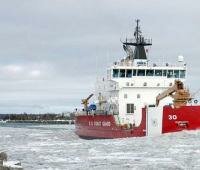
     A new report by the U.S. Naval Forces Naval Studies Board about the implications of climate change for the US Navy argues that the US should ratify the 1982 United Nations Convention on the Law of the Sea (UNCLOS). According to the report this will assist in addressing new issues around conflict and cooperation in the Arctic region arising from a changing climate. 

    Image source: U.S. Coast Guard

    Read more »

    In Asia, an Opportunity to Strengthen Long-term Relationships though Natural Resource Cooperation

    Will Rogers | Center for a New American Security | March 2011

    Issue:Competition over resources

    Writing for the CNAS Natural Security blog, Will Rogers analyses the opportunites for moving from competition to cooperation over resources, particularly between the US and China. 

    Image source: Pacific Command. 

    Read more »

    China’s drought and global food prices

    Issues:Competition over resources, Marginalisation

    What a rollercoaster ride the story of global food prices has been this year – and we’re only a month in.

    Back in January, when news emerged that food prices had reached a new record high, many analysts were relatively sanguine about the rise. As I noted in a Global Dashboard post on 6 January, the new price spike was largely driven by meat, sugar and vegetable oils, rather than, as in 2008, staples like wheat or rice.

    Governments weren’t sliding into panic measures – unlike in 2008, when over 30 of them imposed export bans, forcing prices still higher. And while the 2008 spike was marked by protests in 61 countries (with violent unrest in 23 of them), that didn’t seem to be happening this time around.

    How things can change in a month. No sooner had I published that post than Algeria erupted in rioting over high food prices – and while food prices weren’t the cause of recent events seen in Tunisia, Yemen and Egypt, they have certainly formed part of the backdrop.

    Read the full article at China Dialogue

    Image source: vivianepereiras

    Read more »

    Diplomatic shifts in the warming Arctic

    Issue:Competition over resources

    The summer of 2010 saw the third-lowest amount and extent of Arctic sea ice ever recorded. For the third year in a row both the Northwest Passage between Greenland and Alaska and the Northern Sea Route between Norway and Kamchatka were ice-free – something that had not happened before 2008 in recorded history. As the physical state of the High North is changing, so too is the diplomatic environment. 

    Article source: IISS

    Image source: IISS


    Read more »

  • Sustainable Security

  • Climate conflict: how global warming threatens security and what to do about it

    Climate conflict: how global warming threatens security and what to do about it

    Jeffrey Mazo | Adelphi 409 | March 2010

    Issue:Climate change

    Climate change has been a key factor in the rise and fall of societies and states from prehistory to the recent fighting in the Sudanese state of Darfur. It drives instability, conflict and collapse, but also expansion and reorganisation. The ways cultures have met the climate challenge provide object lessons for how the modern world can handle the new security threats posed by unprecedented global warming.

    Combining historical precedents with current thinking on state stability, internal conflict and state failure suggests that overcoming cultural, social, political and economic barriers to successful adaptation to a changing climate is the most important factor in avoiding instability in a warming world. The countries which will face increased risk are not necessarily the most fragile, nor those which will suffer the greatest physical effects of climate change.

    The global security threat posed by fragile and failing states is well known. It is in the interest of the world’s more affluent countries to take measures both to reduce the degree of global warming and climate change and to cushion the impact in those parts of the world where climate change will increase that threat. Neither course of action will be cheap, but inaction will be costlier. Providing the right kind of assistance to the people and places it is most needed is one way of reducing the cost, and understanding how and why different societies respond to climate change is one way of making that possible. 


    ‘Dr Mazo authoritatively tackles a much overlooked, yet pivotal dimension of the broader climate change debate – the security implications of evolving climate trends. He makes a strong case, anchored in both contemporary developments and historical analysis, that climate change can serve as a “threat multiplier”, contributing to instability, exacerbating conflicts and complicating foreign-policy decision-making. This book is a must read for foreign-policy professionals.’

    Ambassador Paula J. Dobriansky, former US Under Secretary of State for Global Affairs

    Available here.

    Comments

    Post new comment


  • Sustainable Security

    Momentum towards a nuclear weapons ban treaty: what does it mean for the UK?

    International momentum towards a treaty to ban nuclear weapons reached a milestone in the December 2014 Vienna conference. Even assuming that the UK does not initially sign up to such a treaty, it is subject to the pressures of a changing legal and political environment and could find its present position increasingly untenable – not least on the issue of Trident renewal.

    Read Article →

  • Competition over resources

    Competition over resources

    In the environmentally constrained but more populous world that can be expected over the course of this century, there will be greater scarcity of three key resources: food, water and energy. Demand for all three resources is already beyond that which can be sustained at current levels. Once population growth and the effects of climate change are factored in, it is clear that greater competition for such resources should be expected, both within and between countries, potentially leading in extreme cases to conflict.

    Articles EXCLUSIVELY written for sustainablesecurity.org

    Issues:Climate change, Competition over resources, Global militarisation, Marginalisation

    To browse a list of all of the articles EXCLUSIVELY written for sustainablesecurity.org – follow this link

    Read more »

    Louisiana is Sinking

    Anna Alissa Hitzemann | | January 2013

    Issues:Climate change, Competition over resources, Marginalisation

    Hurricane Katrina and the sinking of coastal Louisiana stand as a reminder that we must address climate change, competition over resources and marginalisation as the root causes of conflict before it is too late.

    Most will remember the horrific pictures on the news in 2005 when hurricane Katrina struck New Orleans. Nearly 2,000 people died, thousands more were left homeless and displaced, the material destruction was catastrophic with damages well over $100 billion.

    Image source: Brother O’Mara

    Read more »

    Strategic Thinking in a Resource-constrained World

    Ben Zala | | December 2012

    Issue:Competition over resources

    Two new reports surveying the strategic trends that are likely to shape the next few decades of global politics point very clearly to the prospect of a severely resource-constrained world. Released two days apart, both the new Chatham House report on Resource Futures and the US National Intelligence Council report on Global Trends 2030: Alternative Worlds raise a number of important questions relating to conflict and security. Both reports deserve careful consideration in national security policymaking circles now.

    Image source: Stayraw 

    Read more »

    Sustainable Finance & Energy Security

    Phillip Bruner | | November 2012

    Issue:Competition over resources

    General volatility in financial markets – fuelled by irresponsible lending and trading practices, as well as evidence of market manipulation – have had an effect on oil prices. And while the complexity of global markets means that much deeper investigation is required into the specific effects of the finance sector on oil prices, a sustainable and secure future, in which a wider energy mix has been developed to meet rising demand, will require a more sustainable financial system which can service the real needs of citizens.

    Image source: Heatingoil

    Read more »

    Greener Cities: What We Can Do

    Anna Alissa Hitzemann | | October 2012

    Issues:Climate change, Competition over resources

    A recent article on this website entitled The United States, Niger & Jamaica: Food (In)security & Violence in a Globalised World explored some of the possible links between climate change, food insecurity and violence. Many current articles in the media warn of growing food insecurity as global warming and climate change have devastating effects on crops, livestock and even fisheries. A piece in yesterday’s Guardian states that if extreme weather becomes the norm (which it has) then “starvation awaits”.

    Image source: Gates Foundation

    Read more »

    Resources and Militarisation in the East China Sea

    Ben Zala | | October 2012

    Issues:Competition over resources, Global militarisation

    As the long running tensions over the Senkaku/Diaoyu islands in the East China Sea appear to be coming to a head, the time for thinking through the alternatives to the militarisation of this conflict seems to be well and truly upon us. The conflict raises interesting issues about sovereignty claims based on offshore territories, particularly as we face a climate-constrained future as well as the increasing importance of competition over scarce resources. The latter is fast becoming one of the most important global trends if one thinks about the potential ‘drivers’ of conflict and even war.

    Image source: Al Jazeera English. 

    Read more »

  • Teaching Religion, Taming Rebellion? Religious Education Reform in Afghanistan

    Teaching Religion, Taming Rebellion? Religious Education Reform in Afghanistan

    Issues:Global militarisation, Marginalisation

    In this Peace Research Institute Oslo (PRIO) Policy Brief, Kaja Borchgrevink & Kristian Berg Harpviken explore claimed links between Taliban militancy and religious education in Afghan and Pakistani madrasas.

    Access the report online at the PRIO website

    Image source Rizwan Sagar

  • Sustainable Security

    Due to the absence of a functioning government, a counterinsurgency in a failed state can be a difficult enterprise. Since Somalia’s state collapse in 1991, various actors have been combating the threat of Al-Shabaab with mixed results.

    Counterinsurgency measures, as the name suggests, are meant to suppress an insurgency and in the long run create an enabling political environment for the establishment of a functional state capable of ensuring sustainable security. These goals are, however, difficult to achieve under conditions of state collapse given the virtual absence of a functional government. As a collapsed state that has had no functional government since the end of Siad Barre’s rule in 1991, Somalia represents an interesting case.

    Since 1991, many of Somalia’s counterinsurgency operations launched have been driven by concerns regarding the impact of Somalia’s conflict on regional security and the desire to create a functional state capable of providing basic human and physical security to its citizens. Given that Somalia is a collapsed state, the initiative of adopting and effecting counterinsurgency measures in the country has been externally driven by regional and international organisations such as the African Union (AU) and the United Nations (UN), as well as Western countries such as the United States (US) rather than by the Federal Government of Somalia (FGS).

    This article focuses on the military component of the peace enforcement African Union Mission in Somalia (AMISOM), which has positioned itself as a counterinsurgency force against the armed insurgency group Harakat Al-Shabaab Al Mujaheddin group, commonly known as Al-Shabaab.

    Somalia’s insurgency and counterinsurgency

    aminson-somalia

    Image of AMISON troop via UN Photo/Flickr.

    The nature of insurgency and counterinsurgency in Somalia is complex as it involves a variety of non-state, state and international actors. The militant Islamist group Al-Shabaab, the most significant armed non state actor, describes and perceives itself as an insurgent movement but is labelled and depicted by the FGS and external actors as a terrorist group as they see it as a transnational violent armed non-state actor. The conceptualisation and labelling of Al-Shabaab both simultaneously as an insurgent and terrorist group only complicates counterinsurgency operations in the country. This is so, in that it is not effective enough to conduct counterinsurgency as counterterrorism to suppress a group that perceives itself and thereby conducts its operations as an insurgent rather than a terrorist one.

    The combination of state collapse with the complexity and paradoxical nature of insurgency and counterinsurgency operations in Somalia has adversely affected human and physical security in the country and has provided Al-Shabaab with new political opportunities to sustain violent action. The AMISOM’s strategic concept of operations (CONOPS) and rules of engagement (ROE) indicate that its short-term repressive security measures are better clarified as counterterrorism rather than counterinsurgency, as they appear to focus on both simultaneously national and transnational terrorist activities, rather than efforts to defeat the insurgency in Somalia and ultimately create a functional state.

    The AMISON’s CONOPS combine all ongoing separate military operations in Somalia into a coordinated and coherent effort against Al-Shabaab so as to extend the authority of the FGS country-wide. It also aims at creating an enabling environment for the effective implementation of AMISOM’s mandate. AMISOM’s CONOPS have, however, been adversely hindered by the mission’s lack of adequate financial, human and military resources, thereby rendering it ineffective in its mandated operations. AMISOM’s ROE are key to ensuring that military operations are conducted in compliance with international humanitarian law obligations in Somalia’s socio-political context.

    Though the ROE are in conformity with the operational realities of the mission, AMISOM continues to operate in extremely volatile conditions created by state collapse, whereby Al-Shabaab’s asymmetrical warfare targets civilians within populated areas. This situation makes it extremely difficult for AMISOM to ensure civilian protection in the conduct of its operations and to consistently apply the mission’s ROE Counterinsurgency operations that cannot consistently sustain themselves for long periods are ineffective and will not achieve the intended outcome of enhancing sustainable security.

    A success or failure?

    The successes or failures of insurgency and counterinsurgency operations in Somalia depend on population support.  So far, the counterinsurgency strategies in Somalia conducted by AMISOM and its coalition forces, especially the Somali National Army, have been unable to gain the support of the people. Al-Shabaab’s led insurgency has gained popular support among the local-level communities, largely due to the social services and more importantly the local-level security governance it provides, in the absence of a functional state. All these strategies of Al-Shabaab, which are aimed at legitimising itself, are implemented through variants of Islamism. The movement was very effective in the provision of alternative governance structures at the local-level prior to the pre-2010 military intervention of AMISOM. The literature on counterinsurgency operations in Somalia indicates that the security vacuum created by Al-Shabaab’s departure as a result of AMISOM’s operations in these areas has led to an increase in the levels of insecurity thereby questioning the legitimacy of the latter’s operations.

    The Somali populace also perceives these counterinsurgency efforts as externally driven and extremely hesitant to engage, positively, with the fundamental Somali socio-political structures such as the clan structure and Islam. In order to be effective counterinsurgency measures, should take into account the legitimacy of these socio-political structures that play a significant role in local-level peacebuilding and governance processes.

    Doomed from the start?

    Counterinsurgency operations in Somalia have also been adversely affected by poor planning and their inability, so far, to create an enabling environment which enhances state capacity. Any credible counterinsurgency operation with a military component requires careful planning before any military incursion begins. A number of indicators suggest that, in the early stages, AMISOM neither planned nor implemented an effective counterinsurgency strategy. The initial objective of Kenya’s military incursion into Somalia through Operation Linda Nchi and subsequent incorporation into AMISOM was not peace enforcement countering the direct physical threats posed by Al-Shabaab on its territory.

    Counterinsurgency measures were later driven by socio-political and economic interests rather than peacebuilding in Somalia. Kenya’s military intervention in Somalia can be perceived as counterterrorism rather than counterinsurgency efforts given that they were initially driven by short-term strategic interests.  The establishment of a functional state has so far not been achieved in Somalia as it has been has been compromised by the manner in which regional and international peacekeeping efforts, have been conducted in the country. Most of these, if not all have been characterised by failures rather than successes. For example, the UN Monitoring Group on Somalia constantly accuses the Kenya Defence Forces component of violating AMISOM’s mandate. AMISOM has not been effectively taking the appropriate measures aimed at supporting the creation of a functionally effective state due to the strategic interests of its member states. This has compromised peacebuilding and security governance in the country.

    The resilience of Al-Shabaab as a transnational violent non-state armed actor, is partly a function of ineffective repressive counterinsurgency measures in Somalia. The repressive counterinsurgency operations conducted largely by external actors in the country are reactive, achieve unintended consequences ande hence counterproductive. A political strategy supported by security operations in the formulation and implementation of counterinsurgency operations is still ideal for any country facing an insurgency.

    Counterinsurgency measures, however, that do not require repressive security operations that focus on causes not symptoms are best suited for Somalia in the medium and long-term.  Since Somalia does not have a functional government capable of providing effective counterinsurgency operations let alone human and physical security, non-repressive measures would best be conducted by non-state actors such clan leaders and clans, and Islamic civil society organisations.

    Non-state actors are appropriate in the implementation of non-repressive counterinsurgency measures in that they not only located within fundamental Somali socio-political structures, but also have the capacity to use informal process oriented means rather than formal goal-oriented ones. Informal process-oriented methods are more appropriate when it comes to addressing the root causes of the insurgency while formal goal-oriented ones are reactive focussing on symptoms. These measures, such as those that focus on countering violent extremism, take into account fundamental Somali socio-political structures, and their corresponding customs norms and traditions thereby gaining population support and subsequently legitimacy. Such counterinsurgency measures will achieve their intended outcome of dealing with insurgency, the grievances of that insurgency and ultimately create the socio-political environment required to establish a functional state.

    Oscar Gakuo Mwangi (PhD) is an Associate Professor at the Department of Political & Administrative Studies National University of Lesotho.

  • Global militarisation

    Global militarisation

    The current priority of the dominant security actors is maintaining international security through the vigorous use of military force combined with the development of both nuclear and conventional weapons systems. Post-Cold War nuclear developments involve the modernisation and proliferation of nuclear systems, with an increasing risk of limited nuclear-weapons use in warfare – breaking a threshold that has held for sixty years and seriously undermining multilateral attempts at disarmament. These dangerous trends will be exacerbated by developments in national missile defence, chemical and biological weapons and a race towards the weaponisation of space.

    Conflict Minerals in the Democratic Republic of the Congo: Aligning Trade and Security Interventions

    Ruben de Koning | SIPRI | July 2011

    Issues:Competition over resources, Global militarisation

    Mineral resources have played a crucial role in fuelling protracted armed conflict in the east of the Democratic Republic of the Congo (DRC). This Policy Paper examines the the prospects for and interactions between various trade- and security-related initiatives that are aimed at demilitarizing the supply chains of key minerals. It also describes the changing context in which such initiatives operate. Finally, it offers policy recommendations for how the Congolese Government and international actors can coordinate and strengthen their responses in order to break resource–conflict links in eastern DRC.

    Article source: SIPRI

    Image source: Tim Pearce, Los Gatos

    Read more »

    A New Road for Preventative Action

    East West Institute | East West Institute | June 2011

    Issues:Climate change, Competition over resources, Global militarisation, Marginalisation

    A gap continues to exist between the international community’s rhetoric about conflict prevention and its responsibility to protect people from severe human rights violations. The record of human misery caused by violent conflict is testimony to the chronic  lack of political will to respond collectively to newand emerging threats to peace. The ineffectiveness of many global efforts at preventive diplomacy is evidence that traditional diplomatic approaches,  including the use of force, simply may not work.

    Article source: East West Institute

    Image source: AfghanistanMatters

    Read more »

    Drones Don’t Allow Hit and Run

    Prof Susan Breau | Oxford Research Group | June 2011

    Issues:Global militarisation, Marginalisation

    If You Use Drones You Must Confirm and Report Who They Killed, Says Legal Team.

    International lawyers have identified an existing but previously unacknowledged requirement in law for those who use or authorise the use of drone strikes to record and announce who has been killed and injured in each attack.

    A new report, ‘Drone Attacks, International Law, and the Recording of Civilian Casualties of Armed Conflict’, is published on 23 June 2011 by London-based think tank Oxford Research Group.

    Article source: Oxford Research Group

    Image source: Official U.S. Navy Imagery

    Read more »

    Space: the final frontier of Sino-US rivalry?

    Sahiba Trivedi | openDemocracy | June 2011

    Issue:Global militarisation

    China’s sky-high space ambitions have the potential to upset the current world order. Within the coming decade, China may become capable of challenging America’s dominance over space and its monopoly over global navigational systems.

    Over the past few years, China has engaged in completing high-profile, grand projects like high-speed rail, the world’s biggest airport terminal (since overtaken by Dubai) and the 2008 Beijing Olympics. Its space programme, like all else, is a matter of Chinese prestige. On successful completion, it will be yet another grand feather in China’s cap signalling its ambition of becoming a world power.

    Image source: Matthew Simantov

    Article source: openDemocracy

    Read more »

    Climate Change, Nuclear Risks and Nuclear Disarmament: From Security Threats to Sustainable Peace

    Jurgen Scheffran | World future Council | June 2011

    Issues:Climate change, Global militarisation

    This study brings to light the multidimensional interplay between climate change, nuclear risks and nuclear disarmament, and its critical implications for the strategic security environment. In addition, it explores prospects and openings to tackle these key challenges, stressing the role played by institutions to “strengthen common ecological and human security, build and reinforce conflict-resolution mechanisms and low-carbon energy alternatives, and create sustainable lifecycles that respect the capabilities of the living world.”

    Read the full report here.

    Image source: GreenDominee

    Read more »

    Security Net: Nuclear Risk Reduction in Southern Asia

    Lydia Walker and Annie Siris Coomb | Institute of Peace and Conflict Studies | June 2011

    Issue:Global militarisation

    “Security  Net” is a scenario for a future Nuclear Risk Reduction Regime in Southern Asia. It explores what such a regime might look like, how it might come into existence, what are its central challenges, and what might be its ramifications  for  nuclear proliferation and non-proliferation policy in Southern Asia today.  

    This study examines the idea of a “Southern Asia” itself and considers the differences between the relationship  of  regional identity  formation  to  nuclear  non-proliferation in Southern Asia in comparison  to  Southeast  Asia  and  Latin America.    It  then  considers  what  sort  of internal  drivers,  wild  cards,  or outside forces could create incentives for regional cooperation on Nuclear Risk Reduction in Southern Asia the future.  

    Article source: Institute of Peace and Conflict Studies

    Image source:  jmuhles

    Read more »

  • Sustainable Security

    Following the vote to renew the Trident nuclear programme, a former nuclear-armed submarine commander discusses why the UK needs to seriously rethink its attitude to nuclear weapons. 

    Editor’s Note: Commander Forsyth’s explanation as to why he has changed his view on the deterrence value of the now and future Trident weapon system was originally written for family members. It has been edited by the ORG with the full involvement and agreement of Commander Forsyth to be suitable for wider publication. Of particular interest is his alternative proposal for a smaller,  ‘for but not with’ and  more versatile submarine platform as a stepping stone to reducing the level of ready use weapons whilst preserving the ability to resurrect full CSD posture if required.

    In 1972 I became Executive Officer of HMS Repulse, one of the four Polaris A3 missile-carrying submarines based on the Clyde. Based on this experience I can say, without any sentiment or exaggeration, that the use of nuclear weapons during the Cold War would have threatened the existence of humanity.

    I believed that Mutually Assured Destruction (MAD) was at the centre of the UK’s deterrence policy, meaning that if the Soviets fired at us then we (as well as the USA and, latterly, France) would respond in such measure as to immediately annihilate several major cities in the Soviet Union.

    The consequential radiation effects of any nuclear detonation would largely complete the destruction and this would almost certainly have caused a ‘nuclear winter’.

    MAD and the Cold War

    forsyth

    Commander Forsyth on HMS Sceptre.

    The policy of MAD would, we were told, only have been used in retaliation to a Soviet nuclear first strike with missiles en route to Europe or the USA. We were constantly assured that under no circumstances would we fire our Polaris missiles first even if tanks were rolling across the German plain, unless the Soviets had already fired nuclear weapons at us.

    As Paul Rogers notes, the UK’s other tactical nuclear weapons could have been used against such a Soviet offensive. Yet at the time we thought that this would not necessarily start a strategic exchange. Perhaps naively, we tended to consider Polaris in isolation from the tactical battlefield and on a whole different level.

    The UK’s retaliatory only policy (assuring a second strike was possible) let us sleep easily at night during the years that we took 16 Polaris missiles to sea. As Nick Ritchie explains, each of these missiles carried two warheads with an estimated yield of 40kt. Thus, with 16 missiles per boat, just one patrolling submarine could have fired 32 40kt warheads, which would have given a potential explosive yield of 1.28 megatons—hence why we called what would happen if they were used Armageddon.

    Understanding the power of the bomb

    The US had many more submarines, aircraft and land-based missile silos. Our contribution was a gesture of togetherness against a common enemy whose declared policy was assumed to be ‘world domination by any means’.
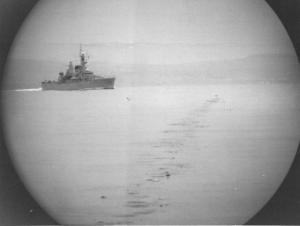
    Torpedo tracks perishot_enhanced

    Periscope pic of torpedo tracks approaching the target.

    In comparison, the atomic bomb that physically destroyed the Japanese city of Hiroshima in WWII and killed 100,000 people in the process had just a 15 kiloton yield.  So when Prime Minister Theresa May stated in parliament last July that she was prepared to press the button and kill 100,000 people, we should recognise that the number of deaths she was referring to was significantly less than that which Polaris missiles were capable of inflicting—never mind the massive collateral structural and radiation casualties which would result.

    Each Trident warhead has a yield of up to 100 kilotons, which, in terms of destructive power, is equivalent to six or seven Hiroshimas. The UK presently deploys 40 nuclear warheads and not more than eight missiles on its four submarines, meaning that the destructive power on board just one of these submarines, if used at the same time against a densely populated country, would kill considerably more than 100,000 people.

    Justifying nuclear use

    The ownership of this sort of power begs the question: what threat might justify the use of such destructive force? We also need to be clear under what circumstances and at what scale the Prime Minister might authorise a nuclear strike because she could be taking us all with her.

    Two government statements are relevant to this discussion:

    1. Then Secretary of State for Defence, Geoff Hoon, stated in 2002, prior to the invasion of Iraq, that Saddam Hussein could ‘be absolutely confident that in the right conditions we would be willing to use our nuclear weapons’.
    2. A government policy paper of 8th May 2015 stated that ‘it will not rule in or out the first use of nuclear weapons’ to ‘deter and prevent nuclear blackmail and acts of aggression against our vital interests that cannot be countered by other means’. This leaves open the option for the Prime Minister to authorise Trident’s use to deter an aggressor who may be threatening to use nuclear weapons or is using massive conventional forces which we do not have sufficient conventional force to counter. But, importantly, the government deliberately maintains ‘some ambiguity precisely when, how and at what scale we would contemplate use of our nuclear deterrent’.

    Keeping the option open of using nuclear weapons first against an adversary who you judge is threatening your ‘vital interests’ with non-nuclear force is quite different from MAD. This is what makes me question the whole basis of what we may or may not do with Trident. Formerly we would not have fired Polaris missiles until British cities had been totally destroyed by a megalomaniacal action by the Soviets. It would have been a futile gesture by us but the threat of doing so was considered to be a deterrent. Now it is ultimately a matter of the Prime Minister’s judgement as to whether we embark on a nuclear war. This raises the prospect of deliberately causing Armageddon as opposed to a reaction to one already started.

    In which case, I would argue that we have the right seriously (a) to question whether the Government should have that power and (b) if so, to constrain the circumstances in which such power can be used. As Nick Ritchie points out, the UK ‘does not dispute that international humanitarian law applies to the use of nuclear weapons and has incorporated the notion of “extreme circumstances of self-defence” into its declaratory nuclear policy statements’. Yet will all future Prime Ministers follow such guidelines in practice?

    The need to ask these questions, and decide if building a new generation of nuclear weapons is justified and will ‘keep us safe’, is particularly important given that no military case has been made for Trident’s use by its supporters—other than the vague statement that we don’t know what the future holds.

    Reference to the prospective use of nuclear weapons is nearly always qualified by adding that they are a weapon of ‘last resort’. As part of the Prime Minister’s decision making process she has therefore, at the very least, to be satisfied that all other alternative avenues have been exhausted, starting with the political and economic ones, escalating up through the increasing use of conventional military power.

    Rethinking what military capabilities the UK needs
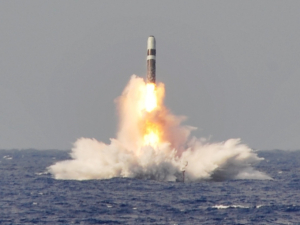
    140602-N-ZZ999-202 ATLANTIC OCEAN (June 2, 2014) A trident II D-5 ballistic missile is launched from the Ohio-class ballistic missile submarine USS West Virginia (SSBN 736) during a missile test at the Atlantic Missile Range. The test flights were part of a demonstration and shakedown operation, which the Navy uses to certify a submarine for deployment after a major overhaul. The missiles were converted into test configurations with kits containing range safety devices and flight telemetry instrumentation. The U.S. Navy supports U.S. Strategic Command's strategic deterrence missions by operating and maintaining Ohio-class ballistic missile submarines to deter regional and strategic threats. The triad, the U.S. strategic nuclear forces of ICBMs, bombers, and ballistic missile submarines, remains the primary deterrent of nuclear attacks against the U.S., our allies, and partners. (U.S. Navy photo/Released)

    Image of Trident missile via Wikimedia.

    When I was at sea in the 1960s and 1970s the UK invested in both the Polaris force and significant conventional armed military forces in all three services. The country was able to send a Task Force as far afield as the Falklands and, more importantly, the armed forces were strong and large enough to withstand the quite considerable attrition—particularly in the Navy—in fighting a full-on war.

    The services have gradually been whittled down to a level in which such a Task Force could not be assembled. By its own admission the Navy does not have enough ships and submarines to meet peacetime commitments—never mind war. The six Type 45 destroyers designed to protect the UK’s two new carriers were victims of over-design and under-funding (albeit costing £1billion each) such that they are now in harbour with major operational limitations which will take some years to be rectified.

    Meanwhile, the next generation of frigates have been delayed. When they do come they will have outdated equipment and there will still not be enough of them to give anti-submarine warfare protection to the carriers—unless they forego other roles of which there are many. The Army and Air Force also have their own tales of woe—soldiers die for lack of body armour and the correct vehicles because the military budget has to cope with the costs of Trident.

    Why is this? To some extent you can blame senior officers for lack of management ability and vision when challenged by the need to meet major commitments with a constantly reducing budget. They should perhaps have been stronger and said we are not well placed to play the role assigned in the Iraq war, be peace keepers afterwards and also embark on a new war in Afghanistan. The ‘can do’ spirit has been counter-productive.

    However, the other budgetary factor is that the cost of building four Successor submarines alone is now set to cost at least £31 billion. You can buy quite a lot of aircraft carriers, frigates and hunter killer submarines for that.

    The consequential reality is that we have very little conventional capability before the use of Trident becomes our last resort—a very dangerous situation for world peace. So who are we likely to need to use our last resort against having said that rogue states and dirty bombers are not likely targets? The answer is no one at the moment. Yes, Russia is acting aggressively, waving their nuclear weapons stick, but Russia has no grand plan for world domination. I must therefore conclude that the Royal Navy is being exploited to operate a political status symbol with no military value at the cost of other important capabilities.

    There is no threat to the UK that justifies our nuclear force

    During the Cold War the UK’s nuclear-armed submarines were at 15 minutes notice to fire. Since 1994 however, following an agreement with Russia, the UK’s nuclear weapons have been de-targeted—although this situation could be quickly reversed. The Trident submarines are lurking on standby ‘just in case’, so there is time to target and arm them if the situation escalates. Saying North Korea is a threat to the UK is not credible. Pyongyang may become a threat to US interests, but even that is unlikely and the US is more than capable of responding.

    Some may argue that now is not the time to lay down our nuclear arms because it might further destabilise our position in Europe and be seen as a further ‘weakness’ post-Brexit. But what does this mean? That the Russians will see an opportunity and seize it? I believe they know, despite the Prime Minister’s words, that we would not fire our nuclear weapons except in retaliation to a major nuclear first strike by them—which they are unlikely to launch.  But I also believe it is possible that Putin could take advantage of our regular Force’s weakness, for example, through giving covert military support and overt political support to ‘popular’ pro-Moscow uprisings in Russia’s near abroad. The calculation here would be that NATO would likely find it difficult to find an effective response to such manoeuvres.

    As for a developing intercontinental threat from elsewhere in the future, if it’s not on the drawing board now (and it’s not) then we have time to consider our options. Designing a submarine today to go to sea in 17 years’ time to counter a future undefined notional threat is really fighting yesterday’s war with yesterday’s technology. By making that decision now it becomes harder to change our posture as more and more money is poured into the Successor programme.

    Is there an alternative? Yes there is. If, despite all the above, the UK decides it needs to have a nuclear weapon system for ‘insurance’ reasons then a submarine platform is probably the best vehicle to carry it because it is considerably less vulnerable (I would not use the word invulnerable now) to counter-detection than cruise missiles, aircraft or land based weapon platforms. However, the problem with the current and future Trident submarines is that they are a single purpose platform, very big—consequentially comparatively slow—and really only have a self-defence capability. They contribute nothing to peacetime surveillance or war-fighting capability in any other area than firing strategic missiles and cost the earth.

    We have already reduced the number of missiles per boat so why not make a further reduction to say four per boat and fit a missile section into existing Astute class hunter-killer submarine hulls?[1] This option could save money, enable a dual role and, by building five, two or even three of them could be at sea at any time in either role and be a useful enhancement to the UK’s broader submarine needs.

    Furthermore, if the Government wished to demonstrate its willingness to comply with the Nuclear Non-proliferation Treaty, then missiles and warheads could be placed in ready-use store. This is justifiable on the basis that there is no threat today that requires the cost of having a submarine at sea at all times employed solely on what is known as Continuous at Sea Deterrence (CASD). Apart from anything else, the maintenance of the ‘invisibility’ of the SSBN on patrol requires additional support from ships, submarines and maritime aircraft taken off other more real time operations. Should it ever begin to become necessary, a CASD posture could, of course, be re-introduced very quickly as a clear signal of the UK’s determination to deter and as a further step up the nuclear ladder.

    Conclusion

    I believe that it is highly unlikely that the UK will ever come under nuclear attack from an enemy remotely susceptible to a threat of nuclear retaliation. I also don’t think first strike nuclear attack should ever be an option for the UK—we should not duck saying that. But if, as some may argue, that now is not the time to scrap the nuclear option because there is a remote chance we need to retain a nuclear weapons capability, then there is an option which cuts the cost significantly, allows for the restoration of our three Services to something resembling useful and still maintains the nuclear deterrent as a capability to be deployed if events ever require. Yet, of course, even this option would not prevent the government of an independent Scotland from forcing the relocation of Trident south of the border at a massive extra cost.


    [1] Trident submarines have 16 missile tubes and the Successor class is due to have 12. Each missile is capable of carrying 12 warheads. The 2010 Strategic Defence and Security Review, unilaterally downgraded the outload per submarine to a maximum of 8 missiles and 40 warheads. There are, therefore, redundant missile tubes in existing and planned submarines. Only 4 missiles are needed to carry 40 warheads.

    Commander Forsyth joined the submarine service in 1961 (aged 22). He subsequently served in conventional and nuclear powered submarines until 1980. During his career he commanded HMS Alliance (diesel powered), was Executive Officer (2nd in command) of HMS Repulse (Starboard Crew) a nuclear powered, Polaris missile firing submarine, Commanding Officer (Teacher) of the Submarine Command Course (aka ‘Perisher’) and Commanded HMS Sceptre a nuclear powered Hunter Killer submarine deployed on Cold War patrols. He created the website www.whytrident.uk with the aim of providing the wider world with answers to the obvious questions not easily obtainable elsewhere.

     

  • Sustainable Security


    NPT Double Standards 4President John F. Kennedy once said:

    “You cannot negotiate with people who say what’s mine is mine and what’s yours is negotiable.”

    However a small group of states (including the state of which Kennedy was President) have done just this in relation to the possession of nuclear weapons for decades. Five of them (China, France, Russia, the United Kingdom and the United States) have held the position of being the privileged few allowed to possess nuclear weapons under the terms of the 1968 Treaty on the Non-Proliferation of Nuclear Weapons (NPT)  while all others agree to forego developing the ‘ultimate weapon’ in return for access to civilian nuclear technology. Three others have refused to sign the treaty (India, Israel and Pakistan) and instead developed their own nuclear weapons (overtly in the cases of India and Pakistan after 1998 and covertly in the case of Israel from the late 1960s) happy to free-ride on the lack of global proliferation ensured by the treaty. To paraphrase Kennedy, the decision of these eight states (nine if you include North Korea from 2003 onwards) to inflict mass destruction on an adversary is theirs, but everyone else’s decision to acquire the same capability can be negotiated away.

    What is perhaps most extraordinary about the NPT ‘grand bargain’, as it is often called (although given that the five nuclear weapon states have exactly the same access to civil nuclear technology as the rest of the signatories, ‘bargain’ here really is a polite term for ‘scam’), is that it has remained largely intact for so long. For something built on such a seemingly unsustainable basis as an institutionalised double standard (particularly one that relates to the ultimate survival of nation states), the fact that its indefinite extension was negotiated in 1995 and that the treaty is still with us defies most conventional wisdoms about the ‘dog-eat-dog’ nature of self-help politics in an anarchical international system. Yes, the treaty may have been abused by some states and used as a cover to develop covert weapons programmes (Iraq, Libya, North Korea and possibly Iran) and one state has even withdrawn from the treaty under Article X (North Korea in 2003), but these are four cases in a treaty that boasts 189 signatories.

    Challenging sustainable security

    In many ways the success of the treaty regime provides one of the most robust challenges to the whole concept of sustainable security. Why bother addressing the root causes and underlying drivers of nuclear proliferation if you can effectively stem the flow of nukes by maintaining a treaty which promotes a ‘norm’ of non-proliferation as good international behaviour, and allows you to deflect charges of hypocrisy as long as you make encouraging noises about ‘eventual’ nuclear disarmament at some unspecified point in the future?

    However, like a building with rotten foundations, it may be that what has appeared to be a relatively sustainable global non-proliferation regime is far less stable than many believe it to be. Recently, Egyptian negotiators walked out of the UN talks that are held in the lead-up to each five yearly review conference of the NPT. This dramatic move from Egypt was a public expression of the long-held private frustrations of its diplomats who, after being effectively promised serious negotiations towards a Middle East Weapons of Mass Destruction Free Zone (WMDFZ), in return for their support for the indefinite extension of the Treaty in 1995 (and re-affirmed explicitly at the review conference in 2010), face the continued postponement of such talks. The problem is, Israel has no interest at all in such a zone – why would it? A combination of the NPT and Western action against would-be proliferators such as Iraq, Libya and Iran have meant that the construction of a WMDFZ in the Middle East would mean that Israel would either have to join and give up its position as the only state in the region with nuclear weapons, or be the one state in the region that refuses to join. Either way, it would also mean attracting global attention to its nuclear weapons arsenal, something Israel has managed to successfully avoid of late in all the focus on the weaponisation concerns over Iran’s civil programme.

    Calling it like it is

    Before leaving the NPT preparatory talks, Egypt’s Ambassador Hisham Badr explicitly referred to the resolution passed in 1995 that called for negotiations on a Middle Eastern WMDFZ, and called out those that thought they could get away with Egypt sticking to its side of the bargain and getting little in return. His comments challenged the idea that the double standard could be maintained indefinitely when he stated clearly that “we cannot wait forever for this resolution to be implemented.”

    Perhaps the most worrying signs here are the responses to Egypt’s move. Israeli diplomats have effectively said that with the security situation in Syria, in Egypt itself and elsewhere in the region, a WMDFZ is the least of its concerns. The United States has referred to the episode as “theatrics” and in the meantime has pushed on with negotiating a nuclear trade pact with Saudi Arabia. These trade deal talks are taking place at a time when experts are tracking an increase in the acquisition of strategic ballistic and cruise missiles by the Kingdom. The other nuclear weapons states have been conspicuously quiet throughout.

    So rather than seeing this as a sign of the potential unravelling of an unsustainable regime based on a double standard, those who have most to gain from the NPT arrangement (both inside and outside the regime), are betting on this being just another ‘NPT in crisis’ – a moment they assume will pass. Whether this storm will blow over (like a mushroom cloud over the Pacific Ocean…no, sorry that bad pun is stopping right there!) is now THE big question for those concerned about nuclear threats. If the regime falls apart and 189 states are no longer happy to give up nuclear weapons, the simple days of dealing with Iranian and North Korean nuclear ‘crises’ will be looked back upon with great fondness.

    Time for regime change?

    While the NPT regime story is one of a continuing death foretold, it is difficult to see how the all-important 2015 review conference can outrun the double standard that sits at the heart of the regime without all signatories applying some degree of what could be called a ‘sustainable security’ approach. As Egypt’s actions make clear, anything less than a regime specifically geared towards addressing the reasons why some states seek nuclear weapons  – including regional insecurity, conventional weapons imbalances and the prestige attached to nuclear arsenals by their possessors – is a regime existing on borrowed time.

    Ben Zala is a Lecturer in International Politics at the University of Leicester.

    Image source: Wikimedia