Blog

  • Sustainable Security

    Momentum towards a nuclear weapons ban treaty: what does it mean for the UK?

    International momentum towards a treaty to ban nuclear weapons reached a milestone in the December 2014 Vienna conference. Even assuming that the UK does not initially sign up to such a treaty, it is subject to the pressures of a changing legal and political environment and could find its present position increasingly untenable – not least on the issue of Trident renewal.

    Read Article →

    Too Quiet on the Western Front? The Sahel-Sahara between Arab Spring and Black Spring

    While the world’s attention has been focused on the US-led military interventions in Iraq and Syria a quieter build-up of military assets has been ongoing along the newer, western front of the War on Terror as the security crises in Libya and northeast Nigeria escalate and the conflict in northern Mali proves to be far from over. In the face of revolutionary change in Burkina Faso, the efforts of outsiders to enforce an authoritarian and exclusionary status quo across the Sahel-Sahara look increasingly fragile and misdirected.

    Read Article →

    Humanitarian Consequences of Nuclear Weapons: Five Reasons for the P5 to participate in Vienna

    The ‘humanitarian dimension’ initiative highlighting the consequences of nuclear weapons has evolved and consolidated itself in the non-proliferation regime since 2010. The five nuclear weapons states (NWS or P5) under the NPT – China, France, Russia, UK and US – boycotted the first two international conferences on the humanitarian consequences of nuclear weapons. A third conference will be held in Vienna on 8-9 December 2014. This article gives five reasons why the P5 should consider participating.

    Read Article →

    Building the Case for Nuclear Disarmament: The 2014 NPT PrepCom

    The humanitarian impact of nuclear weapons, highlighted by a wide-ranging, cross-grouping, multi-aim initiative which continues to consolidate itself in the non-proliferation regime, has come to the fore in the 3rd Prepatory Committe for the 2015 NPT Review Conference. Frustrated with the lack of progress towards NPT Article VI commitments to complete nuclear disarmament, the initiative has invigorated attention to the urgency of nuclear disarmament and a need for a change in the status quo. NPT member states and civil society continue to engage actively in publicizing the humanitarian consequences of nuclear weapons as an impetus to progress towards nuclear disarmament.

    Read Article →

    Beaux Gestes and Castles in the Sand: The Militarisation of the Sahara

    Whatever the benefits for Mali, the French-led eviction of jihadist groups from northern Mali may have made the wider Sahara a less safe place, and has done little to lower the capacity of such groups to threaten European interests.. In 2014, France is implementing a major redeployment of its forces in Africa into the Sahel and Sahara. Meanwhile, the US has been quietly extending its military reach from Djibouti to Mauritania. However, as elsewhere, the western military approach to countering Islamist insurgency in the Sahel rests on very unsteady foundations and the potential to provoke wider alienation and radicalisation is strong.

    Read Article →

    Can the Nuclear Non-Proliferation Treaty outrun its double standard forever?

    The recent walkout by Egyptian negotiators at UN talks have demonstrated that, like a building with rotten foundations, the nuclear non-proliferation regime is far less stable than many believe it to be. Egypt’s actions make clear that anything less than a regime specifically geared towards addressing the reasons why some states seek nuclear weapons is a regime existing on borrowed time.

    Read Article →

  • Sustainable Security

    In recent years, the Mexican government has been struggling to deal with a dramatic rise in crime and violence, with state responses largely failing to effectively resolve these problems. But there are some grounds for optimism.  

    Over the course of too many years of elevated crime and violence, the Mexican government has been visibly struggling to identify the best possible course to improve public security and a more effective administration of justice. This article examines the magnitude of Mexico’s still ongoing security crisis, as well as the measures that the Mexican government has employed to try to resolve it. Drawing from an ample body of academic and policy research, there are some clear indications of what has not worked, as well as some bright spots for Mexico moving forward.

    The State of Play in Mexico

    For the past decade, the Justice in Mexico program based at the University of San Diego has studied the proliferation of crime and violence in Mexico, the country that has seen the greatest increase in homicides among all Latin American countries. Notably, following a marked decline in violent crime from the mid-1990s to the mid-2000s, Mexico experienced a dramatic increase in homicides during the five year period from 2007 to 2011, when homicide rates rose threefold nationally, from 8.1 to 24 per 100,000 inhabitants, according to official homicide statistics. (Based on the author’s own elaboration from Mexico’s national statistical clearinghouse, the National Institute of Statistics, Geography, and Information; see here also). The net result during that period alone was a total of nearly 100,000 homicides, and the subsequent four years through 2015 added roughly 90,000 more. Many of these homicides—an estimated 30-40%—bear characteristics frequently associated with the country’s powerful drug cartels and other organized crime groups: use of high caliber weapons, mutilation and dismemberment, execution style killings, publicly displayed bodies, and chilling messages and threats authored by the perpetrators.

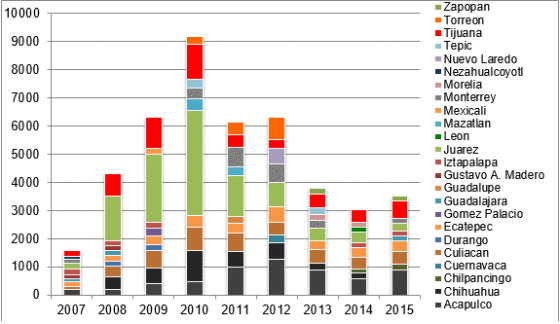
    While casual observers might assume that Mexico’s violence was widespread and pervasive throughout the country, the phenomenon was highly concentrated in certain regions and localities, primarily in the northern border region and in the country’s Pacific coastal states. In 2007, a Mexican city with more than 100 homicides could easily make it onto the country’s “top ten” list for total homicides; in fact, that same year, only Tijuana—the quintessential Mexican border city—reported more than 200 homicides (206 to be exact). Yet, just two years later, no city among the top ten most violent cities in Mexico had fewer than 200 homicides, and the top five had at least 400 homicides (as illustrated in Figure 1). Indeed, by 2010, arguably the peak of the violence, there were 18 Mexican cities with more than 200 homicides: now Mexico had many “Tijuanas.” Indeed, some of Mexico’s most violent cities—such as Acapulco, Ciudad Juárez, and Nuevo Laredo—saw rates more than triple the national homicide rate.

    Homicides Mexico data

    Figure 1: Number of Homicides in Mexico’s Top Ten Most Violent Municipalities by Year. Source INEGI.


    In a country unaccustomed to the civil wars and brutal dictatorships that plagued other parts of Latin America in the 20th century, such an explosion of violence was unexpected and previously unfathomable. The Mexican government’s apparent inability to resolve the problem triggered an international debate on the problems and limits of the Mexican state. A 2008 worst-case assessment by the U.S. Joint Forces Command named Mexico as one of two countries—along with Pakistan—that could suffer a sudden collapse into a “failed state.” Specifically, the report asserted, “In terms of worst-case scenarios for the Joint Force and indeed the world, two large and important states bear consideration for a rapid and sudden collapse: Pakistan and Mexico…”. Pronouncements by U.S. officials—including Secretary of State Hillary Clinton in 2010—asserted that Mexico’s woes were comparable to Colombia’s long-standing problems of domestic insurgency, or even on par with a civil war. Others sensationalized Mexico’s recent violence as a new hybrid threat of “criminal insurgency” or suggested that the power and infiltration of such groups had turned Mexico into a “narcostate” overrun by violence, corruption, and “narco- terrorism.”

    The merits of such assertions were quite debatable then and have proved false with time, as they tended to exaggerate and misconstrue Mexico’s current security situation. The methods and organizational forms of Mexican organized crime groups are arguably terrifying and sometimes truly mimic those of terrorists and insurgents. Yet, Mexico’s organized crime groups have shown no ambition to govern or supplant the state. They have no record or evident intention of disrupting the state’s capacity to deliver basic services. Moreover, the Mexican state maintains substantial democratic legitimacy, and has successfully deterred would-be insurgents in recent decades. Lastly, by the various measures used by the Fund for Peace to compile the Fragile States Index (formerly known as the Failed State Index), the health of the Mexican state ranks about average for Latin American countries, and its capacity is far greater than in war-torn countries like Afghanistan, Central African Republic, Iraq, Somalia, Syria, or Yemen.

    The Mexican State Response

    police mexico

    Image by Presidencia de la República Mexicana via Flickr.

    There is no doubt that Mexico’s recent security crisis presented—and continues to present—a major challenge for the Mexican state, and raises serious questions about its limits and failings. It is true that, like any other individuals who violate the law, the goal of organized crime groups is to minimize the state’s ability to detect, prevent, and/or punish their illicit activities. Yet, unlike other criminal actors, organized crime groups—and particularly drug trafficking organizations—in Mexico have demonstrated a remarkable capacity to secure protection from the state to support and sustain their criminal activities, with corrupt officials on their payrolls at all levels of government. Also, to varying degrees, such groups have at least temporarily attained a stronger presence and degree of control than the government in some limited geographic areas. Moreover, in some places, organized crime groups have capitalized on anti-government sentiments to achieve a degree of popularity or even legitimacy that seriously undermines state capacity. What, then are the sources of Mexico’s recent violence, and why have state responses failed to resolve the problem in a timely manner?

    The rise of Mexico’s most powerful organized crime groups—commonly referred to as drug trafficking organizations, or “cartels”—came amid a severe economic crisis in the 1980s. While other industries faltered, illicit drug production and trafficking enjoyed a major boom and substantial impunity, thanks in part to the complicity of government and law enforcement personnel. By the late 1990s, growing problems of crime and violence contributed to a crisis of “public insecurity,” characterized also by a feeling of widespread fear and frustration on the part of the general public due to the inability of the Mexican government to maintain order. Following a major political transition in 2000—the ouster of the PRI, Mexico’s long-time ruling party, from the presidency—the administration of Vicente Fox (2000-06) disrupted the leadership of two of the country’s four main organized crime groups.

    This tactic of arresting, extraditing, or otherwise eliminating the top leaders of major criminal organizations has been commonly referred to as the “kingpin” strategy. Fox’s successor, President Felipe Calderón (2006-12), deployed the kingpin strategy vigorously. Calderón and other proponents of the kingpin strategy argued that taking out the top leadership would help to disrupt their operations and convert a national security threat into a more localized public security problem. In some cases, at least, the government succeeded in reducing the functional capacity of some of the country’s major criminal organizations, but the unintended result was the creation of internal power vacuums and incentives for regionally based drug trafficking organizations to clash over turf and expand into rival territories. The subsequent conflicts within and among these groups were responsible for tens of thousands of organized crime-style killings that made up nearly the entire increase in homicides noted above, especially in major drug trafficking production and transit zones.

    In December 2012, a new president, Enrique Peña Nieto, took office and restored the PRI to power. His government continued to deploy the kingpin strategy, arresting high-ranking members of the Zeta and Sinaloa cartels. Remarkably, these arrests did not produce the same kind of violent aftershock that occurred under previous administrations, perhaps because of a new equilibrium among organized crime groups (there were few large cartels left standing) or perhaps more effective accommodation strategies (such as negotiations with the leaders next in line to take control of criminal operations). Whatever the reason, during 2013 and 2014, Peña Nieto’s first two full years in office, levels of homicide actually declined by around 8 and 12%, respectively (author’s own calculations from INEGI data. http://www.inegi.org.mx). However, statistics on homicide investigations for 2015 suggest that there was slight increase—about 10%—in the number of homicides nationwide, reversing the modest downward trend and provoking concerns that Mexico’s violence would ramp up again in the coming years. Final figures for 2015 likely to be released by Mexico’s national statistics agency sometime in late summer 2016, but as of mid-2016 there are troubling signs that violence is on the rise. (As this article went to press, INEGI statistics were unavailable for 2015, so the figures referenced here are Mexican law enforcement investigations into homicides tabulated by the Mexican National Public Security System – Sistema Nacional de Seguridad Pública, SNSP).

    Conclusion

    Looking toward the future, Mexico’s security situation will likely be affected by a number of important international and domestic factors. International factors could also significantly shape Mexico’s prospects. As a growing number of leaders and civic organizations push for the legally regulated production, distribution, and consumption of drugs (including the legalization of marijuana in two U.S. states in November 2012), this shift in discourse and policy could have major implications for Mexican organized crime groups. A loss of illicit revenues will likely reduce the capacity of these organizations to challenge the state, but it will also result in a painful restructuring of black market industries, pushing drug traffickers to increase exports of other drugs (like heroin) and further diversify into other violent criminal activities (e.g., kidnapping, extortion, robbery, etc.). This has already caused an abrupt increase in violence in some states, like Guerrero. In terms of drug policy, there are no quick and easy fixes to the problem of organized crime and violence in Mexico.

    However, there are some reasons for optimism in Mexico. Changing demographic trends (including a declining population of under-educated, underpaid, and underemployed young males) and an improvement of the country’s overall economic situation could facilitate a reduction of various societal ills, including both violent crime and large-scale external migration. At the same time, with the right mix of fiscal and political reforms, Mexico’s rising economic fortunes could also bolster the state’s capacity to respond more effectively to these problems, thanks to investments and reforms in the criminal justice system, as well as public education and social programs to strengthen the social fabric. Fortunately, in recent years, the Mexican government has begun to implement major economic, social and judicial sector reforms that could greatly strengthen both state and societal capacity to reduce the power of violent organized crime groups. The main question is whether these reforms will be rapid and adequate enough to substantially reduce the number of violent deaths in Mexico over the next decade.

    Dr. David A. Shirk is graduate director of the Master of Arts in International Relations program at the University of San Diego, director of Justice in Mexico, and a global fellow at the Woodrow Wilson International Center for Scholars. He is the co-author of Contemporary Mexican Politics, with Emily Edmonds-Poli.

  • Competition over resources

    Competition over resources

    In the environmentally constrained but more populous world that can be expected over the course of this century, there will be greater scarcity of three key resources: food, water and energy. Demand for all three resources is already beyond that which can be sustained at current levels. Once population growth and the effects of climate change are factored in, it is clear that greater competition for such resources should be expected, both within and between countries, potentially leading in extreme cases to conflict.

    A New Strategy for the US: From the Control Paradigm to Sustainable Security

    Schuyler Null | The New Security Beat | May 2011

    Issues:Climate change, Competition over resources, Global militarisation, Marginalisation

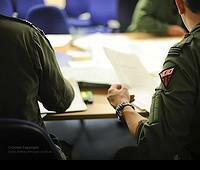
    Writing for the New Security Beat, Schuyler Null discusses a recent event on creating a new national security narrative for the US held at the Woodrow Wilson Center. The event was based on a white paper by two active military officers writing under the pseudonym “Mr. Y” (echoing George Kennan’s famous “X” article). In “A National Strategic Narrative,” Captain Wayne Porter (USN) and Colonel Mark Mykleby (USMC) argue that the United States needs to move away from an outmoded 20th century model of containment, deterrence, and control towards a “strategy of sustainability.”

    Image source: LizaP.

    Read more »

    Sustainable Security and Environmental Limits

    Rachel Tansey | Quaker Council for European Affairs | May 2011

    Issues:Climate change, Competition over resources, Global militarisation, Marginalisation

    The Quaker Council for European Affairs publicises a briefing on the topic of Sustainable Security, specifically highlighting environmental concerns:

    “The treatment of the natural world by humankind has contributed towards the two related major trends that are likely to drive insecurity in the coming decades: climate change and competition over natural resources.”

    Article source: Quaker Council for European Affairs

    Image source: kretyen

    Read more »

    Human Security and Marginalisation: A case of Pastoralists in the Mandera triangle

    Abdul Ebrahim Haro | Exclusively written for sustainablesecurity.org | May 2011

    Issues:Competition over resources, Marginalisation

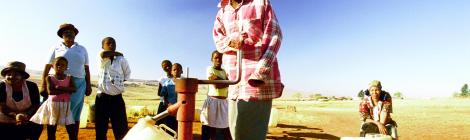
    This paper seeks to bring out the relevance of human security in pastoral areas of Mandera triangle and the relationships and contradictions that exist between it and national security. The “Mandera Triangle” encompasses a tri-border region of Ethiopia, Somalia, and Kenya that exemplifies, in a microcosm, both a complex and a chronic humanitarian crisis that transcends national boundaries. The resident Somali pastoral population is highly vulnerable to periodic droughts and floods; high levels of poverty; long-term disruption to the traditional systems of livelihood; ongoing inter-clan conflicts and border tensions between states. 

    Image source: TURKAIRO

    Read more »

    World Not Prepared for Climate Conflicts

    Laurie Goering | AlertNet | May 2011

    Issues:Climate change, Competition over resources

    Accelerating climate change and competition for limited supplies of water, food and energy are poised to ignite long-simmering conflicts in fragile states, monopolising the world’s military resources and hampering development efforts, security experts say. Defusing these new 21st century conflicts – or at least preparing governments and citizens to cope with them – will require a broad range of innovative interventions, a gathering at Britain’s Department for International Development (DFID) heard earlier this month.

    Image source: Images.Defence.Gov.au

    Read more »

    The Arab World’s Next Battle: Water Supply and Population Growth on Collision Course

    Lester Brown | The Guardian | April 2011

    Issue:Competition over resources

    Population growth and water supply are on a collision course. Hunger is set to become the main issue writes Lester Brown for the Guardian.

    Image source: UN Photo. 

    Read more »

    How the Competing Security Needs of Caribbean Community Members have Crystallized Through Multilateralism and Consensual Decision-Making

    Serena Joseph-Harris | Exclusively written for sustainablesecurity.org | April 2011

    Issues:Competition over resources, Global militarisation, Marginalisation

    In a paper exclusively written for sustainablesecurity.org, Serena Joseph-Harris (former High Commissioner for Trinidad and Tobago) focuses on competition over natural resources, the role of maritime routes in the Caribbean, and the importance of multilateral approaches to finding sustainable solutions in the Caribbean.

    Image source: Len@Loblolly

    Read more »

  • Global militarisation

    Global militarisation

    The current priority of the dominant security actors is maintaining international security through the vigorous use of military force combined with the development of both nuclear and conventional weapons systems. Post-Cold War nuclear developments involve the modernisation and proliferation of nuclear systems, with an increasing risk of limited nuclear-weapons use in warfare – breaking a threshold that has held for sixty years and seriously undermining multilateral attempts at disarmament. These dangerous trends will be exacerbated by developments in national missile defence, chemical and biological weapons and a race towards the weaponisation of space.

    Wikileaks reveals Arctic could be the new cold war

    Greenpeace UK | Greenpeace UK | May 2011

    Issues:Climate change, Competition over resources, Global militarisation

    New Wikileaks releases today have shown the Arctic oil rush is not just a threat to the environment and our climate, but also to peace. The documents show how deadly serious the scramble for Arctic resources has become. And the terrible irony of it is that instead of seeing the melting of the Arctic ice cap as a spur to action on climate change, the leaders of the Arctic nations are instead investing in military hardware to fight for the oil beneath it. They’re preparing to fight to extract the very fossil fuels that caused the melting in the first place.

    Article source: Greenpeace UK

    Image source: U.S. Geological Survey

    Read more »

    A New Strategy for the US: From the Control Paradigm to Sustainable Security

    Schuyler Null | The New Security Beat | May 2011

    Issues:Climate change, Competition over resources, Global militarisation, Marginalisation

    Writing for the New Security Beat, Schuyler Null discusses a recent event on creating a new national security narrative for the US held at the Woodrow Wilson Center. The event was based on a white paper by two active military officers writing under the pseudonym “Mr. Y” (echoing George Kennan’s famous “X” article). In “A National Strategic Narrative,” Captain Wayne Porter (USN) and Colonel Mark Mykleby (USMC) argue that the United States needs to move away from an outmoded 20th century model of containment, deterrence, and control towards a “strategy of sustainability.”

    Image source: LizaP.

    Read more »

    New Films on Nuclear Threats and the Prospects for Disarmament

    Issue:Global militarisation

    Two new films in TalkWorks’ series about nuclear disarmament have been released. In the latest instalments, Baroness Shirley Williams and Sir Jeremy Greenstock give their personal perspectives on the current state of affairs regarding nuclear dangers and progress with the multilateral nuclear disarmament agenda.

    Image source: Kingdafy.

    Read more »

    Sustainable Security and Environmental Limits

    Rachel Tansey | Quaker Council for European Affairs | May 2011

    Issues:Climate change, Competition over resources, Global militarisation, Marginalisation

    The Quaker Council for European Affairs publicises a briefing on the topic of Sustainable Security, specifically highlighting environmental concerns:

    “The treatment of the natural world by humankind has contributed towards the two related major trends that are likely to drive insecurity in the coming decades: climate change and competition over natural resources.”

    Article source: Quaker Council for European Affairs

    Image source: kretyen

    Read more »

    The economic relationship of armed groups with displaced populations

    Josep Maria Royo Aspa | Forced Migration Review | March 2011

    Issues:Global militarisation, Marginalisation

    Practically all armed groups are heavily dependent on external support. Armed groups primarily seek support from both other states and from the diasporas, displaced populations and other armed groups, in order to prevent the burden of  the war effort from falling entirely on the civil population they claim to protect, a situation that has its own political costs. States too need external support to deal with outbreaks of instability and violence; during the Cold War this was normal and it still continues today in most current armed conflicts.

    Image source: Gustavo Montes de Oca

    Article source: Forced Migration Review

    Read more »

    NGOs Call for Immediate and Full Reporting of Every Casualty in Libya

    NGO coalition | Oxford Research Group | April 2011

    Issues:Global militarisation, Marginalisation

    As rebel forces reportedly claim that 10,000 deaths have occurred and up to 55,000 have been injured since the start of the conflict in Libya, a group of NGOs have sent a call to those intervening in Libya to commit to properly monitoring and recording every casualty in the conflict.

    This call is made in the belief that the accurate recording and reporting of all casualties will benefit accountability, any assessment of the international intervention, and humanitarian programming.

    Article source: Oxford Research Group

    Image source: Defence Images

    Read more »

  • Sustainable Security

    Water Security in South Africa: The need to build social and ecological resilience

    Tackling South African water insecurity will require addressing the technical deficiencies, governance gaps and social inequality that are currently having a dangerous and environmentally devastating impact. The links between environmental health and socio-political stability are clear in South Africa, where there has been an exponential increase in violent protests over poor or privatized service delivery, social marginalization, and unequal access to water. South Africa must act to solidify the links between resilient societies and resilient ecosystems.

    Read Article →

    Environmental security in the Arctic: the ‘Great Game’ vs. sustainable security

    Arctic security remains wedded to traditional, state-centric military threats despite the fact that the threat of outright conflict is as remote as the farthest reaches of the Arctic region itself. These approaches are predictable, but they will contribute little to alleviating the complex, interrelated, and underlying drivers of insecurity in the Arctic region. Cameron Harrington argues that if our understanding of both Arctic security and the Arctic environment continues to be reduced to the international scramble for untapped resources and for newly opened “shipping lanes”, it is unlikely that the hugely alarming and damaging environmental effects of climate change will ever be truly overcome.

    Read Article →

  • Sustainable Security

    The Global Land Rush: Catalyst for Resource-Driven Conflict?

    Michael Kugelman of the Woodrow Wilson International Center, argues that the factors that first sparked many of the land acquisitions during the global food crisis of 2007-08 — population growth, high food prices, unpredictable commodities markets, water shortages, and above all a plummeting supply of arable land — remain firmly in place today. He writes that land-lusting nations and investors are driven by immediate needs, and they have neither the incentive nor the obligation to slow down and adjust their investments in response to the wishes of distant international bureaucrats. This, he argues, has serious consequences for global security.

    Read Article →

    Human Security and Marginalisation: A case of Pastoralists in the Mandera triangle

    This paper seeks to bring out the relevance of human security in pastoral areas of Mandera triangle and the relationships and contradictions that exist between it and national security. The “Mandera Triangle” encompasses a tri-border region of Ethiopia, Somalia, and Kenya that exemplifies, in a microcosm, both a complex and a chronic humanitarian crisis that transcends national boundaries.

    Read Article →

  • Global Climate Change Vulnerability and the Risk of Conflict

    Global Climate Change Vulnerability and the Risk of Conflict

    Uppsala University | Center for Sustainable Development | June 2011

    Issue:Climate change

    In a study from the Center for Sustainable Development at Uppsala University in Sweden titled “Climate Change and the Risk of Violent Conflicts in Southern Africa,” authors Ashok Swain, Ranjula Bali Swain, Anders Themnér, and Florian Krampe examine the potential for climate change and variability to act as a “threat multiplier” in the Zambezi River Basin. The report argues that “socio-economic and political problems are disproportionately multiplied by climate change/variability.” A reliance on agriculture, poor governance, weak institutions, polarized social identities, and economic challenges in the region are issues that may combine with climate change to increase the potential for conflict. Specifically, the report concludes that the Matableleland-North Province in Zimbabwe and Zambezia Province in Mozambique are the areas in the region most likely to experience climate-induced conflicts in the near future.

    Article source: The New Security Beat

    Image source: The City Project

    Comments

    Post new comment


  • Sustainable Security

  • Multiple Futures Project – Navigating Towards 2030

    Multiple Futures Project – Navigating Towards 2030

    Issues:Competition over resources, Global militarisation, Marginalisation

      The following is an excerpt from Multiple Futures Project (MFP) Findings and Recommendations:

    The Multiple  Futures  tell  the  story  of  four  plausible worlds  in  2030, and  are  constructed  to  reflect  their  underlying  logic  and  reasoning.  None of these is what the future actually will be, but each provides a common  ground  for  structured  dialogue  on  the  risks  and vulnerabilities  that  will  potentially  endanger  Alliance  populations, territorial integrity, values and ideas. 

    The  first  future  is  called Dark  Side  of  Exclusivity,  and  describes  how globalization, climate change and resource scarcity significantly affect the  capacity  of  states  outside  the  globalized  world  to  function effectively and meet the needs of their populations. Weak and failed states are sources of instability, and the states of the globalized world are faced with strategic choices on how to react. 

    The second future, called Deceptive Stability, refers to a world where advanced nations are preoccupied with  societal  change and how  to manage the coming demographic shift as native populations age and young migrants  fill  the  void.   States  in  this world of  relative benign stability are preoccupied.  They focus inward on social cohesion, legal and  illegal migration,  and  transnational  issues  related  to  diasporas.  This leaves them ill-prepared to deal with geopolitical risk. 

    Clash of Modernities, the third future, sketches a world where a strong belief  in  rationalism,  coupled  with  ingenuity  and  technological innovation,  fuels  and  promotes  horizontal  connections  between advanced  networked  societies  across  the  globe.  This  network  is challenged  from  the  outside  by  authoritarian  regimes  of  the hinterlands,  and  from within  by  a  precarious  balance  between  civil liberties and oversight by the state. 

    The  fourth  future  is  called  New  Power  Politics,  in  which  growing absolute wealth, including the widespread proliferation of WMD, has
    increased the number of major powers, between whom there  is now a  tenuous  balance.  Globalization  through  trade  integration  and
    internationally  agreed  standards  is  undermined  as  these  powers compete  for  and  impede global  access  to  resources  and  spheres of
    influence.

    Each  of  the  futures  provides  a  backdrop  for  conceptual  analysis.  Together  they present  a  canvas on which  to  evaluate  risks,  threats,
    potential  strategic  surprises,  implications  and,  of  course, opportunities.  The  study  has  yielded  a  rich  set  of  Risk  Conditions, ranging  from  ‘failed  states’  and  ‘disruption  of  access  to  critical resources,’  to  ‘increasing  ethnic  tension’  and  the  ‘challenge  of conflicting  values  and  world  views.’  When  linked  with  the  six potential  Sources  of  Threat  identified  in  the  MFP,  the  resulting Threatening Actions  or  Events  yield  33  Security  Implications  and  26 Military Implications.

    All Multiple Futures Project documents can be found here.

    Comments

    Post new comment


  • Sustainable Security

    voller

    Dr. Yaniv Voller is a Lecturer in the Politics of the Middle East at the School of Politics and International Relations, University of Kent. Prior to that he was a Leverhulme Early Career Fellow at the School of Social and Political Science, University of Edinburgh. He gained his PhD in International Relations at the London School of Economics and Political Science, his MSc in Middle East Politics at the School of Oriental and African Studies, University of London, and his undergraduate degree at Tel Aviv University. His current research examines the impact of colonial-era legacies and practices on the strategies of the liberation movements and the governments involved in these wars, focusing on the liberation wars in Iraqi Kurdistan and Southern Sudan. His previous book, The Kurdish Liberation Movement in Iraq: From Insurgency to Statehood, was published in 2014 as part of Routledge’s Studies in Middle East Politics series. His articles have been published in International Affairs, the International Journal of Middle East Studies and Democratization, among other journals.

    Dr. Voller discusses the history of, and recent developments in, the Kurdish struggle for a homeland.

    Q. Numbering approximately 35 million worldwide, the Kurds are often referred to as the largest group of stateless people in the world. Today, the Kurdish nationalist movement is often seen as one of the largest worldwide campaigns for self-determination. Who are the Kurds and what are the origins of their struggle for a homeland?

    The Kurdish people are a distinct ethnic group, concentrated mostly in a broad region which is often referred to as Kurdistan. Most of the Kurds are Sunni Muslims, but there are large Shi’i, Yezidi and other Kurdish-speaking communities.

    Already during the time of the Ottoman and the different Iranian empires there existed semi-autonomous Kurdish kingdoms that served as a buffer between the two empires.

    Modern Kurdish nationalism emerged in the late 19th and early 20th century, along with other nationalist movements, such as Arab and Turkish nationalism. After the end of the First World War, Kurdish leaders were promised an independent state as part of the Paris Peace Conference. However, following the establishment of the Republic of Turkey under Mustafa Kemal Ataturk, this promise was overturned. By the mid-s, Kurdistan ended up divided between Turkey, Iraq, Syria and Iran.

    The Kurds protested this decision and there were some uprisings in different parts of Kurdistan. In there was even an autonomous Kurdish republic, known as the Mahabad Republic, which survived for a year.

    The first major Kurdish uprising erupted in Iraq in . This uprising lasted until when, after years of brutal, even genocidal, Iraqi counter-insurgency campaign, the Kurds in Iraq gained complete autonomy over their territory.

    In Turkey, Kurdish insurgency emerged primarily during the late s, with the formation of the Kurdistan Workers Party (PKK) by Abdullah Ocalan. The PKK is still active today, though it formally renounced its aspiration for independence and is now calling for an autonomy for the Kurds within a democratic Turkey.

    In Iran, too, there has been a long conflict taking place. The Islamic Republic has not been less brutal than the Turkish Republic or Saddam Hussein’s Iraq in suppressing Kurdish demands for self-determination.

    The Kurdish struggle in Syria has been the least organised, although sporadic uprisings had occurred. The Assad regimes, both father and son, not only oppressed Kurdish nationalism, but denied the Kurds in Syria their most basic rights, including citizenship. The Syrian civil war provided the Kurds in Syria with an unprecedented opportunity to fight for their rights, although they too officially demand autonomy rather than independence.

    Q. Looking at the Kurds in Iraq, did Saddam Hussein’s counterinsurgency campaign actually help create a strong sense of Kurdish nationalism?

    Yes, it did. Particularly the Anfal Campaign, which took place between and , served to foster Kurdish national identity and desire for self-determination. The Iraqi army’s use of chemical weapons made it clear to most Kurds that living under Baghdad’s rule is impossible in the long term. Even Kurds who openly collaborated with the regime, the so-called National Defence Battalions, seemed to have come to this conclusion after their own towns and villages came under attack. National tragedies often serve to foster national identities, and even though the Ba’th regime’s genocidal campaign devastated Kurdish society, it did strengthen Kurdish national identity.

    Q. In Turkey, there has been much systematic discrimination against Kurds and historic attempts to eradicate Kurdish identity. Did these repressive measures in Turkey also help Kurdish nationalism gain momentum?

    Yes, to some extent. Government repression and discrimination often foster a national identity among persecuted groups. But this is only one factor among others. Other factors that have contributed to the strengthening of Kurdish identity include Kurdish activism, whether in Turkey or in the diaspora; urbanisation; modernisation; greater access to education. And the experience of Kurds in other parts of Kurdistan, and especially in Iraq.

    Q. Western powers over the past century have used Kurdish fighters when it suited their purposes, and then arguably abandoned them. There have been promises from Western leaders of establishing a Kurdish homeland only for those promises go unfulfilled. Why do you feel Western powers have treated the Kurds this way? Is it simply a matter of realist interests and Western leaders wanting to appease regional powers?

    The only time that Western powers made a clear promise about a Kurdish homeland was at the Paris Peace Conference. The US supported the KDP in the early s as proxies in Iran’s conflict against Iraq, but they didn’t make an explicit promise about a Kurdish homeland. The Americans also implicitly encouraged the Kurds and Shi’is to rise against Saddam after the First Gulf War – but again, without promising them independence.

    Undoubtedly, the West has abandoned the Kurds many times in the past. But we have to remember that the International community has traditionally been suspicious of separatist movements, because changes in state boundaries are considered a source of regional and global instability. And of course, there has also been the realist aspect of keeping good relations with Turkey. Turkey is a key ally of the West in the region and a NATO member. And it has traditionally objected to Kurdish independence.

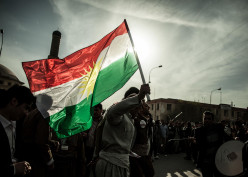
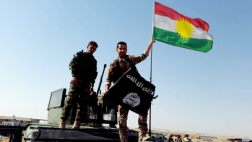
    Q. The Kurds have been a vital part of the war against the Islamic State (IS). Through a combined effort of Peshmerga, PKK, YPG, and Yazidi militias, the Kurds became the most effective fighters by far on the ISIS frontier. Why do you feel the Kurds have proven to be such an effective force against IS?
    kurd-flag

    Image by Mustafa Khayat/Flickr (cropped).

    There are several factors that have turned the Kurdish militias into the most effective fighting force in the war against the Islamic State. The first is familiarity with the area and the terrain. The Kurds, and especially the Peshmerga and the YPG, are natives of the region. They know it well and are aware of the challenges they are facing. The second factor is experience. The Peshmerga has years of experience fighting against the Iraqi army, Islamist militias and even each other. The PKK has been leading a guerrilla warfare against the Turkish security forces for decades. The third factor is motivation. The Kurds are fighting in and for their homeland. The Islamic State has attacked the Kurds in their own lands. The Yazidis are particularly motivated, not just by vengance, but also because many Yazidis are still in captivity. But there is also an ideological motivation. Especially for the Peshmerga, fighting along the West has meant greater legitimacy for their autonomy and sovereignty. The KRG is a de facto state. And states establish alliances. The KRG has considered itself an ally of the West for many years now. For the PKK, fighting IS has meant challenging its status as a terrorist organisation. In short, these are highly trained, disciplined and motivated fighters, who are fighting for their home and for recognition. They outweigh most other forces involved in the fighting in these parameters.

    Q. How far do you feel that the fight against IS will help the cause for a Kurdish homeland?

    This is a difficult question to answer, because we need to define what we mean when we say a Kurdish homeland. If we mean a scenario in which a Kurdish state is established in Iraqi Kurdistan then the answer is probably positive. The KRG’s fight against IS has once again proved to the West, but also to Turkey and other regional states the viability of the KRG and its ability to function as a sovereign actor. The Peshmerga has been one of the most reliable forces in the conflict, and in essence functions as the West’s “boots on the ground.” But if we talk about a Kurdish homeland that spreads over other parts of Kurdistan then I am in doubt. Ankara, which is still the most important veto actor when it comes to the idea of a Kurdish state, will not allow the formation of a Kurdish state in Rojava and even more so in Turkey. Even the PKK’s contribution to the fighting would not change Turkey’s mind – if anything, it will make Ankara even more intransigent about it.

    Q. Looking at the Iraqi case, Massoud Barzani, President of the Iraqi Kurdistan Region has recently called for a referendum on a Kurdish state in northern Iraq. Would the fight against ISIS at least help strengthen the case for a referendum?

    Yes I believe so. The Peshmerga’s participation in the war against ISIS has demonstrated once again to the International community, and especially Washington and Ankara, that the KRG is indispensable for regional security and that the Kurdish leadership could contribute to regional stability. The Peshmerga has proven able not only to protect the KRG’s domestic sovereignty, but also to participate as an equal partner in regional counterterrorism campaigns. This could play in the KRG’s favour when time comes.

    Q. Turkey’s shooting down of a Russian jet last year resulted in dramatic swifts in relations between those two states. The Kurdish question has also entered into this complicated relationship as Russia has shown some support for Kurdish groups in Syria and Iraq. How do you feel the Kurdish question will effect relations between the two in the future?

    This is more challenging for me to respond to, because I am not an expert on Russian foreign policy, and am not sure on how much Russia is committed to the Kurds. From a Turkish perspective, the question of Syrian Kurds has been something of a red line. Any support perceived as helping the Syrian Kurds toward independence is bound to make Ankara extremely nervous. And while Moscow has its own interests in Syria, which may clash with Ankara’s, I don’t believe that Moscow would cross this particular line. After all, Russia also prefers a unified Syria.

    Q. In regards to Turkey, would simply a change in leadership to a more liberal position help the case for a Kurdish state or is the issue of what has been described as anti-Kurdism or ‘Kurdophobia’ far more deep seated in Turkey?
    peshmerga

    Image of Peshmerga by Kurdishstruggle/Flickr.

    A change of leadership wouldn’t have much impact on Ankara’s approach to the Kurdish question. I am afraid that there is no liberal opposition in Turkey – certainly not toward the Kurdish question. The People’s Republican Party (CHP) may be more secular than the AKP. However, its agenda has been based for many years on Turkish nationalism and objection to any hint of Kurdish nationalism and separatist desires. The other, much smaller, Turkish opposition party is the Nationalist Movement Party (MHP). This is an ultra-nationalist party with a neo-fascist ideology. Militias associated with the party were involved in attacking and assassinating Kurdish activists in previous decades. Ironically, in its early days, the AKP had been considered more liberal than most other parties with relation to the Kurdish question, and therefore gained many Kurdish votes. The most liberal party in Turkey nowadays is the predominantly Kurdish People’s Democratic Party (HDP). But not only that I don’t see the party ever elected for power in Turkey, its actual existence is under threat nowadays, with the arrest of its leaders in the last few weeks.

    Undoubtedly, anti-Kurdish sentiments are entrenched in the Turkish public and political discourse. But even if a change takes place, I don’t see it affecting party politics, amid the absence of genuine opposition on the subject among the main Turkish parties.

    Q. What impact do you think Trump’s presidency will have on the Kurdish question, if any?

    Based strictly on Trump’s statements, I don’t think the Kurds should be overly optimistic. Trump has hinted that he is after an isolationist foreign policy. This means, in my opinion, that Trump will, at best, will not intervene against Turkish repression of the opposition, including the Kurdish opposition. As for other parts of the Middle East, such an isolationist approach may also result in a regional chaos. Such chaos could have disastrous implications for regional stability, but also opportunities for a change in the status quo.